
Got your eyes on the CAT 2026 exam like millions of aspirants in the country? This exam (also known as the Common Admission Test) is a very competitive one and decides the admission of students into top Business Schools, among which IIMs are a top destination. More than 2.5 lakh aspirants compete every year and the cracking CAT requires a proper and structured strategy, conceptual clarity, and consistent practice.This blog will take you through all important details and tips that will help you crack the Common Admission Test 2026 exam, along with study plan, preparation tips, best books and so on. That will help both beginners or working professionals no matter which step of the journey you are on.
Key Highlights CAT 2026
- CAT 2026 notification release date is expected to happen in the last week of July 2026.
- Registration begins between August 1st to Mid-September 2026.
- Expected Common Admission Test 2026 exam date is November 29, 2026.
- The result date for the exam will likely be in early January 2027.
Note: These dates are tentative and subject to change. Check the website for latest updates.
CAT 2026 Exam Overview
The Common Admission Test continues to be known as the top entrance exam for MBA in India. It is conducted every year by one of the newly established IIM institutions from IIM Lucknow, Bodh Gaya, Kozhikode, Indore, Rohtak, or Ranchi. Moreover, based on latest statistics, the number of candidates taking this test is around 2.58 lakhs in 2025. The test takes place once a year and evaluates an applicant's proficiency in English, mathematics, logic, and data interpretation. Aspirants can look forward to the exam as the syllabus will most likely be similar to the Common Admission Test of the previous year. It comprises, usually, Verbal Ability and Reading Comprehension, as well as Data Interpretation, Logical Reasoning, and Quantitative Aptitude.
CAT Exam Sections
|
Parameter |
Details |
|
Exam Date |
Last Sunday of November 2026 (Nov 30) |
|
Mode |
Computer-Based Test |
|
Total Duration |
120 minutes (40 min/section) |
|
Sections |
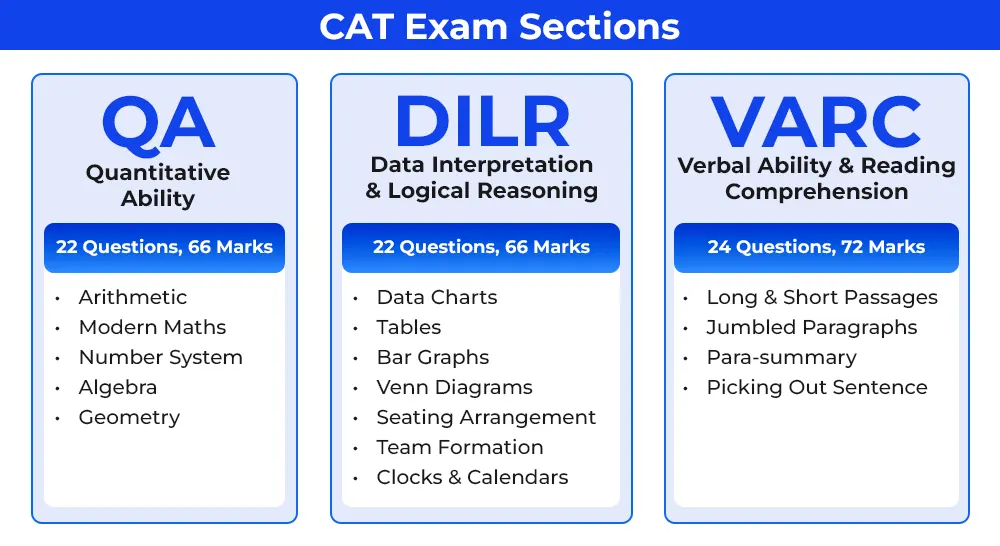
Verbal Ability & Reading Comprehension Data Interpretation & Logical Reasoning Quantitative Aptitude |
|
No. of Questions (Section-Wise) |
VARC: 24 questions DILR: 22 questions QA: 22 questions Total: 68 questions |
|
Total Marks |
VARC: 72 marks DILR: 66 marks QA: 66 marks Total: 204 marks |
|
Marking Scheme |
+3 marks for correct answer –1 mark for incorrect MCQ 0 for incorrect TITA or unanswered questions |
|
Question Format |
MCQs and Non-MCQs (TITA – Type In The Answer) |
|
Top Score |
198 (scaled) |
Who Will Conduct CAT 2026?
IIMs usually rotate conducting duties among newer campuses. In 2025, IM Lucknow conducted the Common Admission Test exam. Following this pattern,
- There is a high probability for CAT 2026 to be conducted at IIM Kozhikode.
- An official announcement is expected in March 2026. Pattern holds since the 2018 rotation began.
CAT Study Plan 2026 (Month-wise)
A well-structured CAT exam preparation timetable is necessary for candidates to study for Common Admission Test 2026 effectively. This will guide learners on how to prepare the entire syllabus, strengthen their conceptual understanding, and improve their speed and accuracy. Below is a thorough study plan for CAT aspirants, follow this plan for best results.
|
Phase / Month |
Duration |
Key Objectives |
Section-wise Focus |
Mock Test Plan |
|
Month 1 (Foundation Phase) |
4 weeks |
• Understand CAT syllabus & pattern • Build strong basics • Assess current level |
VARC: Daily reading + grammar basics DILR: Common LRDI topics, 2 sets/day QA: Arithmetic basics, 10–15 Qs/day |
• 1 diagnostic mock at start • No pressure on score, only analysis |
|
Month 2 (Concept Building Phase) |
4 weeks |
• Strengthen core concepts • Identify strengths & weaknesses |
VARC: 5–10 VA Qs/day + RC practice DILR: CAT PYQs, 2–3 sets/day QA: Arithmetic revision + Algebra start |
• 1 mock/week • Focus on section-wise accuracy |
|
Month 3–4 (Practice Phase) |
8 weeks |
• Revise concepts using topic tests • Improve sectional time management |
VARC: RCs from CAT PYQs & editorials DILR: Variety of LRDI sets QA: Algebra + Geometry practice |
• 1–2 mocks/week • Start sectional tests |
|
Month 5–6 (Advanced Practice Phase) |
8 weeks |
• Solve past CAT papers thoroughly • Increase speed & exposure |
VARC: Higher-difficulty RCs + VA daily DILR: 3–4 mixed-topic sets/day QA: Geometry + Modern Math |
• 2 mocks/week • Deep mock analysis mandatory |
|
Month 7–8 (Optimization Phase) |
8 weeks |
• Maximize accuracy & speed • Improve question & set selection |
VARC: Strengthen strong RC areas, fix VA gaps DILR: Advanced DI & LR puzzles QA: Difficult questions + revision |
• 2–3 mocks/week • Focus on strategy refinement |
|
Month 9–10 (Final Revision Phase) |
6–8 weeks |
• Full revision • Error correction • Exam temperament |
VARC: Learn from mock mistakes DILR: Finalize set selection strategy QA: Formula & shortcut revision |
• 3–4 mocks/week • Replicate exam conditions |
Preparation Tips for Beginners
Making sure that the basics are strong is the first step that first timers have to focus on for the exam prep. It is one way to struggle with the basic math concepts and to actively read newspapers and online articles to improve reading skills. Besides, they can take a full Common Admission Test mock test at their prep's beginning to evaluate their knowledge level. During the first few months of preparation, build a basic concept foundation and then proceed to topic-wise and sectional tests.
CAT Preparation as a new aspirant can seem like a steep hill to climb. The reason is the vast syllabus, tricky concepts and questions. However, the aspirants can resort to CAT online coaching, which will provide them with structured learning, expert guidance, and a diverse range of study materials and mock tests to prepare from.
Strategy for Working Professionals
Working professionals who want to ace the CAT exam 2026 will have to adopt a different method. This is because they have a full-time job and the hard CAT preparation to be done side by side. The points to focus on are proper time management, better resource selection, and consistent effort.
Taking into consideration that the number of hours available for study after work is restricted, working candidates will have to distribute proper study slots of 2–3 hours each day of the week and 6-7 hours each weekend. They will also have to choose qualitative resources since they will not have much time. As a result, many working professionals opt for CAT online coaching.
This gives them the most current resources and the ability to cover the whole syllabus in little time. Among these are recorded video form lectures that students can view when they get the time, which could be early in the morning, very late evening, or during the commute. Also, structured support is provided which is vital for those having a busy schedule.
Extra Tip: Even on a busy day, make sure you complete exam Daily Targets to stay consistent with all the 3 sectionals of the exam. This is an important step to pass this crucial exam.
Section-Wise Preparation Strategy
The exam has three sections namely VARC, DILR, and QA. Each section tests different skills and focus on each section is needed. Here are section-wise tips to help you prepare each part well.
VARC Section Preparation Tips:
The Verbal Ability and Reading Comprehension section syllabus mainly tests the reading and understanding skills of test-takers. To score well in this subject:
- Start by reading every day. It can be newspapers, storybooks, or online articles. This builds habit and improves reading speed.
- A big part of this section is reading comprehension. At least 1-2 RC passages have to be practiced daily. While doing this, focus must be on the main idea, tone, and what the author is trying to say.
- Try to learn 5 to 10 new words every day, which improves vocabulary. It is a very important part along with grammar. Maintain a small notebook or a flashcard app.
- Parajumbles and Sentence Arrangement questions do not come up very often in the exams, but still, practice them as they can be quite tricky.
- Get familiar with the question style by going through previous years' papers and mock tests.
Quantitative Aptitude Preparation Tips
Most aspirants find the QA section to be the hardest. However, if the fundamentals are solid, the section becomes simple. Therefore, the candidates need to:
- Focus on Arithmetic, Algebra, Geometry, and Number Systems concepts so study them without fail. Practice formula applications rather than memorisation.
- Maintain and revise a daily notebook of key formulas for quick recall.
- Begin with easy questions. Then move to medium and difficult ones.
Follow these three steps while solving questions:
Round 1: Only understand the question and method.
Round 2: Try to solve with full accuracy.
Round 3: Solve for speed and efficiency.
Use MBA Common Admission Test mock tests to check overall progress. Analyze each and every mistake and rework them. Improve mental calculation skills because it saves a lot of time in the exam.
Data Interpretation and Logical Reasoning Aptitude Preparation Tips:
The DILR section from the syllabus exam checks how well applicants understand data and how logically they solve problems. To prepare smartly for this section:
- Start with the basics by learning tables up to 20, squares up to 30, and cubes up to 20. These help with faster calculation.
- Practice reading graphs, pie charts, and bar diagrams for Data Interpretation. Focus on speed and accuracy.
- Logical Reasoning (LR) has no formulas. It's all about practice. Try puzzles, seating arrangements, blood relations, and number series regularly.
- Make it a habit to solve 1 DI set and 1 LR set daily. Don’t skip because maintaining consistency helps a lot here.
Best Books for CAT 2026
The best books that will help your 2026 Common Admission Test are as follows. This will help with your studies significantly:
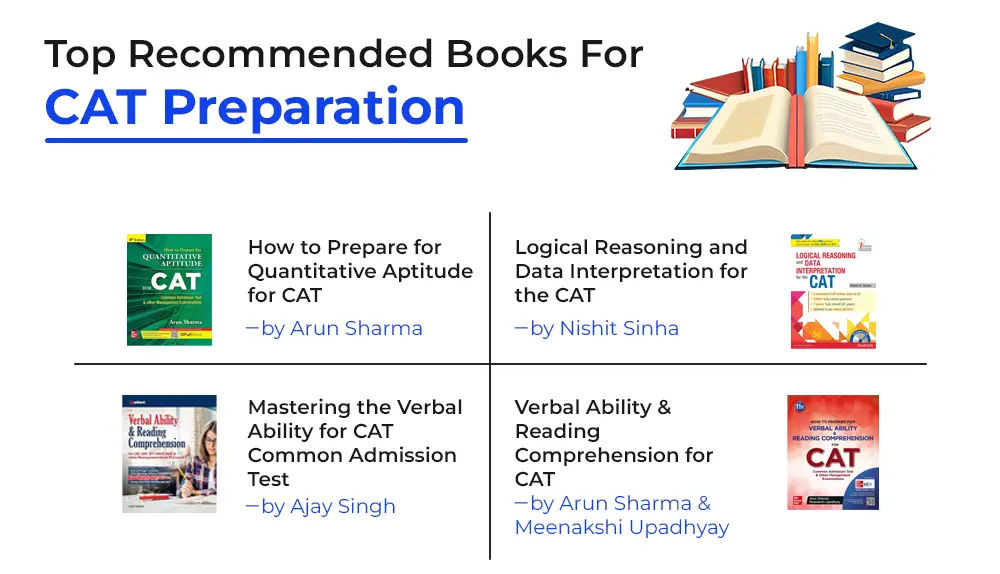
- How to Prepare for Quantitative Aptitude for CAT by Arun Sharma: Master Quant Fundamentals
- Logical Reasoning and Data Interpretation for the CAT by Nishit Sinha: For advanced LR puzzles
- Mastering the Verbal Ability for CAT Common Admission Test by Ajay Singh: Build reading comprehension and verbal logic skills.
- Verbal Ability and Reading Comprehension for CAT by Arun Sharma and Meenakshi Upadhyay: For VARC
Conclusion & Next Steps
Individuals who wish to take the 2026 Common Admission Test have to come up with a tactical study plan since this exam is known for high competition. Also, to pass it is an admission requirement to enter the best B Schools in the country. A good strategy will take students fully through the huge syllabus, gain understanding of the concepts, and increase speed and accuracy at the same time. And scoring high and being accepted to desired universities will be easier with it. Moreover, a plan that will be curated for working professionals or fresher students will assist with thorough preparation. If your objective is to pass CAT 2026, the perfect moment to begin your prep is now. Start with your preparation with a customized strategy to the competition and IIMs of your choice?