


 Expert Interviews
- University Reviews
- Career Guide
 Video Counseling
Important Facts
- Ask any Question - CV Forum

From Idea to Execution: Online Courses for Entrepreneurs
Devina Bhagat Jan 12, 2026 1K Reads

It is thrilling to start a business, but it is also a daunting undertaking. Then, when you are brimming with ideas, and the next, when you are agonising over branding, finances, product development, and marketing strategies. The best part is that you do not require an MBA or years of trial and error to make your entrepreneurial vision come true. Nowadays, the best professionals in the world are able to utilise all their decades of experience and put it online in the form of courses that can be accessed by anyone with Wi-Fi and a willingness to learn.
Regardless of whether you are refining your first business proposal or expanding an already established company, the right courses can be of great help in skyrocketing your learning curve and sparing you expensive errors. This guide takes you through the necessary courses that every entrepreneur ought to consider to plan step by step on how to create an idea and execute it, develop, and become a strong leader.
Why are online courses a game-changer for the entrepreneur?
Online courses are a game-changer for an entrepreneur due to their flexibility, accessibility, and scalability, which directly address the core challenges of starting and growing a business. They provide a practical, cost-effective way to acquire essential skills, build a brand, and generate passive income without disrupting day-to-day operations.
In the future, online courses will be the best opportunity to enhance career and skills to advance career path:
- Entrepreneurs are known to be busy multitasking and on strict schedules. The online courses reduce the amount of time and effort on new knowledge and skills because, unlike traditional education, it is self-paced, meaning that new knowledge and skills can be learned during off-hours, evenings, or weekends.
- It may be costly to start a conventional business or even get a full-time degree. The online courses are cheaper in most cases, and they do away with the costs such as commuting, physical infrastructure. This renders necessary business education affordable to more business owners of the aspiring population, irrespective of their budget.
- Availability of Specialised and Current Knowledge The world of business, and particularly the digital world, evolves at a fast rate. There is a tremendous number of courses that are provided online, which relate to niche and industry, such as digital marketing and financial management, as well as AI and e-commerce strategies. This will enable the entrepreneurs to be updated with any new trends, and they can implement straight away what they have learned in their business in real-time.
- It is also among the best business models among those entrepreneurs who develop and market their own online classes. The information is produced once and can be resold to a worldwide market numerous times, and can provide a possible source of passive revenue. This saves time and resources to work on other activities or life.
- By developing a course in their field, businesspersons can establish themselves as leaders in their field and experts. This establishes credibility with their audience, which results in additional opportunities, including consulting services, engagements, and /collaborations, which further increase their coverage and presence.
- Through online learning communities, people with different backgrounds and geographical locations are brought together. The discussion forums and group projects with other students, mentors, and industry professionals may result in useful professional networks, collaborations, and even investments.
- Online learning is self-motivated, and thus, it would help the entrepreneur to develop some of the transferable skills of time management, self-discipline, and independent problem-solving, which are essential in the management of a successful business.
Why Online Courses Matter for Entrepreneurs?
Online courses are empowering entrepreneurs as they furnish them with the necessary tools, knowledge, and flexibility required to manoeuvre through the hurdles of entrepreneurship, and thus make success more achievable in the tied and bound digital economy. You can study alternatives at the best universities and businesses. eLearning will change lives in 2026, providing flexible access to skills, degrees, and career upgrades that will fit your hectic schedule.
You take classes from the comfort of your couch, learn how to code at midnight, or even upskill at lunch without having to leave your classroom:
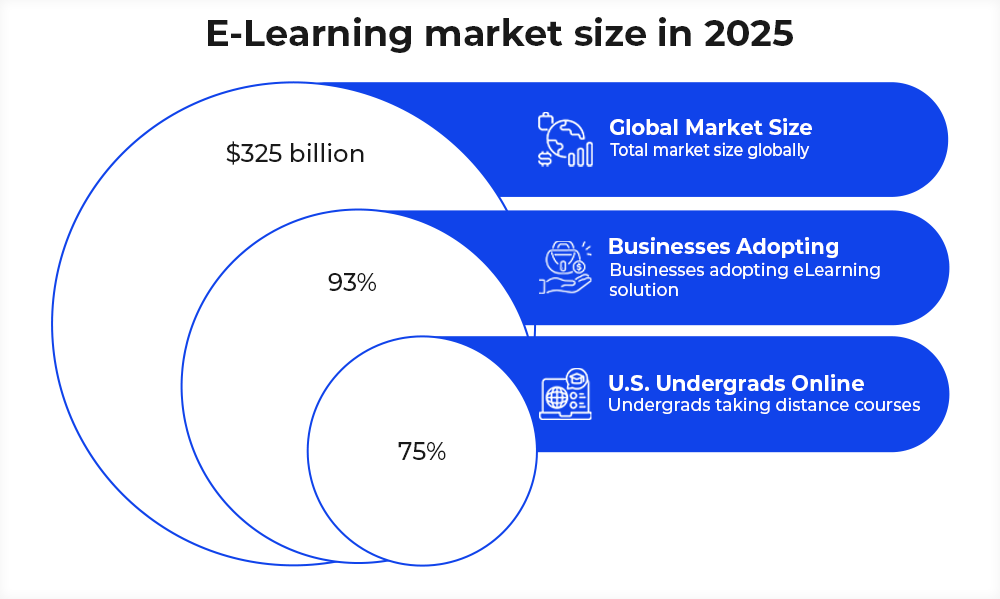
- The e-learning market in the world is expected to achieve USD 419.31 billion by 2030 with a compound annual growth rate (CAGR) of 11.01.
- Industry statistics show that in 2026, e-learning will have achieved USD 325 billion worldwide, a 14 per cent increase over 2024.
- More than 93 per cent of corporations intend to implement e-learning, and 90 per cent already provide electronic training.
- E-learning is expected to involve more than 3 billion learners across the world.
These figures suggest that online education is not a mainstream and scalable learning approach anymore. To an entrepreneur, it would translate to access to world-class education, and in most cases, at their convenience of time and at a small fraction of the price of traditional business schools.
The Entrepreneur’s Learning Roadmap: From Idea to Execution?
To build a successful career entrepreneur can execute these five master stages:-
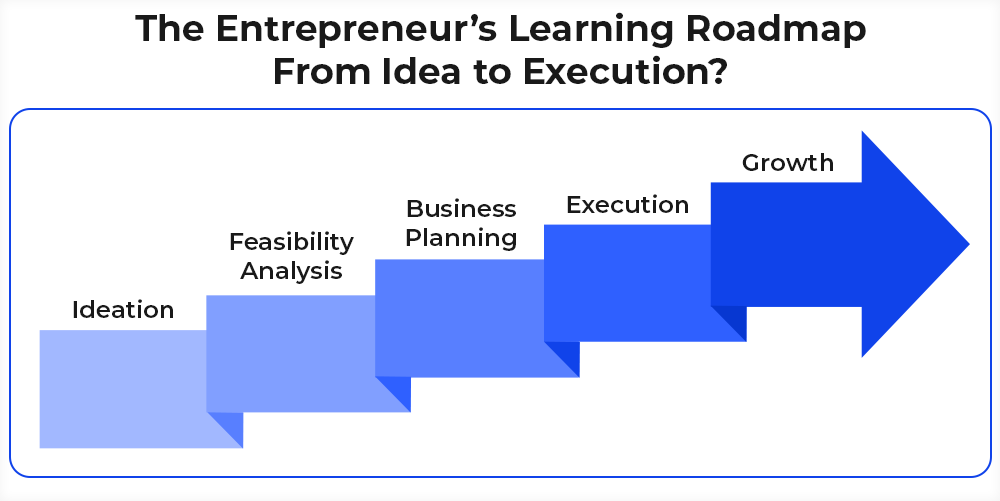
- Ideation:- Ideation is the process through which business ideas are generated and refined by entrepreneurs. It is searching in the market and developing new solutions in the form of problems or opportunities. In order to do it efficiently, entrepreneurs must be creative, understand the market and be aware of the needs of customers. Entrepreneurs can think individually or in teams. They are also in a position to research the market to identify gaps or trends and seek feedback from potential customers and experts. The primary idea is to generate as many ideas as possible and select the ones which have the most chances of success.
- Feasibility Analysis: Feasibility analysis is where the entrepreneurs will determine whether the idea of their business is feasible. They examine such factors as the market, competition, resources and potential risks. Market research will assist them in knowing the kind of customers they will have, the size of the market, as well as what people prefer to purchase. It assists you in researching the competition performance, who will sell the same products, what they do best and where the entrepreneur has to improve. They also examine whether they possess sufficient funds, abilities and resources to actualise the idea. Another aspect that entrepreneurs consider is risk, which includes laws that they should comply with, technological problems or shifts in the market. Through this process, they can make decisions to either go with the idea as it is, update it or cease and pursue new strategies to do things at a faster rate.
- Business planning:- Another stage of entrepreneurs is business planning. It is the creation of a business model, a marketing strategy, a financial projection, and setting the goals of operation. The business model defines the way the venture is going to generate, provide, and extract value. It establishes customer target groups, value statements, sources of revenue, as well as cost base. The marketing strategy will lay down the process of positioning, promoting, and distributing the product or service introduced to the target market. Revenue, costs, and profitability through financial projections are projected in relation to the duration of a period. They assist businessmen in knowing the feasibility of the business and how much funding it will need.
- Execution: It is in execution that entrepreneurs make their plans a reality. It includes the creation of a team, the creation of products or services, and the opening of the business. This phase involves proper management of the project, resource management, and flexibility to overcome challenges and utilise opportunities. It is important to develop a team of talents. Entrepreneurs are required to find the skills required, hire the appropriate individuals, and develop a culture that is in line with the vision and values of the business.
- Growth:- The last phase of the entrepreneurial process is growth. This phase is the expansion and scaling of the business, the expansion to new markets, and the optimisation of operations. It entails making strategic decisions, resource distribution, and constant innovation to maintain and grow market share. Entrepreneurs need to take growth opportunities without losing the values and vision that made them successful in the first place. Business people have to come up with strategies of growth that are in line with their long-term vision. It can be by entry into new markets, product diversification, strategic alliances, or mergers and acquisitions. Customer acquisition, customer retention procedures, including marketing and sales, are very important in attracting and retaining customers.
Best Online Course for An Entrepreneur
Online courses are the best courses that an entrepreneur can take based on their goals, though the most popular are the Harvard Business School Entrepreneurship Essentials and the Wharton Entrepreneurship Specialisation, which are top-tier and comprehensive. The Startup India Learning Program, a government-funded program, is also a good option.
Other specialised courses, such as the Online MBA in Digital Entrepreneurship offered by IGNOU, are designed specifically to meet the needs of the digital world. List of such courses is mentioned below:-
- Online MBA in Digital Entrepreneurship:- Online MBA in Digital Entrepreneurship is an online degree course that teaches the capability of creating, running and developing businesses in the online environment by employing online models and platforms. A blend of the conventional foundations of MBA and the digital world requires skills, e.g. digital marketing, e-commerce, and technology exploitation are included in the curriculum, which is more flexible as it is offered online. In order to take part in this program, the applicants should have a bachelor's degree in any field from a recognised university, usually with 50 per cent marks. Other institutions would focus on candidates having 1-3 years of working experience and might attach importance to entrance examination results, including CAT, MAT, XAT, GMAT, or their own internally developed online test.
- Online BBA in entrepreneurship: The Online BBA in entrepreneurship is a 3-year undergraduate degree course in entrepreneurship which trains students on how to own and operate their own business, as the major courses, including finance, marketing, and management, are online courses. The program may be suggested to those who are ambitious to become innovative, and the program provides a flexible method of learning the required skills in business through the use of online courses, by studying resources and projects. This will enable the students to blend their studies with employment or other activities. To be able to apply to this program, the candidates should have taken 10+2 (or equivalent) with a recognised board and with remarkably 45-50 per cent marks. Age is not generally restricted, and certain institutions might carry out simple aptitude tests or English language tests.
- Online MBA in entrepreneurship and leadership:- Online MBA in Entrepreneurship and Leadership is a graduate degree program that incorporates the knowledge of business management and entrepreneurship, and leadership. It is training students to form and manage businesses with the emphasis on innovation, strategy, and leadership through the implementation of the curriculum that integrates the following courses: business planning, finance, marketing, and organisational behaviour. The online degree provides the flexibility of a master's degree that working professionals and aspiring entrepreneurs can receive in order to further their careers. Application to this program also involves a bachelor's degree in any discipline, which is received at an accredited university, and meets 50% marks (not all the time mandatory, though). 1-3 years of work experience in a business or leadership-related field is usually required. Entrance exam scores may also be required, or their own admission tests may be administered.
- Online certification program in entrepreneurship and new venture creation: Online Certification Program in Entrepreneurship and New Venture Creation is a career advancement course, which provides an entrepreneur with the ability to open, operate and grow a new business. Ideation of businesses, business planning, business funding, business marketing, and business management are all covered in the content of such programs and targeted at future entrepreneurs, existing business owners, and professionals. The online formats are not restrictive, and thus, the participants can learn this knowledge and skill set anywhere. Application to this certification is more liberal, and normally, one must have at least a 10+2 qualification, although in most cases, undergraduates, graduates, or professionals can also be admitted. There is no work experience needed, and basic computer literacy and internet access are usually good enough.
- Online DBA/Doctorate in Entrepreneurship: The Online DBA (Doctor of Business Administration) in Entrepreneurship is a professional doctorate that is thought to equip more experienced business people and entrepreneurs with both superior entrepreneurial skills and research capabilities. It involves both theoretical and practical real-life experience, which allows the student to conduct certain research on complex business problems and gain the high level of knowledge needed in order to work in a top executive position or be the leader of their own company. The internet platform is flexible to the individual who has to juggle between work and school assignments. The admission to this program usually involves a master's degree (MBA or equivalent) from a recognised university with at least 55 per cent marks and 5-10 years of professional or managerial experience. Some of them also require applicants to provide a research proposal and participate in an interview, and, again, depending on their admission policies, some may request the applicant to provide GRE/GMAT scores.
Conclusion
It is not enough to be passionate to transform a business idea into a successful venture; one has to engage in lifelong learning, strategy formulation, and have an appropriate skill set. The silver lining is that online courses in modern days provide every entrepreneur with options to learn under the tutelage of professionals in the industry, hone their skills, and make wiser decisions at each level of the process. You could be testing an idea, developing a product, learning to market, or growing your start-up, but the correct online learning course can be a fast-tracked way to do so. Invest in yourself, keep your eyes open, and allow knowledge to be your power behind your successful entrepreneurship.
FAQs (Frequently Asked Questions)
Online courses also enable an entrepreneur to acquire the necessary skills, know best practices in the industry, and remain competitive without necessarily having to attend classroom learning.
Business planning, marketing, leadership, finance, and product development courses are particularly useful in the early stages of business.
Yes! Most online courses contain hands-on work, case studies, and professional commentaries that can be directly relevant to actual business situations.
Find courses that suit your business objectives, courses that have reputable teachers, those that are well-reviewed, and courses that offer practical learning.
Absolutely yes! Market research, product validation, and customer discovery courses assist entrepreneurs in determining whether the idea they have is feasible.
It will be determined by your schedule, but even 2-3 hours per week may result in regular progress and significant skill improvement.
Most of the online courses offer certificates, which can assist the entrepreneurs in developing credibility, particularly in some fields such as marketing and project management.
Yes! Some of the most popular online courses that entrepreneurs can get through online courses include digital marketing, social media, branding, and SEO.
Definitely yes! Additional lessons on technology, leadership trends, automation, and scaling strategies remain helpful to even experienced entrepreneurs.

2 Years of Experience / Storyteller / Research-driven Writer
Passionate about digital marketing with a creative flair for content writing. 3-years Experienced Always eager to learn, grow, and make a meaningful impact in the digital space.
Every query is essential.
Our team of experts, or experienced individuals, will answer it within 24 hours.
Recommended for you
Tired of dealing with call centers!
Get a professional advisor for Career!
LIFETIME FREE
Rs.1499(Exclusive offer for today)

Pooja
MBA 7 yrs exp

Sarthak
M.Com 4 yrs exp

Kapil Gupta
MCA 5 yrs exp
or


Career Finder
(Career Suitability Test)
Explore and Find out your Most Suitable Career Path. Get Started with our Career Finder Tool Now!

ROI Calculator
Find out the expected salary, costs, and ROI of your chosen online university with our free calculator.