
Social network platforms and online forums and messaging applications create a new type of bugs which affect millions of users across the globe. The world experiences the cyber trolling phenomenon. Most people who use Instagram or comment on YouTube videos or post their opinions on Twitter have encountered or witnessed trolling. The term "cyber trolling" needs an explanation of its actual meaning. People need to learn troll protection methods to safeguard their online safety.
Cyber trolling often involves hacking, stealing others’ identities, and misusing someone’s personal data. Thus, A B.Tech in Computer Science, IT, or Online MBA Cyber Security teaches subjects like network security, ethical hacking, and digital forensics. These skills help professionals track cyber trolls, secure user data, and prevent online attacks.
What is Cyber Trolling?
Cyber trolls intentionally post inflammatory, offensive, or irrelevant comments. Today, it is easier to troll as images and content can be destroyed or mislead using AI, and anyone can do that. This causes more emotional disturbance or disharmony. A cyber troll may enter into a peaceful subject matter and make outlandish comments that are so completely off the wall, causing emotional and mental distress to the victim or target.
Today, trolls use fake accounts and anonymous usernames to hide their true identities. Cyber trolls believe they possess unearned bravery because they can execute their actions without facing any repercussions. Cyber trolling has developed into a severe problem which exists in modern online environments. The problem includes online harassment together with the creation of fake profiles and the posting of abusive comments and the making of threats on social media and digital platforms.
Cyber trolling is a technology-based problem. This means we need better systems to guard against online trolling, social accounts, and data available on the internet. So, Cybersecurity has become a major concern to protect the identity being misused. To secure the data, those who are interested in developing their career in cyber security field can apply for the courses in Artificial Intelligence, Data Science, and Machine Learning. Developing systems that can build automated systems to find hate speech, abusive language, and fake profiles to control the damage and develop safe digital platforms. Moreover, to design better privacy systems, reporting tools, and content moderation features to reduce cyber trolling at the platform level. It can be said that engineers play a crucial role in making the internet a safer place for everyone.
Key characteristics of cyber trolling include:
|
Characteristic |
Description |
Examples in Cyber Trolling |
|
Intentionally eliciting emotional response from others |
Trolls post provocative content designed to anger, upset, or frustrate targets for amusement. |
Inflammatory comments like personal insults in comment sections. |
|
Posting inflammatory or offensive content |
Shares shocking, rude, or hateful material to shock and derail conversations. |
Racist memes or exaggerated political rants in forums. |
|
Disrupting regular online discussions |
Introduces off-topic arguments or spam to halt productive talks. |
Flooding threads with unrelated GIFs or flame wars. |
|
Hiding behind anonymous or sham profiles |
Uses fake accounts or pseudonyms to avoid consequences and enable bold attacks. |
Sock puppet accounts mimicking real users. |
|
Harassment on multiple platforms in one go |
Coordinates attacks across social media, forums, and apps simultaneously for maximum impact intellipaat. |
Raid trolls are swarming Twitter, Reddit, and Discord. |
|
Targeting an individual or group based on personal characteristics |
Focuses on traits like gender, religion, ethnicity, or opinions to exploit vulnerabilities. |
Pile-ons against women sharing opinions or minorities. |
Types of Cyber Trolling
Knowing the many kinds of cyber trolling will enable you to know whether you or someone else is the target of such an action. The following are some of the most common forms:
- Classic Troll: When it comes to this, the classic troll is the most basic type of trolls that post comments on threads to react to others and create conflict situations. Maybe in some fan sites, the classic troll tends to post something like, “Your favorite movie is trash!” or “This song is the worst that I have ever heard.”
- Flaming: It is the act of posting highly offensive messages. The individual carrying out the act of flaming uses offensive words to undermine the target’s esteem. It is even worse than cyber trolling. Flaming is meant to hurt the target emotionally.
- Concern Trolling: It is quite crafty and seems to be full of concern for the other person, only trying to bring them down in the end. Example: "I am worried about your sanity for sharing this," when in fact they are trying to get you to question your own.
- Sock Puppeting: In this form of trolling, they create multiple fake accounts, such that it seems like a thought shared by many people. The trolls end up talking to themselves in efforts to make it look like a common thought.
- Sealioning: This is a request for evidence or a justification for something being done or asserted in a polite but incredibly harassing way even though he or she may have answered before out of curiosity.
- Doxxing: Another of the very dangerous forms of cyberbullying, doxxing is where one troll’s activity of placing particular personal information of the victim, such as their home address, phone number, or office, online, is used as bait to get harassed offline.
- Impersonation: This refers to trolling where an individual creates a fake account with another person’s identity and posts derogatory content with that particular identity.
- Grief Trolling: It is regarded as one of the most harsh and ugliest forms of trolling. It is the process by which trolls troll grieving or hard-pressed people. It entails trolls posting negatively on condolence sites or making smart comments on loss.
- Online Trolling of Politics: Political trolls on the online world, because of political discussions and online elections, are disseminating misinformation, actively criticizing contrarian ideas, and inducing polarization on political discussions.
- Body Shaming & Appearance Trolling: The troll can attack the physical appearance of a person, their costumes, to make them feel insecure.
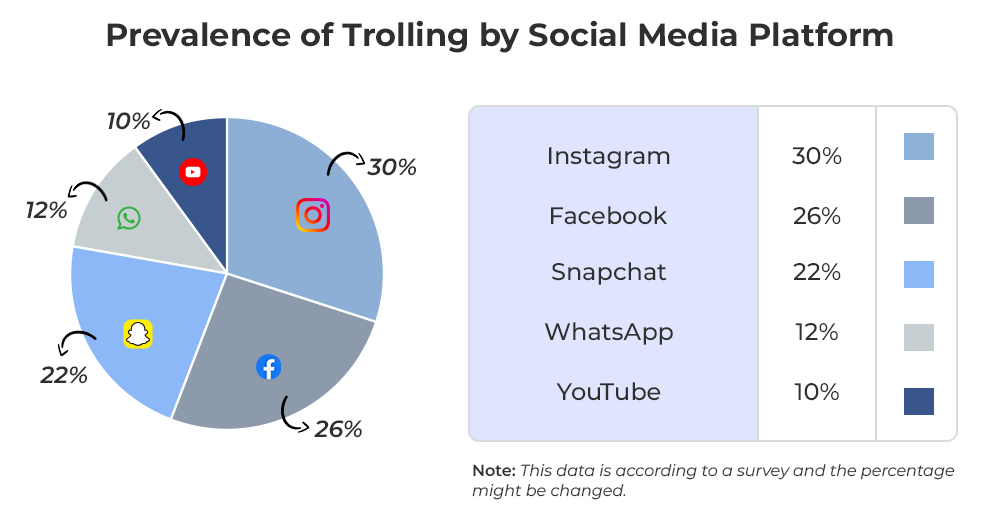
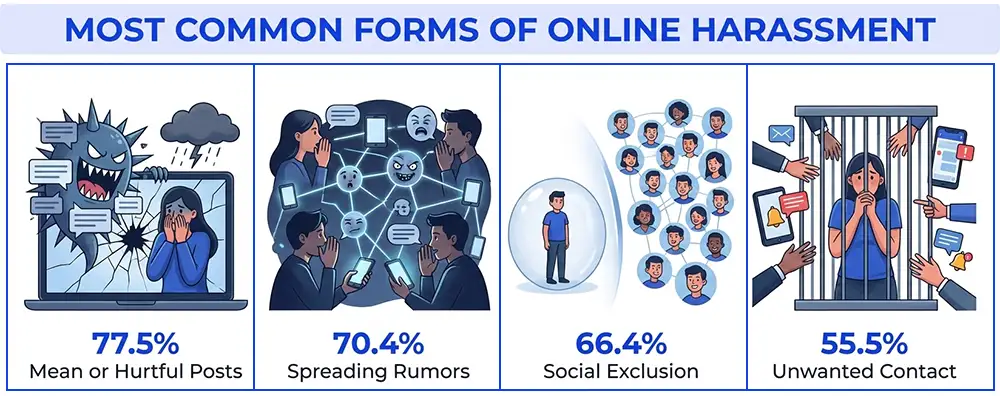
Note: This data is according to a survey and the percentage might be changed.
What leads one to become a Cyber Troller?
Understanding what provokes individuals and leads to the trolling behaviour, so that we can better understand the problem. Common reasons include:
- Anonymity: The internet creates an advantage of anonymity; since one feels anonymous, they can comment on anything.
- Attention Getting: Trolls seek attention, even if it's negative.
- Entertainment: Unfortunately, it amuses some people to distress others and relish the chaos they create.
- Revenge: Some individuals who may feel wronged in some way troll others as a means of getting even with the world.
- Psychological Issues:Maybe the trolls were carrying lots of their own baggages-emotional problems and so much resentment-to project out online.
- Group mentality: When a person sees others trolling, they also start to troll because it is an acceptable behavior according to them.
- Cyber Trolling: How to avoid and fight back
Fortunately, there are ways to protect yourself and minimize the impact of trolling:
- Don’t Feed The Troll: The first thing is to just not feed them. If a troll is trying to get a rise out of you and your first response is to fire back at them because of anger or hurt feelings, that is what they want. If you do that, more often than not, it will take away their reasoning for posting them in the first place.
- Privacy Options: Make your accounts private. Try to keep people who comment on your posts from being strangers to you. Try to keep people who are strangers to you from viewing what people who are strangers to you can't see.
- Block and Report: Block trolls and take the time to report their behavior on the website or platform you’re on. Social websites mostly follow guidelines against harassment and will do something about it if it is brought to their notice and reported as a violation.
- Think Before You Share: Think carefully about the personal information that you publish on the Internet. You should never share your location or phone number or address with anyone nor should you disclose any other private information that could be used to harm you.
- Save Every Detail: You should keep all messages and posts when the trolling activity reaches dangerous or severe levels. The evidence from this case will become important if you decide to report it to higher authorities or take legal action.
- Use Strong Passwords and Two-Factor Authentication: Make sure your accounts are not hacked by trolls by keeping strong passwords on all of these platforms and enabling two-factor authentication wherever possible.
- Support others: Have the confidence to realize that discussing the problem of trolls and their psychological effects in conversations with friends, relatives, or psychologists is what other people need to do. Having people understand the reality around them helps immensely.
- Educate yourself about digital literacy, such that understanding the nature of the internet, troll behavior, and what your rights on the internet will allow you to navigate this world safely.
- Use filters on content: Often, most platforms will have keyword filters, which might even prevent comments with particular words or phrases in them. Of course, this might just be an effective means of reducing the risk of exposure to hate.
- Social media break: “If the trolling is getting to you, this is a perfect opportunity to take a break. Your mental health is more important than any other necessity to be online,” says Vale.
The Legal Side of Cyber Trolling
Most countries in the world, including India, have laws about cyber harassment and trolling. In India, the Information Technology Act 2000, besides the Indian Penal Code, has provisions that can be invoked against cyber trolls, especially in cases threatening, defaming, or harassing the victim.
If you find that you are suffering at the hands of some serious trolling-involving threatsharassment, youotherwise harassment-you can report it to the cyber crime cell in your vicinity. Remember, serious trolling is not just irritating; it's against the law.
How to fight back against cyber trolling?
With cyber trolling being an ever-increasing problem, the need for experts in both technology and cybersecurity also increases. This is where pursuing Computer Science Engineering in specializations like Artificial Intelligence and Cyber Security becomes extremely important.
- Overview of Security Training: In this regard, Such courses in has specific streams of cybersecurity, ethical hacking, and digital forensics. It makes the students comprehend how each electronic danger functions, for example, the mechanism of trolling, and how one can foster arrangements against these dangers. This is something of real importance in the current digital space, where enterprises and individuals have to be safeguarded against harassment online.
- Practical Development Skills: This program truly focuses on students learning by doing. They use real-world scenarios to train students in developing security systems, creating safer online platforms, and grasping the technical side of how trolls operate. With such practical training, the graduates are definitely job-ready or able to make prompt contributions to cybersecurity teams.
- Overview of Social Media Architecture: The computer science students will achieve this goal by studying the construction methods used to create social media platforms and online communities and online forums. The program enables students to acquire knowledge about more effective reporting systems and content moderation tools and AI solutions that detect and prevent trolling activities.
What Programs can be enrolled in?
Students who are interested in fighting cyber trolling and building safer digital spaces can choose from several technology-focused programs. These courses provide the technical, analytical, and ethical skills needed to handle online abuse and cyber crimes.
B.Tech Programs
- B.Tech in Computer Science Engineering (CSE): Learn programming, web technologies, and system design to understand how online platforms work.
- B.Tech in Cyber Security: Focuses on network security, ethical hacking, digital forensics, and cybercrime prevention.
- B.Tech in Information Technology (IT): Covers databases, networking, and information systems used by social media and digital platforms.
- B.Tech in Artificial Intelligence & Machine Learning: Helps in building systems for hate-speech detection, content moderation, and fake account identification.
- B.Tech in Data Science: Teaches data analysis and pattern detection used to monitor online behavior and abuse trends.
Undergraduate Alternatives
- Online BCA: A practical course focused on software development and cyber basics.
- Online B.Sc in Computer Science / IT: Suitable for students interested in research and technical foundations.
Postgraduate & Skill-Based Options
- M.Tech in Cyber Security or CSE: For advanced roles in cybercrime investigation and security analysis.
- Certification Courses in Cyber Law, Ethical Hacking, or Digital ForensicsShort-term programs for quick skill development.
How can Polytechnic Diploma holders develop a career in Cyber Security?
It is possible that polytechnic diploma holders can also develop a successful career in Cyber Security via lateral entry. B.Tech Lateral Entry programs allow diploma holders to join directly in the second year, fast-tracking engineering degrees for professionals. Specializations like Cybersecurity teach threat detection, secure coding, and ethical hacking—directly countering trolling tools like bots and doxxing.
Graduates develop AI moderation algorithms, forensic analysis skills, and platform security protocols. For instance, they design systems flagging flame wars via sentiment analysis, reducing troll impact by 70% in tested environments. This education empowers working pros to innovate defenses without career breaks.
Introduction to B.Tech for Working Professionals
So, everybody can not quit their job, thus there are flexible undergraduate engineering programs like B.Tech for Working Professionals. B.Tech for Working Professionals offers flexible engineering degrees via evening, weekend, or online classes, ideal for diploma holders advancing careers. These UGC-approved programs cover IT, CSE, and cybersecurity, blending theory with projects. Lateral entry skips basics, completing in 3 years.
Universities like Lingaya’s Vidyapeeth provide CSE-Cyber Security tracks, emphasizing malware prevention and network defense vital against trolls. Sanskriti University offers practical curricula, Shri Venkateshwara University stresses affordability, and Kalinga University focuses on industry ties. These serve as convenient alternatives, with remote access suiting shift workers.
Why B.Tech for Working Professionals Beats Regular B.Tech Lateral Entry
Regular B.Tech demands full-time campus attendance, clashing with jobs, while working professional variants prioritize flexibility without compromising quality.
|
Aspect |
Flexible B.Tech for Working Professionals |
Regular B.Tech Lateral Entry |
|
Schedule |
Evenings/weekends/online |
Full-time weekdays |
|
Experience Integration |
Applies job skills to projects |
Limited real-world focus |
|
Duration for Laterals |
3 years |
4 years from start |
|
Cost-Effectiveness |
Lower fees, no income loss |
Higher with living expenses |
|
Networking |
Industry peers/mentors |
Mostly students |
|
Career Boost |
Immediate promotions |
Entry-level starts |
Skills Gained for Cyber Defense
Participants master Python for threat scripts, machine learning for troll detection, and ethical hacking to simulate attacks. Courses cover OS security, preventing password cracks, and core to troll tactics. Hands-on labs build resilient systems, directly aiding prevention.
Future Outlook
As trolling leverages AI deepfakes, B.Tech pros will pioneer countermeasures like blockchain verification. Governments push such education, with India mandating cyber modules by 2027.
Career Opportunities in Cybersecurity
Some of the positions that one can work after receiving a degree in Computer Science Engineering from approved universities are:
- Cybersecurity Analysts have to protect organizations from online threats.
- Digital Forensic Experts investigating cybercrimes, including trolling
- Social Media Security Specialists are working for the platforms to keep users safe.
- Ethical hackers test systems for weaknesses.
- Information Security Managers who develop company-wide protection strategies
- AI/ML Engineers who build automated systems to detect abusive content
- Building Safer Digital Spaces
The thrust is on responsible usage of technology and encourages the students towards devising solutions on how to make the internet a safer place. Students work on projects addressing real problems like cyber trolling while learning how to balance free speech with user protection.
Industry Related Curriculum
The syllabus in Computer Science Engineering gets updated regularly to keep up with the current trends in technology and cybersecurity. Therefore, students learn about advanced trolling techniques, platform vulnerabilities, and defense mechanisms being used worldwide by leading tech companies.
- Research and Innovation: They have research opportunities into cyber behavior, patterns of online harassment, and technological solutions. This researcher mindset will prime them to be innovators who can create the next generation of tools to combat cyber trolling.
- Soft Skills and Awareness: Besides technical skills, the program focuses on digital citizenship, online ethics, and the psychological impact of cyber behavior. This all-rounded approach creates professionals who are not only keen on the technology behind but also on the human aspect of online interactions.
The Future of Fighting Cyber Trolling
As new technologies emerge, so do the methods that trolls are using. However, at the same time, the same things that have caused rapid changes in technology are also driving the development of Artificial Intelligence (AI), Machine Learning (ML), and Natural Language Processing (NLP), and thus developing additional weapons for combating harassment on the internet.
The following are several potential solutions that may be available in the near future:
- AI-Powered Moderation: This type of automated moderation system can identify and delete trolling content before it has a chance to inflict harm, thus protecting users from harassment.
- More Robust Verification Systems: With improved verification of identity, it will be more challenging for trolls to create anonymous accounts. This means they can no longer hide behind a pseudonym.
- Psychological Support Tools: These types of platforms are intended to gather mental health resources for those affected by trolling and will provide users with access to mental health services and support.
- More Robust Legal Frameworks: Many governments around the world are currently working towards creating a comprehensive legal framework to combat cyber harassment.
- Education Programs: Schools and universities are starting to include Digital Citizenship and Online Safety as part of their curriculum.
The individuals developing and implementing these solutions will be Computer Science professionals. Education will continue to play a significant role in preparing people for careers in Computer Science, and therefore, Computer Science is becoming increasingly important.
Conclusion
The issue of cyber trolling affects millions around the globe, making it a universal problem. However, cyber trolling is not something that anyone should have to endure as a natural part of their online experience. There are ways we can all improve the internet, both individually and collectively.One way to do this is by studying Computer Science Engineering. As future engineers in this field, the combination of proper education and skill sets will allow you to help create a safer digital environment for all.
Cyber trolling exists in two parallel worlds: one is through education and awareness, and the other is through technology and innovation. Regardless of which path you choose to take, each person has the opportunity to positively affect the online community. Keep informed, continue to learn, and remember that we control what happens on the internet. We can either choose to be kind and supportive by helping each other, or we can choose to be cruel, backstabbing, and use technology to separate us.