


During the COVID-19 Pandemic & even after that distance learning has become a preferred choice for many students & professionals. The rising number of admissions for distance learning courses is a reflection of the adoption of remote learning methods by today’s education industry. Moreover, technological advancements in the education sector have enhanced the teaching-learning experiences of distance learning.
So, if you are planning on diving into the world of remote or distance learning, you must have a clear idea of its types, advantages, disadvantages, etc. Here in this article, we will be discussing all such important factors to make you know all about distance learning!
What is Distance Learning?
Distance Learning is a category of remote learning methods that involves a flexible learning routine. In this mode, learners are not required to attend regular on-campus classes. They have a fixed schedule of weekend or evening classes which allows them to continue their professional or personal commitments while learning.
In distance learning mode, students are provided with study materials (books) by the university through courier service & digital portals. Thus, an independent learning format is encouraged in this distance education mode which is mostly based on self-paced learning.
Types of Distance Learning
Distance learning has two major types: synchronous & asynchronous.
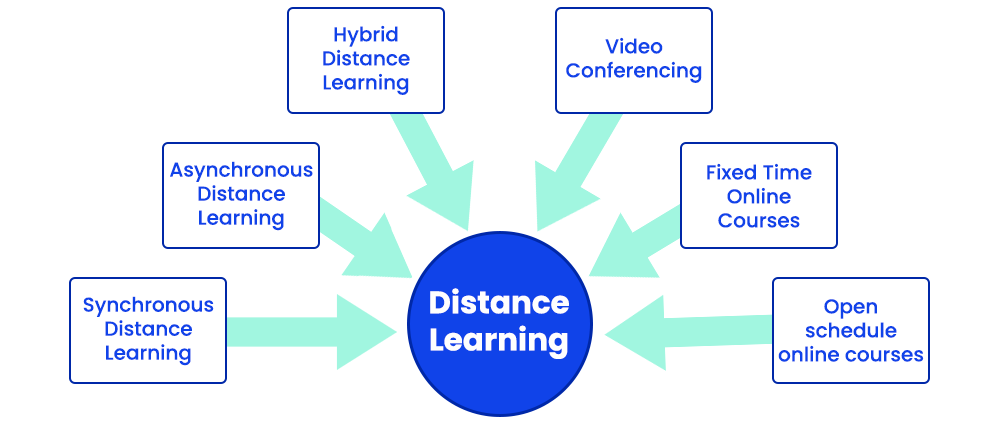
A brief detail about these two is provided below.
- Synchronous Distance Learning
In this type, learners get to establish one-on-one interaction with their peers & faculty members. This interaction can be done in either physical mode or via digital platforms. Here learners will attend live lectures at a fixed schedule which makes it relatively less flexible than it is expected to be. The live communication involved in this category uses teleconferencing or videoconferencing using technical tools & software.
- Asynchronous Distance Learning
In this mode, learners will have the freedom to learn at their own pace. With the 24*7 availability of course content, they are required to meet their project or assignment deadlines as provided by the faculty members. This way learners can fulfill their objective of choosing a flexible distance learning program. The modes of communication that can be used in this type by the students include quizzes, video comments, and conversations.
Different Ways of Learning Involved in Distance Education
When you enroll in any distance learning program, you will encounter a variety of learning modes being used by your university or institution. The four common ones that are highly preferred are listed here.
- Video Conferencing
In video conferencing, multiple learners can connect at one time using the internet. This way they will have a chance to interact with their teachers & fellow learners. This makes the distance education program to be delivered in a structured way. Platforms or tools usually used for video conferencing are Zoom, Adobe Connect, Blackboard Connect, etc. It is more like a synchronous type of distance learning.
- Hybrid Distance Education
By combining synchronous & asynchronous distance learning types, we get a hybrid mode of distance education. In this way of learning, you will have to meet your deadlines but have the freedom to study on your own with the provided study materials.
You can connect with your professors in this learning method via online portals & clear your doubts for a better understanding of the subject. With an independent learning module, this mode offers you one-on-one interaction with your teachers & peers.
- Online Open-Schedule Courses
This mode falls in the category of asynchronous distance learning. Here you have the complete freedom to study at your pace with digital facilitations like online books, bulletin boards, & online portals. You will have to follow certain deadlines in this as well but there is no stress involved due to the online academic support.
To do well in this way of learning, one needs to have high motivation & self-discipline.
- Fixed Time Virtual Course
This is the most common way of learning in distance education programs. In this, you have a fixed schedule of classes that you need to attend for an enhanced understanding of topics. Moreover, with unlimited access to the study materials, you need to pass the scheduled tests to get your degree or certificate.
Who Should Pursue Distance Learning Programs?
Distance learning programs are open for all aspirants, however, some specific categories can get high benefits from it. A list of such categories is provided below.
- Students living in rural areas who cannot attend regular classes in a reputed college in the big city.
- Students who fail to crack the merit list of regular colleges.
- Students who cannot afford to pay for regular college.
- Students who want to study abroad at an affordable cost by staying at their homes.
- Working professionals who need to upskill their knowledge for better career opportunities.
- Organizations who want to give professional training to their employees for better growth of their businesses.
Advantages of Distance Learning
Distance learning programs offer a variety of advantages. Consider the below-mentioned benefits to make a confident decision to enroll in one such program.
- Flexibility: Distance learning courses provide you with a high flexibility of learning from anywhere at any time with the help of digitized academic resources. The option of attending weekend or evening classes helps distance education learners to continue their jobs while studying.
- Say No To Travelling: In distance learning programs, you do not need to travel regularly to the college campus for classes. However, virtual trips to seminars, workshops, & industries are arranged to make you get equipped with the latest industry trends.
- Accessibility: Distance learning helps you access quality education from your preferred college or institution even if it is not located in your town or city. This high accessibility is a major advantage that contributes highly to equipping the Indian workforce with quality knowledge from all around teh world.
- Save Time & Money: Distance education is quite affordable which saves your or your parent’s hard-earned money. With low tuition fees & less overhead costs, it saves you a lot of money. In addition, it saves your travel time which is a big saving for your busy schedule.
Disadvantages of Distance Learning
With a long list of advantages associated with distance education, there are some disadvantages reported by the learners. The most common ones are:
- Lack of physical interaction with teachers causes distraction from studies which makes you lose concentration & ultimately results in missed deadlines.
- A slow internet connection makes you frustrated as it won’t let you learn at a smooth pace in online classes & takes longer to load the recorded videos.
- Some instructors might ask you to get additional tools or software for your course which sometimes causes a financial burden on you.
- Lack of technical support confuses you with handling several technical tools & applications.
Are Distance Learning Degrees Recognized?
Even with the gain in popularity of distance learning, the question of its credibility always revolves in one’s mind. As per the guidelines launched by the University Grants Commission (UGC), distance learning programs completed from recognized institutions or universities hold equal weightage as an on-campus one.

As per a report, “77% of academic leaders rate distance education as equal or superior and 69% of chief academic officers agree.” This makes you fulfill your dream of working at an international firm with a distance learning degree. However, the necessary skill sets & experience are additional requirements that would be specific to your recruiting firm.
What is the Future of Distance Learning?
Earlier distance education was thought to be an inferior mode of learning but now this is certainly not the case! With all the technical developments & increased dependency on them, the admission rate to distance education is rising in great numbers. Moreover, during the Covid-19 pandemic, we got an understanding of what are the basic needs that are important for our survival, and guess what? Remote learning is one of those needs!
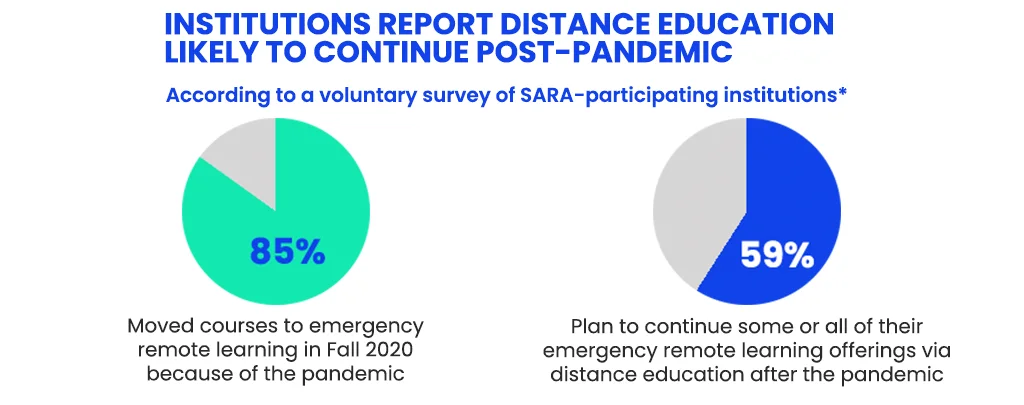
Remote or distance learning is an effective learning mode that does not require your physical presence in the classes. It makes you gain theoretical (via books & digitized academic resources) & practical knowledge (via your job) at the same time. This way it not only improves the quality of education but fills the gap between “what we know?” and “what we should know?” as per today’s industry standards.
The scope of distance learning is highly promising & is not going to drop in any sense in the future. One of the reasons for this high scope is that even the top organizations are encouraging their employees to upskill themselves with remote or distance learning programs. Whether a student or a professional, distance learning is a perfect fit for everyone’s schedule.
Top Universities Offering Distance Learning Programs
After getting to know about a plethora of benefits of distance learning programs, you must be curious about the university names that have made this learning format such popular. Here is a list of a few top universities in India that have changed the impression of distance learning courses with their dedicated faculty & smooth services.
| Location | University |
| Andhra Pradesh |
|
| Arunachal Pradesh |
|
| Bihar |
|
| Delhi |
|
| Haryana |
|
| Kerala |
|
| Punjab |
|
| Rajasthan |
|
| Sikkim |
|
| Tamil Nadu |
|
| Uttarakhand |
|
| Uttar Pradesh |
|
The above-mentioned universities are not the only ones in the particular state but hold a good reputation in their regions.
Most Sought-After Distance Learning Programs
A variety of distance learning courses are available at government & private universities but some of them have gained significantly high popularity in this category. The table below lists some of them for your awareness.
| Postgraduate Distance Education Courses | |
| Distance MBA | Distance MCA |
| Distance M.Com | Distance MA |
| Distance M.Sc | |
| Undergraduate Distance Education Courses | |
| Distance BBA | Distance BCA |
| Distance B.Com | Distance BA |
| Distance B.Sc | |
For engineering aspirants, BTech distance education & MTech distance education are also provided by certain universities. However, these programs are valid only after incorporating some modifications as established by AICTE. The official name of these AICTE-approved flexible engineering courses is B.Tech with Flexible Timings & MTech with Flexible Timings.
Difference Between Regular & Distance Learning Programs
The table below lists the key differences between a regular & distance learning program.
| Parameter | Regular Program | Distance Learning Program |
| Flexibility Level | Very low | Moderate to high |
| Class Schedule | Daily fixed class timings | Weekend or evening classes |
| Physical Presence | Necessary | No need |
| Interaction With Teachers | In-person | Via Regional Centers, Digital platforms, forums, or LMS |
| Fee Structure | Quite high | Affordable |
| Admission Process | Done from the university’s admission office | Either through the university’s admission office or the official website |
| Exam Format | At college campus | At college campuses/regional centers/online |
| Networking opportunity | Mostly domestic | International professional networking via digital platforms |
| Industry Exposure | Low to moderate | Quite high |
Conclusion
Today, you can opt for the distance learning mode for your graduation, postgraduation, or doctoral degree programs. Thus, you can now upskill with your relevant program even in your busy schedule. Moreover, the low fees & flexible way of learning make you enjoy your journey along with your other commitments.
So, don’t stay stuck in the old traditional methods, join a distance learning program & make a smart choice for your career!