



If you are an individual possessing strong organizational skills and managerial aptitude to oversee the execution of tasks, then project management, often referred to as “PM” can be a lucrative career option for you. In this career, a professional works to ensure that various projects are planned and executed seamlessly to deliver the desirable results as planned.
The role of a project manager or PM is diverse and dynamic, as each project, whether technical or nontechnical, brings in new scope, new challenges, and new strategies to devise solutions. Project management roles offer lucrative compensation as more and more organizations now require systematic project execution with certain quality standards to be met.
So if you are someone looking to establish yourself in a career of project management, this blog will walk you through the career prospects, required qualifications as well as skills needed to excel as a project manager!

Why Choose a Career in Project Management?
Project management is a career field that is growing in demand in the contemporary professional ecosystem, and PMs with both technical and non-technical backgrounds are turning to project management careers. But before you make the crucial choice of choosing your career pathway, here are a few of the key reasons to consider taking project management up as your career.
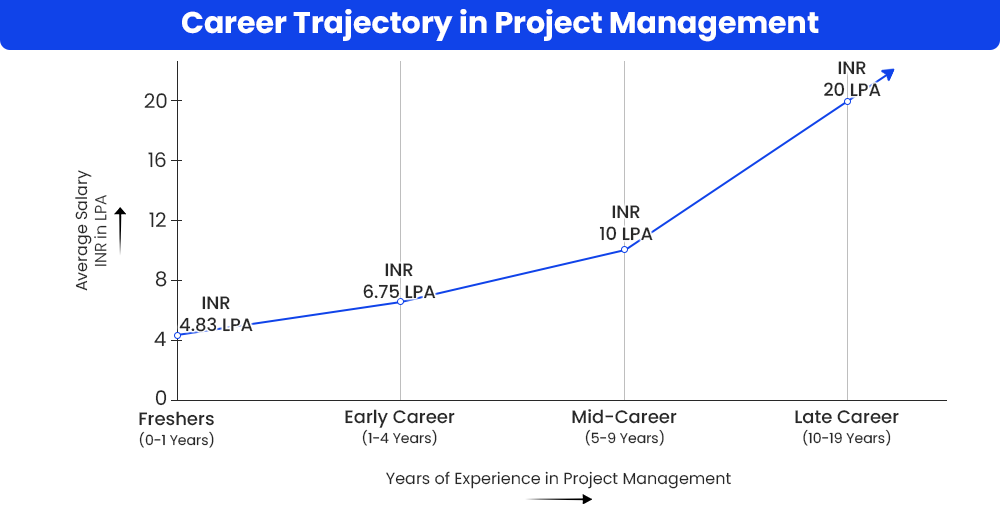
- Lucrative Compensation: Project management is one of the most lucrative management domains to work in, and it also offers significant scope for financial growth over the years. For instance, the latest figures show that one can expect nearly a 5x growth in project management compensation over the course of their career.
- Honing of Transferable Skills: Working in project management helps in the development of skills like communication skills, time management, risk management, stakeholder management, etc, which are transferrable and critical across a number of job roles, thus widening your career prospects.
- Demand Across Industries: Professionally trained project managers are required in a myriad of diverse industries, ranging from manufacturing and FMCG sectors to those like technology, healthcare,e and finance. Hence, the job scope in PM is considerably vast.
- Scope for Strong Career Progression: Project managers, while starting out as PM executives, can expect steep growth progression in their careers, escalating to senior roles like leadership positions, program manager roles, portfolio managers, etc.
- Dynamic Working Opportunities: With different projects presenting different requisites, deliverables, and scope, project managers get vast exposure across industries and clients which helps them hone their skill repertoire as well as form strong networks across industries, both helping their future professional journeys.
Roles & Responsibilities of a Project Manager
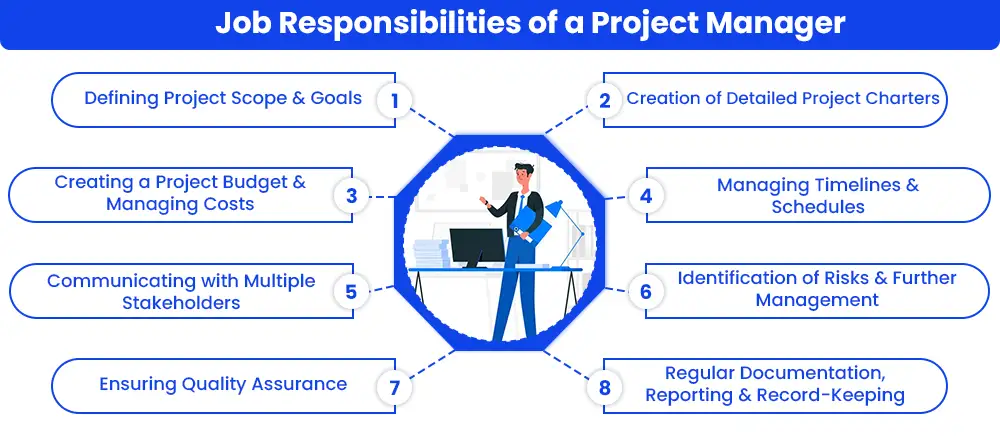
The nature of the role of a project manager is versatile and dynamic, and each project brings in new expectations and requirements around which a PM must strategize their project charter. However, there are certain core aspects of the job that a PM must look into, and these start right from the strategizing of the project plan and goals to the end-to-end overseeing of the project tasks and deliverables. Some of the core job responsibilities of a project manager have been described below.
Key Skills Needed for Project Management
There are a number of technical skills and soft skills that are important for a project manager to possess for succeeding in their role. Be it expertise in technical domains, knowledge areas or being proficient in one’s interpersonal interactions, a PM can navigate the job role easily with these core skills.
1. Technical Skills & Knowledge to Succeed as a Project Manager
Technical skill and knowledge areas form a critical part of the competency needed for the role of a PM. There are several financial, strategic, and operational areas which a PM must be familiar with. The details of these skill areas have been provided below.
| Key Skills | Specifications |
| Budgeting & Financial Management | Having a strong grasp over areas like cost estimation, making financial planners, budgeting and resource allocation as well as financial forecasting. |
| Risk Management | Being able to efficiently predict potential risks as well as manage unforeseen setbacks and risks that arise through effective mitigation strategies. |
| Project Management Frameworks | Being familiar with using project management methodologies such as agile. waterfall, Scrum methods, etc. for effective management |
| Project Management Tools | Being proficient with using project management tools such as JIRA, Trello, Microsoft Project, and so on to streamline and optimize practices for project management. |
| Vendor Management | Being efficient in contracting vendors, setting expectations, negotiating with multiple vendors, ensuring due compliance with project needs, and streamlining project deliverables with third-party vendors. |
| Quality Control & Performance Management | Taking a holistic approach towards managing quality of service and efficient performance by members to ensure quality deliverables are produced. |
2. Soft Skills to Succeed as a Project Manager
Soft skills, aptitude areas, and interpersonal skills are also quite crucial for the role of a project manager, as they require these skills for efficient handling of various stakeholder interactions, team management, task prioritization, and so on. The further details of these skill areas have been mentioned below.
| Key Skills | Specifications |
| Communication Skills | Being able to articulately present one’s message, negotiate with multiple stakeholders, and maintain channels of formal communication. |
| Time Management & Prioritization | Being able to effectively prioritize multiple deliverables and tasks and accordingly being able to deliver them within stipulated timelines as per project requirements. |
| Attention to Detail | Having a knack for working in a detailed manner, with an eye for detail, identifying errors, noticing patterns, and so on. |
| Leadership Skills | Having a potential for leading from the front, taking due accountability and ownership of project deliverables, accordingly working with and guiding team members to meet requisite expectations. |
| Problem-solving | Being able to understand and interpret complex problems, identify their potential solutions, and accordingly execute a solution that meets current needs. |
| Adaptability & Flexibility | Having an adaptable and flexible approach to solving problems and addressing concerns at work, with consideration of the factors involved in different projects. |
What are the Career Opportunities for Project Management (Types of Options available in Project Management)
A project manager can hone several skills and knowledge areas that are transferable and relevant in related roles. Thus, if you are professionally trained in project management, several related career areas also open up for you including project administration, risk management, project administration, and so on. Not only are these domains well-compensated, but they also offer a steep career progression, which means you can expect a fairly decent scope of career growth in these domains as well!
| Career Option | Average Salary (Per Annum) |
| Project Manager | INR 14.7 LPA |
| Program Manager | INR 16.9 LPA |
| Portfolio Manager | INR 13.10 LPA |
| Scrum Master | INR 14.97 LPA |
| Risk Manager | INR 12.79 LPA |
| Change Management Consultant | INR 9.56 LPA |
| Risk Consultant | INR 8.99 LPA |
| Project Coordinator | INR 5 LPA |
| Event Manager | INR 5.05 LPA |
| Project Administrator | INR 5.65 LPA |
Career Analysis: Scope of Project Management
Before venturing into the education needed to become a project manager, it is crucial to understand the prospects of this career from the current industrial perspective. Herein, we take a look at the industrial trends in project management, the financial investments needed to become a project manager, as well as the prospects of financial growth here.
1. Demand for Project Managers: Industry Trends
Some of the recent pertinent facts and figures that reflect the industrial trends around project management as a career domain have been enlisted below.
- The projected growth rate for the field of project management is expected to grow by 7% from 2023 to 2033, with nearly 77,000 openings to emerge in the field each year.
- Taking up the Project Management Professional (PMP) certification ® can help boost a professional’s career significantly as those with this certification can expect to earn nearly 22% more than those professionals without the qualification.
- Some of the major industries that employee project managers include the finance and insurance sector, scientific and technical services, the manufacturing industry, administrative and support services, the construction industry, etc.
- A predictive analytical report by Visual Planning indicates that nearly 25 million new project manager roles will open up by the end of 2030 across the globe.
2. Fees & Costs Involved in Becoming a Project Manager
While a few courses like BBA and BMS provide insights to an aspirant at some level about the nature of project management, detailed courses in the domain are available mostly at the postgraduate or executive level. The financial investment required to become a PM is contingent upon several factors including the institution you decide to study from, the mode of education you go for, the course duration, and so on. Online and remote learning courses in project management in the form of PG diplomas, degrees, and executive certificates offer some of the most pocket-friendly and affordable options for education in project management.
A few of the prominent online and regular courses available to take up in the domain of project management are mentioned below.
| Project Management Courses | Approximate Course Fees |
| Online BBA | INR 1,50,000 |
| Online MBA in Project Management | INR 2,50,000 |
| Online Executive MBA in Project Management | INR 3,50,000 |
| Online PG Diploma in Project Management | INR 65,000 |
| PG Certification in Project Management | INR 1,45,000 |
| Project Management Professional (PMP) Certification | INR 47,150 |
| Certified Associate in Project Management (CAPM) | INR 17,220 |
| Program Management Professional (PgMP) | INR 57,400 |
| Portfolio Management Professional (PfMP) | INR 57,400 |
| PMI Agile Certified Professional (PMI-ACP) | INR 28,454 |
| PMI Risk Management Professional (PMI-RMP) | INR 54,940 |
Career Growth Trajectory of Project Management
While initial salary packages in entry-level roles have a moderate to high range for project management, with years of experience and due upskilling, a professional can experience considerable growth in terms of compensation in this domain. Through the course of one’s career trajectory, one can experience anywhere between 5x growth in compensation as the latest figures indicate. With the growing demand of project managers, the scope of the career along with compensation are both likely to surge further.
The overall expected growth trajectory in this career has been illustrated below.
Career Navigator: What Course to Pursue for a Career in Project Management?
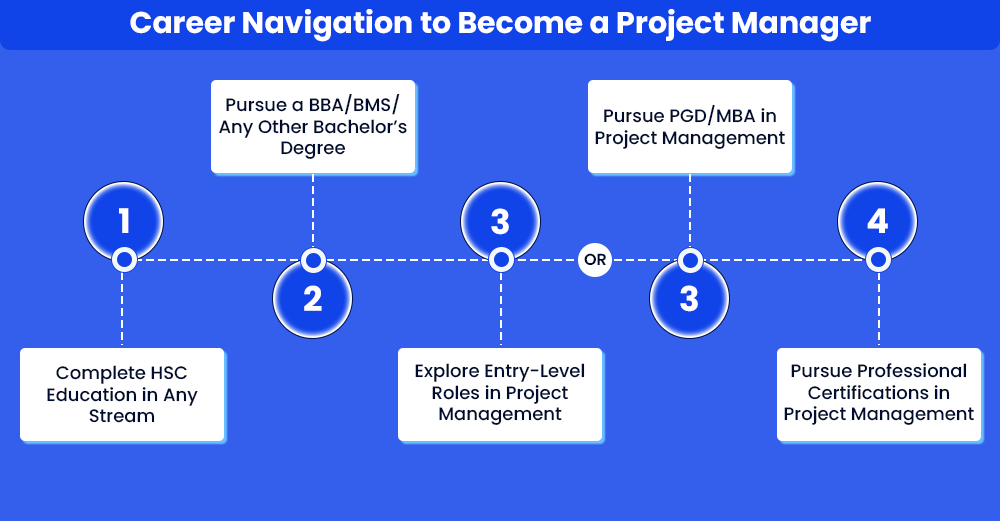
Project management is a career domain in which students from any educational background can venture provided they have the requisite qualifications. Training and qualification courses for project management primarily begin at the postgraduate level, i.e. after completing one’s Bachelor's degree. However, courses like BBA or BMS can provide a detailed knowledge of management which can support further education in the domain of PM.
After completion of UG education, one can look at two pathways for further qualification– they can consider taking up a PG course like an MBA/PG diploma in the specialization of project management, or they can look to take up professional certifications in PM such as a Project Management Professional (PMP) Certification ®, a Certified Associate in Project Management (CAPM) course, a Program Management Professional (PgMP) certification, etc. The details of navigating the career pathway in project management are given below.
Top Colleges & Institutes for Project Management
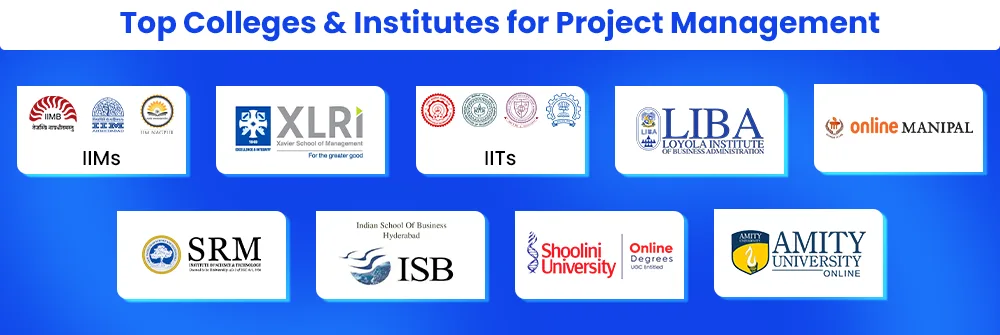
There are several prestigious higher education institutions (HEIs) as well as professional institutions in India that offer specialized education in project management. For instance, among the renowned public institutions of India are IIMs and IITs which offer courses in PM, among the private universities are those like Amity University, ISB Hyderabad, SRM Institute, etc. The Project Management Institute or PMI is among the most elite and credible institutions that offer specialized education in this domain to professionals, including recognized certifications such as the PMP, CAMPO, PgM, etc.
Conclusion
Project management is a versatile and appealing career field for technical and non-technical aspirants. It is growing in demand with the systematic standardization of processes surrounding project completion in organizations and corporations. With lucrative compensation, affordable professional certification options, and an attractive return on investment, it can be a field well-suited for a management aspirant to grow through their career continuously.