



When one talks about a career involving the holistic overseeing of product/service delivery through its full lifecycle, supply chain management is the domain that usually comes to mind. As a career field, supply chain management, often abbreviated as “SCM”, is a field that involves the overseeing and optimization of the delivery of a product or a service through its entire lifecycle, i.e. right from the procurement of the raw materials to the final product/service delivery to the consumer or target population. Supply chain managers (SCMs) are responsible for overseeing this entire procedure and optimizing it so as to reduce costs, enhance profits, minimize shrinkage and other losses, and ensure timely deliveries without disruptions.
Supply chain management is a dynamic career field that tests the combination of a person’s skills across technical and soft, interpersonal domains while providing a humongous scope for growth and career development. In this blog, we walk you through the career including the educational trajectory to follow for SCM, the career’s scope, industry trends surrounding this career,r and more!

Why Choose a Career in Supply Chain Management?
There are quite a few lucrative pros and prospective benefits of this career, which have been highlighted below. While each individual can have differing reasons to venture into SCM, there are certain common beneficial aspects associated with the career as mentioned further.
- Opportunity to Integrate Digitization of SCM: As the nature of all industries and functions are transforming with digitization, this field is also becoming increasingly suitable for technologically proficient professionals to venture into, allowing the integration of AI, blockchain technology, automation etc. into supply chain management.
- Opportunity to Explore Diverse Career Options: Being a dynamic career field, supply chain management allows students and aspirants to explore diverse career opportunities in closely tied domains including logistics, global logistics, transport coordination etc.
- Global Scope of SCM: With India being one of the core hubs of supply chain managers, individuals well-trained in SCM here can easily explore opportunities in the field at a global scale given their proficiency in globally-relevant skills needed to thrive in this domain.
- Lucrative Compensation & Salaries: As a career domain, SCM is genetically a lucrative one, offering appealingly high compensation from fresher roles. Additionally, the growth potential in the field allows for further financial success.
- High Demand in a Number of Industries: SCM as a career domain is cross-industrial in nature, it is highly demanded in a number of industries including those like e-commerce industries, pharmaceuticals, manufacturing industries, retail sector, and so on.
Thus, it can be seen that SCM is not only a lucrative career domain to venture into, but also offers significant potential for career escalation and growth with the wide and dynamic exposure it entails.
Roles & Responsibilities of a Supply Chain Manager
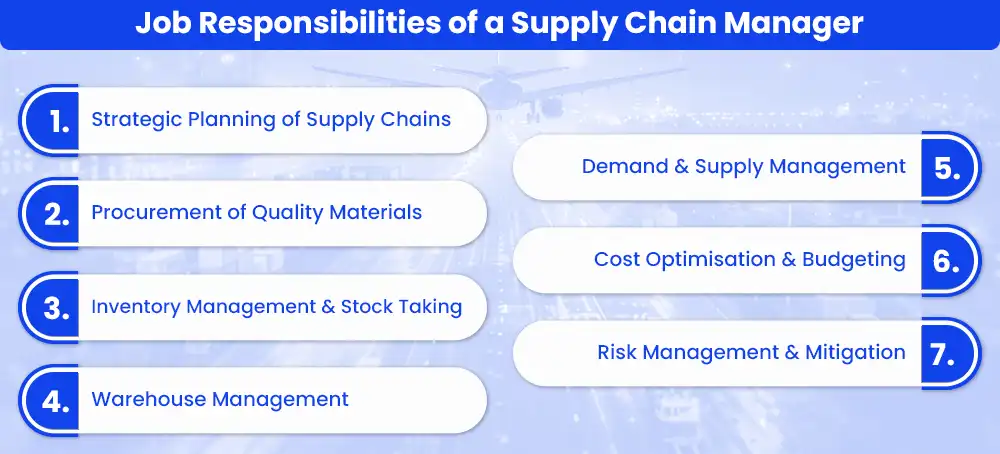
Understanding the nature of a professional role is highly important before venturing into the profession, and there are numerous domains that a supply chain manager must handle. The overall role of an SCM includes end-to-end management of delivery of products and services. The major areas of responsibilities that a supply chain manager must take care of include those represented below.
Key Skills Needed for Supply Chain Management
As a career field, SCM tests a professional’s competence in both technical (or “hard”) domains as well as soft and interpersonal domains. A repertoire of soft and hard skills makes up the desirable profile for an SCM professional. Further details about these skills are highlighted below.
1. Technical Skills & Knowledge to Succeed as a Supply Chain Manager
The technical skills and knowledge domains that are desirable for success as a supply chain manager include proficiency with ERP systems, TMS, proficiency in inventory management, budgeting, data analysis, and so on. Further details related to the same are provided below.
|
Key Skills |
Specifications |
|
Supply Chain Softwares |
Proficiency in using SCM-related software such as enterprise resource planning (ERP) systems along with warehouse management systems (WMS) and transportation management systems (TMS). |
|
Inventory & Warehouse Management |
Knowledge and skills for overseeing stock levels in the organization, managing them effectively, ensuring proper storage and monitoring warehouse operations. |
|
Procurement & Sourcing |
Taking due care of overseeing and managing various aspects of resource procurement including selection of vendors and suppliers, price negotiations, budgeting, formulation of contracts etc. |
|
Cost Analysis & Budgeting |
Having the costing of various products and services on one's fingertips and effectively managing the overall budgeting and resource allocation for various services and logistics in the company. |
|
Data Analysis & Forecasting |
Ability to handle and analyze large datasets about products, stock levels, resources and logistics and accordingly forecasting demands and optimize supply chain processes. |
|
Logistics & Transportation |
Ability to manage freight operations, and take care of route optimisation and last-mile deliveries. |
2. Soft Skills to Succeed as a Supply Chain Manager
Soft skills and interpersonal competencies required in SCM revolve around the need for being flexible in the role, managing unforeseen challenges adeptly, interacting regularly with various stakeholders, and ensuring seamless delivery irrespective of disruptions. The further details of how these pan out in the role of a supply chain manager are elaborated below.
|
Key Skills |
Specifications |
|
Adaptability & Flexibility |
The ability to quickly assess and manage changes in demands, available stocks as well as logistics to ensure effective functioning and seamless organizational functioning. |
|
Time Management |
Ability to handle multiple priorities adeptly whilst maintaining high standards of delivery and seamless process optimization |
|
Attention to Detail |
Being able to minutely examine stocks, plan orders and supplies deliveries, and track inventories and databases. |
|
Stakeholder Management |
The ability to proficiently manage conversations and communicate during deals, contracts, and requirements with stakeholders like managers, vendors and suppliers, office operational staff, etc. |
|
Problem-Solving Skills |
The ability to manage and quickly mitigate unforeseen problems, devise solutions, and ensure seamless deliveries and supply chain management without disruptions |
|
Leadership & Team Management |
Being able to motivate and manage team members and subordinates towards the achievement of aligned and shared goals of effective performance. |
What are the Career Opportunities for Supply Chain Management (Types of Options available in Supply Chain Management)
The field of supply chain management is closely tied to those coordination, supply chain analysis, inventory management, operations management, logistics, warehouse management, etc. As a career field, all of these domains are well-compensated and offer potential for dynamic exposure. This reflects that an aspirant of SCM can also explore professional opportunities in related career domains and identify the option that resonates the most with their career aspirations.
Mentioned below are a few of the top career options and roles that a supply chain manager can also consider exploring, along with lthe atest statistics about the compensation offered for the roles.
|
Career Option |
Average Salary (Per Annum) |
|
Supply Chain Manager |
INR 16.5 LPA |
|
Supply Chain Analyst |
INR 6.5 LPA |
|
Logistics Manager |
INR 8 LPA |
|
Procurement Manager |
INR 12 LPA |
|
Operations Manager |
INR 10 LPA |
|
Inventory Management |
INR 7.2 LPA |
|
Warehouse Manager |
INR 7.3 LPA |
|
Supply Chain Consultant |
INR 11 LPA |
|
Transportation Coordinator |
INR 3 LPA |
Career Analysis: Scope of Supply Chain Management
Further, we shall dive deep into analyzing the nature of the career of supply chain management with respect to the current trends of the field, the financial and other investments required to become a supply chain manager as well as the growth trajectory in the field.
1. Demand for Supply Chain Managers: Industry Trends
There are certain key trends and developments that are shaping the field of supply chain management due to various forces like advanced technologies and shifting demands across industries. Some of the pertinent trends and facts that reflect the domain trends in supply chain management have been provided below.
- Automation has become centric in the best practices of supply chain management, as the integration of artificial intelligence and automation has helped enhance the efficiency and optimization of processes in the field.
- The latest reports and analytical figures indicate that India is emerging as a giant in the field of SCM with an expected CAGR of about 11%, estimated to touch $6433.24 million by the year 2030.
- The top industries with high demands for supply chain managers include pharmaceuticals, e-commerce, textiles, automotive, IT, etc.
- At a global level, it is observed that organizations are facing challenges in risk mitigation, calling for more resilient supply chains, making supply chain resilience and sustainability a major area to look into.
- Data analytics and forecasting are becoming central to supply chain management as they allow professionals to enhance forecasting, inventory management, and operational efficiency.
2. Fees & Costs Involved in Becoming a Supply Chain Manager
There are a diverse number of options available in terms of the courses and their modes that a student or aspirant of SCM can consider taking up. At the undergraduate level, a BBA in the specialization of SCM or a related domain is the relevant option to consider. At the postgraduate level, a student can consider venturing into an MBA degree with SCM or a relevant specialization, take up a professional certification in SCM or conversely pursue a PG diploma in SCM. These courses are available to pursue in the fully offline or regular mode, the fully online (OL) or open-distance (ODL) modes. Courses in the regular mode are in a slightly higher fee bracket in comparison to the online courses in SCM.
Mentioned below are the average full course fees of a few of the commonly pursued courses in the domain of supply chain management.
|
Supply Chain Management Courses |
Approximate Course Fees |
|
BBA in Supply Chain Management |
INR 4,50,000 |
|
BBA in Logistics Management |
INR 2,50,000 |
|
BBA in Logistics & Supply Chian Management |
INR 6,50,000 |
|
INR 2,50,000 | |
|
MBA in Supply Chain Management |
INR 5,00,000 |
|
MBA in Logistics Management |
INR 3,00,000 |
|
Online Executive MBA in Global Logistics & Supply Chain Management |
INR 2,00,000 |
|
INR 3,00,000 | |
|
INR 85,000 | |
|
Professional Certification in Logistics & Supply Chain Management |
INR 1,50,000 |
Career Growth Trajectory of Supply Chain Management
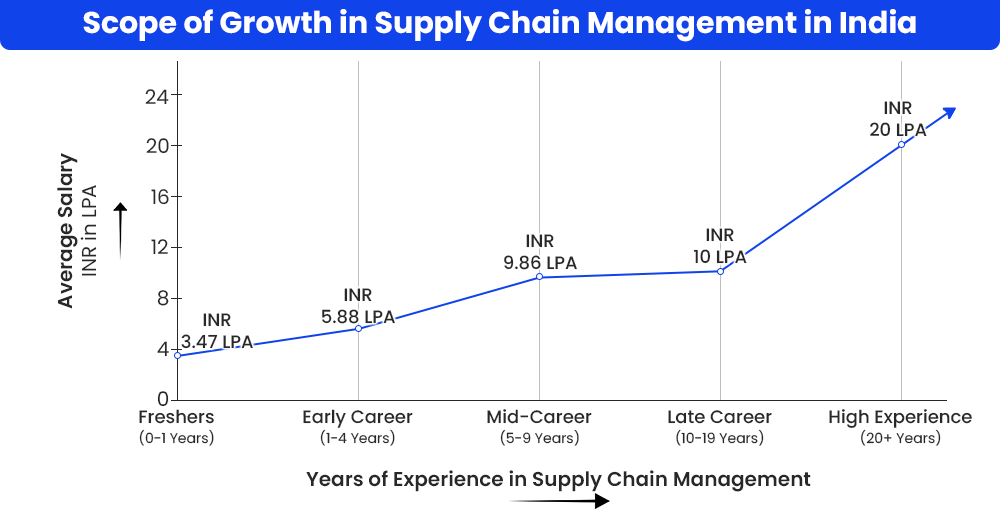
A person in India starting off their career in SCM can earn anywhere between INR 3 LPA to INR 4 LPA varying as per organisation and role. However, the growth potential in a financial capacity for the role is appealing as a professional can expect up to 6x growth over the span of their career on average. Furthermore, with due upskilling and professional experience, the scope for bagging lucrative packages in supply chain management expands. As a career domain, it is one of the relatively highly compensated fields of management right from the initial stages of a person’s career.
The average growth trajectory that one can expect as a supply chain manager in India has been represented below. Please note, that the figures presented here reflect average statistics of India and are liable to variation over time, location, and organization.
Career Navigator: What Course to Pursue for a Career in Supply Chain Management?
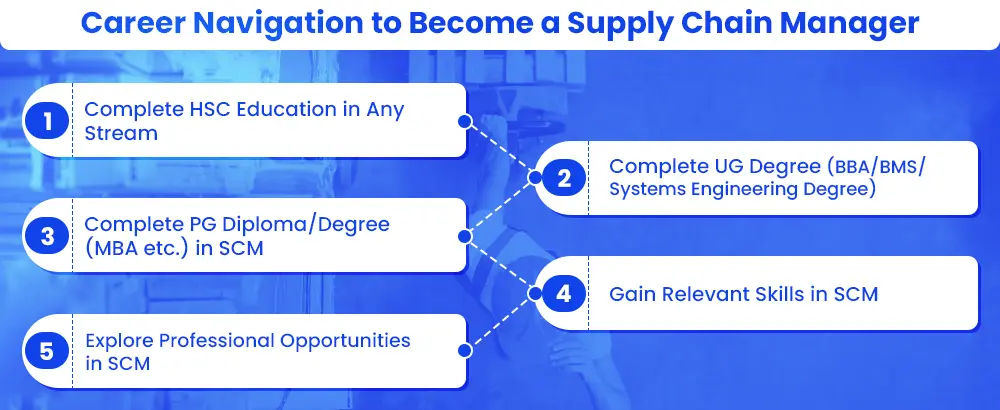
To kickstart one’s career as a supply chain manager or supply chain analyst (in initial years), one must have acquired a minimum undergraduate education in supply chain management, which includes a degree such as a BBA or a BMS with relevant specialization (SCM, logistics, etc.). Furthermore, a number of organizations require the professional to be formally trained in SCM such as through an MBA, an executive MBA or a professional diploma/certification.
The overall navigation path to practice professionally as a supply chain manager has been outlined below for reference.
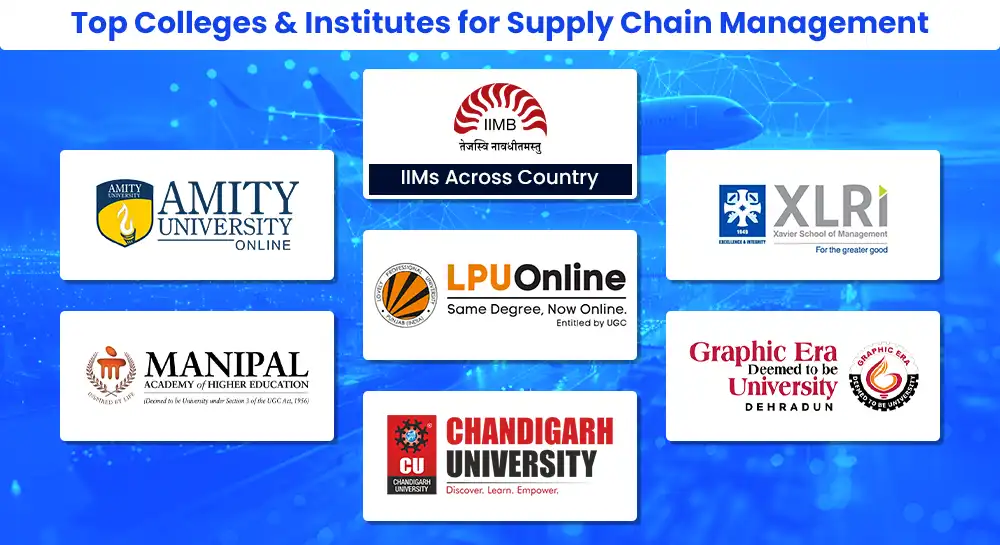
There are a number of top institutions, colleges, and universities in India, both in the private higher educational sector and the public one, which are offering UG and PG education in supply chain management in India. These include eminent institutions such as the IIMs as well as a number of private universities, as represented below.
Conclusion
Thus, it can be seen that supply chain management is not only a lucrative career domain in India, it is also a career that is expected to boom in India by 2030. Being a hub of supply chain managers, Indian SCMs have a scope of exploring options in this domain across the globe, making up for an appealing scope for growth through one’s career.