

Whenever a business or a firm decides to come forward in the market with a line of products to maximise business, a myriad of steps and procedures go into the backend procedures before the final product is ready for a launch. The career domain of product management centres around these phases of product development and their effective completion to come up with a robust and market-ready product.
Product managers, also referred to as PMs in many cases, are essentially professionals who plan, oversee and manage the entire process of developing a new product, coordinating with multiple teams and stakeholders as well as ensuring the technical integrity of the product.
In recent times, product management has come up as a major and lucrative career path in various industries of production as more and more businesses are realising the need for well-trained professionals to oversee and manage the otherwise cumbersome process of product development. So if you are someone who wishes to put your technical knowledge and strategic skills to best use, then product management is just the field for you!

Why Choose a Career in Product Management?
If one were to look at the latest statistical figures, which reflect the growing requirement for trained PMs, it would show that over 43.3% of companies believe that PMs play an active role in boosting the annual growth rates of companies. As one might guess, product management is accordingly coming up as a lucrative field with humongous scope of growth for those looking to venture into products and SaaS domains.
Here are some of the key reasons to look at if one is considering a career as a product manager.
- Potential for Career Growth: The career path of product management allows for significant growth and career escalation with years of experience. With due upskilling and job switches, a product manager can navigate their way to the corporate ladder starting from associate or junior PMs to PM to senior PM and so on.
- Opportunity for Cross-Functional Collaboration: If you desire to work in cross-functional teams allowing for collaboration and managerial exposure to diverse segments of an organization, product management is just the right career for you–it provides the opportunity to interact with multiple teams including the development teams, marketing teams, customer relations and so on.
- Ability to Make High-Impact Contributions: The role of a product manager is undoubtedly a high-stakes role for any company as it involves the end-to-end overseeing of the development of a product and its due success. As a result, if you are a professional desiring to contribute meaningfully and create an impact to your organisation through your work, product management provides the apt outlet to you for it!
- Outlet for Creativity & Innovation: If you are beaming with creativity and innovation and wish to contribute in the development of a unique and useful product/service, product management as a career option provides you the chance to do the same. Creativity and innovation being core desirable competencies in the field, it is a thriving ground for those wishing to transform their their creativity into commercially successful products.
- Lucrative Compensation: The compensation available in this field is quite lucrative and offers sufficient scope for hikes with growing expertise and experience. As a result, if you are someone seeking an appealing package alongside making best use of your diverse skillset, then the role of a product manager will help you strike a balance between the two.
- Ability to Utilise Diverse Skillset: The desirable skillset and competencies required for a product manager are quite diverse, including an amalgamation of technical expertise and soft skills. So, if you are a professional looking to put your diverse skillset, including a strong technical suit alongside strategic and soft skills to effective use, product management is an appropriate career to venture into.
Roles & Responsibilities of a Product Manager
It is important to understand the nature of the job role of a product manager, since it presents a vast myriad of task domains to take care of from a managerial perspective. Given below is a brief of the major tasks that a PM might be entrusted with in their job role:
- Conducting initial market analysis to gain insights about market trends, industry practices, target audiences, competing businesses, etc.
- Formulate a vision and strong rationale for the product in alignment with the market analysis.
- Create a roadmap for the development of the actual product, including detailing the use cases of the product, a minimum viable product (MVP) version, and prioritizing product requirements.
- Developing plans of action for effective execution of the product development lifecycle, starting with identification of key stakeholders, working and coordinating with them through cross-functional collaboration.
- Monitoring the real-time progress on deliverables and product development, alongside facilitating changes and operations, accordingly adapting strategies based on faced challenges.
- Initiate product testing and oversee functions like user testing and feedback collection.
- Collect user feedback and coordinate with quality assurance (QA) professionals to ensure product quality and user expectations are met before the final launch of the product.
- Conduct product demonstrations to key stakeholders and prepare supporting materials for the product including user guides, use cases manuals and so on.
- Coordinate with cross-functional teams like sales and marketing departments to prepare a detailed marketing plan and product launch plan.
- Manage and supervise the product launch to understand audience perception and reception of the product.
- Regularly monitor the product’s performance in the market and with users, keeping track of feedback and working for continuous improvement.
- Work on the end-to-end vision for the product, including the development of further advanced versions, changes or product retirement depending on the success and requirement of the products.
As can be observed, the overall responsibilities of a product manager are quite vast and entail a series of end-to-end activities related to the specific product. Thus, the role in itself ensures a wide exposure to all types of tasks associated with the development of a product, starting right off from the envisioning of the product to the development of futuristic versions of the same after it has been launched and created an impact on the market.
Key Skills Needed for Product Management
Both technical competence in certain key software, best practices, and design as well as soft skills are important to thrive in the SaaS field as a PM, and a detailed overview of the same has been presented below.
1. Technical Skills & Knowledge to Succeed as a Product Manager
Considering that product managers are required to oversee and manage the product development lifecycle on an end-to-end basis, they need to have thorough knowledge and grasp over the stages and steps involved in the cycle, the required softwares needed to expedite these processes as well as some methodologies such as Agile and Scrum which can help ensure adherence to best practices during the product lifecycle.
Details about some key technical skills areas desirable for the role of a product manager have been described below.
|
Key Skills |
Specifications |
|
Product Lifecycle Knowledge |
Knowledge about the entire product lifecycle, crucial phases involved, tasks involved in each of the phases, etc., facilitates a smoother navigation of the entire cycle and coordination with key stakeholders. |
|
Writing Technical Specs |
A thorough knowledge and grasp of the technical stack of a product, its user impacts, use cases, etc., helps in having a solid understanding of the product’s nature and accordingly planning its development. |
|
Market Research |
Regularly assessing the market to identify changing industry trends, tapping on user impact created by the own product as well as checking for changing market requirements are needed to develop a product and adapt it with time. |
|
UX/UI Design |
Knowledge of user experience and user interface and related technicalities is necessary for creating a robust, useful, and engaging product. |
|
Performance Metrics Analysis |
Knowing how to operate various software and platforms to generate and analyze the findings of the performance of a product is needed for continuous improvement. |
|
Agile & Scrum |
Knowledge of agile and scrum principles is important to seek continuous user feedback and implementing manageable product changes each step of the way, instead of developing the complete product before the release. |
2. Soft Skills to Succeed as a Product Manager
In addition to technical competence, having soft skills, including the likes of strategizing skills, analytical aptitude, problem solving, and effective decision making, etc., are aspects which are fruitful for the smoother operation of a product lifecycle. Hence, understandably, these skill areas are important to possess if one is to succeed as a product manager. The details of the same have been outlined below.
|
Key Skills |
Specifications |
|
Analytical & Critical Aptitude |
The ability to approach and analyse situations and user problems from a critical and analytical lens is crucial for the continuous improvement of the product. |
|
Creative Problem-Solving |
The ability to find unique and useful solutions to the various unforeseen changes and problems that can arise in the product lifecycle contributes to the robustness of the final product. |
|
Decision-Making Ability |
During the phases of product development, a product manager is faced with multiple instances requiring quick and effective decision-making, making it a crucial skill needed to thrive in this career. |
|
Communication Skills |
Effective communication, whether between or across teams, with stakeholders, external vendors, and so on, requires the PM to have a grasp over their communication and interpersonal skills. |
|
Strategic Skills |
Strategic skills are crucial in product management for the holistic planning, envisioning, development and adaptation of the product systematically and continuously. |
|
Agility & Adaptability |
The need to move with speed and effectiveness to make quick and useful decisions, and ensure the smooth operation of the product development procedure calls for agility and adaptability |
What are the Career Opportunities for Product Management (Types of Options available in Product Management)
Conventionally, the role of a product manager entails the handling of the entire product lifecycle on an end-to-end basis, i.e. from the stage of envisioning the product to that of working on its further versions and updates with time.
However, in many companies and firms, the need for further specialisation in certain stages of product management has opened up additional career opportunities for interested candidates to explore. For instance, one can practise as a product owner, a product operations manager, a product launch manager, a product marketing manager or even a product strategic manager. These fields are growing in scope as companies are offering lucrative compensation to professionals with due qualifications and training to take these roles up.
Details about a few of the up and coming specialisations in product management along with the approximate compensation offered in India to such professionals have been provided herein.
|
Job Role in Product Management |
Average Salary in India (Per Annum) |
|
Associate/Junior Product Manager |
INR 15 LPA |
|
Product Manager |
INR 20 LPA |
|
Chief Product Officer/VP Of Product |
INR 40 LPA |
|
Technical Product Manager |
INR 25 LPA |
|
Product Owner |
INR 22 LPA |
|
Platform Product Manager |
INR 18 LPA |
|
Product Launch Manager |
INR 16.8 LPA |
|
Data Product Manager |
INR 27 LPA |
|
Strategic Product Manager |
INR 22 LPA |
|
Product Operations Manager |
INR 15 LPA |
|
Product Marketing Manager |
INR 16.5 LPA |
Career Analysis: What is the Salary & Demand for Product Management?
Having looked at the number of options available to explore as a product manager, let’s now take a deep dive into this career and its demand in the market.
1. Demand for Product Managers: Industry Trends
Certain key industry trends and relevant statistics that speak of the career scope of product management have been provided below.
- The industry rates of compensation for a PM can jump approximately by nearly 50% within 5 to 20 years of professional experience (source: Payscale).
- The growing hubs of startup ecosystems such as Bengaluru and Hyderabad are currently also the locations offering the most lucrative job opportunities to PMs in India.
- The field of product management is getting increasingly integrated with data analytics, user experience, artificial intelligence, and the internet of things (or IoT), making expertise in these areas more pertinent for career success.
- Some of the prominent industries where the demand for product managers is growing include fintech, healthcare, and e-commerce.
2. Fees & Cost Involved in Becoming a Product Manager
Becoming a product manager requires a good grasp of the desirable skill areas, updated knowledge about the best industry practices, as well as a formal qualification with a technology background and product management credential.
While there are a myriad of options available in the educational market for taking up courses in product management, the most well-regarded and accredited ones include short-term certificates, diplomas and degrees at the postgraduate level. The fee range for these courses can vary anywhere between INR 30,000 and up to a few lakhs. Enlisted below are the fees involved in pursuing accredited and recognised online courses in the domain of product management.
|
Product Management Courses |
Approximate Course Fees |
|
Post Graduate Program in Product Management |
INR 3,20,000 |
|
Chief Product Officer (CPO) Programme |
INR 6,00,000 |
|
Executive Development Programme in Advanced Product Management |
INR 1,63,000 |
|
Executive Program in Product Management |
INR 15,000 |
|
Professional Certification in Product Management |
INR 2,00,000 |
|
PG Program in Business Analysis and Product Management |
INR 75,000 |
|
Executive Certification in Product & Brand Management |
INR 1,50,000 |
|
Post Graduate Program in Product Management & Analytics |
INR 1,35,000 |
Career Growth Trajectory of a Product Manager
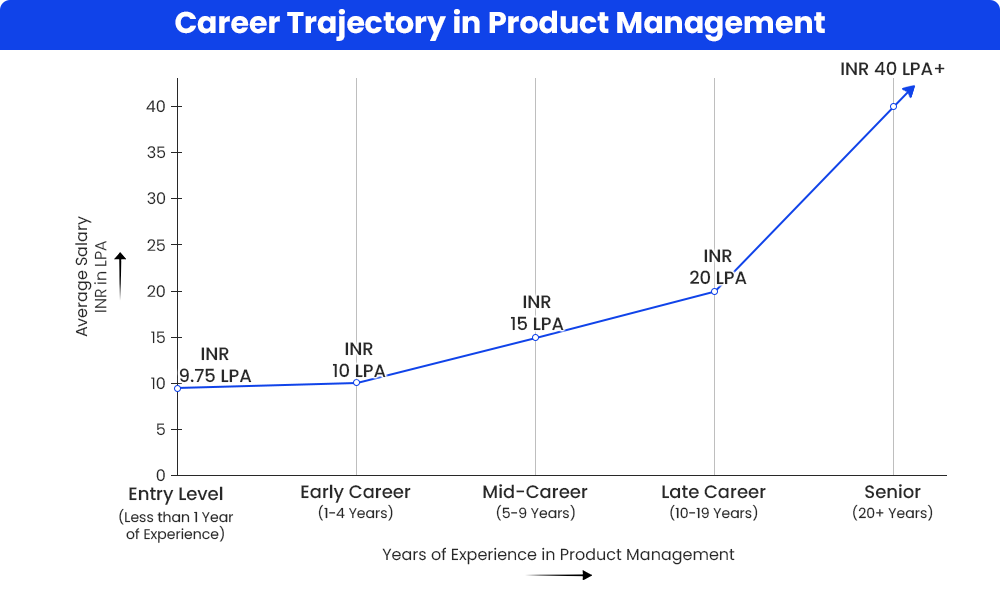
Product management has emerged as one of the most lucrative roles in the product and service industry in the recent decades. Owing to the high-stakes work and tasks involved in the role, PMs are paid lucratively. Starting off from associate PM and similar roles, one can work their way through the corporate growth ladder and work in pivotal roles such as product owner and so on. Furthermore, a fair leap of compensation accompanies the promotion through various levels of the role.
A trajectory of escalation and growth potential as a product manager is represented below based on the latest industry statistics.
Career Navigator: What Course to Pursue for a Career in Product Management?
While pursuing undergraduate education in technical fields such as engineering and in management studies isn’t mandatory, they offer a significant career advantage to students and professionals to have a sound technical knowledge for understanding the backend development of products and services. However, students from any background can aim to develop their career as a PM. The traditional career trajectory to become a product manager in India is outlined below.
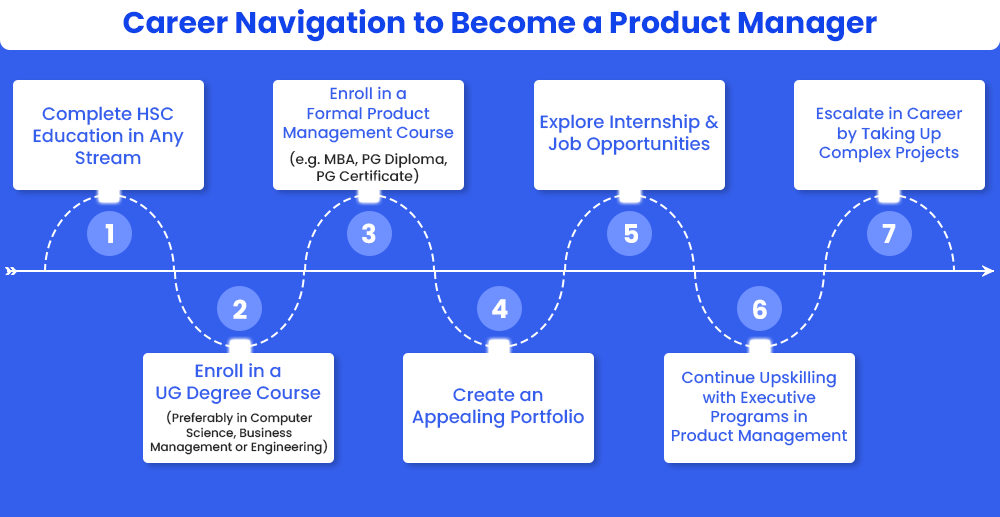
Individuals interested in venturing into this field should preferably venture into a technical field such as engineering at the undergraduate level, as it opens up opportunities for them as product managers in the technical service industry. Furthermore, an aspiring PM can take up a formal educational course in product management and/or development at the postgraduate level in the form of a degree, diploma or PG certificate.
Additionally, with online education making strides in India, there are numerous options available to pursue formal education and training in product management from the convenience of one’s home. Online PG diplomas, certifications, and degrees like an MBA with the specialisation in product management are appealing options to consider. When going for an online course in product management, one must remember to check for the necessary accreditations of the course, including the approvals from bodies such as UGC-DEB.
Top Colleges & Institutes for Product Management
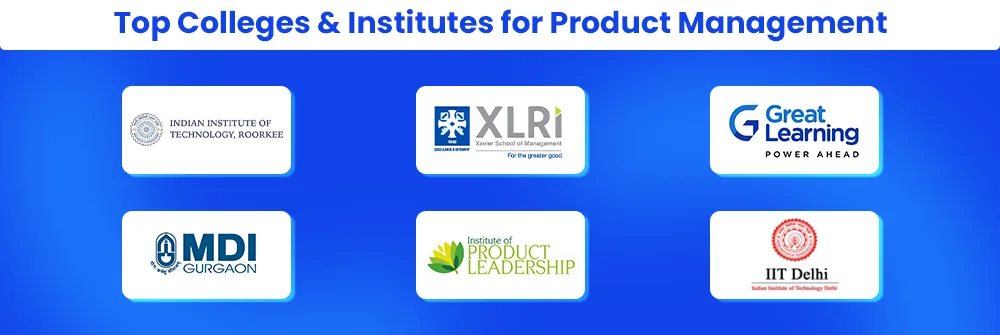
Mentioned below are some of India’s top colleges and management institutions offering courses in product management, including private and public institutes and universities.
Conclusion
The career of a product manager is a vast and dynamic one wherein they get to manage the end-to-end cycle of coming up with a new product. With growing prospects and increasing recognition of the role they play in seamless product delivery, the job scope of this field is growing, making it suitable for technical and non-technical professionals to consider as a lucrative option.