


Is getting a Master of Business Administration degree on your mind lately? It is one of those courses that have been opted for by a lot of individuals of late. But another question has been a common one, which is whether to take a traditional MBA program or an online one. Many individuals pursue an MBA degree thinking of improving their career prospects, salaries, or to gain the latest business knowledge. And for that, an online MBA course becomes much more accessible than a traditional MBA degree, which comes with a lot of investments and commitments. In this blog, you will be going through a lot of factors to understand which is the better choice for you, an online MBA or a traditional MBA degree. We will also unravel which course has a better return on investment in India.
Online MBA and Regular MBA: Which is Better?
Selecting between an online or traditional MBA in India is a choice that may alter your career path considerably. The two alternatives offer their respective benefits and drawbacks, thus it is essential to consider them thoroughly. Which is better among the two also depends on the priorities that students have. Let’s look at how both programs are and what learners can get out of it.
What is a Traditional MBA?
Regular mode Master of Business Administration programs are ideal for students and working professionals at the start of their careers who are looking for growth prospects with this degree. An offline MBA is a two-year program that involves regular classes, which are important for the student to attend. It also involves face-to-face interaction with the faculty and peers. Hence, students residing at a considerable distance from the university campus are required to relocate in order to attend classes regularly. These courses comprise four semesters and often require an internship as part of the course.
What is an Online MBA?
An online MBA is a program that runs flexibly and is conducted through online classes. So, learners can choose any place and time to study. The online program is perfect for people who are employed or for students who are busy and have work or other obligations performing alongside their studies. The UGC approved online courses are considered equivalent to regular MBA courses. It can be taken at the student's own pace, and there is no need to take a break from the job, which is the best part of an online program.
|
Online MBA vs Traditional MBA: Core Differences |
||
|
Parameters |
Online MBA |
Traditional MBA |
|
Ideal for |
Freshers and Working Professionals |
Students, Non-Working Individuals (as there are strict class timings) |
|
Duration |
1 to 2 years (flexible pace) Duration may depend on the program you choose. |
1 to 2 years of full-time regular classes. |
|
Eligibility |
Bachelor’s degree with 45-50% score |
Bachelor’s degree with 45-50% score |
|
Work Experience |
May or may not be required, depends on the institution |
Some colleges may ask for it |
|
Entrance Exams |
Rarely, some institutions may require it |
CAT, XAT, GMAT, etc are crucial |
|
Flexibility |
High |
Low |
|
Mode of Learning |
Online |
Offline/ On Campus |
|
Curriculum |
Industry Focused Curriculum and practical application |
Curriculum with direct industry exposure |
|
Cost |
Usually lower, as it involves no relocation or living costs, only course fees. |
Varies depending on the program and the institution you apply to. Usually higher as it includes tuition fee, relocation, living expenses, etc. |
Online MBA vs Traditional MBA: Salary & Placements
Placements and salaries are important factors that students seek out when thinking of an online MBA or a regular one. Traditional MBA courses from top and reputed universities yield structured placements and even fairly good starting salary packages. In contrast, the case with online mode degree is that it provides strong long-term salary growth, which serves working professionals' flexibility to study along with work, and not having to take a career break.
Fees Comparison
The total online MBA fees come within the 1 to 14 lakhs range, thus the course stays accessible to a broad group of learners. The cost of an online learner stays limited to the program fee and does not include travel, hostel or relocation expenses. But with traditional MBA courses, all costs are included along with fees, which range from INR 3 lakh to more than 25 lakhs.
Salary Ranges
Online Master of Business Administration graduates earn ₹4.8 LPA as freshers, rising to ₹10.15 LPA for mid-level and ₹18.30+ LPA for seniors, with good hikes post-degree. However, regular MBA students earn in the range from INR 6 lakhs to more than 25 lakhs. The higher end being the salaries of those from top B schools in India. Further, this gap is narrowed over time as experience grows.
Placement Differences
Traditional MBA programs, depending on the institutions, provide structured campus placements with top companies, face-to-face interaction, internships, etc. However, the placement chances in online MBA courses are also quite similar as they also provide alumni networks, skills enhancement, flexible placement support, as well as better ROI for working professionals, and rising recruiter acceptance.
ROI Comparison: Online MBA vs Traditional MBA in India
When thinking about the return on investment between online MBA and traditional MBA courses. There is a University ROI that helps students to take the right program from the right college. Also, the Online MBAs bring better ROI for students, the reasons are cited below,
- The fees for online MBA degrees are reasonable and more affordable than those for regular courses.
- Further, regular courses include multiple costs from relocation, hostel fees, travelling costs, along with the course fees, which together incurs higher cost.
- But with a virtual mode MBA course, you don’t have any of those expenses, just the course-related fees and chance to work alongside.
|
Key Aspects |
Online MBA |
Traditional MBA |
|
Course Fees |
Affordable |
Expensive |
|
Other Expenses (travel/relocation/hostel) |
Does not include |
Includes extra expenses |
|
Salary and Placement |
Good salary packages and placements similar to an offline MBA |
Placement chances are high, and good salary potential |
So, online MBA courses have better ROI compared to a regular MBA course.
Online MBA vs Traditional MBA: Which one to Choose?
Let’s discuss when to choose online vs regular degree and who is suited for each type of degree. For instance, working professionals and career switchers can benefit from online MBA more due to its flexibility. Moreover, fresh graduates and those who can afford to spend on Top universities can opt for a regular program.
So, an online MBA is a great choice for budget-conscious learners who still want the benefit of networking connections and practical exposure, etc.
|
Online MBA vs. Traditional MBA |
||
|
Learner Profile |
Best Fit: Online MBA |
Best Fit: Traditional MBA |
|
Working professionals |
Yes. Flexible schedule, opportunity to earn, real-time skill application |
No. Requires full-time commitment, have to career break |
|
Career switchers |
Yes. Builds skills leveraging experience for mid-level transitions |
Possible. Structured path but less flexibility |
|
Budget-conscious learners |
Yes. INR 1-14 lakhs fees, faster ROI |
No. INR 3-27 lakhs includes living costs, comparatively lesser ROI. |
|
Fresh graduates |
More ideal for working professionals, placements mostly similar to regular setup |
Yes ideal for freshers, structured campus recruitment. |
|
Campus networking seekers |
Networking with mostly virtual interactions, some in-person sessions in some cases. Diverse alumni ties. |
Yes. In-person events, lifelong alumni ties |
Which Universities are Best for Online MBA?
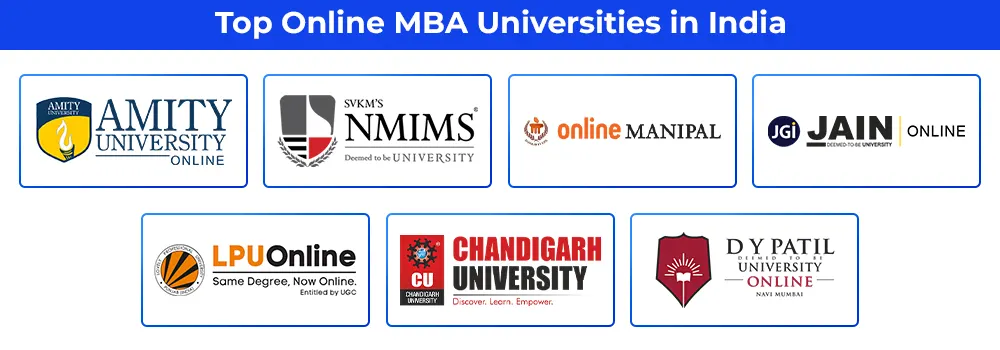
Online MBA programs in India have surged in popularity by 2026, offering UGC-equivalent degrees with flexibility for those working and freshers alike, strong ROI through low fees and placements, and curricula aligned to trends like AI and digital leadership. The fee package of an online program at UGC-approved universities is quite low in comparison to the traditional programs. However, there is a wide variation in the fee range of UGC-approved online MBA colleges. To help you choose an affordable UGC-approved online college with low fees, a list of fee structures and placement support is provided for the top 10 universities.
|
Top Online MBA Colleges in India and Course Fees |
||
|
List of Universities |
Course Fees |
Accreditations |
|
INR 1.99 lakhs |
UGC-DEB | AICTE | AIU | NIRF | WES | QS World University |
|
|
INR 2.20 lakh |
UGC-DEB NIRF | NAAC A++ |
|
|
INR 2.80 lakhs |
UGC | NIRF | NAAC A++ | QS World University |
|
|
INR 1.96 lakhs |
UGC | AICTE AIU | NIRF | WES | NAAC A++ | |
|
|
INR 1.31 Lakhs |
UGC-DEB | AICTE | AIU | NIRF | WES | NAAC A++ |
|
|
INR 1.58 Lakhs |
UGC-DEB | AICTE | NIRF | WES | NAAC A+ and more |
|
|
INR 1.89 lakhs |
UGC-DEB | AICTE | AIU | NIRF | NAAC A+ |
|
Is Online MBA Worth It in India in 2026?
Online MBA programs have increased in popularity, but the question still remains. Are they a worthwhile investment in 2026? The answer is yes, these courses are made for the future and provide a strong return on investment. Learners of online MBA can update their theory and practical skills in emerging technologies like VR and AI, and an emphasis on future-oriented business skills, sustainability, data analytics, and ethical leadership.
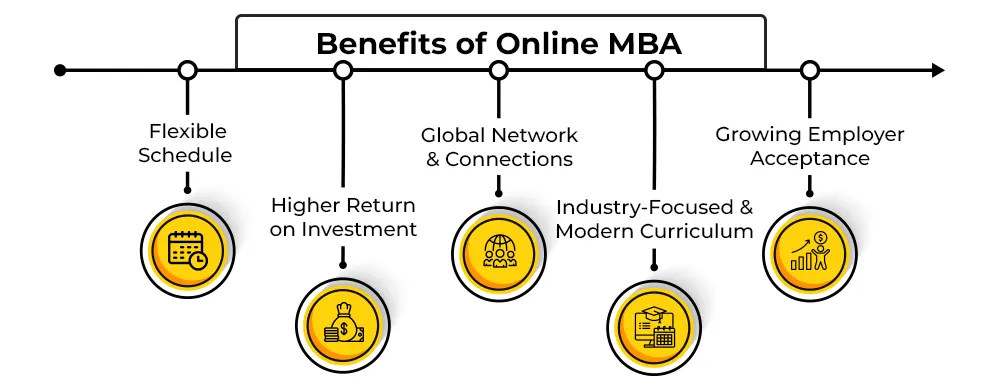
Online MBA degrees have other benefits too, from providing a chance to build meaningful professional connections and partnerships with top companies. UGC approved courses even get employer acceptance and validity equivalent to that of regular programs. And with more upskilling happening in the job market, these affordable and flexible format courses are poised to gain even greater popularity.
Conclusion
For a person considering doing a Master of Business degree, the question of whether to do it an online MBA or a traditional is a crucial one. Online mode stands out as it caters to a wider student audience, offering massive benefits of saving time and money without taking a career break. Also, the online MBA has a greater ROI compared to a traditional degree, which makes the online format a better alternative. However, this choice hinges on your career stage, budget, and goals. For instance, a Master of Business Administration in online mode works best for working professionals and many freshers prefer regular mode. So, pick that MBA path that aligns with where you stand today and accelerates where you're headed tomorrow.