


MS stands for Master of Science, It usually provides a postgraduate degree in a varied range of subjects. The program usually takes around 2 years to complete which consists of 4 semesters, 2 semesters yearly. MS degree typically includes writing the thesis, research, analysis, and non-thesis programs.

The master of science mainly includes subjects related to science and mathematics. The Master of Science degree was first introduced in 1858 at the University of Michigan.
What is the Master of Science [MS]?
In India, master of science degrees are mainly available in science disciplines and considered as a post-graduate degree. It's less common than the MSc and is generally associated with professional coursework.Pursuing a master's degree in a specific subject can be a great choice for a better opportunity as the program typically rewards the students with professional subjects like technology, mathematics, medicine, and some other subjects related to social science. The degree usually prepares students to have a remarkable career in research, analysis, PhD programs, etc.
Modes of Pursuing the Master of Science Degree
Many specializations in a Master of Science [MS] are available in different modes, one can pursue the program in three different ways which are recognized globally and accredited by the top bodies. The modes of pursuing a master's degree are as follows;
1) Regular Mode
Pursuing a master of science (MS) in regular mode is a traditional way of learning where students actually attend classes in person at the university. This traditional way of learning allows students to have structured learning and real-time interactive sessions with faculty and peers. A regular master of science includes a series of modules and, independent dissertation projects. Semesters usually focus on study, learning, and class tests.
- Eligibility
To be eligible for a regular master of science (MS degree), candidates must have completed a Bachelor of Science (BSc) degree or equivalent from a recognized university. Pursuing an MS degree also means having a master's degree in subjects like biology, chemistry, physics, and mathematics. Some other requirements include;
- Earned number of credits
- Candidates have successfully passed the examination conducted by a board or university at the Plus Two level.
|
Working Professionals Also Looking for | |
Types of Entrance Exams for Master of Science
There are some programs that require to be cracked by the candidates, Master of Science is one of them. Universities need to make sure that students wishing to pursue the program are eligible in every aspect as pursuing a master's degree could not be easier for many of them.
An entrance exam could be a great way to know if the program is for you and gives you the chance to find out where you stand academically. This may save so much time for a candidate, sometimes maybe a year or so. One can aim for any specific specialization in MS as the available programs vary widely depending on the department and the program. Let's explore a few crucial entrance exams in order to pursue any master's degree.
1) GMAT
GMAT stands for Graduate Management Admission Test. It is a standardized exam designed in a way that evaluates analytical, verbal, and reading skills, writing, and quantitative abilities. The exam consists of four main sections that include;
- Analytical Writing Assessment
- Integrated Reasoning
- Quantitative Reasoning
- Verbal Reasoning
GMAT is a computer-adaptive test (CAT), that indicates the candidate's performance adjusts the difficult level of questions. Graduate Management Admission Council (GMAC) is the administrative body of GMAT. Candidates can take the exam 5 times a year.
2) MCAT
MCAT stands for Medical College Admission Test (MCAT), which consists of four sections. This test is for admission at medical schools in Canada, the USA, and many more. MCAT usually evaluates the various skills and knowledge which include;
- Critical Analysis and Reasoning Skills
- Psychological, Social, and Biological Foundations of Behavior
- Biological and Biochemical Foundations of Living Systems
- Chemical and Physical Foundations of Biological Systems
The administrative body of MCAT is the Association of American Medical Colleges (AAMC). One can opt for the test three times a year.
3) LSAT
LSAT stands for The Law School Admission Test administered by the Law School of Admission Council (LSAC). The score ranges from 120 to 180 and also includes an average score of around 150. It evaluates the skills and abilities of law students in the USA, Canada, and many more.
The LSAT usually has multiple-choice sections and writing mentioned below;
- Logical Reasoning
- Analytical Reasoning
- Reading Comprehensive
- Writing Sample
- Experimental Section
4) GRE
GRE stands for Graduate Record Examination, which usually evaluates the verbal reasoning, quantitative reasoning, and analytical writing skills of candidates. It is a computer-based test. Education Testing Services (ETS) is the administrative body of GRE.
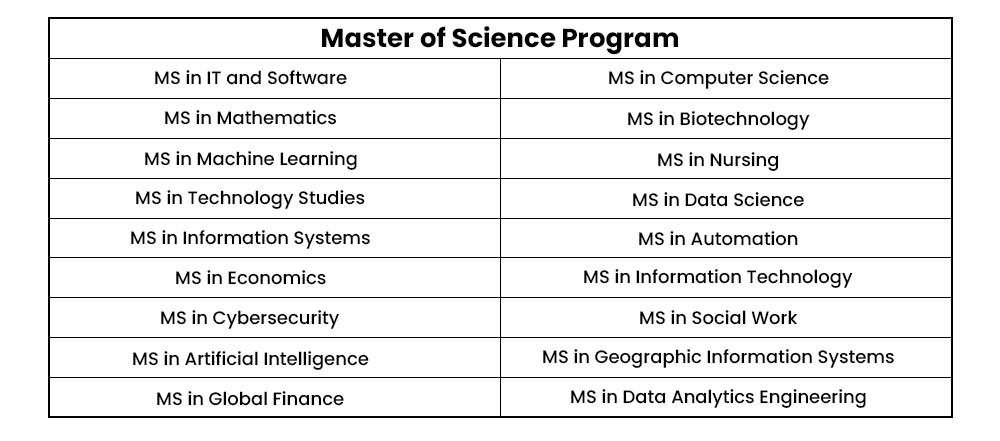
Popular countries that Offer MS degree in Regular Mode
There are many top countries that provide MS degrees with a varied range of specializations. Furthermore, we have discussed the top Countries as well as the universities with the rankings information. Below are some of the top countries that offer master of science in regular mode;
1) MS in the United States
Pursuing a master of science (MS) degree in the USA is the dream of many, Thousands of ambitious candidates around the world prepare to get into the universities situated in the USA. Most Indian Students prefer to get into the USA's colleges as a wide range of educational options are there that help students to have professional and personal growth. One can apply for a student visa at the time of the admission process. In the USA, there are 3 types of study visas; F1 Visa, J1 Visa, and M1 Visa. The cost of study in the USA ranges somewhere around $12,000 to $40,000 (INR 10 lakhs to INR 33 lakhs).
Here are some of the popular universities in the States that offer MS;
|
University’s Name |
Rankings |
California State University- Long Beach |
|
|
Harvard University |
|
|
Massachusetts Institute of Technology |
|
|
Southern Illinois University |
|
|
Stanford University |
|
2) MS in Canada
A Master of Science in Canada usually takes 1-2 years to complete. Most of the candidates nowadays started enrolling in Canadian universities for master of science because of the diversity of higher education. The country has now started known for its diversity of higher education. Universities provide the best environment for their international students. Canadian degrees and certifications are well-known all around the world for their higher educational standards. Additionally, the living costs and tuition fees are also remarkably low. The tuition fee in Canada for an MS degree may vary from university to university but the average annual fee ranges somewhere around $15,000 to $55,000 (INR 12,73,680 to INR 46,70,160)
Here are some of the popular universities in Canada that offer MS;
|
University’s Name |
Rankings |
|
University of Toronto |
|
University of Ottawa |
|
|
University of Alberta |
|
|
University of Windsor |
|
|
Western University Canada |
|
3) MS in Australia
The Master of Science in Australia is a coursework-based and research-based program. It is a designated degree by STEM that typically takes 1.5 to 2 years to complete, offering advanced knowledge and skills in science, technology, engineering, and mathematics fields, preparing graduates for high-demand careers in these industries. STEM stands for Science, Technology, Engineering, and Mathematics. There are three ways in which one can divide the degrees; Professional Development Masters, Professional Masters, and Traditional Academic Masters. The average fee for the program ranges from INR 10 lakhs to INR 17 lakhs.
Here are some of the popular universities in Australia that offer MS;
|
University’s Name |
Rankings |
|
The University of Adelaide |
|
|
Queensland University of Technology |
|
The University of Sydney |
|
|
Charles Darwin University |
|
|
University of Canberra |
|
4) MS in Germany
A master in science from Germany is known for its quality education, affordability, and placement facilities. The curriculum is designed in a way that is technically oriented and develops analytical and problem-solving skills in their students. The main criteria to follow in order to get enrolled in a Germanian university is academic excellence such as educational certificates, publications, patents, and many more. The cost of study in Germany usually ranges between INR 9-10 LPA.
Here are some of the popular universities in Australia that offer MS:
|
University’s Name |
Rankings |
University of Bayreuth |
|
Technical University of Berlin |
|
Braunschweig University of Technology |
|
Technical University of Munich |
|
|
Dresden University of Technology |
|
2) Online Mode
The online mode of pursuing a Master of Science (MS) is the most popular these days as many top universities are now providing Master's degrees in some of the legit subjects that benefit students in many ways. One can pursue the whole program in online mode without stepping out of their comfort place. universities designed their program in a way that includes most of the required subjects for better understanding. No entrance exams will be there for enrollment in the online Master of Science.
Eligibility
Eligibility for Master of Science (MS) in Online mode are as follows;
- Pursuing an online MS usually requires a graduation degree such as a BSc degree and specialization specifications. Candidates must have a minimum mark of 50% in the last qualifying exam.
|
In-Demand MS Degree Specialization | |
Master of Science Eligibility Criteria
To apply for a Master of Science (MS) degree, different universities and programs have different requirements. Generally, you need a bachelor's degree from a recognized university in a related subject. Most programs ask for a minimum score in your bachelor's degree, which is usually between 50% and 60%. Some programs may prefer students with a first-class degree or an equivalent.
You also need to have a degree in a field that is related to science, such as Physical Sciences, Chemical Sciences, or Biological Sciences. You can apply if you studied subjects like Chemistry, Physics, or Mathematics. Additionally, degrees in areas like Bachelor of Technology or Engineering are considered relevant and can help you qualify for the MSc program.
Why Study for a Master's Degree?
This is the type of question that one must ask themselves if they are planning to pursue a master's degree. The no. of opportunities these postgraduates receive is quite high. There are many benefits one can have after a master's degree, a few are as follows;
1) Higher no. of New Opportunities
A master's degree equips you with the knowledge that is required to acquire new opportunities for yourself. This boosts your career, in securing higher positions in reputed organizations with higher pay. Even if you're a working professional and want to change your field professionally for better opportunities, a master's degree will automatically equip you with that too. This gives you the opportunity for mid-career change and find yourself while exploring new things.
2) More Connections
While pursuing the degree one can build their own peer group that helps them with the studies, exploring new options, and making beneficial connections with the faculty and students. The degree allows you to meet like-minded people who match you with the same career goals or maybe a thought of developing a business after postgraduation. Having these sorts of individuals around will let you build and expand your professional connections.
3) Professional and Personal Growth
The master's degree prepares you with skills that include critical thinking, analytic abilities, time management, and presentation skills. It also changes the way an individual takes and learns things (positively). Students get to develop an analytical ability toward every opportunity or challenge while managing the timing of their busy schedules. Universities ensure that the way students get to learn from the faculty should be creative and easy to grasp and develop the curriculum accordingly.
4) Credibility
A master's degree enhances credibility in one's field, as the program majorly focuses on specific subjects for deep learning and understanding. Having enhanced knowledge at the master's level can bring up varied job opportunities because of learning about the specialized subject. Most of the jobs after the postgraduation involved senior roles in any organization.
Tuition Fees and Other Expenses
Tuition fees and other expenses of pursuing a Master of Science (MS) may vary depending upon the universities, geographical conditions, recognitions, and country. Here is the cost of an MS degree in two main countries where students pursue an MS degree.
In India, it depends on the institutions and the program. Most of the government medical colleges usually charge lower fees than the other universities. The fee typically ranges somewhere around INR 2000 to INR 50,000 each year. In private colleges, the fees and other expenses are somewhere around 5 lakhs to 15 lakhs each year. Additionally, Fees may vary as per the chosen program and the university's policies.
Furthermore, in the USA the total fee and other expenses mainly depend on the university and its location. The tuition fee usually ranges somewhere around 34,897$ (29,60,000 INR). The living cost is almost $5,172 (1,33,336 INR). Some of the top universities in the USA for master's degrees are in New York, California, and Massachusetts.
Skills Required to Pursue MS degree
If you are sure of the fact to pursue a master of science, there are some skills that are usually required to pursue the program smoothly. Some of the main skills are mentioned below;
- Time Management: In order to pursue a Master of Science, you need to master your time management in a way that helps you organize coursework, research projects, work responsibilities, and personal commitments accordingly. Managing time is one of the popular skills in order to gain success in anything you do. For those who pursue a master of science in online and distance mode, students need to know about the importance of managing time as they must be doing some chores while pursuing an online degree.
- Problem-Solving: It is the process that helps you achieve the goal by tackling obstacles while pursuing a master of science. The problems that seem to be impossible to solve, with these skills you can tackle and mold the problem into an opportunity and can make something good out of it. Having this skill shows the ability to make logical and analytical decisions based on the actual decision.
- Team Work: A Master of Science requires the ability to work in a team, as the program itself consists of a lot of collaborative activities in order to achieve the set targets. The Master of science gives you the opportunity to master your teamwork ability. There are some of the mandate projects that need to be completed as a team where no. of students get to connect and build a team for better performance in the academic journey.
- Communication: Most of the students pursuing the master of science are working professionals wanting to have a varied range of career opportunities or maybe career change. The program gives opportunities to students to build their own social and professional circle. Communication and networking abilities are helpful for long run as this will be applicable in every step in making a great career. Communication is not all about talking and communicating without listening. Listening plays a crucial role too in order to have valuable conversations.
- Writing Skills: Along with communication skills, one needs to be fluent in writing as well, the program includes a master's degree students need to write a thesis in a way that helps them gain higher academic results for better opportunities. Having this skill also shows that one is fluent in expressing their thoughts, and also in making their own point of view.
Is Online MS Degree Worth It?
Before getting onto the train it is required to check whether you're catching up on the right one or not. Similarly, suppose you are planning to pursue a master of science (MS) in regular or online mode. In that case, you must consider if the program aligns with your career goals and helps you have great opportunities after the completion of the program. This way you will be able to grasp the actual worth of the program. The worth also depends on the field of study and personal circumstances as you are putting in the time and cost.
Pursuing a master's degree means that you are adding an additional degree in order to have more opportunities professionally if someone is looking for a massive increment in their salary and position. In sectors like business, engineering, healthcare, and science it is easier to notice the growth in every aspect. The program also provides you with job roles like leadership and managerial positions. The higher the education level, the higher the possibility of having well-reputed job positions.
The program shapes you in a way that helps in building strong industry connections and networking opportunities. One will get to connect with like-minded people throughout the program. Having a master's degree helps you in switching your whole career based on your academics and skills.
Career Opportunities after Master of Science
Pursuing a Master of Science in any specialization leads to many different career paths, this also shows the demand for a master's degree in various fields. Let's get into the depth of the program as the duration of the program is 2 years and candidates usually pursue the master of science after the completion of a B.Sc degree. This mainly includes subjects related to technical or mathematical background, exceptions are always there. Below are some of the most popular job roles after the completion of the master of science;
- Business Intelligence Analyst :Nowadays cruciality of data science these days are increasing rapidly. One can apply to many sectors of data science and one such popular option is business intelligence analysis. These analysts usually gather data using strong powerful computing technologies. Mainly, business intelligence analysts develop data according to corporate objectives, critical performance metrics, warehouse strategies, and informed decision-making that eventually increase the organization's efficiency, productivity, and market share. The average salary for the position ranges from around INR 8 to INR 17 lakhs per year.
- Statistician:A statistician is a person who works with theoretical or applied statistics. One can have a well-recognized position in both the private and public sectors. It is required to have an MS degree if your career goals align with the utilization of statistical techniques. The job role usually works with the analysis, interpretation of numerical data, theory collection, and utilization of statistical techniques. The national average salary for this position usually ranges somewhere around INR 4.3 to INR 5.8 lakhs per year.
- Cyber Security Expert :The demand for cyber security experts is higher not only in India but outside India too. As the cases of cyberattacks are increasing day by day. The job role is new in the market which makes it even more fruitful for the ones who already know about the career opportunity. Cyber security experts mainly work for the digital security of any organization. These experts also eliminate the on-time flaws and discover new flaws digitally.
- Data Scientists:More and more organizations are using data to improve their daily operations. Data scientists play a key role by analyzing this data and creating machine-learning models that can predict future trends. Their work helps companies develop new strategies and set long-term goals. Data scientists also create customized data products that help businesses better understand their customers. So, if you're wondering what to do after your M.Sc., becoming a data scientist could be a great career option for you. It’s a growing field with plenty of opportunities to make an impact.
Conclusion
In conclusion, pursuing a Master of Science (MS) degree opens up a varied range of opportunities for professional growth. It provides a comprehensive understanding of specialized subjects, including technology, mathematics, medicine, and social sciences. With a wide range of specializations and the flexibility to choose from regular, online, or distance modes of study, students can find a path that suits their preferences and career goals. An MS degree not only enhances knowledge but also builds valuable skills like time management, problem-solving, teamwork, communication, and writing, all of which are essential for a successful career. An MS degree often comes with higher-paying job opportunities, increased chances for career advancement, and the ability to work in various industries. Fields like data science, cybersecurity, business intelligence, and statistics are in high demand, offering promising career paths for those with the right qualifications. While the cost of pursuing an MS may vary depending on the country and institution, the long-term benefits, such as job satisfaction and higher salaries, can make it a worthwhile investment. Ultimately, an MS degree equips you with the expertise and skills needed to excel in today's competitive job market.