
Compare in 2 mins



India's leading Online Universities on a Single Platform within two minutes
Compare & Apply from 100+
Electrical Engineering Universities

Get an
Online Discount of 15%

College Vidya Promise
Lowest Price Guarantee
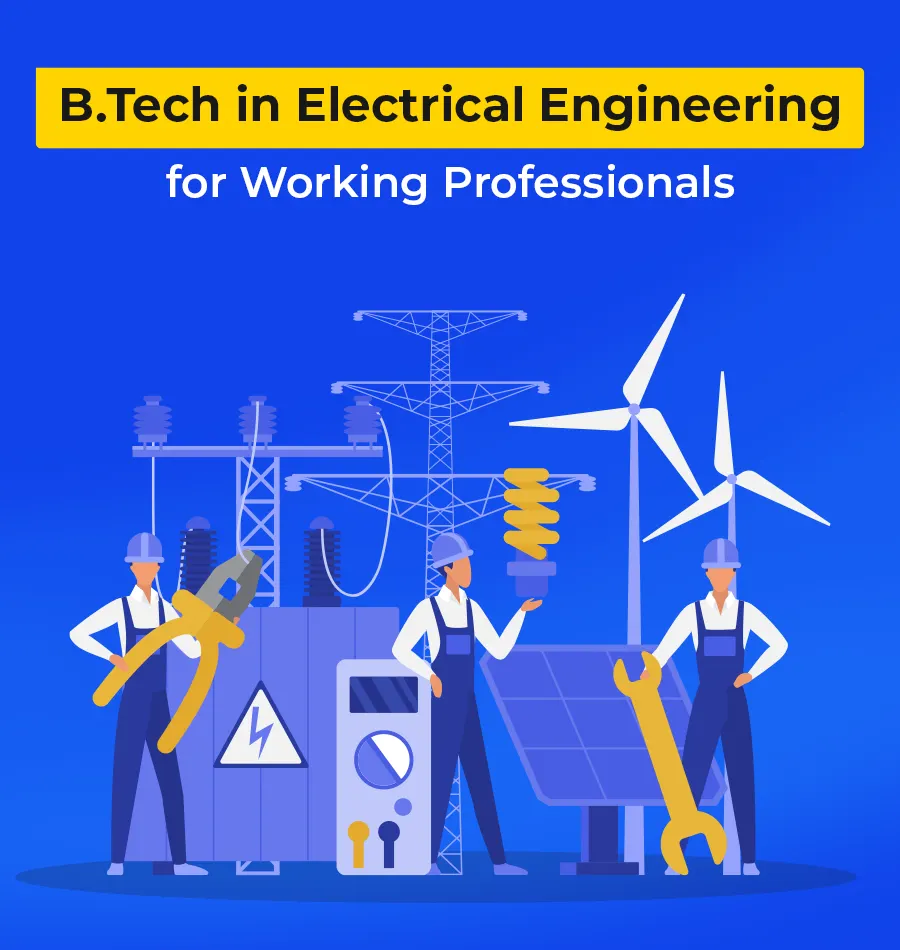
Kya aap ek Diploma Holder hain aur B.Tech na hone aapka Promotion rok raha hai?
Aaj hi janiye ki kya job ke saath B.Tech Possible hai?
Hazar se bhi zyada log apna jawab dhoond chuke hain Ab baari aapki hai!
Top Comparisons this week
Electrical Engineering programs from top Universities
 Top Rated
Electrical Engineering From Lingaya's Vidyapeeth Engineering
4.7/5
UGC, AICTE, AIU, NAAC B+
₹ 2,50,000
Top RatedElectrical Engineering From Sanskriti University Engineering
4.6/5
UGC, AIU, NIRF, ISO, AICTE**
₹ 2,40,000
Top RatedElectrical Engineering From Kalinga University Engineering
4.6/5
UGC, AICTE, AIU
₹ 3,00,000
B.Tech After Polytechnic in Electrical Engineering Course
OverviewThe Lateral Entry program for working professionals is known for its blended learning. Concerning technical programs, as per the guidelines of the regulatory bodies (AICTE/UGC), B.Tech Electrical Engineering can’t be provided in online or distance mode. And diploma holders are required to lay the foundation of the conceptual framework, which is possible through the B.Tech via lateral entry, a valid program.
B.Tech Electrical Engineering is a 3-year hybrid program where students can attend the sessions online and keep a track of their learning via LMS. When it comes to lab sessions, crucial for courses like B.Tech Electrical Engineering, conducted remotely. However, exams are handled offline, so learners have to be present at the examination hall.
There is a difference between the B.Tech Lateral Entry program and B.Tech for Working Professionals via lateral entry. In the case of B.Tech Lateral Entry, learners may have to attend the classes regularly, and most universities select the candidates through an entrance exam. These may not be required relevant work experience. On the other hand, B.Tech Lateral Entry for Working Professionals is designed for employees who need to earn a degree to upgrade their skills after polytechnic, but they don’t plan to quit their jobs. An additional criterion is that work experience is required to register for the program.
Will a B.Tech in Electrical Engineering help a Polytechnic Diploma? The B.Tech in Electrical Engineering elaborates on the knowledge gained in polytechnic diplomas. This course provides an understanding of Electrical Systems, Power Engineering, Automation, and Control technologies. Also, the development of Analytical and Problem-Solving Skills. So, students who complete their diploma programs can succeed from technicians to engineers. Improving students' career chances and salary opportunities, as they become eligible for roles like Electrical Design, Industrial Automation, Renewable Energy, Power Utilities, and the Main Engineering Areas.
Future of the B.Tech Electrical Engineering Lateral Entry for Working Professionals
The demand for electrical engineers will continue to rise due to rapid growth in sectors like power infrastructure, EV manufacturing, automation, and smart grid technologies. This is making lateral entry in electrical engineering a secure future for working professionals after diploma:
- Focus shift to renewable and sustainable energy: Engineers with knowledge in solar power systems, wind energy, and smart metering will be preferred for core industry roles.
- EV Technologies: It comprises battery management systems (BMS), electric motors, charging infrastructure, and power electronics are becoming essential knowledge areas for future electrical engineers.
- Integration of IoT and Automation: Electrical Engineers are required to have skills such as automation, IoT-based electrical systems, and industrial communication protocols. To upgrade their career, learning PLC, SCADA, and embedded control systems, digital substations is crucial.
- Data Driven Technologies: Even electrical engineers must have an understanding of intelligent automation and data-driven technologies that can help in predictive maintenance and energy forecasting.
Who should pursue B.Tech Electrical Engineering Lateral Entry for Working Professionals?
Upgrading from a diploma to a B.Tech degree allows to move into engineering advanced design profiles, government engineering posts, R&D projects, and supervisory roles. Such roles require a bachelor’s qualification.
- Working professionals holding a polytechnic diploma and aiming to earn a bachelor’s degree.
- Employees who want to upgrade from technician-level tasks to engineering-level roles.
- Professionals seeking promotions, salary growth, or supervisory positions in the electrical and industrial sectors.
- Diploma holders planning to shift into design, automation, electrical maintenance, or project engineering roles.
- Employees want eligibility for government engineering posts that require a B.Tech degree.
- Professionals upgrading skills for emerging domains like EV technology, renewable energy, and industrial automation.
When should I do B.Tech EE Lateral Entry for Working Professionals?
There is a high demand for the online B.Tech course among polytechnic diploma holders. So there are B.Tech course via lateral entry but aspirants have to quit their jobs to complete the degree program, as they have to attend the regular classes. However, working professionals can apply for the blended learning program for engineering, which provides relaxation as they don’t have to visit the campus on a regular basis. Thus, B.Tech for Working Professionals can apply for the Electrical Engineering:
- Polytechnic diploma holders who are interested in Electrical Engineering.
- Upgrade qualification without leaving the job
- Technical background required graduation degree in Electrical Engineering
- Looking for promotions and higher job roles that are associated with Electrical Engineering.
- Wishing to conduct research in Electrical Engineering after gaining years of experience in the field, or want to work on their ideas, must enroll for the program. Graduation is the way through which one can access the research platform in India.
Where should I get the B.Tech EE Lateral Entry for Working Professionals?
Aspiring learners must check the approvals before signing up for the B.Tech Electrical Engineering Lateral Entry course. Working professionals must consider whether the program is flexible for them. Flexibility lets them manage both higher education and work commitments, with aspirations like higher job roles and promotions. Here are some institutions known to offer B.Tech EEE Lateral Entry for working professionals, offering flexible shifts:
- Shri Venkateshwara University
- Lingaya’s Vidyapeeth University
- Sanskriti Univerity
- BITS Pilani
- Mangalayatan University
- Galgotias University
Look at How Your Week Will Look!
A typical week of a working professional pursuing an Online Degree with College Vidya. Numbers are drawn from actual routines, not stock templates, so you can plan before you enrol.
Weekdays are workable. Live sessions sit in the evening, coursework fits around your shift, and you still keep hours for family, food and sleep.
Built on real routines of 1.25 Lakh+ Students guided by College Vidya across Online MBA, MCA, MA, MCom and other Online Degree Programs.
Key Highlights of B.Tech After Polytechnic in Electrical Engineering in India
- The B.Tech EE for Working Professionals via lateral entry is feasible because it can be managed easily with 9 to 5 job schedule.
- The duration of the B.Tech EE Lateral Entry is a 3-year program. Learners can start directly focusing on the advanced skills, and they don’t have to go through the fundamentals.
- The 3-year graduation engineering program is valid and approved by UGC and AICTE.
- Students have access to the live sessions and recorded sessions via the LMS (learning management system).
- The program is beneficial for those who are looking for online B.Tech or Part-Time B.Tech courses.
- Courses like this are best to learn advanced skills in the field.
- Exams are conducted offline at the examination center.
- Lab sessions are managed and supervised remotely whenever required practical classes are scheduled on weekends, so working professionals can easily manage.
Admissions Closing soon
Compare & Enroll NOW
- To avoid paying 25% Late Fees on all the online courses
- To secure a seat in your dream university
- To avail of some amazing Early Benefits
Will AI Take My Job?
9 out of 10 Profiles Needed Attention! Access Yours!
Thousands of Users Already Accessed Their AI Career Threat Report!
Real students. Real outcomes.
Over 1.25 Lakh students found their right university through College Vidya.

Ritik
Through College Vidya, I found a B.Tech program that fits my working schedule. The weekend classes make it much easier to balance work and studies.
Kalinga University

Mujasw Ahmed
College Vidya helped me turn my Diploma into a B.Tech while continuing my career. The flexible learning and support made upgrading my qualification much easier.
Kalinga University

Ramesh
After 24 years of engineering experience, I realized a degree was essential for career growth. College Vidya helped me upgrade my qualification while balancing work and studies.
Kalinga University

Durga Prasad
B.Tech had become a basic requirement for my career growth. College Vidya helped me pursue my degree while continuing my job without putting my career on hold.
Kalinga University

Prasit Ghosh
Since I work in Jaipur, College Vidya’s support for exam arrangements made things much easier. I didn’t have to worry about accommodation.
Kalinga University

 FAQ's
FAQ's
Let's clear up some doubts
Yes, working professionals are eligible to apply for B.Tech EE lateral entry programs. However, candidates must possess relevant work experience in the electrical engineering domain. A minimum of 1 year of professional experience is mandatory after completing a diploma in a related discipline or a B.Sc degree with Mathematics as a core subject.
Candidates holding a diploma in engineering or a B.Sc degree with Mathematics are eligible to apply for B.Tech Electrical Engineering through lateral entry. This pathway is suitable for working professionals who wish to advance their qualifications without interrupting their careers, provided they meet the experience requirements.
Yes, several universities offer flexible B.Tech EE Lateral Entry programs specifically designed for working professionals. These programs enable candidates to pursue their degree while continuing their employment. Institutions like Lingaya's Vidyapeeth University, Sanskriti University, and Shri Venkateshwara University provide such work-friendly B.Tech lateral entry options.
Candidates must have at least one year of relevant work experience to be eligible for B.Tech EE lateral entry. The work experience should be directly related to the electrical engineering field or similar technical domains.
Yes, polytechnic diploma graduates are fully eligible to pursue B.Tech EE through the lateral entry route. Even working professionals can apply for the blended learning.
While numerous universities offer B.Tech Lateral Entry programs, only select institutions provide flexible schedules suitable for working professionals in Electrical Engineering. Top choices include Kalinga University, Sanskriti University, BITS Pilani, and Lingaya's Vidyapeeth University, all of which offer the convenience to the employed students.

Checklist I Wish I Had Before Enrolling
College Vidya Smart Choice Checklist
A checklist to help you reach your goal!
Compare Universities
vs
Add To Compare
vs
Add To Compare
vs
Add To Compare

Get the right guidance with us
Download the app



Online & Distance MBA
Online & Distance Best University for
Online & Distance UG Courses
Online & Distance PG Courses
General



College Vidya is an independent education guidance platform designed to help learners compare, evaluate, and make informed decisions about accredited online and distance programs. We do not directly conduct academic programs. All admissions, curriculum structures, fee details, approvals, scholarships, and placement policies are managed and executed by the respective universities or institutions. We aim to keep information accurate and updated. For complete and official details, learners are encouraged to connect with experts from College Vidya. Our role is to simplify research and provide structured guidance throughout the decision-making process.
© 2026 College Vidya, Inc. All Rights Reserved
Built with Made in India