


Quick answer: Aman Gupta, co-founder of boAt and a Shark Tank India investor, visited College Vidya on 29 April 2026. He spent the session with College Vidya's Career Development Advisors, the team that guides learners through online degree and university decisions. The conversation covered brand perception, career decision-making, and why the degree a learner picks matters less than the reasoning behind it. This page covers who Aman Gupta is, his education, his career, and what came out of his time at College Vidya.
Aman Gupta is an Indian entrepreneur, investor, and the co-founder of boAt, the consumer electronics brand that turned earphones into a fashion category in India. He was born on 4 March 1982 in Delhi. Most of India met him through Shark Tank India, where he has been on the panel since season one in 2021.
Here is the thing most profiles skip.
Before the Shark Tank chair, before the ₹10,000 crore-plus valuation, before any of it, Aman Gupta was a Chartered Accountant sitting in a corporate job. He went back to business school at 28. He worked in sales at somebody else's audio company. He built a business that did not work. Then he built one that did.
That sequence is why Aman Gupta at College Vidya made sense to us. We work with 1.25 Lakh+ Students who are mostly working professionals trying to figure out whether going back to study is worth it. Aman Gupta went back to study. It worked out reasonably well for him.
Aman Gupta at a glance
| Detail | Information |
| Full name | Aman Gupta |
| Date of birth | 4 March 1982 |
| Age (2026) | 44 |
| Birthplace | Delhi, India |
| Nationality | Indian |
| Known for | Co-founder of boAt; investor on Shark Tank India |
| School | Delhi Public School, R. K. Puram, Delhi |
| Graduation | B.Com (Hons), Shaheed Bhagat Singh College, University of Delhi |
| Professional qualification | Chartered Accountant, ICAI |
| Postgraduate | MBA in Finance and Strategy, Indian School of Business, Hyderabad |
| International exposure | Exchange programme, Kellogg School of Management, Northwestern University |
| Company | boAt (Imagine Marketing Ltd), Non-Executive Director; Off/Beat Studio |
| Television | Shark Tank India, seasons 1 to 5 |
| Estimated net worth | Around ₹720 crore (estimates vary by source) |
| Spouse | Priya Dagar, married 2008 |
| Children | Two daughters |
| Visited College Vidya | 29 April 2026 |
Aman Gupta's education: the part nobody talks about
Everybody quotes the boAt numbers. Almost nobody walks through the education, which is a shame, because that is the genuinely useful part.
Aman Gupta finished school at Delhi Public School, R. K. Puram. He did his B.Com (Hons) from Shaheed Bhagat Singh College under Delhi University. He cleared his CA and qualified through the Institute of Chartered Accountants of India in his early twenties, which put him comfortably ahead of schedule.
Then he stopped.
He worked. He tried a venture. It did not go the way he wanted. And in 2010, at an age when most people have decided their qualifications are finished and filed away forever, Aman Gupta enrolled at the Indian School of Business for an MBA in Finance and Strategy. During that program he went to Kellogg School of Management at Northwestern University on an exchange, focusing on general management and marketing.
Read that again. A qualified CA with corporate experience decided he needed a second degree in his late twenties in a subject he had no formal background in, because the work he wanted to do next required it.
| Stage | Qualification | Institution | Roughly when |
| School | Senior secondary | Delhi Public School, R. K. Puram | Until 1998 |
| Graduation | B.Com (Hons) | Shaheed Bhagat Singh College, Delhi University | 1998 to 2001 |
| Professional | Chartered Accountant | ICAI | Early 2000s |
| Postgraduate | MBA, Finance and Strategy | Indian School of Business, Hyderabad | 2010 to 2011 |
| Exchange | General Management and Marketing | Kellogg School of Management | 2011 |
So when somebody tells our advisors that they are 31, employed, and too late to study again, we have a fairly specific counter-example. Aman Gupta was 28 when he went back. Priyanka in Pune is 31 and thinking about an online MBA comparison. Different scale, same decision.
Aman Gupta's career timeline
| Period | Role | Organisation |
| 2003 to 2005 | Assistant Manager | Citibank |
| Mid-2000s | Co-founder | Advanced Telemedia (early venture) |
| 2010 to 2012 | Senior Management Consultant | KPMG |
| 2012 to 2013 | Director of Sales | Harman International |
| 2013 | Co-founded Imagine Marketing Pvt Ltd with Sameer Mehta | boAt parent company |
| 2016 | boAt launches as a consumer brand | boAt |
| 2021 to present | Investor and judge | Shark Tank India |
| 2025 | Moves from CMO to Non-Executive Director ahead of boAt's IPO filing | boAt |
| 2026 | Launches Off/Beat Studio, a new D2C venture | Off/Beat |
Notice the Harman stretch. He sold audio equipment for the company that owns JBL before he built an audio brand of his own. He learned the category on somebody else's payroll. There is a whole career lesson sitting in that one line, and it is not a subtle one.
The boAt story
In 2013, Aman Gupta and Sameer Mehta registered Imagine Marketing. The brand most people know, boAt, arrived in 2016.
The gap in the market was obvious once someone said it out loud. Premium audio was priced for a small slice of India. Affordable audio was, to put it kindly, disappointing. boAt went straight down the middle: products that looked good, sounded fine, survived a commute, and did not cost a month's salary. They sold them as lifestyle accessories rather than electronics.
The naming story is worth repeating. Apple had taken A. So they went to B, picked the first word that stuck, and stopped overthinking it.
By 2026 boAt had grown into one of India's largest audio and wearable brands, with a valuation reported at around ₹10,800 crore and a run of years inside the global top five wearable brands by volume. Ahead of the company's IPO filing, Aman Gupta stepped back from the Chief Marketing Officer role into a Non-Executive Director position, and in March 2026 he launched Off/Beat Studio, a new direct-to-consumer venture that raised a reported ₹100 crore seed round.
Aman Gupta on Shark Tank India
Aman Gupta has been on the Shark Tank India panel since season one aired in 2021, and he is back for season five, which ran from 5 January to 17 March 2026.
He is the shark who asks about distribution. Everyone else is on the unit economics. Aman Gupta wants to know how the product reaches an actual human in Indore, and whether anyone will remember the brand name a week later. Across five seasons he has become one of the show's most prolific cheque-writers, with reports placing him as the leading investor by value in season five with around ₹24.6 crore committed across 23 deals, and 50-plus investments across the run of the show.
| Season | Year | Aman Gupta on the panel |
| Season 1 | 2021 to 2022 | Yes |
| Season 2 | 2023 | Yes |
| Season 3 | 2024 | Yes |
| Season 4 | 2025 | Yes |
| Season 5 | 2026 | Yes, reported as the top investor by value |
Aman Gupta's net worth in 2026
Aman Gupta's net worth in 2026 is widely estimated at around ₹720 crore, which is roughly 87 to 93 million US dollars depending on the exchange rate and the publication doing the maths.
| Component | Estimated share |
| Equity in Imagine Marketing (boAt) | ₹400 to ₹500 crore |
| Endorsements and brand income | ₹50 to ₹80 crore |
| Real estate | ₹40 to ₹60 crore |
| Shark Tank investment portfolio | ₹40 to ₹60 crore |
| Off/Beat equity | ₹20 to ₹50 crore |
A fair warning on all of these numbers. Net worth estimates for founders of unlisted companies are educated guesses built on reported valuations. Treat them as a range, not a bank statement. If boAt lists publicly, every one of these figures gets rewritten overnight.
Aman Gupta at College Vidya: 29 April 2026
Aman Gupta with College Vidya Career Development Advisors during the training session
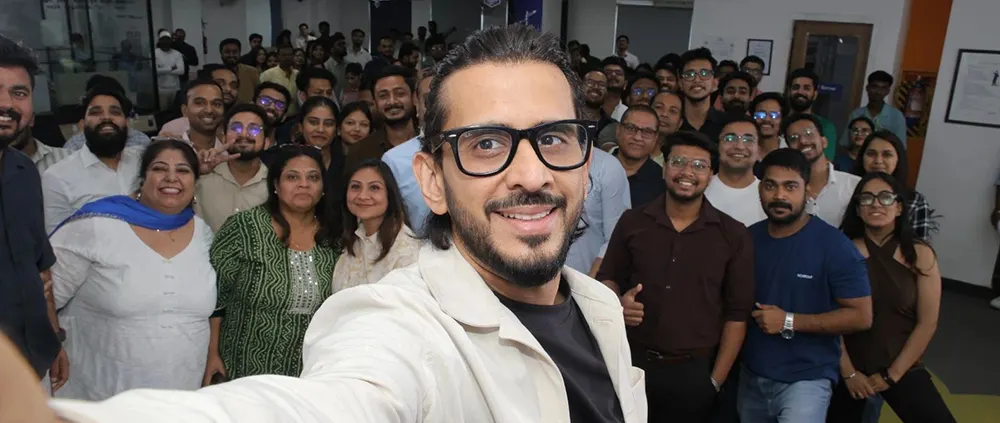
600+ advisors, one room, one very long Q&A
On 29 April 2026, Aman Gupta came to College Vidya.
Not for a shoot. Not for a thirty-second brand clip where somebody nods at a logo and leaves. He sat down with our Career Development Advisors, the 600+ people who take the calls when a learner is trying to decide between two universities and cannot tell the difference between them.
The session ran unscripted on the day, with Aman Gupta taking questions straight from College Vidya's Career Development Advisors instead of working off a deck.
Three themes came up again and again, and all three landed hard.
The first was rejection. Aman Gupta was blunt that consultative work and sales work run on the same rule. "If you have ego in sales, don't do sales," he told the College Vidya team, and then went further: "If rejections would not have been there, I would not be here."
The second was the consumer, which at College Vidya translates directly into the learner. Aman Gupta's version of it ran six words long. "Every salesman should understand the consumer." Most of the room wrote that one down.
The third was failure, where Aman Gupta pushed against the older reflex of treating a single setback as a permanent mark. "Right now in this generation, failures are okay. Failing is okay."
The questions from the College Vidya floor went where you'd expect from a team that speaks to working professionals all day. Did Aman Gupta have mentors on the way up? He said no, flatly. "I did it without them," adding that his own mistakes did more for him than a mentor would have.
Then somebody asked whether a job is the lesser path. That answer is the one College Vidya advisors have repeated most since. Aman Gupta said there's no wrong choice between a job and a business, pointed at Sundar Pichai, and moved on.
Which matters here. Most college Vidya guides aren't starting a company. They're going back to study while holding a job, exactly as Aman Gupta did in 2010.
What we can say cleanly is why the session was built the way it was.
Our advisors are good at the factual side of this job. Entitlement status, fee structures, exam formats, credit transfer rules. Give them a university and they will tell you what is actually true about it. Where the job gets harder is the part that is not factual at all: a learner who has already decided the answer emotionally and is looking for permission, or a learner who dismisses the right programme because the name does not sound impressive enough to say out loud at a family function.
That is a perception problem. And perception happens to be the thing Aman Gupta has spent his working life on. He took a category nobody cared about and made people want the box it came in. Understanding how a decision gets made before the facts arrive is his actual expertise.
So the brief for Aman Gupta at College Vidya was narrow on purpose. Not "tell us your startup story". More along the lines of: when someone is embarrassed about a choice that is objectively correct for them, what do you do about it?
boAt co-founder Aman Gupta at College Vidya

The boAt co-founder, off script
What our Career Development Advisors actually do
Quick context, because the job title does a bad job of describing the job.
A Career Development Advisor at College Vidya does not sell you a university. Nobody here has a university-wise target. The advisor's job is to sit with your situation, your budget, your work schedule, and your five-year plan, and then help you compare online universities on 30+ factors until one of them is clearly the right answer for you specifically.
| What advisors handle | What that means in practice |
| Entitlement and approval checks | Confirming a programme's regulatory status before you commit money |
| Programme fit | Matching the course structure to your working hours and career target |
| Side-by-side comparison | Running your shortlist through 30+ comparison factors |
| Cost clarity | Total cost of the degree, not the headline number |
| Post-admission support | Somebody to call when something goes wrong after you have enrolled |
Every service is free for learners. Fees go directly to the university on its official website, as per UGC rules. College Vidya does not sit in the middle of that transaction, which is precisely why the advice can afford to be honest.
Aman Gupta's session fed directly into how those 600+ advisors handle the conversation where a learner is not asking for information at all. They already have the information. They are asking whether the choice is allowed to be okay.
The questions Aman Gupta's session helped us answer better
Aman Gupta answering questions from College Vidya advisors
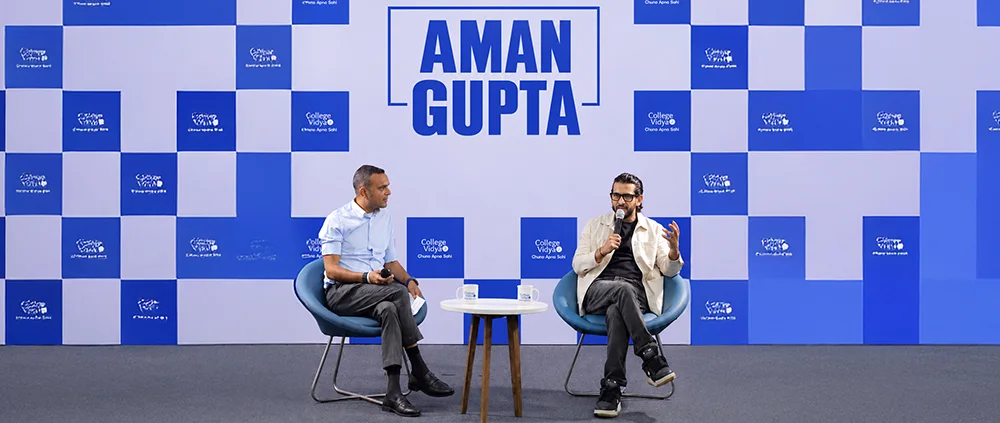
The questions got sharper as the hour went on
These are the doubts that come up on advisor calls almost every day. The session did not change the facts. It changed how directly we say them.
"Is an online degree taken seriously?"
Yes, increasingly so. A UGC-entitled online degree from an approved university carries the same legal standing as its on-campus counterpart. That is the regulatory position, and it has been for years.
The market caught up more slowly than the regulation did, which is where the doubt comes from. But the direction of travel is settled. Employers now hire from online programmes routinely, particularly in IT, sales, operations, marketing, and finance, where a working professional who upgraded while holding a full-time job reads as a positive signal rather than a compromise.
"Online MBA or regular MBA?"
Depends on one thing: whether you are currently employed.
If you are working and want to keep working, an online MBA is the better structure. You keep the salary, you keep the experience clock running, and you apply the coursework to a job you already hold. If you are a fresher with no work experience and you want the campus placement machinery, a full-time programme does more for you. Both are valid. They are just built for different people.
"Will this hold up for a government job or higher study?"
Yes, when the programme is entitled. A UGC-entitled online degree is accepted for government recruitment, for public sector applications, and for further study, on the same footing as the regular mode. Verify the specific programme's entitlement status before you enrol, every time, without exception. That single check removes almost every risk in this entire category.
"How do I pick between two universities that look identical?"
They are never identical. They only look identical on a brochure.
Fee structure, exam mode, LMS quality, faculty access, placement support, alumni strength, entitlement duration, credit transfer policy. Run both through our online university passing percentage tool and the gap shows up quickly. If it still does not, talk to a Career Development Advisor and make somebody else do the work.
Aman Gupta with the College Vidya team after the session
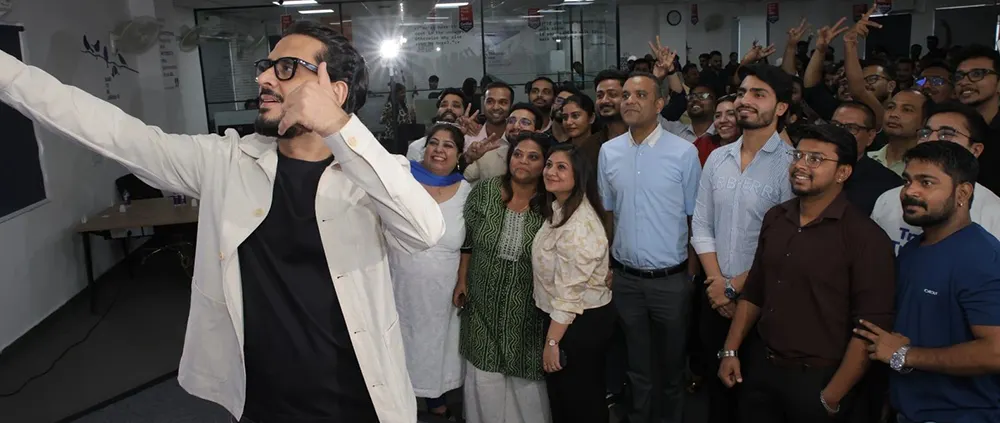
Group photo, 29 April 2026
What to check before you pick an online degree
| Check | Why it matters | Where to verify |
| UGC entitlement status | Determines legal validity of the degree | UGC DEB portal, and cross-check with an advisor |
| Entitlement validity period | Entitlement runs for a defined period, not forever | University's official entitlement letter |
| Total programme cost | Headline fee often excludes exam and semester charges | University's official fee page |
| Exam mode and centre | Proctored online versus physical centre changes your logistics | Programme handbook |
| LMS and faculty access | Decides whether you actually finish the degree | Ask for a demo before enrolling |
| Placement and career support | Varies enormously between universities | Ask for last year's actual numbers |
| Credit transfer policy | Matters if you might switch or continue to a higher degree | University academic policy |
Seven checks. Most learners do two of them and hope. The gap between those seven and those two is where almost every bad online degree decision in this country gets made.