


Quick Overview: Discover the important role of a Business Development Executive in helping businesses grow and build strong customer relationships. A Business Development Executive is responsible for identifying new business opportunities, finding potential customers, understanding their needs, and supporting the company in achieving its growth targets. The role also involves communicating with clients, developing business strategies, following up with leads, and maintaining long-term relationships. Strong communication, negotiation, sales, market research, and problem-solving skills are useful for this position. Explore the key roles and responsibilities, required skills, career opportunities, and growth prospects of a Business Development Executive.
In this era of startups, technology plays a key role in growing a business but finding professionals with the required skills and technical experience is quite a headache for employers. Business Development Executive (BDE) is one of the profiles in the business domain that serve as game changers for organizations. The professional and technical skills of BDEs are of great value to a company as their networking skills bring in new clients and businesses. The competitive nature and influential personalities are some of the highlighted features that one must possess to become a BDE.
What Does a Business Development Executive Do?
Business Development Executives (BDEs) play an important role in helping a company increase its business by finding new customers and developing relationships with existing ones. Although their work may overlap with that of Sales Executives, BDEs often have a broader focus that includes identifying new business opportunities and building long-term client relationships.

Their responsibilities generally include generating leads, contacting potential customers, understanding their requirements, and converting suitable leads into sales. BDEs also communicate with existing clients, collect feedback, address their concerns, and maintain regular follow-ups. Strong communication and convincing skills can help them build customer trust, improve retention, and contribute to the company's overall growth.
Key Responsibilities of Business Development Executives
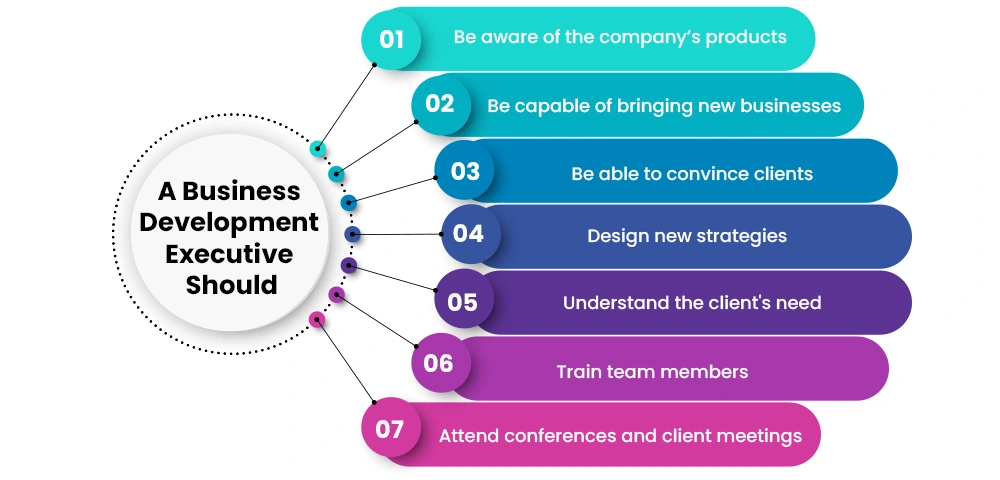
Some of the basic responsibilities of a business development executive are listed here for a better understanding of their job roles:
- Introduce clients to the products and services offered by the company.
- Identify quality and sale-worth leads from a bunch of data.
- Convince clients to get associated with the company either by selling the product or by making them a part of the company’s network.
- Design new strategies to boost the company’s revenue from old as well as new clients.
- Understand the client's need and act on it with an effective pitch without causing a significant change to the company’s policies.
- Read clients’ feedback and implement necessary changes to get a longer and more satisfactory customer association.
- Train team members about new business developments to meet targets as per their KPIs and KRAs.
- Attend conferences and client meetings to make them understand that the company has the best for them as compared to others.
Basic Requirements to Become a Business Development Executive
1) Educational Qualification
Professionals who want to build a career in business development can explore the role of a Business Development Executive (BDE). A bachelor's degree such as BBA, B.Com, or another relevant qualification is generally preferred for this position. Candidates with prior experience in sales or business development, as well as those with an MBA, may have an advantage when applying for certain roles.
BDEs are mainly responsible for identifying new business opportunities, generating leads, building client relationships, retaining customers, and contributing to the company's revenue growth. Good communication, negotiation, sales, marketing, and relationship management skills can help professionals perform these responsibilities effectively.
Certificate courses, internships, and practical experience can further help candidates understand customer requirements and develop relevant business skills. The salary of a BDE varies depending on the company, location, experience, and skills. With experience and strong performance, professionals can progress to positions such as Business Development Manager (BDM), Sales Manager, or other senior business roles.
The career scope of a BDE is broad, with opportunities across industries such as IT, education, finance, healthcare, retail, and consulting. The role can be particularly suitable for individuals who enjoy interacting with people, building professional networks, travelling for work, and working towards business growth. Similar career paths can also include roles such as Sales Executive, Strategic Account Executive, and Account Manager.
| Important Courses | |
2) Additional Skills
Some additional skill sets should be acquired to become an efficient BDE. Since the job role of a business development executive involves interaction with clients, therefore, they must possess professional communication skills. Marketing and sales skills are also a part of the skilling programs that one should learn to become a successful Business Development Professional. These skill sets can be learned through some training programs or with time as on-job training.
Skills Needed to Become a Business Development Executive
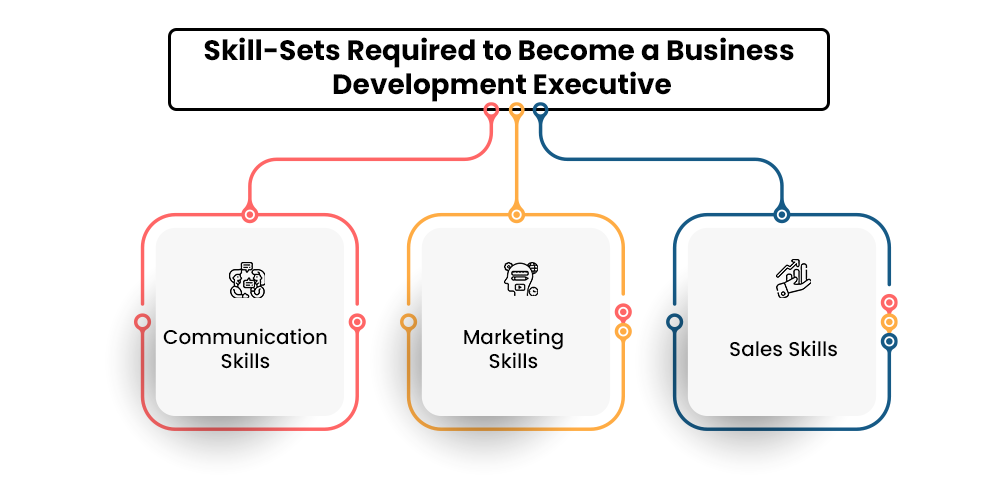
A BDE is supposed to interact with clients and convince them to invest in the company by getting benefited by the company’s services. These responsibilities can be fulfilled effectively with three basic skills:
- Communication Skills
- Marketing Skills
- Sales Skills
These skill sets can be easily gained through internship programs in the business domain. The job skills learned during an internship program are quite helpful in understanding the responsibilities and execution of developments as a BDE.
An idea of the duties of a business development professional can also be obtained by assisting a senior on the same designation in the initial years of the job. This benefits the aspiring candidates in a better way by giving an exposure to the real challenges of the industry. This on-the-job training is quite valuable as it gives a chance to be part of a highly professional network of experts.
Certificate Courses that can be Pursued to Become a Successful Business Development Executive
A Business Development Executive helps a company build and maintain strong customer relationships while identifying opportunities that can support business growth. To prepare for this role, candidates can develop a strong understanding of business, sales, marketing, customer management, and market trends.
Short-term certification courses can be useful for gaining practical knowledge and understanding common challenges in the business environment. Many of these programmes are available online, allowing students and working professionals to learn without changing their current schedules. Candidates from different educational backgrounds can also explore these courses to develop relevant skills and improve their understanding of business development, sales, and marketing roles.
| Certificate Courses for Business Development Executive | |
|
Online Certificate In Business Management | |
These certificate courses aim to provide an in-depth understanding of management, marketing, sales, and communication skills that are key requirements for becoming an efficient professional in business development.
Career Growth for a Business Development Executive
A business development professional has a commendable understanding of corporate goals and working patterns. The customer-centric mindset of professionals in business development not only enhances the organization's growth but widens up their career path as well. With all the experience in the business sector, a BDE can easily get promoted to a BDM (Business Development Manager) position. As a BDM, individuals get to contribute to the company’s growth by managing some teams of business development professionals.
Salary Package for a Business Development Executive
The package of business development professionals is quite promising compared to the other entry-level jobs. The salary package for a fresher BDE ranges between 1.8 LPA to 6.0 LPA. The average package of the same designation is around 3.0 LPA. Apart from the fixed salary packages, there are performance incentives offered to professionals in business development by most organizations.
|
You May Be Interested In | |
What Are the Benefits of Being a Business Development Executive?
A career as a Business Development Executive can offer several benefits along with opportunities for professional growth. One of the major advantages is the chance to meet different people and travel for client meetings, business events, and other professional activities. The role can also provide a dynamic work environment, as BDEs regularly interact with new clients and work on different business opportunities.
Business development professionals can also develop valuable skills in communication, sales, negotiation, networking, and customer relationship management. Since businesses across various industries need professionals who can identify growth opportunities and bring in new customers, BDEs can explore career opportunities in sectors such as IT, education, finance, healthcare, retail, and other industries.
Interview Questions Asked for the Role of Business Development Executive
In today’s competition, only getting the required skills and qualifications is not enough to get you your dream job. You need to have a prior idea of the company with which you want to excel in your career. Apart from that, you should prepare for some of the questions that are generally asked by interviewers for a specific profile. Here is a list of some business development executive interview questions that are generally asked.
- “Why do you want to work with us?”
This question is generally asked to get to know about your interest in the field and your knowledge about the company. You should answer it by emphasizing the quality of services and products that the company offers and relating it to your skills.
- “What would you do to retain an old customer?”
This is the part where the company wants to know about your negotiating and influential skills. You should answer this question by involving the strategies that you would develop to retain customers.
- “How do you react to a failed strategy of yours?”
This question is asked to understand your mindset in failure. This question is not asked to know about your failures but it is asked to know what have you learned from them. So, you should include the learning part and backup plans here.
Is a Business Development Executive Profile Suitable for You?
If you enjoy working with people, understanding business goals, and contributing to company growth, a career as a Business Development Executive can be a suitable option. The role involves regular interaction with clients, team members, and potential customers through meetings, calls, presentations, and networking activities. Strong communication and negotiation skills can help you build trust and convert business opportunities into successful deals.
The position also allows you to develop important professional skills such as leadership, sales planning, relationship management, and strategic thinking. With experience and consistent performance, a BDE can progress to senior business development, sales management, or other managerial positions.
Some Other Related Job Titles
Sometimes getting a desired work profile feels like a tough task but this stress can be avoided by learning the almost same aspects of one job title under the other. Many job profiles have more or less the same responsibilities as that of a BDE. These profiles can be taken up by individuals who are interested in working as a BDE but are not getting the chance to be one. To get practical knowledge of the related work profile, one can secure some of the below-mentioned job profiles:
- Strategic Account Executive
- Business Development Representative
- Sales Executives
- Client Relations Executives
| Top Trending Article | |
Conclusion
Professionals who want to build a career in business development can explore the role of a Business Development Executive (BDE). A bachelor's degree such as BBA, B.Com, or another relevant qualification is generally preferred for this position. Candidates with prior experience in sales or business development, as well as those with an MBA, may have an advantage when applying for certain roles.
BDEs are mainly responsible for identifying new business opportunities, generating leads, building client relationships, retaining customers, and contributing to the company's revenue growth. Good communication, negotiation, sales, marketing, and relationship management skills can help professionals perform these responsibilities effectively.
Certificate courses, internships, and practical experience can further help candidates understand customer requirements and develop relevant business skills. The salary of a BDE varies depending on the company, location, experience, and skills. With experience and strong performance, professionals can progress to positions such as Business Development Manager (BDM), Sales Manager, or other senior business roles.