


An honorary doctorate is an award that is given to a person by a university or institution for their outstanding contributions in a specific field or to society. Once they get this honor, they can use Dr title in their name. Before getting this, you must know what an Honorary Doctorate is and how it works. In this blog, you will be provided with detailed information on the same.
An Honorary Doctorate is an academic award that is given by a university or institution. In India, self-nomination for an Honorary Doctorate was not a thing, but now you can self-nominate, because EIMT Honorary DBA/PhD (European Institute of Management & Technology) offers self-nomination. One of the best things about this university is that this honorary doctorate will be recognized in India and other countries.
What Is An Honorary Doctorate?
Honorary Doctorate is an academic award that is given to a candidate by a university or institution to a candidate for making an exemplary contribution in a specific field or subject that also helps in making a positive impact on society. An honorary is a kind of honor or recognition that is offered to a person for their achievements and impact.
Unlike a normal PhD, an honorary doctorate does not need to match the same academic qualifications as a PhD. It is an award that is given for years of hard work and research in the area that has had a big impact on society. This award recognizes the amazing work that came before a person who worked for years to make a contribution to that area. Once a candidate's name is in the Honorary Dr. and they can call themselves Dr., they need to ensure that the Hons is included as a prefix, to let other people know they are an Honorary Doctorate.
Will It Be Valid To Use Dr Title With An Honorary Doctorate?
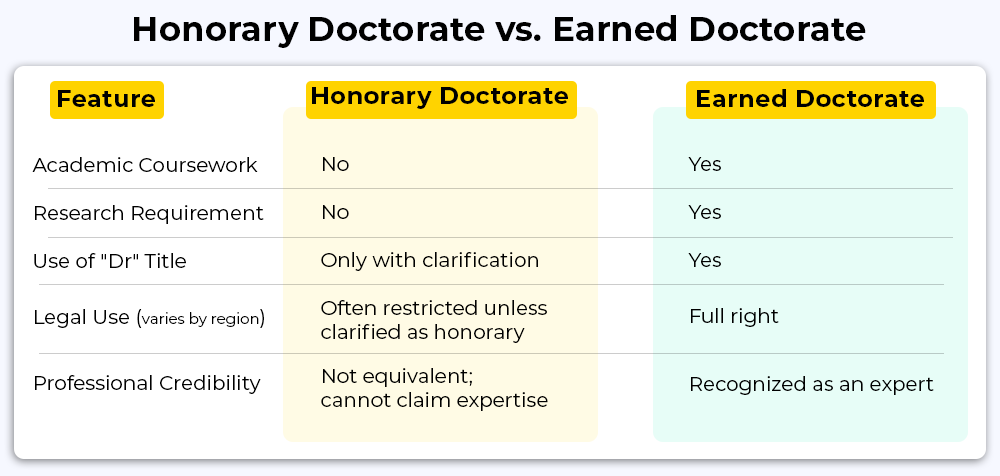
Yes, you are allowed to use the term Dr. after you receive an Honorary Doctorate from the institution or university. Recipients of honorary doctorates have made impactful societal or cultural contributions; the honorary doctorate certificate does not meet the scholarly or research component of an earned doctorate. A full exploration of this subtle subject is outlined below.

Using "Dr" in Different Contexts
- Academic/Professional Settings: The use of the Dr title by holders of honorary degrees is generally frowned upon and may well be considered to be misleading. In fact, many universities and professional authorities will actually tell degree holders that if they do choose to use the title of Dr, they should clearly indicate it is honorary. If this is not done, it may lead to confusion or some doubt about someone’s expertise.
- Social/Informal Settings: In informal scenarios, some recipients may choose to utilize the "Dr." honorific as a courtesy. It is advisable to make clear that the doctorate is honorary. For example, responding with, "My PhD. is an honorary one," when addressed as "Dr." is viewed as ethical and forthright.
- Legal and Regional Variations:
Laws and customs vary by country. For example:- In Germany, it is normally illegitimate to use the Dr title if you have not completed a more traditional doctoral-level programme. The designation "Dr. h.c." (honoris causa) is unambiguous for the honorary status.
- In the United States and in the United Kingdom, honorary degree holders can sometimes use "Dr." but the prevailing practice is to discourage the use of "Dr." unless the honorary status is explicitly made clear, for example, "Dr. (hc)" or "Dr. (Hon..)".
Best Practices for Honorary Doctorate Holders
- Use "Dr." with a qualifying suffix such as "Dr. (hc)", or "Dr. (Hon..)", especially in written communication or biography.
- In academic and professional areasincluding publications, conference papers, or formal documentation, avoid the use of "Dr." unless denoting that the honorary is simply on purpose.
- Never use "Dr. in such a way as to imply licensable or clinical authority, including for medicine or law, if not by an earned degree.
Addressing Someone with an Honorary Doctorate
In official circumstances, it is normal practice to acknowledge the honorary title where appropriate, but not to recognize in every instance its honorary designation by notation. Especially in introductory writing or oral introductions, it is recommended that the name be preceded by “Dr. (Hon.)” or “Dr. (hc)”.
What Makes an Honorary Doctorate Special?
An honorary doctorate is exceptional as it is a prestigious academic award that is given to the candidate for making a special impact in a specific field or society. This award is recognition for the candidate that is given by the university or an institution. There are some points through which you will know what makes an honorary doctorate special:
-
Token of Accomplishment: An honorary doctorate is awarded based on a lifetime of accomplishments and leadership, as opposed to achieving the academic challenge of a PhD.
- Prestige and Public Platforms: Being awarded an honorary doctorate often includes ceremonies, media coverage, and networking opportunities, elevating recognition of their profile, awarded as the title of "Dr."
- Wider Impact: Gifted honorary doctorates have proven to be impactful in their field and communities, serving as aspirational figures and advocates for change.
- Legacy: Honoring the accomplishments of an honorary doctorate solidifies their essence and finds remembrance as a contribution to change by future generations.
How Are Recipients Chosen?
- Nominations come from a member or leader in a university who recognizes the extensive and continuous impact of an individual on society or their discipline.
- The committee assesses the nominee's work carefully to determine originality, ethical value, and the degree of contribution to the community.
- To assist in reducing input bias, universities often award honorary degrees to individuals who are not usually associated with the university or its leaders.
What Does Receiving One Mean?
- Increased Credibility: It serves as an independent endorsement of professional credibility and business influence in the public arena.
- Opportunities: Recipients gain the opportunity to serve as advisors to others, achieve, and work with others across multiple industries and sectors.
- Personal Satisfaction: Being awarded the honor provides deep recognition and a sense of fulfillment for a lifetime of work.
Why was an Honorary Doctorate given?
An Honorary Doctoral Degree is awarded to recognize one's outstanding contribution to society, a profession, or a field of practice; not to honor academic attainment, but as a significant way of offering societal respect and gratitude. This fellowship or recognition is often bestowed on people who have ascended or contributed to such a degree that their achievement and leadership have an impact beyond the traditional academic measures.
Honorary doctorates are awarded by reputable universities to recognize individuals who have contributed enormously in areas of - science, arts, philanthropy, education, social work or public service. These degrees convey appreciation for intellectual or creative contributions that were especially distinctive, provide inspiration to future generations, and improve the reputation of the awarding institution.
The Symbol of Honor
An honorary doctorate is, at its core, a celebration of human achievement and acknowledges the spirit of creativity and service by taking the emphasis away from the value of the invention, service, and change, and putting the emphasis on the value of the formal, academic policies that govern credentials. Honorary doctorates are a celebration of those people who inspire, lead, and create change.
Eligibility Criteria for an Honorary Doctorate
An Honorary Doctorate is a prestigious recognition awarded to individuals who have made significant contributions to a field or society without following the usual academic path of doctoral research or coursework. However, there are some eligibility requirements that are mandatory to follow; only then will you get the Honorary Doctorate.
Here are some criteria mentioned below:
- Major Contribution: Candidates need evidence of major contributions in such areas as high-impact achievements, such as technological innovation, highly cited publications, humanitarian work, or exemplary leadership in public service.
- Public Recognition: Typically nominees have a degree of national or international recognition through awards, hosting by media organizations or engagement in public service; all of which would have resulted in social or professional recognition.
- Alignment with Institutional Values: Contributions should be aligned with the values and mission of the awarding university. For example, if the university espouses sustainability, it would likely be interested in accomplishments around environmental innovators.
- Advocacy and Leadership: People who have demonstrated leadership, influenced policies, or inspired positive social change would be in the running for consideration.
Application and Nomination Process
- Usually, nominations come from university representatives, associations, and colleagues, or someone who knows of the work of the nominee (this is often preferred as the vast majority of nominations are solely from self-nominated work).
- The nominations will generally include a CV listing teaching, research, and service; a couple of letters of justification; and supporting information, sometimes including transcriptions of the nominee's published work or articles related to them from the press.
- The nominations are reviewed and evaluated by a committee comprising faculty appointed by the institution, university representation, and stakeholder representation, who evaluate the nominee's qualifications and the significance of their work. Provided that successful, the awardees are directed to participate in the awards conferral process, usually involving a public declaration as part of the process.
Is there a difference between an honorary degree and a regular degree?
There is an important distinction between an honorary degree and (earned) degree, especially at the doctoral level. Here is an informative blog post that talks about the difference between an honorary degree and a regular degree, why the distinction matters, and what each represents.
Nature and Purpose
A regular degree, like a PhD (Doctor of Philosophy), is earned through rigorous academic experience with original research, coursework, comprehensive examinations, and the defense of a dissertation. It is earned academically and indicates that the recipient is expert-level in their field and can advance knowledge in that area.
An honorary doctorate is different from academic study, as it is awarded as an acknowledgement of a lifetime of accomplishments, differences made in human society or impactful achievements in the arts, sciences, business, or humanitarianism. While the recipient of an honorary degree would not have any academic coursework or research requirements.
Key Differences
|
Regular (Earned) Degree |
Honorary Degree | |
|
Requirements |
Coursework, exams, and thesis 1 |
No coursework or thesis |
|
Time |
3–7+ |
None; usually a single event |
|
Credentials |
Academic/professional |
Symbolic recognition; not a professional credential |
|
Title Usage |
“Dr.” generally, full academic/professional use |
“Dr.” (honorary or h.c.), with specific etiquette |
|
Eligibility |
Advanced study and research |
Distinguished contribution to society |
|
Subsequent Roles |
Qualified for teaching and research |
Not qualified for academic jobs based on the awarded |
Recognition and Prestige
Both degrees carry prestige but in different ways. An earned PhD represents substantial scholarship and original scholarship and opens up possibilities for academic or research careers. An honorary degree, meanwhile, is a public honor and symbolizes respect and gratitude for one's real-world accomplishments, contributions, and service.
Can They Be Converted?
An honorary degree can not be changed to a regular PhD or academic credential either in process or in purpose; they are completely different.