


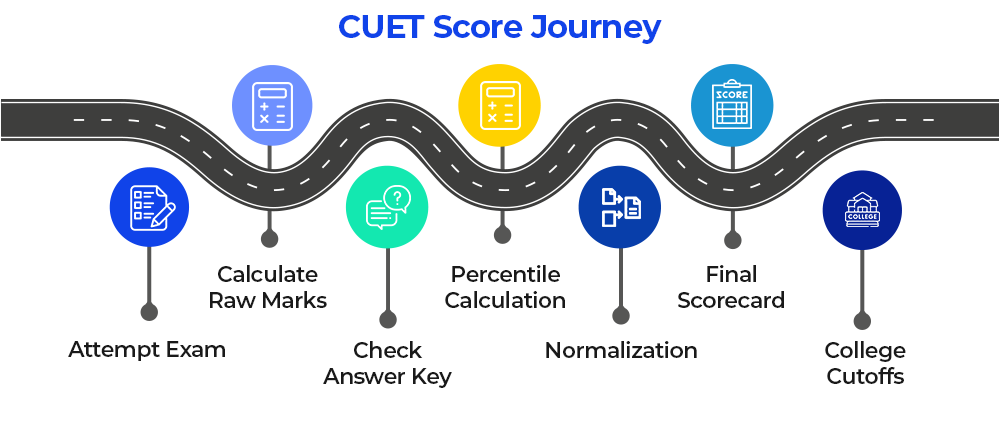
Imagine finishing your CUET 2026 exam, heart racing as you tally those raw marks—200 in math, 180 in physics. Feels solid, right? But hold up: that's just step one. In the real game to get DU, JNU, or BHU seats, it's your percentile that decides if you're celebrating or screaming for backups. With 18-20 lakh students battling multi-shift chaos, understanding marks vs percentile isn't optional—it's your edge to set mock targets, predict cutoffs, and fill choices confidently. This guide breaks it all down: calculations, trends, and pro tips to hit 95+ and lock your dream college.
What are CUET marks vs percentiles?
As a CUET aspirant, your raw CUET marks are that first number you calculate right after the exam—you will get +5 for every correct answer, -1 for wrongs, and 0 if you skip (max 250 for most 50-question sections).
here is our CUET college predictor tool that can help you get your hands on colleges based on your marks Click here
Then comes the percentile—your real game-changer. It tells you straight up how you stack up against everyone else in your session: "95th percentile? You beat 95% of the lakhs who took this shift." DU, JNU, BHU? They don't care about your raw 200; they rank on this because shifts aren't equal—your buddy in an "easy" slot might score higher but rank lower after normalization.
Why both matter to you:
- Marks: Quick reality check for mocks and self-study—hit 190+ consistently? You're on track.
- Percentile: Your admission ticket—95+ opens DU doors; 85+ are safe backups. Raw varies by luck of shift; percentile levels it so your grind counts. Focus here to pick colleges smartly!
|
Metric |
What It Means for You |
|
Raw Marks |
Your unadjusted score per subject |
|
Percentile |
% of peers you beat in session |
|
Normalized |
Fair score across all shifts |
How to Calculate CUET Marks 2026?
Once you have taken your exam (May-June 2026), you will get a provisional answer key right after at cuet.nta.nic.in. Log in with your application number and date of birth to download your response sheet and compare results (+5 for each correct; -1 for each incorrect, and 0 for each skipped).
You will benefit from calculating subject-wise estimates immediately after taking the exam, as you will identify areas of weakness due to errors in judgment and get your expectations corrected before the official announcement of results (late July). If necessary, you can challenge the answer key within an established time period (a challenge fee will apply, but may provide a benefit of 1 to 2 additional points).
CUET Marks Calculation Formula and Example
Marks = (5 × Correct) - (1 × Wrong) + (0 × Unattempted). Max 250/subject encourages 85-90% accuracy over blind guessing—losing just 10% to negatives drops you 50 marks fast. Practice this formula daily on mocks to internalize it. Remember, unattempted = safe zero, so skip doubts in 45-min sections.
Example of CUET Marks Calculation:
Take Physics (50Q): You get 38 right, 7 wrong, 5 blank. Marks = (5×38) - (1×7) = 190 - 7 = 183. Solid for the 95th percentile if normalized well.
Full mock: English 204, Math 198, Chem 192, Bio 185 = 779/1000. This total guides your daily targets—aim for +10 marks/week via error fixes.
How to Calculate the CUET Percentile 2026?
After getting your raw marks, use NTA's official stats (session-wise candidates) from the post-result data. Official percentiles appear directly on your scorecard. This helps you plan choices: aim 95+ for DU top courses, 85+ for safe backups. Check NTA portal daily once results drop (late July).
CUET Percentile Formula
P = 100 × (Candidates ≤ Your Score / Total in Session). Per subject, then averaged—no overall raw total matters.
Ties share a percentile; the top 1% (99+) needs to beat 99% of peers.
|
Your Raw Score |
Session Candidates |
≤ Your Score |
Percentile |
What It Means for You |
|
220/250 |
15,000 |
14,850 |
99 |
Top DU courses |
|
190/250 |
15,000 |
13,500 |
90 |
BHU/JNU safe |
|
160/250 |
15,000 |
11,250 |
75 |
State uni options |
|
130/250 |
15,000 |
9,000 |
60 |
Improve mocks |
Example of Percentile Calculation
Score 215/250, 14,850/15,000. ≤ you: P = 100 × (14,850/15,000) = 99. For 4 subjects averaging 98, you're golden for top 100 colleges.
CUET Normalization Process Explained
NTA uses a simple equi-percentile method to make scores fair across different exam shifts:
- Rank raw scores within your session.
- Match percentiles equally across all sessions.
- Convert to a final 0-100 normalized scale.
Example: In a tough shift, your 180 might become 92 percentile. In an easy shift, 190 might only be 90. It's fair—tested on millions of students.
CUET Marks vs Percentile 2026 (Expected Trends)
In CUET 2026, competition will be tougher because of rising cutoff scores (usually 5-10 points higher than in 2025) and the 20% increase in the number of applicants (estimated at 18-20 lakh total). High-weightage subjects such as calculus and mechanics may experience an increase in the difficulty level of high-weightage topics, creating higher cutoffs for those in the top percentiles.
Stable NTA patterns hold, but growing participation means 210+ raw marks per subject become essential for the 98th percentile—crucial for DU or JNU flagships. As a student, use this to calibrate mocks: if you're hitting 200 now, ramp up accuracy to close the gap.
Key Trend Drivers
- Higher Volume: More toppers dilute percentiles (e.g., 240+ likely needed for 100th percentile vs 235 in 2024).
- Your Action: Track NTA notifications monthly; practice Arihant/Oswaal mocks—they mirror recent shifts closely for realistic targeting.
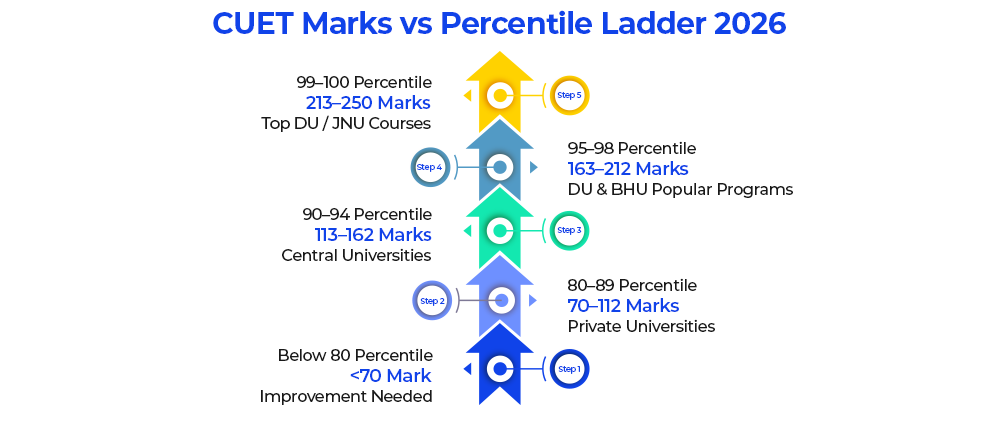
Marks Required for 90, 95, and 99 Percentiles in CUET
You, as a CUET 2026 candidate, can establish daily goals for yourself in terms of how many times you'll practice deluding yourself (mocking) and avoid practicing on a wrong schedule just before the competition; however, you must also look at the projected scores that you should get in order to achieve a top (100th) percentile. Please note that these projected scores are educated estimations based on trend analysis and will need to be adjusted based on your actual practice scores for accurate benchmarks.
|
Target Percentile |
Marks Needed (250 max) |
Strategy for Students |
College Examples |
|
99-100 |
213-250 |
90%+ accuracy, zero negatives |
DU (Econs), JNU (IR) |
|
95-98 |
163-212 |
80% hit rate, skip wisely |
DU (Hist), BHU (Arts) |
|
90-94 |
113-162 |
70% basics solid |
AMU, state flags |
|
80-89 |
70-112 |
Consistent practice |
Mid privates |
Last Year's CUET Marks vs Percentile Analysis
Previous year data gives you a solid benchmark to gauge your mocks against real competition from 14 lakh+ takers—use this table to spot where you stand and push your raw scores up for 2026's tougher field.
CUET 2025 Marks vs Percentile Trends
|
Marks Range |
Percentile |
Remarks |
|
240-250 |
100 |
Elite |
|
234-213 |
99-99.9 |
Exceptional |
|
212-188 |
98-97 |
Very strong |
|
187-163 |
96-95 |
Competitive |
|
162-138 |
94-93 |
Good |
|
137-113 |
92-90 |
Solid |
|
112-100 |
89-84 |
Average—improve |
CUET 2024 Marks vs Percentile Trends
|
Marks Range |
Percentile |
Change from 2025 |
|
235-250 |
100 |
+5 marks needed now |
|
210-234 |
99 |
Tighter |
|
180-209 |
95 |
+10-15 marks shift |
|
120-179 |
90 |
Volume impact clear |
Percentile Required for Top Universities Through CUET
As a CUET aspirant, these percentile cutoffs are your guide to smart choice-filling—generals face the highest bars, but the people from categories get breathing room. Use last year's trends to prioritize: fill 20-30 options from DU flags down to safe-state picks, and check NTA counseling rounds for exacts, since they shift yearly with seats and applicants.
|
University |
Course Type |
Gen Percentile |
OBC |
SC/ST |
Tip for You |
|
Delhi University |
B.A./B.Sc Hons |
98-99+ |
95-98 |
90-95 |
Flags like Econs/Math aim top |
|
JNU |
BA/MA Programs |
95-98 |
92-95 |
88-92 |
Lang/Social Sci strongholds |
|
BHU |
UG All |
92-97 |
88-92 |
82-88 |
Arts/Science safe bets |
|
AMU/JMI |
Major UG |
90-95 |
85-90 |
78-85 |
Good backups, central access |
|
Jamia Millia Islamia |
B.Tech/B.A. Hons |
92-96 |
88-93 |
82-88 |
Engineering/Design options |
|
Christ University |
UG Programs |
90-95 |
85-92 |
80-88 |
Private gem, quick counseling |
|
State/Central Unis |
Gen UG |
80-90 |
75-85 |
70-80 |
Fill 20+ choices for safety |
|
Tezpur University |
B.Sc/BA Integrated |
85-92 |
82-88 |
78-85 |
Northeast edge, low competition |
|
Pondicherry Univ |
UG All |
82-90 |
78-85 |
72-82 |
Southern safe, diverse courses |
Tips to Achieve a High Percentile in CUET 2026

Some pointers to excel up your preparation game:
- Fix your weak link: Spot your lowest mock scorer. Give it 2 extra hours weekly—no ignoring it till exam day.
- Analyze mocks right away: Finish the test and redo errors the next morning—it turns mistakes into strengths quicker than anything.
- Solve the past 5 years' papers: Repeats pop up, plus it builds speed so 45 mins feel easy.
- Health isn't optional: 15-min walk after studying, 7 hours sleep—skip all-nighters or your brain blanks out.
- Build a peer group: WhatsApp doubts weekly with friends—motivation and quick fixes when you're stuck solo.
- Final month game plan: Ramp to 3 mocks/day, no new topics—just polish what you know for that 95+ jump.
Summing Up!
By now know everything you need to know—from how to calculate raw marks and make your own predictions to how to determine university cutoff scores. As we prepare for CUET 2026, remember that consistency in your mocking will give you a better chance at achieving a top percentile than cramming will; therefore, to secure a seat in a flagship program, you want to achieve an average of 210+ in each subject, because this will help you achieve a top-rated percentile in the increasingly competitive environment of CUET 2026.
So get started today by picking up an NCERT, finding a self-timed mock to complete, and tracking your progress; you have a place in a flagship programme waiting for you — now it's time to work smart, stay focused, and have confidence in your results in July.