


If you are drawn to professional roles that can help you connect with large audiences and impact them, then journalism is a career option that will enable you to do just that! A quite mature field in its own right, having grown ever since the pre-independence era of our nation, journalism is referred to as the fourth pillar of Indian democracy. As a career domain, journalism includes the dissemination and communication of information and news to a larger audience, usually the general population, upon due collection, analysis, and fact-checking.

Journalism includes various forms–investigative journalism, online journalism, opinion journalism, broadcast journalism and so on, depending on the type of information being shared or the media being used for it.
As a career domain in India, journalism is regarded as one of the most mature fields, with a number of opportunities in public and private domains for a professional to venture into. It is a well-paid field in India and has multiple channels of formal education to kickstart one’s career in it. In this blog, we will deep dive into the career field’s scope, educational trajectory, career opportunities,s and more!
Why Choose a Career in Journalism?
If you are someone in split minds about becoming a journalist or are exploring the field to decide whether it aligns with your career aspirations, here are some of the key factors that you should consider in the domain’s favor:
- Diverse Subfields to Venture Into: Journalism as a career field is quite vast and diversified, offering a myriad of career opportunities in fields like news reporting, sports journalism, sociopolitical journalism, fashion journalism, and so on.
- Appealing Compensation: Journalism as a field pays lucrative and appealing compensation in addition to the networking opportunities it offers. While freshers may have to start off with moderate to low packages in their career, with the growing experience and exposure, this amount grows manifold.
- Ability to Create a Social Impact: Unlike a lot of other lucrative career domains, journalism offers the chance for a professional to directly impact the general audience through their work and reporting. This ability to create a social impact and facilitate change is another major factor to consider while considering a career in journalism.
- Dynamicity & Fast-Paced Work Environment: The dynamic and fast-paced nature of the field of journalism brings vast exposure in addition to honing skills of flexibility and adaptability in the profession.
- Widespread Networking Ability: Working in a field such as journalism often helps you build strong connections across industries and network with influential individuals, both of which can further help in gathering information and reporting from a further informed perspective. It can additionally open up many doors for the professional.
While there are several pros associated with the field of journalism, there are certain considerations to make which might make the role challenging for some individuals. These include aspects like the high workload and pressure, the requirement for round-the-clock availability especially in the initial years of the career, exposure to risks involved in live reporting from various venues, the possibility of being subjected to public and ethical scrutiny, etc.
Choosing one’s career in journalism must be a holistic decision depending on consideration of several factors including the career’s scope, the pros and cons involved in it, the education involved, the return on investment, and so on.
Roles & Responsibilities of a Journalist
To understand the job role of a journalist in its entirety, knowing the key responsibility areas is important. Enlisted below is a glimpse of some of the main responsibilities that a journalist must look after:
- Conducting research and analysis into various news stories, events, and cases.
- Conducting factual checks into various pieces of information to ensure their factual accuracy and precision.
- Covering various stories, cases, and events and reporting them from the venue (for news reporting).
- Writing articles, news pieces, blogs, short content pieces, etc. about various current affairs and happenings.
- Interacting and interviewing the general population or specific individuals to gain public opinions, gather information, and share the same with the masses.
- Participate in news production by closely working with editors, designers, photographers, etc.
- Analyse datasets and draw meaningful insights about the same, further visualizing them through graphical and chart representations (especially for the subdomain of data journalism).
- Help produce news content to spread awareness through digital media including videos, audio, print/textual content, and so on.
- Ensure the adherence of produced news content to ethical guidelines.
Overall, a journalist’s role involves right from the gathering of information either live from sites, through research,h or through one’s sources followed by its factual checking, production through collaborating with multiple stakeholders to its release and adherence to ethical guidelines.
Key Skills Needed for Journalism
A host of technical and soft skills form the required repertoire of skills needed to thrive in a career in journalism. These have been elaborated upon below.
1. Technical Skills & Knowledge to Succeed as a Journalist
Technical skills in journalism include the hard skills and functional areas one needs to be proficient in to manage their day-to-day job responsibilities. These include aspects like digital literacy, multimedia efficiency and so on which have been elaborated upon herein.
|
Key Skills |
Specifications |
|
Reporting Skills |
Being able to report information and messages impactfully in multimedia including press, audiovisual, or audio media is central to a career in journalism |
|
Research & Factual Checking Skills |
Ensuring that the information being delivered to the general population is factually sound, credible, and accurate is a key part of a journalist’s role (especially if they are in the reporting domain of journalism) |
|
Content Creation |
The ability to generate unique and original content in terms of news articles, news reporting, social media posts etc. is key to the role of a journalist |
|
Multimedia Production |
Being proficient in multiple media forms (e.g. print media, audiovisual media, audio media etc.) in terms of content creation, content management and designing etc. are essential to thrive in journalism |
|
Digital Literacy |
Being able to manage digital media effectively in terms of knowledge of search engine optimization, familiarity with content management systems (CMS) etc. are becoming important given the rise of digital journalism. |
|
Data Analysis & Visualisation |
Data journalism is a niche domain of journalism which includes representation of information and news in data-based formats, thus calling for proficiency in effective data analysis and visualization through tools like Tableau, MS Excel etc. |
2. Soft Skills to Succeed as a Journalist
Soft skills or interpersonal skills form an integral part of the needed competencies of journalism. This career domain calls for the ability to connect with one’s audience at an emotional level so as to create meaningful impact, in addition to being able to thrive professionally. Thus, soft skills like the ones mentioned below form a key part of the repertoire of needed skills in journalism.
|
Key Skills |
Specifications |
|
Communication Skills |
Being able to communicate in an impactful manner, facilitating conversations around various sociopolitical happenings, creating impact through one’s messages, etc. helps a professional thrive in this domain. |
|
Emotional Intelligence |
Journalists need to be attuned to one’s audience, their psyche, perceptions, and opinions, identifying their emotional reactions and managing them through one’s messages and reporting. |
|
Interpersonal Skills |
Being able to network efficiently, and build trust in relationships with one’s audience, sources of information and colleagues are essential to journalism as a career. |
|
Ethical Integrity |
Journalists require a commitment to be unbiased and honest in their reporting, considering their work includes an impact on the general population. |
|
Adaptability & Flexibility |
Being attuned to and aware of changing social landscapes, current events and happenings, etc. requires the journalist to flexibly adapt to such situations. |
What are the Career Opportunities for Journalism (Types of Options available in Journalism)
Journalism is a career field that has matured in India over the years. Resultantly, it has diversified into numerous subdomains, each with its niche audience, requirements, and industry trends. Today, journalists can decide whether to venture into investigative journalism, broadcast journalism, opinion journalism, and so on. Additionally, there are several other domains studying journalism such as digital journalism, mobile journalism, and domains like fashion, social media, sports, etc. to explore as a journalist.
Various subfields of journalism offer varying compensation and perks to professionals, and the packages see considerable growth with added years of experience as well. A few of the traditional and up-and-coming roles in this field have been mentioned below. Please note, that the salary figures mentioned reflect approximate compensation levels in India, subject to variation with time and across organizations.
|
Career Option |
Average Salary (Per Annum) |
|
Sports Journalist |
INR 4,50,000 |
|
Journalist |
INR 3,96,000 |
|
Fashion Journalist |
INR 5,00,000 |
|
News Reporter |
INR 3,02,000 |
|
News Anchor |
INR 6,87,000 |
|
Newspaper Editor |
INR 3,91,000 |
|
PR Specialist |
INR 5,74,000 |
|
Freelance News Writer |
INR 3,00,000 |
|
Research & Academia |
INR 6,00,000 |
|
Broadcast Journalist |
INR 7,50,000 |
Career Analysis: What is the Salary & Demand for Journalism?
Continue reading to dive deep into the career of journalism and its scope, compensation trends, and current industry insights.
1. Demand for Journalists: Industry Trends
Some of the current pertinent trends in the field of journalism have been enlisted below for you to consider if you are pondering about establishing yourself as a journalist in India.
- The expected growth in the industry of journalism is projected to be around 8.8% CAGR over the next 2 years till 2026.
- The up-and-coming opportunities in journalism are available for professionals in domains like digital digital journalism, investigative reporting, content creation, and production.
- The integration of AI is another growing trend in the field of journalism, opening up opportunities for software developers and AI engineers to explore job opportunities in the industry. However, there is a concern associated with this automation regarding ethical reporting.
- There is an accompanied decline of dependence on traditional journalism and mass communication sources like television reporting, print media, etc. owing to the widespread rise of digital media as a channel for journalism.
- A few of the top and prestigious employers in this field in the Indian context include The Times of India Group, NDTV, Indian Express etc.
2. Fees & Costs Involved in Becoming a Journalist
While journalism is a free profession open for students and professionals from all educational backgrounds, formal education in journalism gives major professional leverage to those deciding to pursue a career as a journalist. Preferably, taking up a course in journalism (often in dual specialization with mass communication) at the undergraduate level can be helpful for the student to explore career options. Alternatively, one can also consider PG degrees or certifications/diplomas in journalism.
The fee for these courses depends on several factors including the particular institution one chooses to pursue the course from, the mode of education (e.g. distance versus regular versus fully online modes), the course levels and duration (e.g. a Bachelor’s degree versus a Master’s degree). In consideration of these factors, the financial investment in the form of course fees varies. A few of the prime online degrees, diplomas, and certifications available in journalism have been mentioned below for reference.
|
Journalism Courses |
Approximate Course Fees |
|
INR 2,00,000 |
|
|
INR 1,50,000 |
|
|
INR 1,50,000 |
|
|
M.A. in Media Business Studies |
INR 3,00,000 |
|
M.A. in Communication & Journalism |
INR 2,50,000 |
|
M.A. in Strategic Communication |
INR 2,50,000 |
|
Post Graduate Diploma in Journalism |
INR 95,000 |
|
Post Graduate Diploma in Radio & Television Journalism |
INR 1,70,000 |
|
Post Graduate Diploma in Advertising & Communication |
INR 1,50,000 |
|
Post Graduate Diploma in Digital Media |
INR 2,50,000 |
|
Diploma in Journalism |
INR 2,00,000 |
Career Growth Trajectory of Journalism
The latest career growth statistics for the field of journalism provide the following insights represented graphically below.
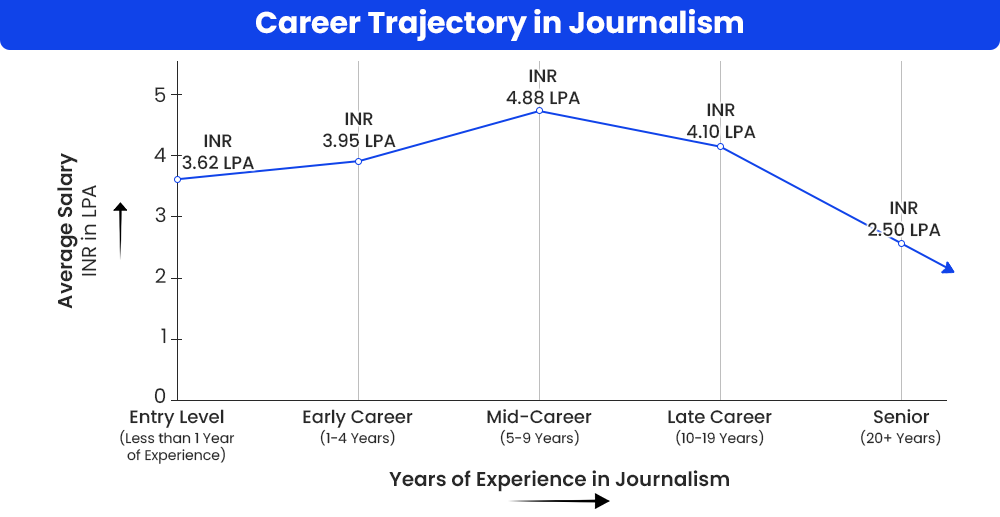
As can be seen, starting off one’s career in journalism may entail moderate salary ranges. Following this, over a few years of experience, the compensation offered to a journalist grows. Once the professional explores relevant opportunities in the field, the salaries they can bag grow immensely.
Career Navigator: What Course to Pursue for a Career in Journalism?
Starting one’s career in this domain can be facilitated once a student obtains at least an undergraduate education in journalism. There are no stream-wise restrictions for students at the higher secondary level to take up a Bachelor’s in journalism. However, even if a Bachelor’s graduate is not from a journalism background, the option of establishing oneself in the field can still be explored through a Master’s degree/ PG diploma/ PG certificate in journalism.
The overall trajectory of establishing oneself as a journalist has been elaborated below:
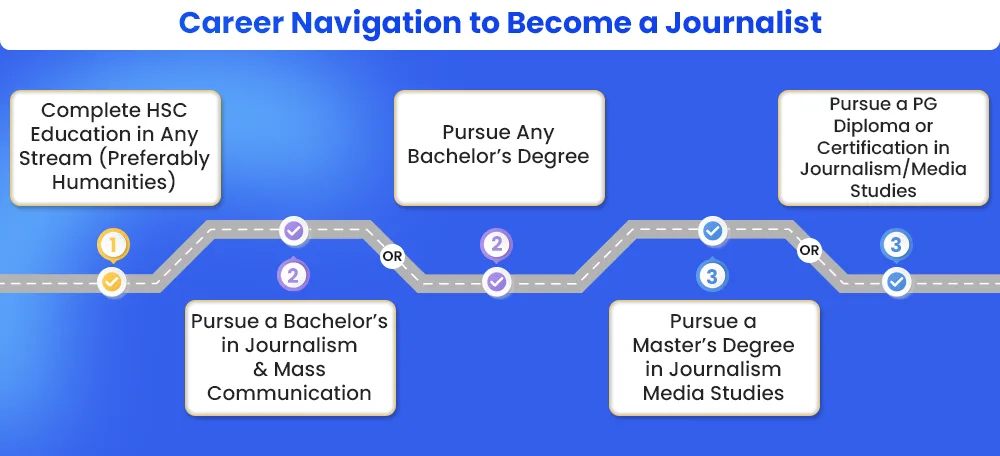
Some of the most commonly pursued courses in journalism include a Bachelor’s in Journalism or Mass Communication (often referred to as BJMC), a Master’s in Journalism and Mass Communication, a Post Graduate Diploma in Journalism, a diploma in journalism, etc. There are numerous top institutions in the public and private domains to pursue formal education in this field. Moreover, a large number of these institutions offer their educational services in the fully online mode and distance modes as well.
Top Colleges & Institutes for Journalism
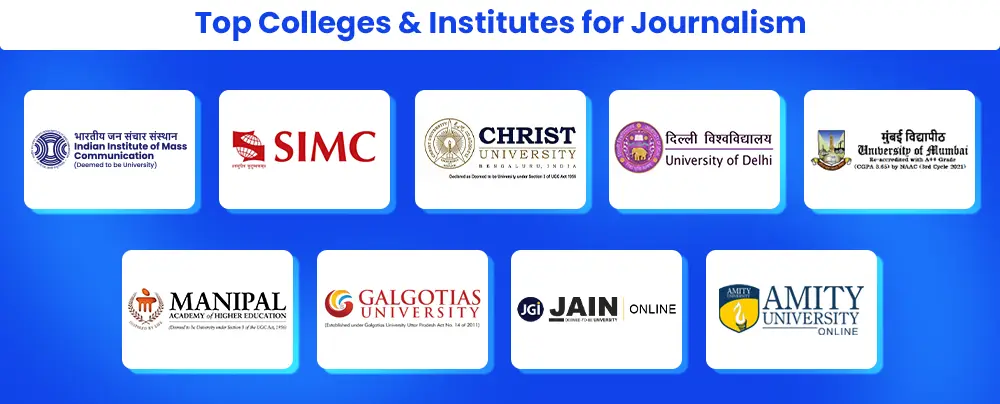
Here are a few of the most prestigious institutions for journalism, mass communication,n and media studies are represented below:
Conclusion
Journalism is a career field in the non-technical domain that offers an opportunity to an aspirant to connect with the masses through the dissemination of information and contribute towards creating a social impact. In addition to the vast scope and exposure that journalism offers, the field has become increasingly accessible to students from a vast variety of backgrounds given the number of online as well as regular courses available to pursue in this domain.