
Becoming a Supreme Court lawyer in India demands dedication, deep legal expertise, and a clear route of academic and professional milestones. While all advocates begin their careers through similar legal education and Bar Council registration, training in the Supreme Court requires extra qualifications, including passing the Advocate-on-Record exam. This journey combines experience, knowledge, and a strong commitment to constitutional and legal excellence.
Who can become a Supreme Court lawyer?
A Supreme Court lawyer is a lawyer who is qualified to practice law and present arguments before the Supreme Court of India. These attorneys frequently defend clients in important and challenging cases and have extensive knowledge of both constitutional and legal issues. They may become Advocates-on-Record to submit petitions directly to the Supreme Court, but they must fulfill certain qualifying requirements to do the legal proceedings right before the Supreme Court Judge, whom we call the Chief Justice of India (CJI).
Let’s explain a bit about the AOR and then you get all the necessary details about it further in this blog. AOR is an exam that makes you eligible to present the arguments in front of the Justice of the Supreme Court. Without qualifying for this exam, the Lawyer may not fight or defend their clients in any case; all they can do is assist the SC Lawyer who is on that record (The Advocate-on-record). You must qualify for the AOR exam and thus can become the Supreme Court Lawyer. Keep reading this blog, you’ll soon get to learn about what is the education qualification required to become a Supreme Court Lawyer.
Roles and responsibilities:
- In high-stakes criminal, civil, or constitutional cases, represent clients.
- Give clients strategic direction and legal advice.
- Keep informed of legislative developments and court decisions to bolster your case.
- Analyze and apply intricate legal precedents and requirements.
- Make sure that all Supreme Court rules and procedures are strictly followed.
- Submit and present petitions to the Supreme Court, including appeals and writs.
- Create compelling legal papers, such as written submissions, answers, and petitions.
The basic difference between a regular Lawyer and a Supreme Court Lawyer:
- Practice Jurisdiction: While Supreme Court advocates work in the highest court, regular lawyers can practice in lower courts, district courts, and High Courts.
- Qualification: Only AORs are qualified to file documents or petitions in the Supreme Court; regular lawyers are not.
- Experience: Supreme Court advocates typically have years of experience and specialization.
- Case Complexity: Supreme Court cases are frequently constitutional or involve matters of national importance.
- Procedural Knowledge: Supreme Court practice necessitates familiarity with particular court procedures.
- Recognition: Supreme Court advocates have a higher legal stature.
Requirement of educational qualification
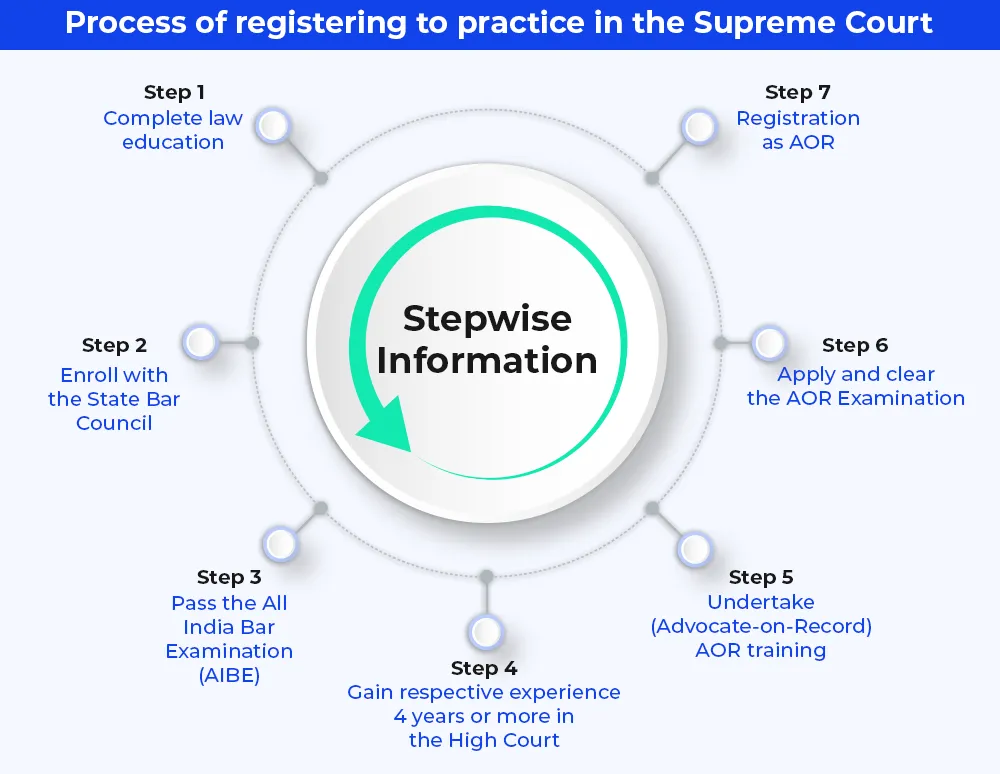
To become a Supreme Court Lawyer, an aspirant must fulfill the following eligibility criteria:
- Aspirants must have completed their bachelor’s degree in Law (LLB).
- Enrollment with the State Bar Council is a must under the Advocates Act of 1961.
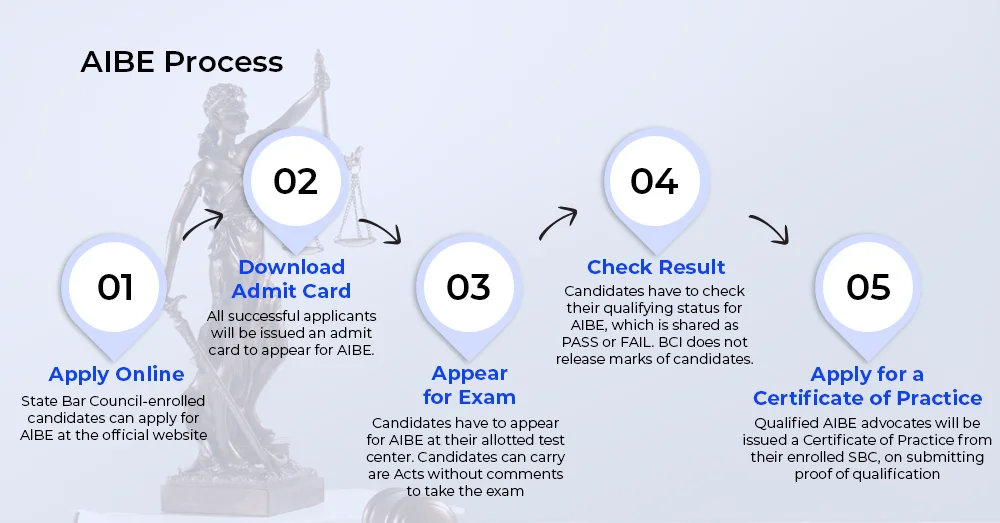
- To practice on the Court of Law, aspirants must have passed the “All India Bar Examination (AIBE)” and get the certificate of practice.
- A minimum of 5 years of legal experience is required. Minimum 3 years in district court and 2 years in High Court. Also, to file directly into the Supreme Court, candidates must have at last 4 years of experience in the High Court.
- Advocate-on-Record (AOR) exam is a must to be passed by the aspirants to file petitions in the Supreme Court.
Syllabus and specializations
LLM needs a specialization to be chosen. Every aspirant must choose a specialization or a combination of two specializations in which they wish to complete the LLM degree. Below is the syllabus that students are going to read in their LLM program, If they wish to pursue it. However, if the students have completed their master's degree in Law, then the students getan additional 5 marks than the students who have applied just after completing an LLB degree. So, one should prefer to complete their master’s degree as well. Keep reading this blog, and you will get the details about LLM programs as well.
|
Syllabus for LLM degree | |
|
Legal research methodology:
|
Law and Justice in the Globalizing World:
|
|
Comparative public law:
|
|
LLM specializations
|
LLM specializations |
Core subjects |
|
Business laws |
|
|
Constitutional Law |
|
|
Criminal Law |
|
|
Human Rights |
|
|
IPR & Tech Law |
|
|
Family Law |
|
What is Advocate-on-Record?
An Advocate-on-Record (AOR) is a lawyer authorized to behave, act, and plead on behalf of a party in the Supreme Court of India. Only AORs can report legal documents, manage court procedures, and represent customers officially before the court docket. They should pass a special AOR examination conducted by the Supreme Court.

AOR Exam Syllabus: Overview
|
Paper |
Question paper name |
Marks |
|
Paper I |
Practice and procedure of the Supreme Court |
100 |
|
Paper II |
Drafting |
100 |
|
Paper III |
Professional ethics |
100 |
|
Paper IV |
Leading cases |
100 |
AOR Exam Syllabus
|
Paper |
Question paper name |
Description |
|
Paper I |
Practice and procedure of Supreme Court |
|
|
Paper II |
Drafting |
|
|
Paper III |
Professional ethics |
|
|
Paper IV |
Leading cases |
|
AOR Exam Pattern
|
Particulars |
Description |
|
Total number of papers |
4 papers |
|
Mode |
Offline Exam |
|
Time duration |
3 hours for each paper |
|
Type of questions |
Descriptive type questions |
|
Total marks |
100 per paper |
|
Language |
English |
Role of the Bar Council of India (BCI)
The Bar Council of India plays a major role in the legal sector. Below are a few of the roles of BCI:
- Manages professional standards and legal education throughout India.
- Speaks on behalf of the Indian legal community abroad.
- Establishes guidelines for advocates' proper behavior and conduct.
- Advocates for access to justice and legal reform.
- Recognizes legal schools and keeps an eye on their curricula.
- Disciplinary power to deal with wrongdoing in the workplace.
- Carries out legal awareness campaigns and lectures.
A few tips for aspiring candidates
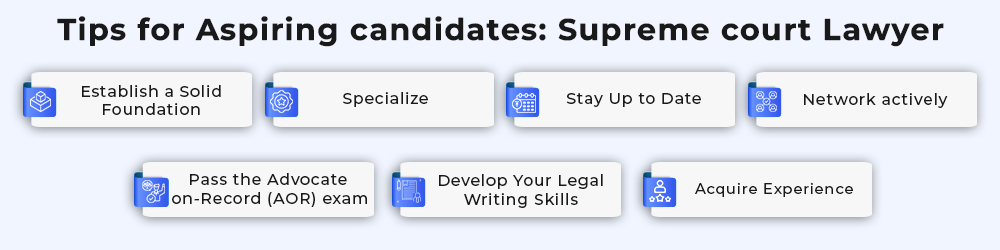
- Establish a Solid Foundation: Get an LLB from an accredited university to begin with a solid grasp of constitutional law and legal processes.
- Specialize: Pay attention to legal fields like criminal, civil, or constitutional law that are important to the Supreme Court.
- Stay Up to Date: Regularly follow significant rulings, modifications, and legal developments.
- Network actively: Engage in active networking by making connections with attorneys, going to seminars, and taking part in bar association events to gain visibility and guidance.
- Pass the Advocate-on-Record (AOR) exam: After four years of practice, one must pass the AOR exam to file before the Supreme Court.
- Develop Your Legal Writing Skills: Acquire the ability to write persuasive arguments, legal opinions, and petitions.
- Acquire Experience: Gain years of courtroom experience, ideally in High Courts, working under experienced attorneys.
Universities offering LLM program
Various universities in India offer LLM degrees to the students which help them to get advanced knowledge about the specific subject or specialization. Below are a few of the universities thet offer LLM programs through regular mode.
|
Universities offering LLM programs in regular mode | |
|
National Law School |
Aligarh Muslim University |
|
Faculty Of Law |
Chaudhary Charan Singh University |
|
University of Delhi |
UPES |
|
Amity University |
Lovely Professional University |
|
NLU |
BHU |
Universities offering LLM programs for working professionals
Universities in India understand that law professionals wish to practice in the court of law and still want to get additional knowledge for certain reasons. Also, having a Master in Law gives them additional marks in the entrance and registration to become lawyers.
|
Universities offering LLM programs for working professionals | |
|
Kurukshetra Univerity |
Jamia Millia Islamia |
|
KUVEMPU University |
Jindal Global Law School |
|
Karnataka State Open University |
Banaras Hindu University |
Top colleges offering 1-year LLM program
Some universities and colleges in India offer 1-year LLM program. Most working professionals apply for this program. This program has various benefits to pursue. Let’ check ome universities offering 1 1-year LLM program with their specialization offered by them to the students:
|
Top colleges offering 1-Year LLM program | |
|
Colleges |
Specializations |
|
Jindal Global Law School (Blended Learning Program) |
|
|
National Law University, Delhi |
|
|
Lovely Professional University |
|
|
Symbiosis Law School International, Pune |
|
|
NLU, Kolkata |
|
|
UPES |
|
Jindal Global Law School
Since its initial establishment in 2009, Jindal Global Law School has been assisting law enthusiasts in realizing their aspirations through the completion of their legal degrees. The Bar Council of India (BCI) and the University Grants Commission (UGC) have both approved Jindal Global Law School. This school provides a blended learning option for its LLM program.
| Jindal Global Law School | |
|
Eligibility criteria for admission |
|
|
Specializations |
|
|
Course Duration |
1-year program |
|
Fee |
INR 3,50,000 |
Syllabus
Below is the table that will help you to get the knowledge regarding the specialization and syllabus offered. Let’s have a look at that:
|
Specializations and syllabus at Jindal Global Law School (Blended Learning Program) | |
|
Specializations |
Syllabus/Subjects |
|
Corporate & Financial Law |
|
|
AI and Emerging Technologies |
|
|
Intellectual Property & Technology Law |
|
|
Dispute Resolution |
|
Conclusion
This blog aims to get you a better understanding of how to become a Supreme Court Lawyer. There are various legal terminologies that you understood after reading this whole blog. Also, there is no need to pursue an LLM program, but if you did your master's and then applied to become a Supreme Court Lawyer then it will give you additional benefits.
Hope you get the answers to what you were looking for in this blog.