

The Indian Institutes of Management (IIMs) stand as pillars of excellence in the realm of management education, not only in India but also on the global stage. For aspiring students, gaining admission to an IIM is a significant milestone, and understanding the admission process is crucial in achieving this goal.
CAT 2025 Latest Update: Answer Key Released on Dec 5: Click Here
CAT 2025 Admit Card OUT (Live)... Download it and check the details. Get CAT 2025 Live Notifications: Click Here.
In this detailed guide, we describe in minute detail all the steps included in gaining admission to an IIM, understanding the eligibility criteria, application steps, evaluation methods, and financial considerations.

| IIM Executive MBA Online |
Whether you aim for vibrant campus life or seek the flexibility of online learning, this guide will serve as your compass, navigating you through the academic rigours and the exhilarating opportunities that await.
IIM Eligibility Criteria
Before you understand the admission process, it is vital to first know if you are even eligible for admission to the course of your choice or not. Following, we have described in detail the eligibility conditions that an applicant must fulfill for IIM admission. Also Read: Eligibility Criteria for IIMS: Online v/s On-Campus Courses!
Eligibility for On-Campus Courses at IIMs
- Minimum Educational Qualifications: To be eligible for on-campus courses at IIMs, candidates are typically required to possess a Bachelor's degree from a recognized institution. This forms the foundational academic qualification.
- Academic Background and Prerequisites: While a Bachelor's degree is the primary requirement, some specialized programs may specify particular academic backgrounds or prerequisites. For instance, a program in finance may require prior coursework in accounting or economics.
- Standardized Test Scores (e.g., CAT, GMAT): Most IIMs use standardized tests like the Common Admission Test (CAT) or the Graduate Management Admission Test (GMAT) as part of the admission criteria. These scores serve as a benchmark for evaluating candidates' aptitude and readiness for the rigors of the program.
Eligibility for Online Courses at IIMS
- Educational Qualifications: The eligibility criteria for online courses are generally aligned with on-campus programs. Applicants are typically required to hold a Bachelor's degree from a recognized institution.
- Additional Considerations: In the case of online courses, there may be additional considerations such as proficiency in the English language and technical skills, given the virtual learning environment.
- Language Proficiency (if applicable): For non-English speakers, some programs may require a minimum proficiency level in English, often demonstrated through standardised tests like TOEFL or IELTS.
Admission Process: On-Campus Courses at IIMS
The admission procedure for the on-campus courses at Indian Institutes of Management (IIMs) is quite detailed as the selection procedure involves the IIM entrance exam - CAT. Given below is the detailed step-by-step admission procedure:
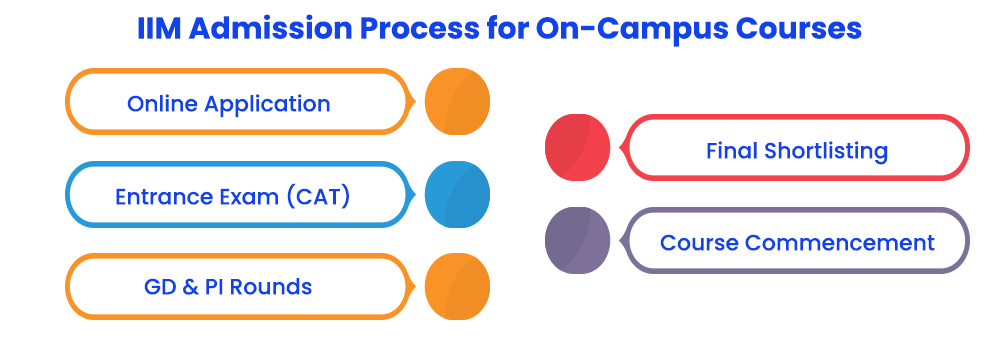
Step 1: Application
The journey begins with the application process. Prospective candidates need to submit their applications through the official channels specified by the respective IIM. Careful attention to detail in filling out forms and providing necessary documents is crucial.
Step 2: Entrance Exam
For on-campus courses, the significance of standardized test scores cannot be overstated. CAT and GMAT scores play a pivotal role in shortlisting candidates for the subsequent stages.
**Tips for Exam Preparation**
- Begin preparation well in advance.
- Utilise official study materials and practice tests.
- Consider enrolling in preparatory courses if needed.
Step 3: Shortlisting
Based on a holistic evaluation that includes entrance exam scores, academic performance, and other relevant factors, candidates are shortlisted for the next stage. Additionally, the Statement of Purpose (SOP) or Personal Statement submitted during the application process can significantly influence the shortlisting decision.
Step 4: Group Discussion (GD) and Personal Interview (PI)
The GD and PI stages serve to assess candidates' communication skills, leadership potential, and ability to work effectively in a team.
**Preparation Tips**
- Stay updated on current affairs and business trends.
- Practice articulating your viewpoints clearly and concisely.
- Engage in mock GD sessions for practice.
Step 5: Final Selection
The final list of selected candidates is determined through a comprehensive evaluation, considering factors such as academic performance, work experience, diversity in background, and performance in GD and PI.
IIM Admission Process: Online Courses
The admission process for the online courses at IIMs is a lot simpler than the on-campus courses because there are no entrance exams for selection. The candidates only need to fulfill the required eligibility criteria. There might be an interview for a few selected courses. The following is the step-by-step admission procedure:
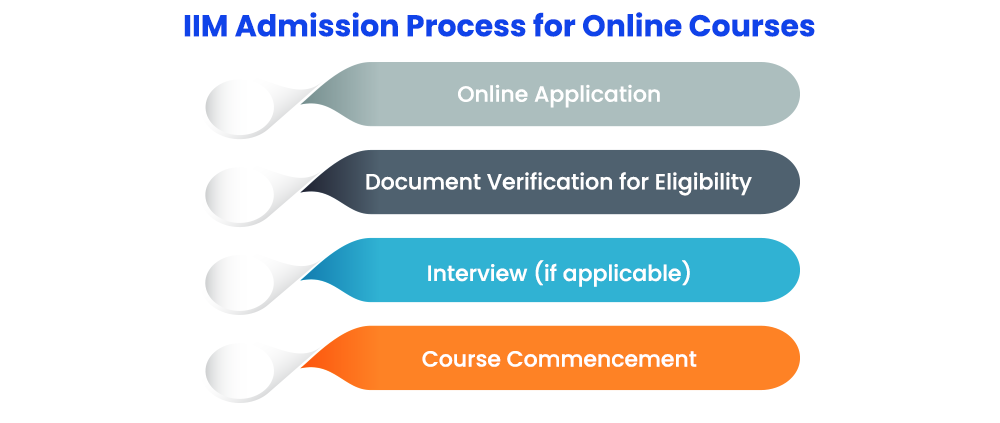
Step 1: Application
The application process for online courses follows a similar trajectory to on-campus programs, with specific considerations for the virtual learning format.
Step 2: Eligibility Evaluation
Document verification is a crucial step for online programs because admission is based mostly on the candidate’s fulfillment of the eligibility criteria. If you fulfill the prescribed eligibility criteria during the document evaluation, then you will be shortlisted for the final selection round (if applicable).
Step 3: Interview (if applicable)
Certain online programs may require an interview to further assess candidates' suitability for the virtual format. In case there is no interview, the applicant gets direct admission to the online program after successful eligibility evaluation.
IIM Admission Process for International Applicants
The admission procedure for international applicants at Indian Institutes of Management (IIMs) may vary slightly from that of domestic applicants. Here is a general overview:
IIM Eligibility Criteria for International Applicants:
- Academic Qualifications: International applicants must hold an equivalent of a bachelor's degree from a recognized institution or university in their respective country.
- Standardized Test Scores: Some IIMs may require international applicants to submit standardized test scores like GMAT or GRE. This requirement can vary by program and institution.
- Language Proficiency: Proficiency in the English language is essential for effective participation in the program. International applicants may be required to submit scores from recognized English proficiency tests like TOEFL or IELTS.
- Work Experience (if applicable): Work experience requirements, if any, will be specified by the specific program. Some programs, particularly executive or specialized courses, may require a minimum number of years of work experience.
- Admission Process for International Applicants: The admission procedure for international applicants at IIMs is quite easy. It is almost identical to a normal procedure. There are minute differences like the submission of certain additional documents, proof of English proficiency, and Visa requirements, etc. Following is the step by step admission procedure:
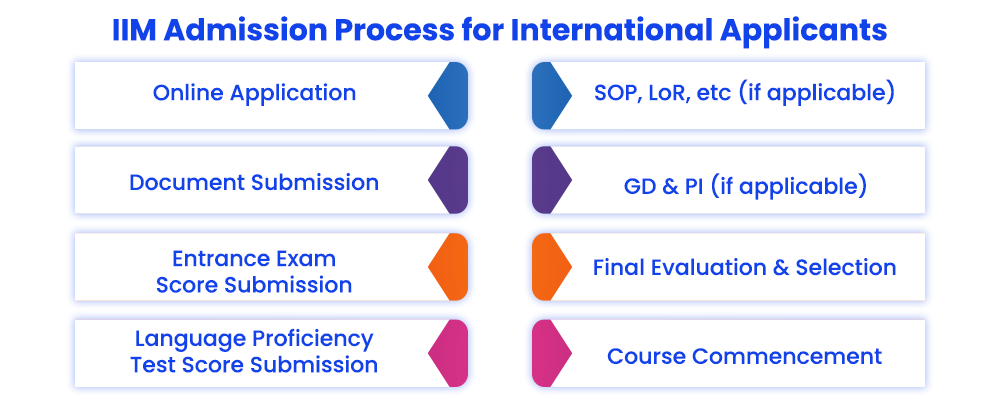
- Application Submission: International applicants need to submit their applications through the official portal or application platform specified by the respective IIM.
- Academic Transcripts and Certificates: Applicants must provide copies of their academic transcripts, degrees, and certificates. These should be translated into English if the original documents are in a different language.
- Standardized Test Scores: If required, international applicants must submit their GMAT, GRE, or any other specified standardized test scores along with their application.
- Language Proficiency Test Scores: International applicants may need to submit scores from recognized English proficiency tests like TOEFL or IELTS, demonstrating their proficiency in the English language.
- Statement of Purpose (SOP) or Personal Statement: A well-crafted SOP or personal statement outlining career goals, motivations, and aspirations may be required as part of the application.
- Letters of Recommendation (if applicable): Some programs may require letters of recommendation from academic or professional sources to support the application.
- Interview (if applicable): Depending on the program, international applicants may be invited for an interview, which could be conducted in person, via video conference, or through other virtual platforms.
- Evaluation of Qualifications: The admissions committee evaluates the qualifications and credentials of international applicants, including academic performance, test scores, work experience, and language proficiency.
- Final Selection: The final selection of international applicants is based on a holistic assessment of all application materials, including academic qualifications, test scores, work experience, and interview performance (if applicable).
IIM Courses
There are several types of courses in the field of Management that IIM offers like 2 year PGP (MBA) courses, 1 year Executive MBA courses, certification, and diploma courses in both on-campus and online learning formats. The eligibility criteria varies for these different types and the admission might also slightly vary.
Given below is the course wise eligibility criteria and admission procedure at IIM:
|
Course Type |
Eligibility Criteria |
Admission Procedure |
|
On-Campus Programs |
||
|
Post Graduate Program (PGP) in Management (2-year MBA) |
|
|
|
Fellow Program in Management (FPM) |
|
|
|
Executive Post Graduate Programs (EPGP) in Management (Executive MBA) |
|
|
|
Online Programs |
||
|
Online Post Graduate Program in Management (Online MBA) |
|
|
|
Online Executive Post Graduate Program (ePGP) |
|
|
|
Online Certificate Programs |
|
|
**These eligibility criteria and admission processes provide a broad overview, but it's important to note that specific details may vary between different IIMs and their programs.**
| Top Trending Courses for IIMs | |
IIM Fee Structure
IIM On-Campus Courses:
- Tuition and Other Fees: The fee structure for on-campus programs encompasses various components, including tuition fees, accommodation charges (if applicable), library fees, and other miscellaneous expenses. The fee is different for different programs.
- Scholarships and Financial Aid: IIMs often offer scholarships and financial aid options to deserving candidates. Prospective students are encouraged to explore these opportunities to alleviate the financial burden of pursuing their education.
- Payment Plans: IIMs may provide flexible payment plans to facilitate the payment of fees in instalments, making education more accessible.
IIM Online Courses:
- Fee Components: The fee structure for online courses may differ from that of on-campus programs. It typically covers tuition, online learning resources, and any associated materials or software. The fee for an online program is a lot less in comparison to its on-campus counterpart, and the online mode also saves you from additional expenses like accommodation, travelling, etc.
- Financial Support Options: While online courses may have fewer scholarship opportunities, some IIMs may offer reduced fees for specific online programs. Also Read: IIM Fees Structure: MBA fees of 20 IIMS for New Batch!
| Top Trending Article for IIMs | |
Conclusion
In conclusion, gaining admission to an IIM is a significant achievement for any aspiring management professional. Understanding the intricacies of the admission process, whether for on-campus or online courses, is crucial in navigating this path. Prospective candidates are encouraged to start early, prepare diligently, and leverage all available resources to maximise their chances of success.





![Is CAT mandatory to take Admission in IIMs? [Alternative 2025]](https://d1aeya7jd2fyco.cloudfront.net/blog/admission-to-iims-without-cat-exam.webp)