


While a few years ago, entrepreneurship was seen as a rather niche field in which few individuals dared to venture due to its ambiguity, of late, it has turned into a full-time career path commonly taken by many. With a number of changes impacting the commercial sector and the economy of the nation, newer avenues where entrepreneurs are stepping are coming to light, highlighting the diverse nature of the field.
In its essence, entrepreneurship involves building up a product or service that addresses a market gap or customer needs and converting that opportunity into a successful business venture through calculated risks. An entrepreneur does not simply stick to a role for an organization; they build it up from multiple perspectives of strategy, production, development, operations, management, and so on.
In this blog, we dive deep into the career of entrepreneurship and explore its value and benefits for an aspiring entrepreneur. Continue reading to discover details about the career’s responsibilities, scope for growth, earning potential, and so on.
Why Choose a Career in Entrepreneurship & Management?
Being an entrepreneur is significantly different from doing a job for another venture. While working on a full-time/part-time job allows you stability and financial security, it usually comes with a restriction to a specific function/role and a limited earning potential. On the other hand, while the financial risk involved in starting an entrepreneurship is high, it allows you the opportunity for exponential financial growth and growing your skills in diverse domains of management, leadership, and strategy.
Here we have drawn a comparison of the nature of your career as an employee on the payroll of an organisation vis. a vis. starting your own entrepreneurial venture. Such a comparison can be helpful to evaluate whether you are fit for a job role or an entrepreneurial role.
|
Domain |
Employee |
Entrepreneur |
|
Flexibility in the Role |
Limited flexibility within the purview of the job role |
High flexibility around work hours, responsibilities, locations to work from, and so on. |
|
Earning Potential |
Scope for Stable Income from the Initial Years, Limited Earning Potential Over Long Periods |
Income may be Initially Low but Grows Exponentially After Business Picks Up |
|
Impact on Users & Consumers |
Indirect or Limited Individual Impact on Users |
Scope to Directly Impact Users, Consumers & Industry |
|
Job Security |
Stable & Secure Job with Lower Financial Risk |
Unstable & High Financial Risk During Initial Years |
|
Career Growth |
Career Escalation Dependent on Performance Reviews, Years of Experience & So On |
Career Growth is Self-Driven & Can be Rapid in the Initial Years Itself |
|
Innovation & Creativity |
Limited Scope for Innovation & Creative Problem-Solving based on Job Role |
Immense Scope for Creative & Innovative Problem-Solving |
|
Work-Life Balance |
Can be maintained right from the Initial Years of the Career |
Difficult to Maintain, Especially in the Initial Period of Setting Up the Business |
Explore the Role: Responsibilities of an Entrepreneur
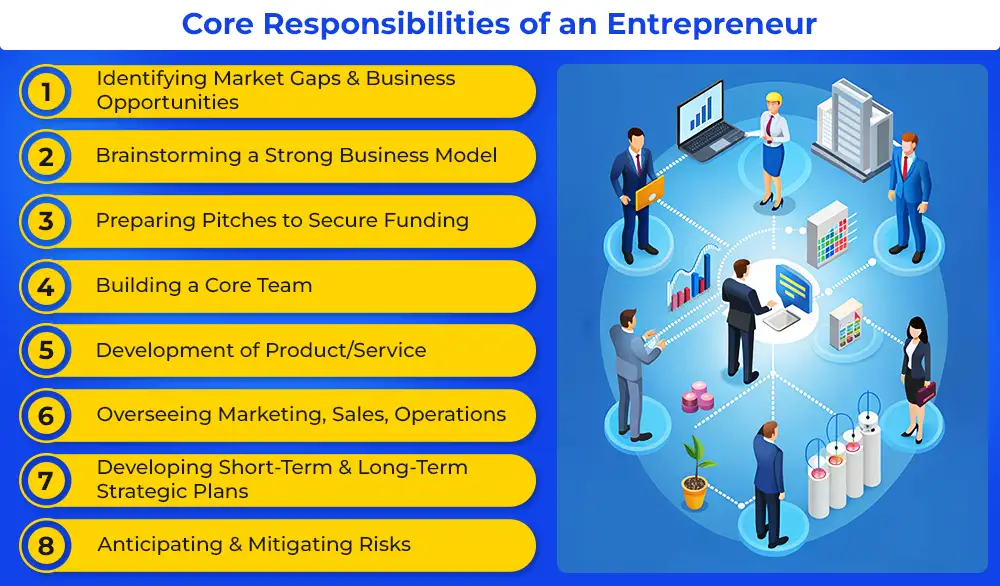
Entrepreneurship most definitely does not come with a fixed job description outlining your core responsibilities. Rather, the nature of this role is as diverse as the scope for growth it offers. Depending upon a number of factors, including the domain you are venturing into, your own educational background, the number of members in your core team, your funding, etc., you might need to perform the role of a strategist, a marketing head, a developer for the product, a customer relationship manager, a risk consultant, and so on!
Entrepreneurship encompasses building up a venture (a product/a service) from scratch to its minimum viable version, followed by developing its upgrades. Alongside the product/service development, it also includes related aspects such as developing your core team, finding funds, registering your business, and so on.
Enlisted below are common areas of responsibility that an entrepreneur usually takes care of. However, the role is quite dynamic and may require an individual to manage a number of other tasks and miscellaneous activities.
Skill Set for Entrepreneurship & Management
Since an entrepreneur plays a very dynamic role in the successful launch of a product or service, there are major functional as well as soft and interpersonal areas that one needs to be skilled at. In this section, we explore a few of the key functional and soft skills to consider for becoming an entrepreneur.
1. Functional Skills to Succeed as an Entrepreneur
A list of the important functional areas about which an entrepreneur should have knowledge is listed below for reference. Having overall knowledge around finances, business strategy and growth, sales, legal regulations, etc., is of key importance when starting a startup. Details about the same are provided below.
|
Key Skills |
Specifications |
|
Business Strategy |
Aptitude in identifying potential business opportunities, resources to tap into, long-term and short-term goals to achieve, and so on. |
|
Financial Literacy |
Having knowledge of aspects such as budgeting, taxes, investments, cash flow management, etc., for the financial management of the venture. |
|
Legal & Regulatory Knowledge |
Knowledge of legal boundaries, regulations, and laws surrounding business, labour laws, taxation, safety compliance, etc. |
|
Sales Strategy |
Having skills to develop effective sales strategies and pitches that can help secure funding, convert leads into clients, and grow the business further. |
|
Product Management |
Having strong knowledge of own product/service along with those of competitors to guide innovation and betterment of the product. |
2. Soft Skills to Succeed as an Entrepreneur
There are a number of behavioural areas and soft skills that an entrepreneur needs to master to succeed in their venture, and a few of them are mentioned below for reference.
|
Key Skills |
Specifications |
|
Strategic Thinking |
Having an aptitude to think of the short-term and long-term impact of business decisions on the venture. |
|
Negotiation & Influence |
Having the ability to influence stakeholders, both internal and external, to achieve business goals and enhance business development. |
|
Leadership Skills |
Having the skill to be an influential leader who inspires their team towards the achievement of a shared vision for the company. |
|
Networking Skills |
Being able to develop a vast and relevant network of professionals who can support the development of your business, starting from investors, leads to customers, suppliers, etc. |
|
Decision-Making Skills |
Having the skill to make quick, effective, and business-oriented decisions that benefit the venture and allow long-term and short-term growth of the business |
Career Analysis: Scope of Entrepreneurship & Management
While not a typical job role in itself, entrepreneurship also presents its own set of risks and benefits. The career scope of entrepreneurship as a career has been elaborated below.
1. Career Opportunities in Entrepreneurship & Management
An individual with a strong understanding of businesses, their management, entrepreneurship, etc., can also explore related job roles wherein they can work full-time for other companies or in a consultative capacity as a risk analyst, business consultant, business coach for other entrepreneurs, and so on. The scope of such roles is currently expanding in India and offers moderate to high compensation depending on your skillset and expertise.
Mentioned below are a few such roles related to entrepreneurship, along with the average salaries offered in India.
|
Career Option |
Average Salary (Per Annum) |
|
Business Consultant |
INR 4 LPA |
|
Corporate Intrapreneur |
INR 5 LPA |
|
Risk Consultant |
INR 9 LPA |
|
Business Coach |
INR 6 LPA |
Career Navigator: How to Become an Entrepreneur?
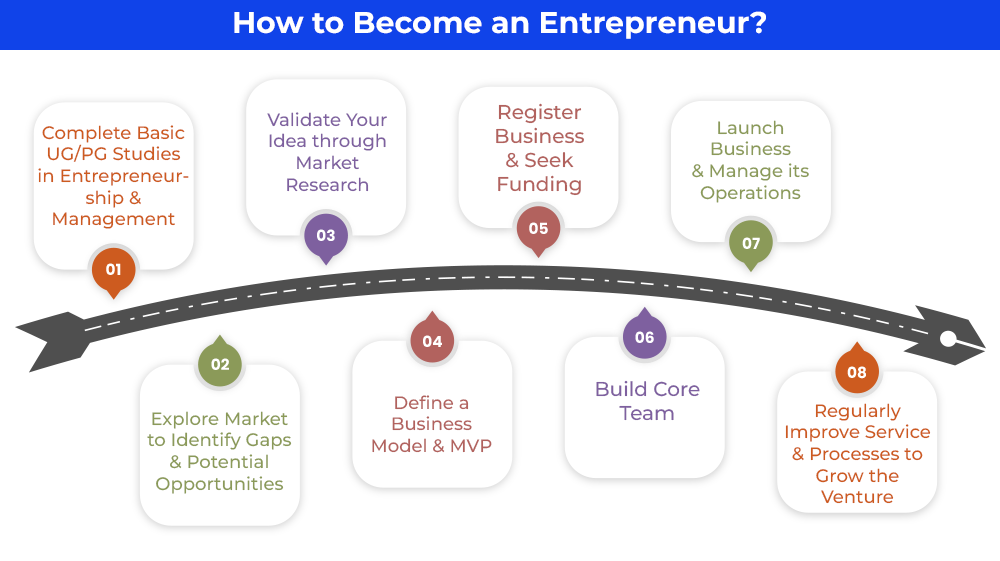
Becoming an entrepreneur is not a linear career journey that follows the same trajectory for each person. Every person’s entrepreneurial dream might be realised at different stages in their life. It is noteworthy to add that there are no mandatory educational qualifications needed to become an entrepreneur, making it a career domain that is accessible to professionals from different walks of life. However, having some basic knowledge about business ventures, starting and growing them, managing their operations, etc., can certainly contribute to your venture’s success.
While the role of an entrepreneur is dynamic and changing as per the situational requirements and can take on various steps, the core steps of starting and establishing a business of one’s own have been outlined below.
Some of the useful courses in the domain of entrepreneurship and business management are listed below. These courses, while not a mandatory qualification to become an entrepreneur, help a professional to have a strong foundation for establishing their own business line.
Courses in entrepreneurship are available in India in both offline and fully online modes. UGC-DEB, which is the prime accrediting body for distance and online education in India, has accredited online entrepreneurship courses as valid and credible. One can take up a course at the UG level (e.g., a BBA) or at the PG level (e.g., a PG Diploma or an MBA) and upskill themselves while establishing their venture.
|
Entrepreneurship & Management Courses |
Approximate Course Fee |
|
BBA (Entrepreneurship) |
INR 5,00,000 |
|
BBA (Entrepreneurship & Family Business) |
INR 10,00,000 |
|
MBA (Entrepreneurship) |
INR 10,00,000 |
|
PGD (Entrepreneurship & Management) |
INR 8,00,000 |
|
MBA (Entrepreneurship & Family Business) |
INR 15,00,000 |
|
Online BBA (Entrepreneurship) |
INR 1,26,000 |
|
Online BBA (Family Business Management) |
INR 1,35,000 |
|
Online MBA (Entrepreneurship & Leadership) |
INR 1,99,000 |
|
Online MBA (Digital Entrepreneurship) |
INR 2,00,000 |
|
Online MBA (Family Business Management) |
INR 1,50,000 |
|
Online MBA (Business Management) |
INR 3,00,000 |
|
Online PG Diploma (Entrepreneurship & Innovation) |
INR 1,50,000 |
|
Online Executive MBA (Entrepreneurship) |
INR 10,00,000 |
|
Online Executive MBA (Leadership & Strategy) |
INR 4,50,000 |
Some of India’s top institutions that offer higher education in entrepreneurship, business management, leadership etc. include prestigious IIMs as well as prestigious B-schools like NMIMS, XLRI etc. These institutions have been illustrated below for reference.
Conclusion
Today, the notion of entrepreneurship as a career has transformed in India, from that of simply starting a business to having a mindset of innovation, effective leadership, and strategic skills too. As a career, it brings financial autonomy, autonomy in day-to-day working, and immense flexibility to a person, which is unmatched by any job role. With the right functional skills, soft skills, and strategic acumen, one can identify a tappable market gap and come up with a venture that successfully addresses customer needs and is financially prosperous.