
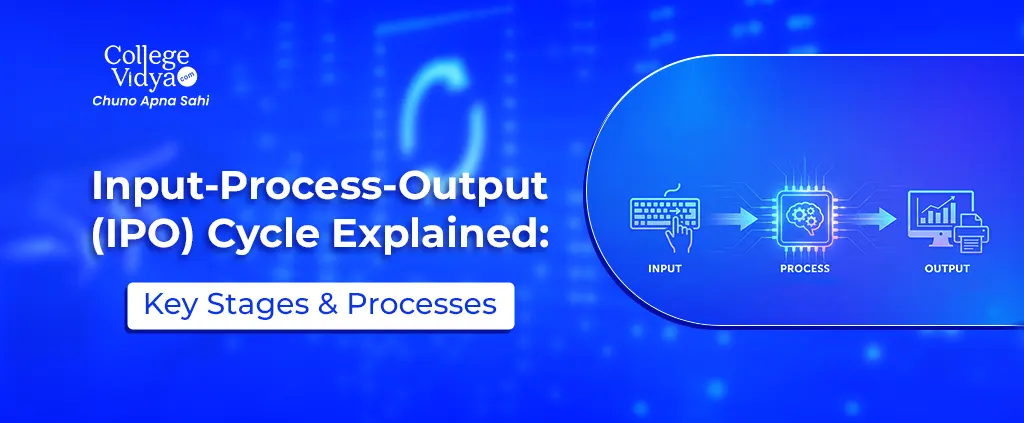
In the information age, literacy in computers and information systems is a basic learning for students and professionals. A very basic and yet very strong idea is at the center of any computing system: an Input-Process-Output (IPO) cycle. This basic framework describes the flow of any data through any computational system, both the most basic calculator and the most complex artificial intelligence platforms.
You could be a student or a professional, and you want to know how to master the IPO cycle; it is crucial. This detailed tutorial will take you through all these steps of this essential process and show you why it is important in the current technologically advanced world.
What is the Input-Process-Output (IPO) Cycle?
The basic functioning of computers and information systems is explained through the Input-Process-Output cycle, which is a basic model. It is the three fundamental steps that the data passes through whenever the data is being processed by any computing system. Imagine it as a factory belt of information: raw data is fed into the system (input), it is processed by different operations (process), and it appears as meaningful information (output).
This model is not just theoretical, but it forms the basis of all computing processes. Whether it is checking your email or a complex data analytics operation, all digital operations operate on this three-phase cycle. Instructions on the IPO model can demystify the nature of computer functionality and serve to analyze and engineer information systems.
In the contemporary computing world, the IPO cycle is cyclical. Whenever you handle any digital device, you are always in this cycle. Millions of IPO cycles per second are being run on your smartphone, recording touchscreen input and complex algorithmic calculations that run your favorite apps.
Stage 1: Input—The Beginning of Data Flow
The first step in the IPO cycle is input, which is raw data entering the computing system. It is at this stage that captured external information is processed to be ready. This stage is very diverse and flexible and can receive input in many forms and soon in different forms.
Types of Input Devices
The present-day computing systems are able to receive input using a wide variety of devices, which have particular purposes:
- Manual input devices include keyboards, mice, touchscreens, and touchpads. These are devices that need direct interaction with a human being and are most frequently used by the user to communicate with the computer. When you are typing a document or going over a web page, you are utilizing manual data input devices to feed information into the system.
- Automated input devices are those that record data without constant human intervention. Automated input is used in barcode scanners in retail stores, sensors in industrial machinery, and biometric readers at security checkpoints. Industries have been transformed by these devices, as they are able to collect data at a large scale and do it accurately and quickly.
- Audio and Visual Input Devices are used to transform sound and images into digital information, like microphones, webcams, and scanners. All these forms of input are needed in voice recognition systems, video conferencing systems, and document scanning applications.
Forms of Input Data
Input data may be structured, unstructured, numeric or textual, discrete or continuous. A sensor temperature is a numeric input with a temperature sensor and a text input with a text document. The nature of input data is also important, as it defines the way that the processing stage will work with the data.
The level of quality of input will translate to the level of quality of output, a concept commonly described as "garbage in, garbage out." The initial step towards meaningful outcomes of any information system is to ensure that the input is correct, relevant, and formatted in the right form.
Stage 2: Process—The Transformation Engine
The process of the IPO cycle is processing, in which raw input data is transformed into meaningful information. This phase entails the Central Processing Unit (CPU) and diverse software codes that execute guidelines to manipulate information based on a particular algorithm and guidelines.
How Processing Works
The processing stage conducts a number of operations on the input data:
- Arithmetic operations involve addition, subtraction, multiplication, and division. These simple mathematical operations are used in hundreds of calculations, starting with sales tax calculations and including many more complicated financial applications.
- Logical operations deal with comparisons and decisions. The system makes evaluations of conditions (like the questions "Is the password correct?), or "Is the inventory level below the level of the threshold level?") and makes a suitable response to the outcome.
- Data manipulation involves sorting, filtering, organizing, and transforming data. By sorting your e-mails by date or searching by category in the search engine, you are using the processes of data manipulation.
- Storage and retrieval operations entail reading and writing data to and out of memory or storage devices. This enables systems to be able to store state, store progress, and store historical information.
The Role of the Central Processing Unit
The CPU is the computer's brain, and it processes billions of instructions per second. It is repeated: it fetches instructions out of memory, interprets what operation to carry out, and performs that operation on the data. The current CPU has more than one core, and its capacity to execute several tasks at the same time is far greater.
Software's Critical Role
Whereas the hardware gives the physical ability to process data, the software gives the instructions to be followed to carry out the processing. The resources are controlled by the operating systems, and the coordination of activities is done. The application software does certain specific tasks such as word processing, data analysis or graphic design. Processing is done through the step-by-step procedures of solving a problem, which are referred to as algorithms.
Stage 3: Output—Delivering Results
Output is the last step in the IPO cycle, through which the processed information is made usable to the users or other systems. This is where the value created in the process of processing avails itself and can be done.
Types of Output Devices
- Visual output devices include monitors, projectors, and printers, which display information in a visual format. Displays present temporary outputs, which are interactive, whilst printers make physical copies of digital information permanently.
- Audio Output Devices such as speakers and headphones decode digital signals into sound. The use of audio in the computing world is seen in notification alerts and streaming music.
- Data output may also be in the form of digital files, database entries, or signals to be sent to other systems. It is producing output when a system leaves a report in a file or passes data to another system via a network.
Output Formats
Output should be presented in a proper format to its target audience and purpose. Financial statements should be written in an accurate numerical format, whereas marketing documents should be written in a visual format. User interfaces should show information in straightforward and intuitive ways; therefore, complex data should be available to non-technical users.
The usefulness of the whole IPO cycle is determined by the effectiveness of the output. Properly designed output conveys information in a straightforward way, helps in decision-making, and allows users to make informed decisions.
Real-World Applications of the IPO Cycle
The practical examples can be used to explain how the IPO cycle can be applied universally:
- Online Shopping: You input product searches and selections (input), the system retrieves databases, calculates prices and shipping (process), and outputs results and order confirmations (output).
- Banking ATMs: The user will need to insert the card and input a processing number (PIN) (input), and the system will validate the user and carry out transactions (process), disbursing money and printing receipts (output).
- Smart Home Systems: Temperature sensors and occupancy sensors (input), algorithms decide the most efficient heating and lighting (process), and actuators change climate and lighting systems (output).
- Social Media Platforms: Feeds are posted, and users interact with the content (input); curation with algorithms is done to recommend content (process); and personalized feeds are shown (output).
- Artificial Intelligence and Machine Learning: There are some advanced applications of the IPO cycle. The input is training data, and the neural networks process information in various layers of calculations, but the result is a trained model that can be used to make predictions or classifications. Upon deployment of the model, the newly received data is used as input, the trained neural network runs it, and the results are given as a prediction or a decision.
- Blockchain Technology: It employs the IPO cycle in the process of transaction. Transaction requests: An input, mining nodes execute transactions by solving cryptographic puzzles and verifying them with the distributed ledger, and confirmed blocks are output to the chain, which can be accessed by all participants in the network.
- Internet of Things (IoT): It involves building large networks in which billions of devices are involved in interconnected IPO cycles. Smart city sensors capture the traffic trends, weather, and utility consumption. Such information is processed by cloud platforms to optimize traffic lights, predict maintenance requirements, and balance the distribution of energy. Output comprises automated changes in the infrastructure of cities and notifications to city managers.
Advancing Your Understanding: Educational Pathways in Technology
With the ever-advancing technology that is finding its way into every sector, the need to have well-trained professionals with knowledge in systems such as the IPO cycle has never been as high as it is today. As a student or as a professional who works, formal education in the sphere of technology can go a long way in improving career opportunities.
It is estimated that the Indian technology sector will become a 350 billion dollar industry by the year 2026, which will generate millions of jobs. Organizations are also aggressively pursuing graduates who possess excellent technical backgrounds, computer competencies, and knowledge about the latest computing systems. These competencies are exactly the ones that a structured engineering education offers.
Why Pursue a B.Tech and Specialized Technical Education?
A Bachelor of Technology (B.Tech) degree equips an individual with the overall knowledge of computing systems, software development, and information technology. B.Tech Lateral Entry programs also present an innovative opportunity for diploma holders or students with similar backgrounds to gain a degree faster by running a second-year program that admits students directly to the second year of the course.
The important advantages of B.Tech programs are as follows:
- Relevant Curriculum in the Industry: Study technologies and frameworks that are actively applied in software firms, IT services, and tech startups.
- Practical Learning: Laboratory work, projects, and internships allow students to be exposed to real-life computing systems.
- Good Placement Support: Engineering colleges with good placements have placement cells that have links to major employers.
- Learning and Research Opportunities: Operate at the frontier of such issues as artificial intelligence, blockchain, quantum computing, and cybersecurity.
- Entrepreneurship Development: The incubation centers and startup assistance help the students to start their own technology companies.
- Professional Network: Establish relationships with faculty, alumni, and industry professionals, which can persist over a lifetime.
High-Demand B.Tech Specializations Building on IPO Concepts
- B.Tech Lateral Entry in CSE: This is a flagship specialization that offers a solid understanding of algorithms, data structures, software systems, and programming paradigms. The graduates of CSE are employed as software developers, system architects, and technology consultants. The specialization covers the processing process in detail and discusses the processing of input data to result in an efficient algorithm for the optimal output.
- B.Tech Lateral Entry in AI & ML: The advanced specialization that comprises neural networks, deep learning, natural language processing, and computer vision. AI systems are advanced IPO applications in which large sets of training data are executed by designing multifaceted mathematically modeled systems to create smart predictions and decisions as outputs.
- B.Tech Lateral Entry in Data Science and Analytics: It is the integration of statistics, programming, and business to derive insights from data. The data scientists feed raw data, which can be from various sources, with statistical computing and visualization and deliver actionable business intelligence. It is one of the most lucrative specializations for a fresh graduate.
- B.Tech Lateral Entry in Cyber Security: Experts in data and system security against threats during the IPO process. Security staff make sure that the input is checked so that malicious data cannot be entered, processing is not easily exploited, and the output does not disclose sensitive data. As the number of cyber threats grows, cybersecurity experts are becoming of high demand.
- B.Tech in Cloud Computing: Expertise in the design, implementation, and administration of cloud infrastructure applications. Cloud architects know how to distribute processing across more than one server, scale systems to respond to variable input loads, and provide output by using global content delivery networks.
Leading Universities Offering Quality Technical Education
In India, there are a number of prestigious institutions that provide good undergraduate programs in B.Tech. with different specializations for working professionals (lateral entry) and regular students too:
- Lingaya's University: It has a modern infrastructure and industry-relevant curriculum. The university also has B.Tech lateral entry programs in several specializations, such as computer science, information technology, and electronics. Lingaya University has a well-trained faculty and good contacts in the industry, leading to the preparation of students to face real-life challenges in technology.
- Sanskriti University: It offers full-fledged technical education with a focus on practice and innovativeness. B.Tech programs offered by them include practical learning, internships in the industry, and exposure to new technologies. The quality engineering education provided by Sanskriti University is yet another option of lateral entry available to students with diploma qualifications and aspiring to achieve a career promotion.
- ISBM University: It offers good education in engineering at a reasonable fee structure, such that B.Tech is affordable to students in various economic statuses. The university has the lateral entry programs and the flexible curriculum that enable students to take electives according to career interests. ISBM dwells on the development of sound fundamentals in the basic subjects, besides exposing the students to modern technology through workshops and seminars.
- Kalinga University: Is known to practice academic excellence and holistic development. Kalinga University provides a broad spectrum of specializations in B.Tech and also has a lateral entry facility, which allows combining theory with practice. The contemporary laboratories, research, and industry collaboration of the university provide an ambience that is favorable to technical studies.
Online and Distance B.Tech Programs for Working Professionals
Considering the fact that there are a great number of working professionals who wish to continue their education at the same time without dropping their jobs, various universities currently have online and distance courses for B.Tech programs. These are courses that ensure the quality of the academic work, but they are flexible in their learning schedule.
Key Features of Online B.Tech for Working Professionals Programs:
- Self-Paced Learning: Study and complete lectures, study materials, and assignments at your convenience.
- Weekend Classes: There are also weekend virtual classes, which allow interactive classes with faculty.
- Industry-Relevant Projects: Whole practical assignments in terms of a real-life work environment in your place of work.
- Digital Library Access: Comprehensive access to e-books, research journals, and online learning materials.
- Virtual Labs: Perform laboratory experiments and simulations via web-based laboratory interfaces.
- Placement Assistance: Resume development, career guidance, and interview preparation.
- Low Cost: The prices are usually lower than standard programs, and they are available by installment.
There are other good B.Tech lateral entry programs, including AISECT University, Mewar University, and Shobhit University, that have lateral entry. These are programs endorsed by UGC-DEB and employers in any industry.
The Future of the IPO Cycle
The IPO cycle is in a state of flux due to the increasing technology. Edge computing moves processing nearer to input sources, lessening latency. Artificial intelligence is transforming the way processing is done, and systems can now learn and adapt. AR and VR are introducing completely new modalities of output, and the user is immersed in digital information.
The Internet of Things (IoT) establishes extensive networks of interdependent devices as each one of them engages in the innumerable IPO cycles. Billions of sensors bring in input, cloud-based systems process it on unprecedented scales, and automated systems give us output that manages the traffic light to the industrial equipment.
The basic model of the IPO is still applicable despite its current developments. All computing technology innovations can be perceived as improvements to one or a few of these steps of the cycle. The knowledge of this fundamental concept will give one a framework of understanding even of the most advanced technologies.
Conclusion
The Input-Process-Output (IPO) cycle is not merely a theory but the basic model of all computing processes. The most basic calculation and even the most advanced artificial intelligence system, the IPO cycle can be described as the flow of information through systems and its conversion into valuable information.
To both students and professionals, the IPO cycle is a crucial learning aspect with regard to the understanding of the workings of technology. This knowledge is the basis of higher learning in computer science, information systems, and other areas. With the world growing more digital, the values suggested in the IPO cycle are becoming increasingly more important.
Be it when you are starting a new education, thinking of lateral entry into a B.Tech program, or are just looking to further your education online, an investment in technical education can profit you all your professional life. Colleges such as the University of Lingaya, Sanskriti University, and Kalinga University are the ones that would provide you with the avenue to fine-tune your knowledge and acquire the expertise that is required of you in the current technology-driven world.
The IPO cycle will remain applicable provided that computers will be used to process information. It is the basic idea that by learning and applying it through formal education and with constant learning, one will be at the right place to succeed in the constantly developing world of technology.