

Quick answer: B.Tech Distance Education is not valid in India. Higher Technical Education Regulatory Body (AICTE) does not permit a full B.Tech program in distance mode. Those who are planning for a 4-year engineering degree via distance mode after 12th have only one option: to enroll in the full-time B.Tech program. However, diploma holders seeking a distance B.Tech program can apply for the B.Tech Lateral Entry program. B.Tech via lateral entry can be enrolled in flexible mode, equally convenient for working professionals.
A distance education program refers to a degree program where a student is not required to attend physical classes to complete the entire coursework. This means theory, assignments, and exams are completed remotely. Learners are provided with study material online or delivered to their address. Such a mode of education can be suitable for programs like B.A., B.Com, or MBA, which are largely theory-driven. But not for fully technical programs like B.Tech.
1.28 lakh jobs gone in 6 months. Yours could be next.
B.Tech is a practical, lab-intensive program that requires hands-on work in engineering labs, workshops, project work, and often internships. That hands-on component is exactly why regulators have drawn a hard line against offering it purely in distance mode.
Why Isn't Distance B.Tech Approved?
There are three main reasons regulators and courts have consistently blocked distance-mode B. Tech:
- No AICTE or UGC-DEB approval. AICTE regulates technical higher education in India, and the apex technical regulatory body does not permit distance B.Tech programs. B.Tech is not on that approved list, and UGC DEB has not recognized it either.
- Practical training can't be delivered in distance mode. Technical education like engineering programs depend on structured lab work, equipment handling, and supervised practical sessions. Regulators have held that technical training can not be given through a distance-learning format because this format is suitable for programs that focus more on theoretical knowledge.
- Judicial backing. Apex Court in India has upheld that an institute or university cannot offer a B.Tech program without AICTE/UGC approval. The technical program offered in distance format by an institution operates outside the regulatory framework.
What Happens If You Enroll in B.Tech Distance Anyway?
Institutions claiming to offer a distance B.Tech or online B.Tech after 12th are operating outside AICTE/UGC recognition. Thus, common consequences for students who enroll in such unrecognized programs would suffer are:
- The degree is not accepted by private companies or government organizations as a valid engineering qualification.
- Graduates are not eligible to sit for GATE, which closes the door to M.Tech admissions at IITs/NITs and PSU recruitment through the GATE route.
- The degree doesn't hold up for higher studies (M.Tech, MS abroad) that require a recognized undergraduate engineering qualification.
- Study material and curriculum at such institutions are often outdated, since there's no regulatory oversight ensuring it keeps pace with industry needs.
Before enrolling anywhere, it's worth directly checking a university's approval status on the official AICTE portal (aicte-india.org) and the UGC-DEB portal (ugcdeb.gov.in) rather than relying on a college's marketing claims.
The Valid Alternatives
The good news for diploma holders after polytechnic is that if their goal is flexibility studying while working or finishing a degree after a diploma, there are valid programs, which are AICTE/UGC-approved routes.
B.Tech Lateral Entry
For diploma holders to get a degree in engineering, a 3-year B.Tech program via lateral entry is designed. Instead of beginning from the first year, you will be enrolled in the second-year B.Tech program to complete the course within three years. This is approved by AICTE and UGC if done by a recognized institute, and this B.Tech degree is equivalent to any other B.Tech degree. But mostly all B.Tech lateral entry courses have an entrance test.
B.Tech for Working Professionals
B.Tech for Working Professionals is a three-year engineering course for diploma holders. The difference from the full-time B.Tech Lateral Entry program is that B.Tech for Working Professionals is meant for working professionals.
This program is beneficial for those who wish to do their higher education without leaving their work. In contrast to distance courses, this course has a combination of classes that include evening classes, weekend classes, and an online learning management system (LMS) for lectures and assignments, with proper arrangement for practicals.
If this program for professionals is from a recognized institute under the AICTE / UGC, then this degree will be useful for jobs and promotions, and even for further studies such as GATE, M.Tech, and MBA programs. But one needs to have work experience to join this course.
How is B.Tech Lateral Entry different from B.Tech for Working Professionals?
These are two distinct pathways into a B.Tech degree, aimed at different kinds of students:
B.Tech Lateral Entry
- Who it's for: Diploma holders (from polytechnics) or B.Sc. graduates who want to earn a full B.Tech degree.
- Entry point: Students join directly into the 2nd year (3rd semester) of the regular 4-year B.Tech program, skipping the first year.
- Basis for admission: through entrance exams like LEET (Lateral Entry Entrance Test) conducted by state authorities (e.g., AP, TS, or other states), based on diploma marks or an entrance score.
- Mode of study: Full-time, on-campus, regular classroom program — same as a normal B.Tech student, just compressed into 3 years instead of 4.
- Purpose: Gives technically skilled diploma holders a bridge into engineering education without starting from scratch.
B.Tech for Working Professionals
- Who it's for: People who are already employed (often diploma holders or ITI-certified professionals with work experience) and want a degree while continuing to work.
- Entry point: Can start from the 1st year or lateral entry into 2nd year, depending on the institute and prior qualification.
- Mode of study: Part-time or flexible — evening classes, weekend classes, or distance/online mode, designed around a work schedule.
- Eligibility: Typically requires a minimum number of years of relevant work experience along with a diploma/ITI qualification.
- Duration: Often longer than the regular full-time track (since course load per semester is lighter) — commonly 3–4 years depending on entry level.
- Purpose: Lets working individuals upgrade their qualification without quitting their jobs.
Key differences summarized:
|
Aspect |
Lateral Entry |
Working Professional |
|
Target audience |
Diploma/B.Sc. holders, usually fresh |
Currently employed individuals |
|
Class mode |
Full-time, regular |
Part-time/evening/weekend/online |
|
Entry year |
2nd year |
1st or 2nd year (varies) |
|
Work experience required |
Not mandatory |
Usually mandatory |
|
Study-work balance |
Studies is the main focus |
Job continues alongside studies |
Important nuance: "distance" vs "online" vs "hybrid"
Learners should not confuse these terms: distance, online, and hybrid,
- Distance mode — no classroom or lab component at all. Not approved for B.Tech.
- Fully online mode — similar issue; a full engineering degree cannot currently be delivered 100% online in India.
- Hybrid/blended mode (evening, weekend, or weekday classes plus an LMS) — this is what genuinely approved "flexible" B.Tech programs for working professionals actually use. It is not the same as distance education, even though many colleges advertise it using distance-related keywords for search visibility.
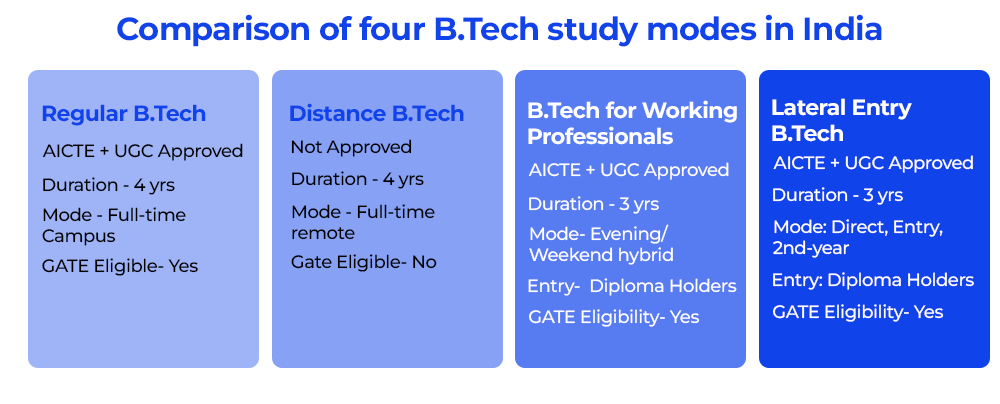
Comparing the B.Tech Options at a Glance
|
Feature |
Regular B.Tech After 12th (Valid) |
Distance B.Tech (Invalid) |
B.Tech for Working Professionals after Diploma (Valid) |
Lateral Entry B.Tech after Diploma (Valid) |
|
AICTE/UGC approval |
Yes |
No |
Yes |
Yes |
|
Duration |
4 years |
Advertised as 4 years |
3 years |
3 years |
|
Delivery mode |
Full-time, on campus |
Fully remote (advertised) |
Evening/weekend/hybrid + LMS |
Direct entry into year 2 |
|
Eligibility |
12th pass |
12th pass |
Diploma holders |
Diploma holders |
|
Valid for GATE |
Yes |
No |
Yes |
Yes |
|
Accepted by employers |
Yes |
No |
Yes |
Yes |
|
Valid for M.Tech/MBA admission |
Yes |
no |
NYes |
Yes |
How to Verify Before You Enroll:
- Check AICTE approval — search the institution and program on aicte-india.org.
- Check UGC-DEB listing — confirm on ugcdeb.gov.in whether the specific program is cleared for distance/online delivery. Some universities offering tech programs are approved by UGC.
- Ask for the exact program name — "B.Tech for Working Professionals" and "B.Tech Lateral Entry" are the valid labels; be wary if a college only ever says "distance B.Tech" or "B.Tech without attending classes."
- Confirm GATE and higher-education eligibility in writing from the institution, and cross-check independently if possible.
- Look for NAAC/NBA accreditation as an additional (not substitute) quality signal alongside AICTE/UGC approval.
Conclusion
An online 4-year B.Tech is not a recognized course in India, and considering it to be an easy route will end up costing you more in time and money rather than saving any, because of all the money spent, the degree not being accepted by any employer, and no scope to pursue GATE or postgraduation. But if you need to pursue a course with more flexibility, then B.Tech Lateral Entry and B.Tech for Working Professionals provide an appropriate, AICTE/UGC approved means for doing so.