

Quick answer: Yes, an online degree holds the same value in India, as long as it's awarded by a higher educational institution that the UGC has actually recognized or is entitled to run that specific program online. UGC's own regulations say it plainly: recognized undergraduate and postgraduate degrees earned online are treated as equivalent to the conventional ones. Same weight, same standing.
Coming to the main question—UGC-recognized online degrees work for both employment and further education, though it's still subject to whatever the employer, examination authority, or institution requires on their end.
1.28 lakh jobs gone in 6 months. Yours could be next.
Here's the thing people get wrong: the online mode itself was never the problem. What actually decides whether a degree holds up is whether the university is authorized to run that program online, and whether your specific program is recognized or entitled for the exact academic session you were admitted to.
UGC's regulations are clear that recognized online UG and PG degrees are treated as equal to their conventional counterparts - not a lesser version, not a "sort of" degree.
So the useful question was never "Is online education recognized?" It's narrower than that: "Is my university, and specifically my program, recognized by UGC-DEB for the session I'm joining?" That's the question that actually matters before you hand over your fees.
What Makes an Online Degree Valid in India?
A handful of things need to line up before you can call an online degree legitimate. Worth checking every one of these:
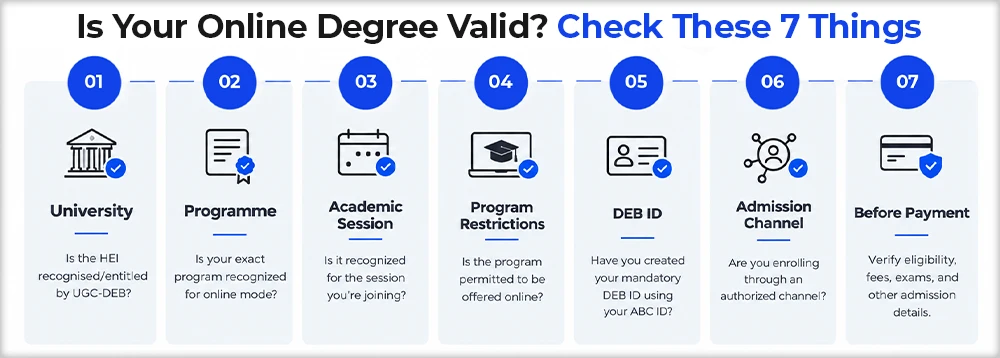
- UGC Recognition or Entitlement: The HEI needs actual recognition or entitlement to run programs online - not just a claim on its website. UGC-DEB keeps this information on record for HEIs and their programs.
- Program-Level Recognition: Checking the university alone isn't enough, and this trips people up more than anything else on this list. Finding a university on the UGC-DEB portal doesn't mean every single program it offers is automatically cleared for online mode - you still have to check the specific program.
- Academic Session: Recognition needs to be checked against the exact session you're enrolling in. UGC-DEB is explicit about this - confirm the status for your session, not just "in general."
- Permitted Program: Some programs - anything involving practical, lab, or clinical components—simply can't be offered fully online. UGC lays out specific conditions under which disciplines are even allowed in online mode.
- DEB ID: If you're enrolling in a recognized online or ODL program, you need a DEB ID, generated using your Academic Bank of Credits (ABC) ID. UGC-DEB is direct about this—no valid DEB ID, no enrollment.
Are Online Degrees Equivalent to Regular Degrees?
Yes—recognized online UG and PG degrees carry the same standing as conventional ones under UGC regulations. The fact that you studied through a screen instead of in a classroom doesn't, by itself, make the qualification lesser.
But that equivalence is tied specifically to recognized, entitled programs. A degree from an unrecognized institution, or from a program that was never authorized in the first place, doesn't get to claim the same status just because it also happened to be "online." UGC also holds recognized online programs to the same academic standards, curriculum depth, credit requirements, and minimum duration as everything else in the regulatory framework - it's not a shortcut version.
Are Online Degrees Valid for Government Jobs?
Yes - a recognized online degree can satisfy the educational qualification listed in a recruitment notification, covering things like:
UPSC examinations, SSC examinations, Banking recruitment, State government recruitment, PSU recruitment, Other government examinations and posts. That said, eligibility ultimately comes down to what the specific notification actually asks for. Some posts want a particular subject, a specialization, or an additional professional qualification on top of the degree itself.
So having a recognized online degree doesn't automatically clear you for every government post out there. Always cross-check your qualifications against what the official notification actually spells out - assumptions here can cost you an application.
Are Online Degrees Accepted by Private Companies?
Yes, private-sector employers do accept recognized online degrees. But - and this is worth being blunt about - a valid degree was never a guarantee of a job. Companies weigh a lot more than the certificate:
Educational qualification, University and program, Relevant skills, Work experience, Projects and practical exposure, Communication skills, Role-specific knowledge
Take someone hiring for a business analyst role, for instance - they're going to look past the degree pretty quickly and get into your actual analytical skills, the tools you know, the projects you've done. Think of the online degree as your entry ticket, not the whole performance.
Can You Pursue Higher Studies After an Online Degree?
Yes, generally—a recognized online degree can take you into higher education, subject to whatever the next program and institution require.
A couple of examples:
- An online bachelor's degree can support applications to eligible master's programs. An online master's degree can lead to further academic or professional programs, wherever the eligibility criteria allow it.
- Some specialized programs will ask for specific subjects, entrance exams, or other conditions on top. Check the admission requirements of wherever you're applying next before you assume your online degree covers it.
Are Online Degrees Valid Abroad?
A recognized Indian online degree can be accepted abroad - but "can be" is doing real work in that sentence. It genuinely depends on the destination country, the specific university or employer, and whatever credential-evaluation process applies there.
If you're planning to use your degree outside India, check:
- The foreign university's admission requirements, employer requirements, credential evaluation rules, and country-specific recognition or equivalence procedures
- Don't assume an Indian online degree walks through every door worldwide automatically - because it doesn't, and the requirements shift quite a bit from one country to the next.
Online Degree vs Regular Degree: What's the Difference?
|
Factor |
Online Degree |
Regular Degree |
|
Learning mode |
Online |
Classroom-based |
|
Flexibility |
High |
Generally lower |
|
Physical attendance |
Generally not required |
Usually required |
|
Recognition |
Depends on applicable UGC recognition/entitlement |
Depends on the university and program recognition |
|
Learning environment |
Digital/LMS-based |
Campus-based |
|
Suitable for |
Working professionals and learners seeking flexibility |
Students seeking a traditional campus experience |
|
Degree equivalence |
Recognized online degrees can be equivalent to corresponding conventional degrees |
Conventional mode |
The takeaway here is simple: the mode of learning by itself was never what decided validity. For an online degree specifically, it all comes down to the institution's recognition and the program's actual status.
How to Check Whether an Online Degree Is Valid Before Enrolling?
Before you pay a single rupee in fees, run through the official UGC-DEB system properly.
- Step 1: Check the University: Search for the HEI on the official UGC-DEB portal and confirm its recognition or entitlement status.
- Step 2: Check the Specific Program: Don't stop once the university checks out - go further and confirm the exact degree program you want is recognised or entitled for online mode.
- Step 3: Check the Academic Session: Make sure both the university and the program have the right status for the session you're actually joining. UGC-DEB specifically tells students to verify this session by session, not once and forget it.
- Step 4: Check Program Restrictions: Confirm the program is even allowed online in the first place - some disciplines simply aren't, due to practical or regulatory restrictions.
- Step 5: Create Your DEB ID: Required before you can enroll in any ODL or online program, and it's generated using your ABC ID.
The current admission flow, roughly:
Create ABC ID → Create DEB ID → Select a recognized/entitled HEI → Verify the program → Complete admission.
- Step 6: Avoid Unauthorized Admission Channels: If an online degree is being sold to you through some unrelated intermediary or franchise setup, treat that as a red flag. UGC-DEB explicitly flags franchising arrangements as something to watch out for.
- Step 7: Verify Before Paying: Right before your final payment, run through this one more time:
- University recognition/entitlement Specific program Academic session Eligibility requirements Fee structure Examination process official admission channel
- It's a small amount of effort that can save you from ending up in an unrecognized program you can't undo later.
Common Misconceptions About Online Degrees in India
There's a lot of noise around online education—recognition, career impact, all of it. Here's what students commonly assume and what's actually true.
"An online degree won't be recognized."
Not necessarily true at all. An online degree from a university and program recognized or entitled under UGC-DEB is a genuinely valid qualification. Recognized online UG and PG degrees carry the same standing as their conventional counterparts under the regulations.
"I can't apply for government jobs with an online degree."
You can—as long as your qualification meets what the recruitment notification asks for. A recognized online degree can satisfy the educational requirement for eligible government roles, though some posts do ask for a specific degree, subject, or extra qualification. Read the official notification, always.
"If the university is UGC recognized, I can choose any online course it offers."
This is where people get burned. A university's overall recognition doesn't mean every program it runs is automatically cleared for online delivery. Check the specific program and session on the UGC-DEB portal - every time, no exceptions.
"Online degrees are much easier than regular degrees."
More flexible, sure. Easier academically? No—that's a myth. Recognized online programs still run through coursework, assignments, assessments, and exams, and they follow the same academic framework as anything else UGC oversees.
"An online degree won't help my career."
The degree's mode of delivery isn't what determines its career value. A recognized degree covers the educational-qualification box; everything past that - your skills, experience, specialization, projects, and how relevant you are to the job—is what actually moves your career forward.
"Any degree can be pursued online."
No, and this one's worth remembering. Programs with practical, clinical, or laboratory components have real restrictions on going fully online. Check whether your chosen program is currently permitted before you get attached to the idea.
Summing Up!
Yes, an online degree is valid in India—but only when it's a recognized, properly entitled program, and that "but" carries real weight.
Don't take a university's website or marketing copy at face value. Check the university, the specific program, and the academic session on the UGC-DEB portal, create your DEB ID, and confirm the program is actually permitted online before you commit.
Get those checks done, and an online degree gives you a genuinely flexible route into higher education - without giving up any of the standing that comes with a recognized qualification under the UGC framework.