

The Kalinga Institute of Industrial Technology Entrance Examination (KIITEE) is a nationwide test held by KIIT University, situated in Bhubaneswar, for admission to a wide range of undergraduate and postgraduate programs. Renowned for its academic excellence and modern infrastructure, KIIT University offers sought-after courses in engineering, biotechnology, computer applications, management, and more, with KIITEE serving as the gateway to these programs.

For engineering aspirants, especially those holding a Diploma in Engineering, KIITEE provides an excellent opportunity to gain direct admission into the second year of B.Tech through its Lateral Entry scheme. The exam is conducted online (computer-based test) and is known for its transparent, free-of-cost application process. There is no application fee, making it accessible to students across India. Whether you’re a student aiming to pursue a full-time B.Tech program or a working professional seeking to upgrade qualifications through lateral entry, the KIITEE exam offers a structured, merit-based pathway to one of India’s top private universities.
What is the KIITEE exam?
The KIITEE exam is defined by the Kalinga Institute of Industrial Technology Entrance Examination, which is conducted at the university level and used to accept students to various undergraduate and postgraduate programs offered in KIIT Deemed University. The exam is multipurpose in that the exam is primarily used for B.Tech lateral entry, but also offers the B.Sc. and M.Tech programs. It is also the common entrance examination for other non-medical courses in KIIT. The exam is conducted online and is conducted in the English language.
Highlights of the KIITEE EXAM
|
Highlights of the Exam | |
|
Full Form |
Kalinga Institute of Industrial Technology Entrance Examination( KIITEE) |
|
Conducting Body |
KIIT University, Bhubaneswar |
|
Exam Level |
National-level exam |
|
Mode of Examination |
Online Computer-Based Test (CBT) |
|
Medium of Examination |
English |
|
Official Website | kiitee.kiit.ac.in |
Important Date KIITEE
These are the important dates:
|
Event |
Date |
|
Phase I Exam Dates |
April |
|
Phase II Exam Dates |
June |
|
Phase III Exam Dates |
July |
|
Admit Card Release |
After Slot Booking |
*Dates are subject to change. Please refer to the official website for the most accurate information.
|
KIITEE (Phase 1) |
Dates |
|
Apply Online |
November |
|
Last date of Application |
April |
|
Slot Booking |
April |
|
Date of Entrance Examination |
April |
|
Counselling Date |
May |
|
KIITEE (Phase 2) |
Dates |
|
Apply Online |
April |
|
Last date of Application |
June |
|
Slot Booking |
June |
|
Date of Entrance Examination |
June |
|
Counselling date |
June |
* New dates for the new session will be updated very soon on the official website.
KIITEE Eligibility Criteria
|
Eligibility Criteria | |
|
Educational Qualifications for B.Tech after Polytechnic |
Pass a three-year diploma course in Engineering with at least 60% marks in aggregate from the State Council of Technical Education of any state or equivalent. |
|
Age Limit |
No specific age limit |
KIITEE 2025 Application Process
-
Registration: Visit the official website. Fill in the required details to create an account.
- Application Form: Log in to your account and complete the application form with accurate information.
- Upload Documents: Upload scanned copies of your passport-sized photograph, signature, and relevant academic documents.
- Application Fee: No application fee is required.
- Submission: Review all details and submit the application form.
KIITEE Applicants Year-wise
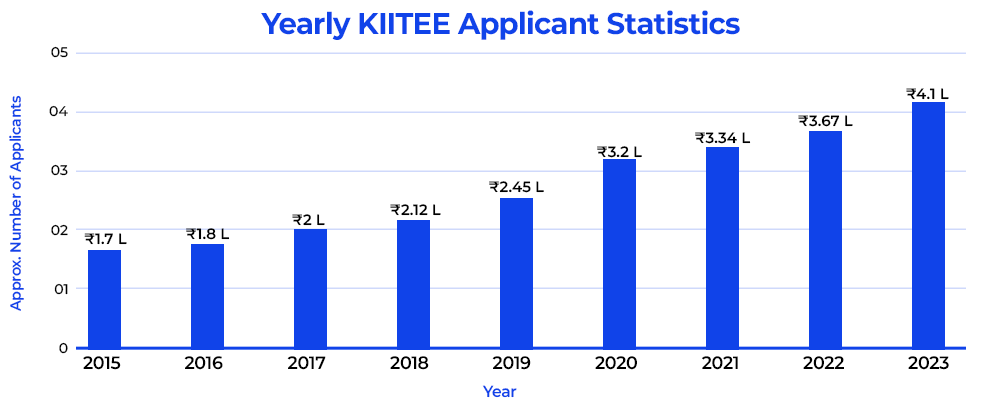
|
Year |
Approx. Number of Applicants |
|
2015 |
170,000 |
|
2016 |
180,500 |
|
2017 |
200,000 |
|
2018 |
212,000 |
|
2019 |
245,000 |
|
2020 |
320,000 |
|
2021 |
334,000 |
|
2022 |
367,000 |
|
2023 |
410,000 or more |
The number for KIITEE 2024 and 2025 hasn't been officially released yet, but if the trend continues, it's reasonable to estimate:
- 2024: Likely around 4.3 to 4.5 lakh applicants
- 2025: Possibly 4.5 lakh+, depending on exam mode, outreach, and academic offerings
KIITEE 2025 Exam Pattern
|
Exam pattern | |
|
Mode of Examination |
Online Computer-Based Test (CBT) |
|
Duration |
3 hours (180 minutes) |
|
Number of Questions |
120 Multiple Choice Questions (MCQs) |
|
Marking Scheme |
Correct Answer: +4 marks, Incorrect Answer: -1 mark, and Unanswered Questions: 0 marks |
|
Medium |
English |
Subjects:
- B.Tech lateral entry: Physics, Chemistry, Mathematics
- Number of Questions: 120
Sections:
- Physics: 40 questions
- Chemistry: 40 questions
- Mathematics: 40 questions
KIITEE Exam 2025 Syllabus
The syllabus for KIITEE 2025 is based on the respective qualifying examinations. Below is a general outline:
| B.Tech Lateral Entry (Engineering) | |
|
Subjects |
Topics |
|
Physics |
Mechanics, Optics, Electrodynamics, Modern Physics |
|
Chemistry |
Organic Chemistry, Physical Chemistry, Inorganic Chemistry |
|
Mathematics |
Algebra, Calculus, Vectors, Trigonometry, Geometry |
KIITEE Exam 2025 Admit Card
- Availability: The admit card will be available for download after slot booking.
How to Download:
- Visit kiitee.kiit.ac.in.
- Log in using your application number and password.
- Find the Admit Card section.
- Download and print your Admit card.
KIITEE EXAM Result Declaration
Result Access:
- Visit the official website.
- Click on the Result.
- Enter your roll number and other required details.
- View and download your result.
- Result Format: The result will display the candidate's score and rank.
KIITEE EXAM Counseling Process
- Eligibility: Candidates who qualify for the KIITEE 2026 examination.
- Process:
- Registration: Register for counseling on the official website.
- Document Verification: Original documents will be verified for authenticity.
- Choice Filling: Candidates can fill in their preferred courses and campuses.
- Seat Allocation: Based on merit and seat availability.
- Admission: Candidates must report to the allotted campus for admission formalities.
* A detailed counseling schedule and procedure will be available on the official website.
KIITEE RESERVATION OF SEATS
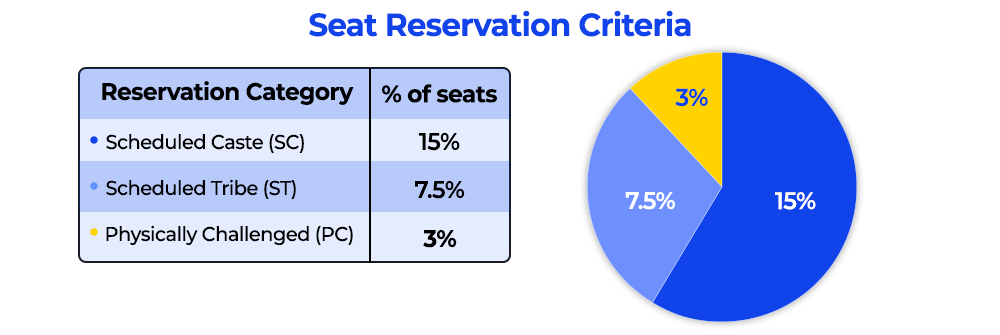
The KIITEE quota seats are distributed among different categories of candidates as follows. A separate merit list will be prepared for each category. Physically Challenged: Candidates will be considered eligible for admission under the PC Category who have a 40% disability, in accordance with Section 39 of the Persons with Disabilities (Equal Participation) Act, 1995. As the institution does not have adequate facilities, the candidates having locomotory disabilities are only eligible to apply for KIITEE.
KIITEE EXAM Preparation Tips
- Plan out time for each subject and follow it.
- Solve the past years' question papers to familiarize yourself with the exam pattern.
- Read through the syllabus of the program that you have chosen in detail.
- It is important to take mock tests regularly in order to become efficient in time management and accuracy.
- To stay healthy, sleep well, have a balanced diet, and exercise to keep physically and mentally fit.
KIITEE Exam Day Guidelines
- Reach the exam center 30 minutes early.
- No electronic gadgets allowed
- Carry only a black/blue ballpoint pen.
- Follow the instructions provided by the invigilators strictly.
Other Ways To Enroll in the Program: B.Tech for Working Professionals
The B.Tech for Working Professionals program is specifically designed for individuals with a diploma who are looking to enhance their technical knowledge while maintaining their full-time employment. The program provides flexible learning modes such as weekend classes or online recorded lectures that can be taken at your convenience.
If you have a 3-year engineering diploma, along with a minimum of one year of full-time work experience, you are able to apply to the program. Another advantage of the B.Tech for Working Professionals program is that there is no entrance exam necessary for admission. These are some universities that provide direct admissions without appearing for the exam: -
|
Direct Admission Colleges | |
|
Name of Universities |
Fee structure (per semester) |
|
₹ 50,000 per semester | |
|
₹ 40,000 per semester | |
|
₹42,000 per semester | |
|
₹ 50,000 per semester | |