

M.Tech Artificial Intelligence(AI) is a 2-year postgraduate program in engineering, and the program is offered in regular and flexible timing shifts. M.Tech AI programs highly emphasize developing the skills of the applicants. For that, projects and assignments are allotted to the students, which are completed under the guidance of the proficient professors. Through projects and assignments, students are capable of developing their skills, such as analytical thinking, and the program also motivates students to solve the challenges existing in their fields with their creative mindset. All in all, the M.Tech AI platform provides students with a platform to develop their personality and skills.
Why M.Tech in Artificial Intelligence? AI continues to evolve, shaping the future with intelligent automation and decision-making capabilities. Artificial Intelligence (AI) is the simulation of human intelligence in machines, enabling them to learn, reason, and make decisions. This technology has revolutionized various industries, from healthcare and finance to automation and cybersecurity.
Key Areas of AI:
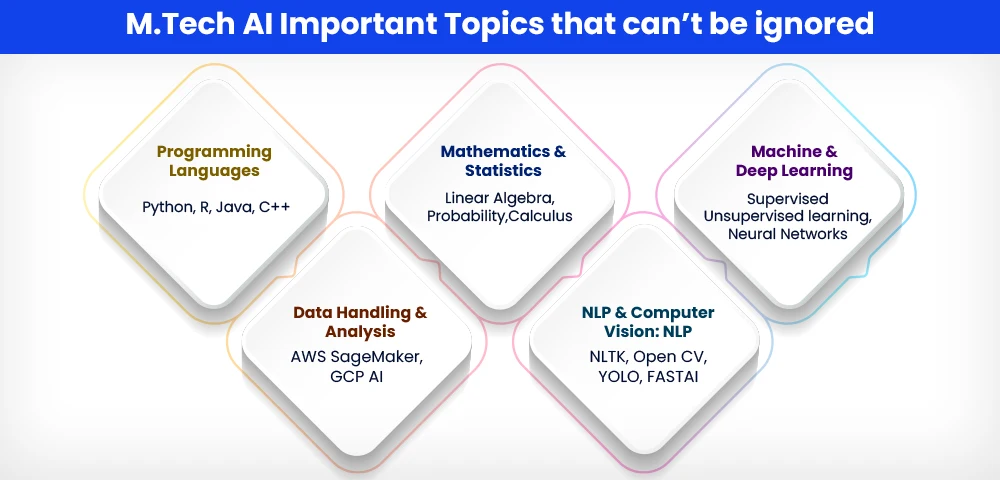
- Machine Learning (ML): Algorithms that allow computers to learn from data.
- Deep Learning: Advanced ML using neural networks for complex tasks like image and speech recognition.
- Natural Language Processing (NLP): Understanding and processing human language (e.g., chatbots, translation tools).
- Computer Vision: AI’s ability to analyze and interpret images and videos.
- Robotics: AI-powered robots performing human-like tasks in industries.
Those who want to pursue a career in AI. They can apply for the M.Tech in (CSE-AI). In this blog, the program is discussed in detail.
M.Tech Artificial Intelligence Regular: Overview
If working professionals want to continue their education and plan to study M.Tech (CSE-AI), they can apply for the regular M.Tech program or M.Tech for Working Professionals. They can check the information here:
|
Particulars |
Details |
|
Full Form |
Master In Artificial Intelligence |
|
Duration |
2 years |
|
Eligibility |
|
|
Entrance Exam |
|
|
Top Colleges |
IIT Hyderabad, BITS Pilani, VIT Vellore, IIT Madras, IIT Kanpur |
|
Fees |
INR 1,00,000- INR 3,00,000 |
|
Jobs Profile |
Research, Robotic Scientist, Computer Scientist, Game Programmer, Software Engineer |
|
Fresher Salary |
INR 5,00,000- 15,00,000 |
M.Tech Artificial Intelligence for Working Professionals: Overview
M.Tech (CSE-AI) is designed for working professionals because working professionals can’t attend the regular class due to their professional commitments. For working professionals, classes are conducted at odd hours, like evenings, weekends, or holidays. Classes at flexible times allow working professionals to balance their studies with other commitments.
|
Particulars |
Details |
|
Full Form |
Master In Artificial Intelligence |
|
Duration |
2 years |
|
Eligibility |
|
|
Entrance Exam |
Direct Admission |
|
Top Colleges |
Sanskriti University, Lingaya’s Vidyapeeth University, and Shri Venkateshwara University |
|
Fees |
INR 1,00,000- INR 3,00,000 |
|
Jobs Profile |
Research, Robotic Scientist, Computer Scientist, Game Programmer, Software Engineer |
|
Fresher Salary |
INR 5,00,000- 15,00,000 |
Part-time M.Tech programs and online M.Tech programs are invalid. Hence, for the convenience of the learners, flexible timing shifts programs are offered by the universities and these programs are approved by the AICTE and UGC.
M.Tech in AI Online
After the judgment of the Supreme Court, M.Tech or technical programs can’t be provided online because students need to learn technical skills. For that, they need proper infrastructure, which can be provided by the university and colleges on the campus. Hence, learners need to visit the campus to gain the knowledge.
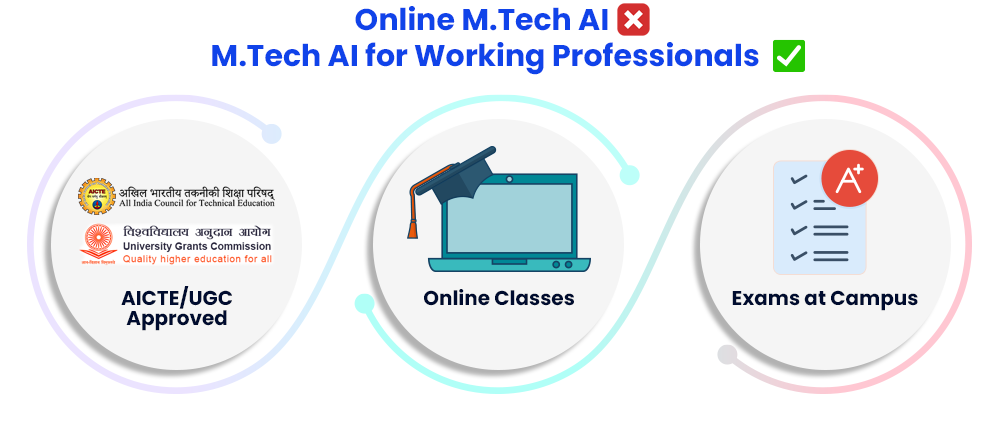
Instead of the Online M.Tech program in AI, there are flexible timing M.Tech programs follow hybrid mode of education which is feasible for working professionals to attend their classes while managing official commitments.
What is the Admission Process for MTech AI?
Different universities follow different admission criteria. Most universities allow direct admission, whereas others ask for the entrance exam score.
Entrance-Based Admission
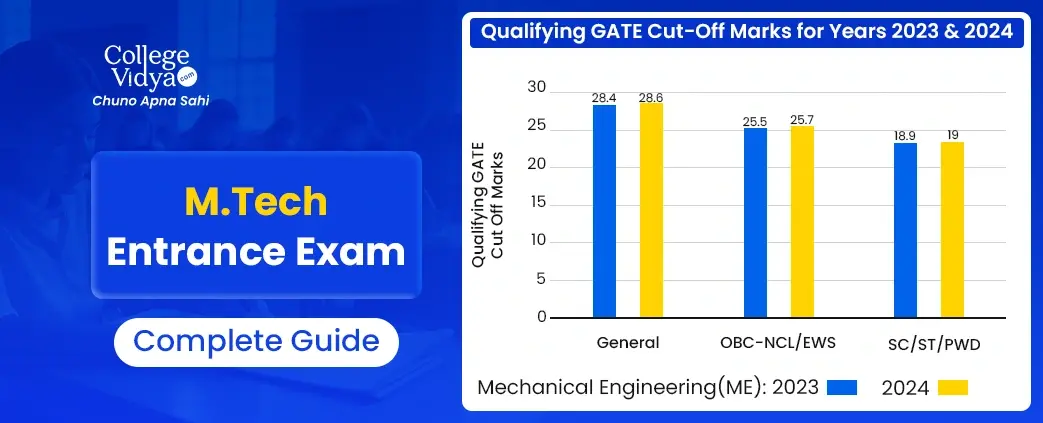
Some universities want students to score certain marks in their entrance exams, like GATE, IPU CET, etc. So, students have to follow the extra steps to get admission in these institutes or universities:
- Students have to sign in on the official website.
- After examination, a cut-off list will be released on the official website. Seats will be offered to the candidate based on the score in the entrance exam.
- Apart from the entrance exam, some colleges conduct their interview and a written test for final selection.
Direct Admission
For direct admission, universities ask candidates a certain aggregate mark to enroll for the program. Applicants have to follow the simple steps for admission:
- First, students are supposed to fill out the application form available online.
- Candidates have to go for a personal interview round.
- Shortlisted candidates will be offered admission.
Eligibility Criteria for M.Tech AI for Regular Program
To enroll in an M.Tech in Artificial Intelligence (AI) Regular Program, candidates must meet the following eligibility requirements:
Qualification Required
- A B.Tech/B.E. degree in Computer Science, Artificial Intelligence, Information Technology, Electronics & Communication, Electrical Engineering, or a related field from a recognized university.
- Some universities may also accept candidates with an M.Sc. in Computer Science, Mathematics, or Statistics, or an MCA (Master of Computer Applications).
Minimum Percentage Requirement
- Generally, candidates must have a minimum of 50-60% aggregate marks in their qualifying degree (varies by university).
- Some premier institutes may have a higher cutoff (e.g., 65-70% or 7.0 CGPA).
Entrance Exams
- Candidates may need to qualify for GATE (Graduate Aptitude Test in Engineering), which is widely accepted by IITs, NITs, and other reputed universities.
- Some private universities conduct their own entrance exams or offer admission based on merit.
Work Experience (Optional)
- While not mandatory, some universities prefer candidates with relevant work experience in AI, Data Science, or Machine Learning.
Additional Requirements
- Certain institutions may conduct personal interviews or written tests as part of the admission process.
- Reserved category candidates (SC/ST/OBC) may have relaxations in minimum percentage and entrance exam scores as per government norms.
Eligibility Criteria for M.Tech AI for Working Professionals Program
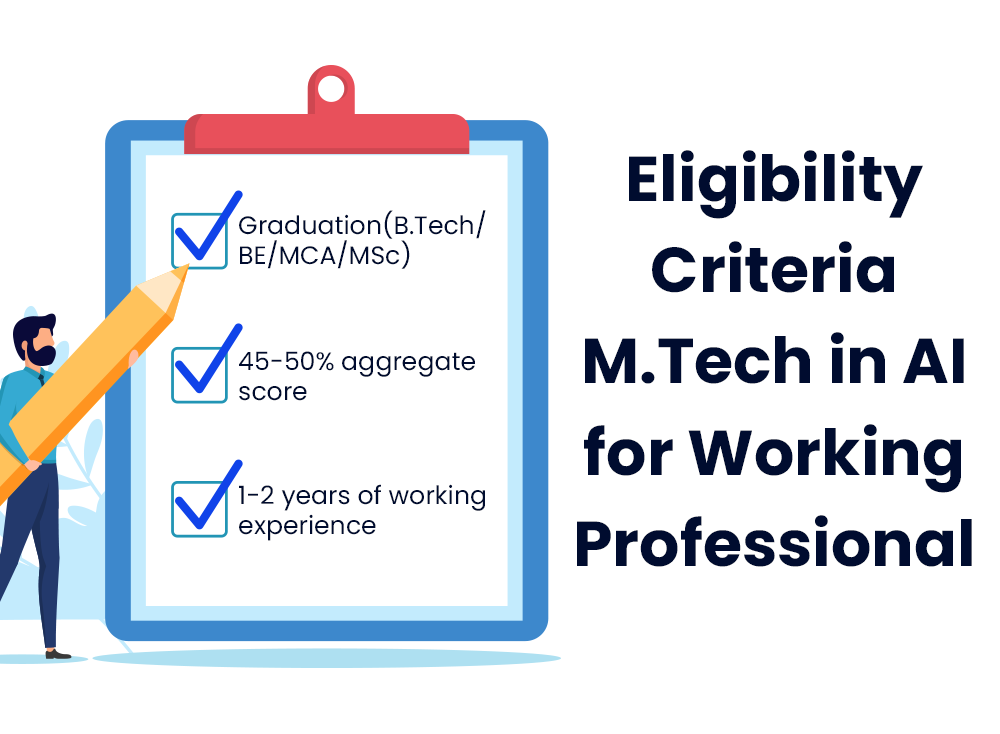
The Flexible Timing program is generally preferred by working Professionals. The M.Tech AI Flexible Timing Program is ideal for professionals looking to upskill while working. Candidates should check specific university requirements for work experience and entrance exam waivers before applying. However, guidelines are designed according to working professionals, so they enroll for the program.
Educational Qualification
- A B.Tech/B.E. degree from a recognized university.
- Some universities may also accept candidates with an M.Sc. in Computer Science, Mathematics, or Statistics, or an MCA (Master of Computer Applications).
Minimum Percentage Requirement
- A minimum of 50-55% aggregate marks in the qualifying degree (varies by institution).
- Top universities may require 65% or a 7.0 CGPA.
Work Experience (Mandatory)
- Most universities require at least 1-2 years of relevant work experience in AI, Machine Learning, Data Science, or related fields.
- Applicants may need to submit an NOC (No Objection Certificate) from their employer to confirm their employment status.
Entrance Exams (Varies by University)
- Some institutions waive GATE requirements for working professionals, while others may require it.
- Some universities conduct their own entrance exams or offer direct admission based on merit and work experience.
M.Tech Artificial Intelligence Entrance Exams
For admission to top institutes like IITs, NITs, and IIITs, GATE is the best choice. State-level and private universities may have their own entrance exams. Candidates should check specific university requirements before applying. Applicants who want to upgrade their knowledge and are dedicated to enrolling for the M.Tech (CSE-AI) program can prepare for these entrance exams. Here is the list of the M.Tech AI Entrance Exams:
|
Entrance Exam |
Level |
Eligibility |
Application Date (Tentatively) |
Exam Date (Tentatively |
|
GATE |
National Level |
B.Tech/B.E. graduates or M.Sc. in relevant disciplines |
31st August - 20th |
1, 2, 15, 16 February |
|
TANCET |
State Level (Tamil Nadu) |
Eligibility: B.Tech/B.E. graduates. |
January 24, 2025- February 28, 2025 |
March 22, 2025 |
|
AP PGECET |
State Level (Andhra Pradesh) |
B.Tech/B.E. graduates from a recognized university. |
March 2025 |
5–7 Jun 2025 |
|
TS PGECET |
State Level (Telangana) |
Eligibility: B.Tech/B.E. graduates from a recognized university. |
March 2025- April 2025 |
June 5 to 7, 2025 |
|
Karnataka PGCET |
State Level (Karnataka) |
B.Tech/B.E. graduates |
April 25, 2025 - May 10, 2025 |
May 31, 2025 |
|
CUET PG |
Central Universities |
B.Tech/B.E. graduates in a relevant field. |
January 2, 2025- February 8, 2025 |
March 13 to April 1, 2025 |
|
VITMEE |
University Specific (VIT University) |
B.Tech/B.E. graduates in a relevant field |
March 31, 2025 |
April 20, 2025 and April 24, 2025 |
|
SRMJEEE |
University Specific (SRMJEE) |
B.Tech/B.E. graduates in a relevant field |
|
|
|
BITS HD |
University Specific (BITS Pilani) |
B.Tech/B.E. graduates in a relevant field |
April 19, 2025 |
May 26th and June 1st, 2025 |
Syllabus M.Tech AI
Here’s a comprehensive overview of the M.Tech in Artificial Intelligence (AI) syllabus, based on common structures followed by top Indian universities and aligned with UGC/AICTE guidelines:
|
M.Tech AI Syllabus | |
|
Semester 1 |
Semester 2 |
|
Mathematics for Machine Learning Programming for Data Science Data Mining Artificial Intelligence Research Methodology & IPR |
Artificial Neural Networks Pattern Recognition Computational Intelligence |
|
Semester 3 |
Semester 4 |
|
Deep Learning Probabilistic Graphical Models Advanced Machine Learning |
Computer Vision AI for Robots Reinforcement Learning |
Top Colleges for Studying MTech AI?
Choosing the right college for your M.Tech in AI depends on your career goals, whether they are research-oriented, industry-focused, or aimed at balancing work and study.
|
Top Colleges M.Tech AI | |
|
IIT Madras |
IIT Delhi |
|
IIT Bombay |
VIT Vellore |
|
NIT Surathkal |
DTU |
Best Govt. Artificial Intelligence Colleges in India
|
Government Colleges M.Tech AI |
Fees (INR) |
Entrance Exam |
|
IIT Bombay |
1 lakh |
GATE |
|
DTU |
2 lakh |
GATE |
|
IIT Delhi |
3 lakh |
GATE |
|
IIT Madras |
3-8 lakh |
GATE |
|
NIT Surathkal |
5 lakh |
GATE |
Best Private Artificial Intelligence Colleges in India
|
Private College M.Tech AI |
Fees (INR) |
Entrance Exam |
|
VIT Vellore |
INR 4 lakh – INR 8 lakh |
VITEEE |
|
Chandigarh University |
INR 11 lakh |
Graduation with 60% aggregate |
|
LPU |
INR 10 lakh – INR 16 lakh |
JEE Main, LPU NEST, CUET |
|
SASTRA |
INR 3 lakh |
GATE |
|
Amity University |
|
Graduation with 60% aggregate |
Best Universities for M.Tech for Working Professionals
|
M.Tech AI for Working Professionals |
Fees (per semester) |
|
Shri Venkastehwara University |
40,000 |
|
Lingaya’s Vidyapeeth University |
50,000 |
|
Sanskriti University |
38,000 |
|
Galgotias University |
77,000 |
M.Tech AI without GATE
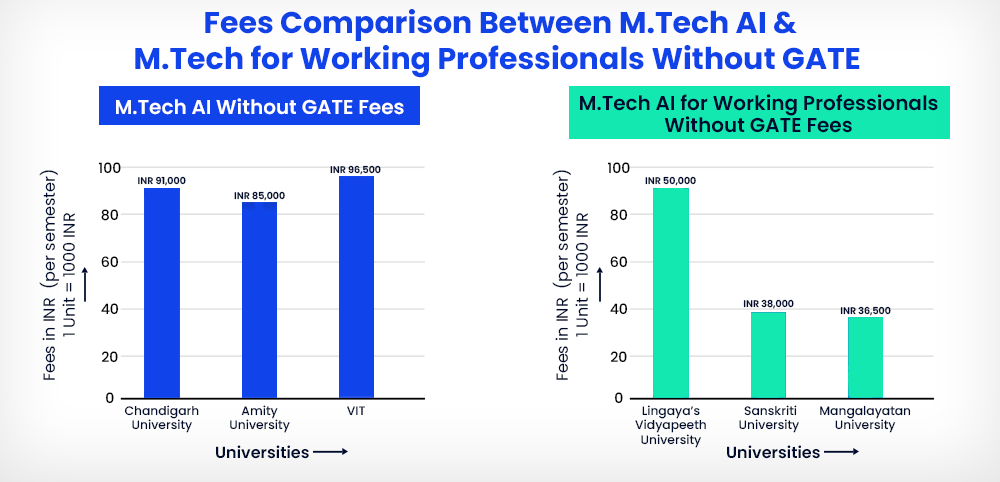
For premier universities and institutes, applicants have to apply for the GATE, an entrance exam, because students are selected through counselling required GATE score. But there are other universities that conduct their entrance exam. For the relief of applicants, there are universities that offer admission without an entrance exam or GATE. Students can apply for the private universities offering direct admission, like Amity University and Chandigarh University.
|
M.Tech AI Without GATE | |
|
BITS Pilani |
VIT Vellore |
|
Chandigarh University |
Amity University, Noida |
|
D.Y. Patil College of Engineering, Pune |
Thapar Institute of Engineering and Technology, Patiala |
Those who are applying for the M.Tech AI program for working professionals can apply to universities such as Shri Venkateshwara University and Lingaya’s Vidyapeeth University. These Universities offer admission without GATE.
|
M.Tech AI for Working Professionals without GATE | |
|
Shri Venkateshwara University |
Lingaya’s Vidyapeeth University |
|
Sanskriti University |
Galgotias University |
Profiles After M.Tech AI Job and Salary Trends
Here’s a breakdown of top job profiles and salary trends after completing an M.Tech in Artificial Intelligence (AI) in India:
Job Profiles After M.Tech in AI
|
Job Role |
Key Responsibilities |
Average Salary (INR) |
|
AI/ML Engineer |
Build and train machine learning models and deploy AI systems |
₹10–22 LPA |
|
Data Scientist |
Analyze complex data, build predictive models, and provide business insights |
₹12–25 LPA |
|
Computer Vision Engineer |
Develop systems for facial recognition, object detection, etc. |
₹8–18 LPA |
|
NLP Engineer |
Build chatbots, language models, and text analysis systems |
₹9–20 LPA |
|
Research Scientist (AI) |
Conduct cutting-edge AI research in deep learning, RL, and generative models |
₹15–30+ LPA |
|
AI Product Manager |
Manage AI-driven products, work with cross-functional teams |
₹18–35+ LPA |
|
Robotics Engineer |
Design intelligent robotics systems for automation |
₹6–15 LPA |
|
AI Consultant |
Provide AI solutions and strategies for businesses |
₹12–28 LPA |
|
Data Engineer |
Build data pipelines and infrastructure for AI systems |
₹8–18 LPA |
Salary Trends Based on Experience
Top-paying industries: FinTech, Healthcare AI, Autonomous Vehicles, Cybersecurity, and Cloud Tech:
|
Experience Level |
Annual Salary (INR) |
|
Entry-Level (0–2 yrs) |
₹6 – ₹12 LPA |
|
Mid-Level (3–6 yrs) |
₹12 – ₹25 LPA |
|
Senior-Level (7+ yrs) |
₹25 – ₹50+ LPA |
Scope of M.Tech AI
M.Tech in Artificial Intelligence empowers students and working professionals to specialize in cutting-edge AI technologies, preparing them for high-demand roles in both industry and research.
Here’s a comprehensive overview of the Scope of M.Tech in Artificial Intelligence (AI) — tailored to highlight its immense potential across industries, research, and career growth:
Key Areas Where AI is Booming
|
Sector |
AI Application Areas |
|
Healthcare |
Medical imaging, AI diagnostics, drug discovery, robotic surgery |
|
Finance & FinTech |
Fraud detection, algorithmic trading, risk assessment |
|
E-Commerce |
Recommendation engines, chatbots, personalized ads |
|
Manufacturing & Robotics |
Predictive maintenance, smart automation, and quality control |
|
Space Research |
Satellite data processing, robotics, navigation systems (ISRO, NASA) |
|
Automotive |
Self-driving vehicles, traffic prediction, and autonomous navigation |
|
Education |
AI tutors, adaptive learning platforms, and automated grading |
Conclusion
Those who are interested to learn new skills in Artificial Intelligence and Machine Learning can apply for the M.Tech program in specialization. They can enroll for the regular M.Tech AI program or the M.Tech for Working Professionals program. In simple terms, those who want to attend the regular classes and want to give more time to their research can enroll for the regular program. Working Professionals who can’t attend the regular classes due to their work commitments can apply for the M.Tech for Working Professionals. The program is designed for employees so they can focus on learning new skills to improve their efficiency.



![M.Tech in Computer Science: Details, Admission, Eligibility, Syllabus, Colleges, Scope [2026]](https://cdn.collegevidya.com/blog/mtech-computer-science-and-engineering.webp)
![BITS WILP M.Tech. Artificial Intelligence and ML [Reviews]](https://cdn.collegevidya.com/blog/mtech-wilp-from-bits-pilani.webp)