
Graphic design is a very diverse and artistic profession. It is an integration of art, communication, technology, and business to generate images that provoke motivation, change perceptions, develop brands, and solve real-life problems. Every design has a story, whether it is a logo, social media content, an application interface, or a product package. Hanging behind these stories are the graphic designers who make ideas come alive with the use of color, typography, layout, and imagination.
Online education has provided opportunities to many potential designers in the modern world as never before. Gone are the days when you were required to join a physical design school to be equipped to work in the industry. As digital learning is becoming more common, you can begin your design studies from the comfort of your bedroom, a cafe, or even at the same time as doing another degree or holding a job. Online programs will also offer the aspect of learning at your own pace, working on real-world projects, a good portfolio, and credentials that are recognized by employers.
This blog will discuss online courses of a popular guidance educational site in India, which is specific to creative students looking to pursue a career in graphic design. We would examine the courses in degrees and certificates, the main points to consider, and how to get the correct path depending on your objectives.
Reasons to Choose an Online Graphic Design Course in 2026
- Flexibility: Flexibility is one of the largest benefits of online programs. As opposed to conventional colleges, online courses enable you to study at your own pace, whatever trend you are in at work, in family life, or doing any other job. Most online classes are self-paced, and some have regular live classes, which would provide you with both form and freedom.
- Cost Efficiency: A conventional design education is costly, both in terms of school fees, travel, supplies, and housing. Online programs, on the contrary, tend to be much cheaper. There are free courses, cheap certificate programs, and cheaper online degrees. Online certificate programs tend to be very inexpensive compared to campus-based degrees, even with the pay.
- Industry-Relevant: The credible online courses are geared towards the provision of skills relevant to the industry. Numerous courses revolve around the basics of design (color theory, typography, and layout), software (Photoshop, Illustrator, and InDesign), and practical (branding, UI/UX, and motion graphics). Others also involve projects and the development of a portfolio, essential to graphic designers.
- Portfolio Development: The industry of graphic design can usually not do without a strong portfolio more than it can do without a degree. Capstone projects or design assignments are often part of online programs, which you will be able to add to your portfolio. These projects provide you with hands-on experience and tangible deliverables to be considered by prospective employers or clients.
- Lifelong Learning and Upskilling: Graphic design is a direction that is constantly developing and changes with the tools, tendencies, and platforms. Online studies provide an opportunity for designers (newcomers and professionals) to continuously upskill. Online programs enable continuous learning of either the addition of motion graphics, new software, or the study of UX/UI design.
How to Choose the Right Online Graphic Design Program?
There is no need to stress that picking the correct online graphic design program can be baffling due to the plethora of choices. The following are the major considerations:
Comprehend Your Ultimate Your Goals
- Hobby vs. Career: Do you want to design as a hobby, or do you want a full-time graphic design career? Short courses or Massive Open Online Courses (MOOCs) may be adequate in the former; certificate programs, diplomas, or degrees are more suitable in the latter.
- Portfolio Building: In case it matters to be a portfolio builder, select those programs that feature project-based learning.
- Specialization: Which do you prefer to work with: branding, print design, UI/UX, or motion graphics? Choose programs that suit your areas of specialization.
Decipher Your Time Commitment
- Part-time vs. Full-time: How many hours a week will you be able to spend on it? The short courses are less demanding; full diplomas or degrees are more demanding.
- Pacing: Is it important to you that the learning is self-paced or that there is a timetabled cohort with live classes?
Decide on the Budget
- Free MOOCs, such as those on Coursera or Great Learning, are free
- Diplomas: This is a more organized program, which is more expensive, but offers tighter credentials.
- Software Costs: The cost of design tools (Adobe Creative Cloud, etc.) is to be considered. Certain programs can offer reduced entry or suggest no-cost options.
Check for Credibility and Accreditation
- Select courses offered by well-known institutions. A diploma from an accredited university or design institution is more valuable.
- In the case of degree courses, verify whether the college is accredited (this can be important in terms of recognition and further studies).
Look for Mentorship Programs
- Feedback plays an important role in design education. Live critique programs, or peer reviews, and instructor feedback programs are highly desirable.
- Community: Courses with a community (forums, student groups) allow you to learn with your fellow students and create a network.
Final Outcome – Talk to Alumni
- Find alumni performance: Are students finding employment? Do they have strong portfolios? Reach out to them and ask whether they received placement assistance or participated in a mentorship program during their course to see how they support their students.
Additional Tips for Making the Most of Online Graphic Design Learning
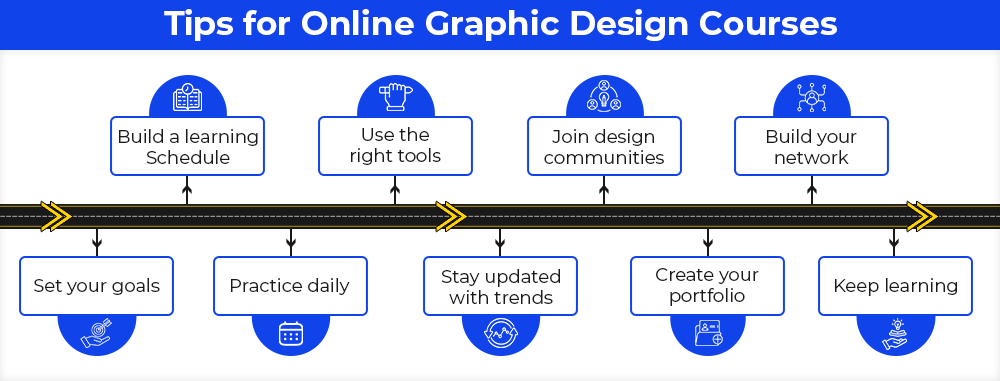
- Set Clear Goals: The first step is to understand what you desire: a portfolio or a full-time job. The choice of a program will be directed by goals.
- Build a Learning Schedule: A routine should be established even in self-paced courses. Set aside studying and practicing hours per week.
- Practice daily: Graphic design is a practical field. It is not just enough to watch the videos. Complete small design tasks: redesign posters, create logos, or create web page mock-ups.
- Use the Right Tools: Develop software in industry standards (Adobe Creative Cloud, Figma). In case cost is a factor, see student versions (or free alternatives, e.g., GIMP, Inkscape).
- Stay updated with trends: Stay informed about upcoming trends. To stay up-to-date, you can visit the WGSN website.
- Join design communities: Participate in design communities, online communities, or peer review groups. Positive criticism will make you better in a short time.
- Create a Portfolio: Organize your assignments, capstone projects, and personal works into a well-organized portfolio. Utilize sites such as Behance, Dribbble, or a personal site.
- Build your Network: Network with fellow designers, participate in webinars, and attend online events in design. Mentoring and employment are issues that can be facilitated through networking.
- Keep Learning: The design trends and tools are very dynamic. After graduating from a program, do not cease but seek further learning programs, workshops, or even micro-credentials.
What are the Challenges and How to Overcome Them?
In addition to numerous advantages associated with online programs, there are challenges related to them. The following are some of the common ones and how to address them:
- Have time limits for yourself and get a study friend.
- Choose live session programs or peer feedback programs. Take critique via the online communities.
- Educational licenses, free trials, or free open-source software until you can purchase industry software.
- Work in online forums, design Slack/Guild groups, or social media design groups.
- Concentrate on developing fewer but better projects. Take the capstone or project work for your certificate or diploma to create portfolio pieces.
- Give priority to programs in good institutions. As an alternative, let your work and portfolio do the talking; most designers have gotten jobs by their work rather than their qualifications.
Extensive List of Courses One Can Pursue for Graphic Design
Find the list of all the courses (diploma, bachelors, certifications, everything below):
- Diploma in Graphic Design (Duration: 6–12 months)
- Bachelor of Design (B.Des) in Graphic Design (Duration: 4 years)
- Bachelor of Fine Arts (BFA) in Applied Arts (Duration: 4 years)
- Diploma in UI/UX Design (Duration: 6–12 months)
- Certificate Course in Motion Graphics (Duration: 3–6 months)
- Diploma in Animation & Multimedia (Duration: 1–2 years)
- Diploma in Web Design (Duration: 6–12 months)
- Certificate Course in Social Media Design (Duration: 2–4 months)
- Diploma in Game Design & Game Art (Duration: 1–2 years)
For students who want fast career entry to the design field, the best options are
- Diploma in Graphic Design
- UI/UX Design Course
- Motion Graphics Course
For students who want a long-term degree in the design field, the best options are:
- B.Des in Graphic Design
- B.Des in Communication Design
Scroll through the table below to find graphic design courses that work best for working professionals. If you are already in the design field, look for the recommended course type and find the suitable fit.
Graphic Design Course For Working Professionals | |
| Long Term Goals | Recommended Course Type(s) |
| Switch to UI/UX or product design | Google UX Certificate, Dribbble Product Design Academy, IDF subscription |
| Add motion graphics/animation/video design to your toolkit | DigitalAdda, Frameboxx graphic and video editing courses, and the AI Graphic Design course |
| Expand from print/branding to digital/web/interactive design | UI/UX courses + motion graphics/multimedia design courses |
| Upskill without quitting job; flexible/part-time/online | Online/self-paced courses from platforms |
Conclusion
In the world of design in 2026, where creativity meets technology to shape brands and solve problems, online programs stand out as your gateway to success. Whether you're a beginner sketching your first logo, a working professional upskilling in UI/UX or motion graphics, or someone chasing a full-fledged degree in design, these flexible, cost-effective courses equip you with industry-relevant skills, portfolio-ready projects, and credentials that open doors. By choosing programs aligned with your goals—factoring in time, budget, accreditation, and mentorship—you'll not only overcome common hurdles like motivation dips or software costs but also build a thriving career through daily practice, community networking, and relentless trend-tracking.
Platforms like Coursera, Great Learning, and Google Career Certificates offer everything from quick diplomas to comprehensive degrees, making elite education accessible from anywhere in India. Start small: pick a Diploma in Graphic Design or Motion Graphics for rapid entry, dedicate consistent hours to tools like Adobe Suite or Figma, and showcase your work on portfolios to get you high-paying clients. Remember, in graphic design or any other creative field, your portfolio speaks louder than any degree—it's the vivid proof of your imagination at work. We are this age now that we can embrace any online learning today, and transform your passion into a profession that motivates, innovates, and endures.