

After long periods of study, many late nights of writing, another draft or two of your thesis, some tough research problems, and, in general, some hard work, you have finally made it through the most important questions to be ready for your PhD viva. This is an important assessment process that is, for many, the only means of hearing from, and engaging with academics in their field of work, to converse, engage, and defend their work and written thesis. While the PhD viva may seem slightly frightening and intimidating, it is also an experience that can be enjoyable and intellectually challenging when approached correctly and with the right mindset.
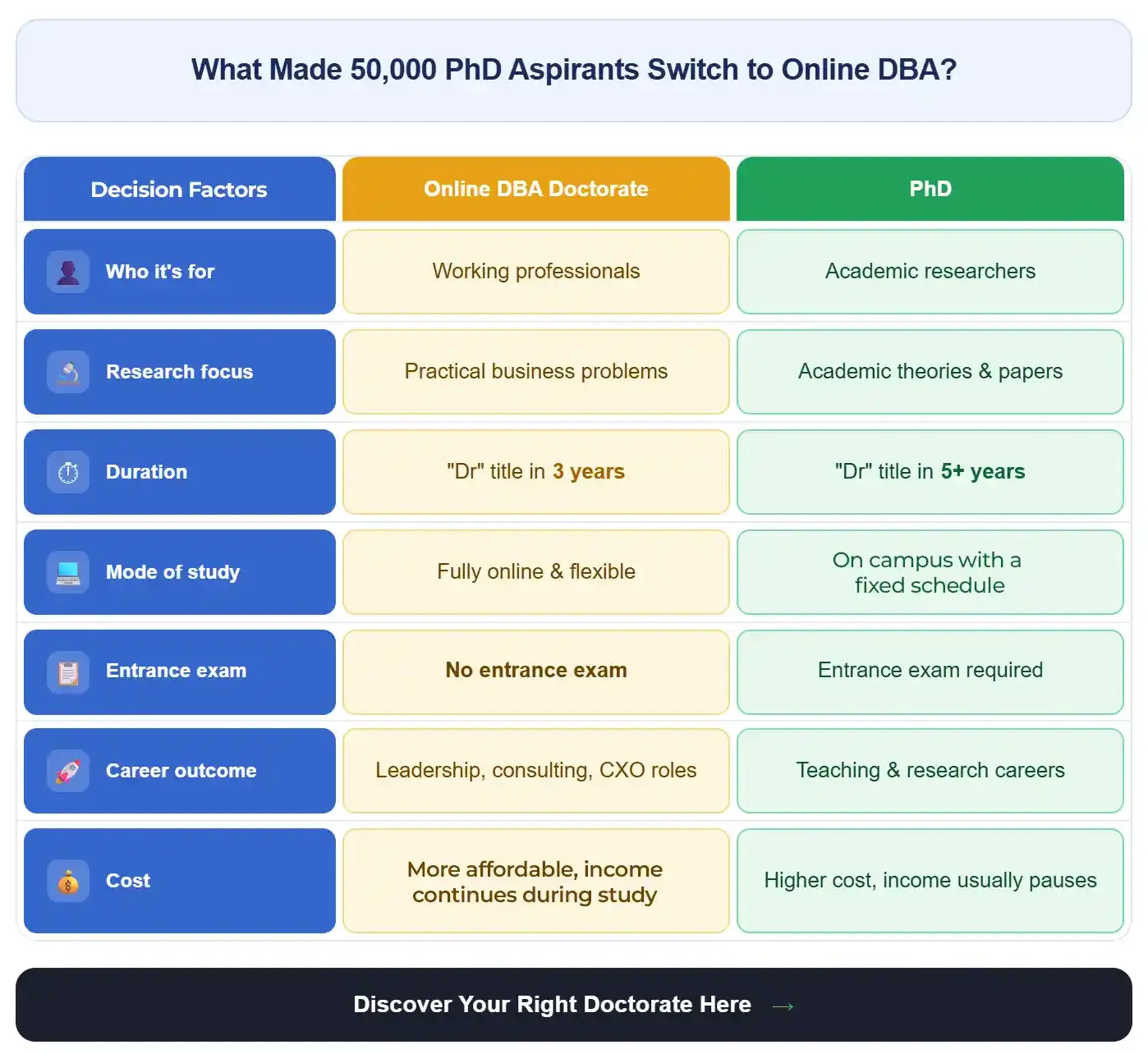
However, you can opt for an online DBA (Doctor of Business Administration) that is equivalent to a PhD. After completing this course, you will get the Dr. title in your name. Once you take admission in this course, you will get a mentor who will help you during the program.
What is a PhD Viva?
A PhD viva (abbreviation for viva voce, Latin for It is with the living voice is an oral examination in which you are asked to defend your thesis in front of an examining committee, typically an internal examiner (from your institution) and an external examiner (from a different institution). The primary purpose is to:
Evaluate your grasp of your research:
- Test your contribution to the field.
- Test your skill at discussing and critically thinking about your work
- Clear up any points of ambiguity in your written thesis
- Vivas can take between one and four hours, depending on the topic, university rules, and the character of your thesis.
1) Know What to Expect: Before diving into preparation, it is important to understand the structure and expectations of a viva at your university. Every institution has slightly different formats, but a typical PhD viva includes:
Opening questions about your motivation, research choices, or a summary of your thesis. In-depth questions about each chapter, methodology, literature review, findings, and analysis Critical discussion about strengths, weaknesses, and contributions, where you might be questioned on future work or application to the real world
Tip: Ask recent PhD graduates in your department to explain what their viva was like. This should make you relax and provide you with insider information.
2) Re-read your Thesis Carefully and critically: You probably handed over your thesis weeks or even months earlier. Start getting ready by reading it from start to finish. Here's how you can do it:
Markdown major arguments, methods, findings, and conclusions:
- Jot down weaknesses, obscurities, or holes that examiners may probe you on.
- Make summaries for every chapter in bullet form.
- Make reference cards for quick reference on citations, data points, or case studies you may need to speak on.
- Do not simply read your thesis; question it. Ask yourself:
Why did I select this approach?
- What other ways could I have approached this problem?
- How do my findings advance the discipline?
3) Prepare for Typical Viva Questions: Although each viva is different, some questions come up regularly. Preparation on these can make you confident:
General Questions:
- What is the central contribution of your work?
- What led you to investigate this issue?
- How did your way of thinking change during your PhD?
Methodology Questions:
- Why did you select this method?
- What are the weaknesses of your method?
- Could your results have been biased?
Literature Questions:
- How does your research connect with major theorists or works?
- What are the main controversies in your area of research?
- Are there any recent studies that contradict what you have found?
Critical Thinking:
- What would you do differently if you were to start again?
- What are the flaws of your thesis?
- How might your research be developed or advanced?
- Rehearse answering these out loud or to a friend/mentor. This will make you clearer and more confident in your answers.
4) Learn About Your Examiners' Backgrounds: Where possible, discover who your examiners are before the viva and study their work. This will assist you:
- Anticipate their areas of interest and likely lines of inquiry
- Acknowledge their work in the area in your defense (diplomatically!)
- Don't contradict or dismiss their published research
But don't worry too much about trying to shape your answers to suit them; stand up for your work honestly.
5) Make a Viva Preparation Binder: Organize your notes into a clear, easy-to-use binder or electronic document. It should contain:
A thesis summary:
- Chapter summaries and key arguments
- Definitions of key terms/concepts
- List of possible questions and answers
- Corrections or improvements you've noticed post-submission
- Key references and page numbers
- Having a structured document will help you review quickly and feel organized on the day.
6) Do Practice A Lot: Mock vivas are very useful. Get your supervisor, peer, or even a non-peer friend to mimic a viva session. This assists with:
- Adapting to speaking your mind
- Thinking under pressure
- Handling nerves
Record yourself responding to the most important questions. Playback can show speech patterns, filler words, or areas to work on.
7) Master the Art of Defense, Not Defensiveness: A viva is not an attack; It is a scholarly discussion. Be prepared to defend your work, but also open to criticism.
- Remain calm when challenged.
- Recognize limitations truthfully.
- Do not be too defensive or argumentative.
- If you do not know the answer, then say so and provide a considered reflection or indicate how you would go about finding out.
- Your reflective and interactive ability is often more appreciated than knowing every answer by heart.
8) Mind the Practicalities: On viva day (in-person or remotely), ensure to attend to the following:
- For In-Person:
- Bring hard copies of your thesis and notes
- Come early and get comfortable
- Dress professionally but comfortably
For Online:
- Check your internet connection, camera, and microphone
- Find a quiet and well-lit space
- Have water, a notebook, and your preparation binder within reach
- And above all, sleep well the night before.
9) Enjoy the Experience: Rather than dreading the viva, attempt to reframe it:
It is the only time you’ll have leading scholars fully focused on your research.
- It is a chance to talk about a topic you’ve mastered over several years.
- It marks the transition from student to independent scholar.
- Most candidates find the viva to be a challenging but positive experience. It may include rigorous questioning, but also genuine curiosity and praise.
10) After the Viva: What to Expect: At the end of your viva, you’ll usually be asked to step out while the examiners confer. Outcomes can include:
- Pass with no corrections.
- Pass with minor/major corrections.
- Resubmission with or without a second viva (rare)
- Fail (extremely rare)
- If corrections are required, treat them as part of the process, not a setback. Most candidates complete minor revisions in a few weeks.
Keep In Mind
Your PhD viva is not simply an examination; It is a celebration of your intellectual journey. With careful preparation, a clear head, and the capacity to think critically, you can approach the viva with confidence and success.
A PhD is the highest degree of academic achievement that a person can attain, a testament to tenacity, intellectual merit, and novel contribution to understanding. However, for most, going for a PhD usually goes along with certain doubts: Is it worth it? What are the actual advantages of a PhD aside from the title?
1) Expertise within a Subject Area: With a PhD, one of the greatest advantages is acquiring in-depth, specialized knowledge in your subject area. While a master's or a bachelor's degree may touch on broad subjects, a PhD enables you to:
- Dive deep into a niche topic
- Explore open questions
- Develop new theories or methodologies
- Become an expert in your field
Whether you love quantum mechanics, ancient philosophy, machine learning, or climate change, a PhD allows you the time and resources to become a real specialist.
2) Career Opportunities in Academia and Research: A PhD is the minimum requirement for academic positions such as:
- University lecturer/professor
- Postdoctoral researcher
- Research scientist
- If you find yourself interested in teaching, guiding students, authoring articles in journals, or influencing the next generation of intellectuals, a PhD is your gateway. It provides access to jobs at leading universities, research institutes, and think tanks.
Besides, most nations prefer research experts holding PhDs for permanent residency and career advancement in higher education.
3) Access to High-Level Positions in Industry: Though academia is a popular path, most PhD graduates do well in non-academic professions. Fields such as pharmaceuticals, data science, engineering, finance, and AI intensely look for PhD graduates because they possess the skills to:
Address intricate issues:
- Process big data
- Think independently and rationally
- Drive creative projects
- Numerous R&D, innovation, product development, and policymaking opportunities are most appropriate for doctorate-level professionals.
4) Better Wage Potential: While it varies by field and location, research again and again indicates that PhD recipients tend to earn higher life wages than those with just a bachelor's or master's degree.
Where specialized knowledge is scarce and precious, for instance in biotech, artificial intelligence, or higher analytics, possessing a PhD can put you at an advantage when negotiating a salary and leadership roles.
5) Acquisition of Transferable Skills: Aside from the subject content, a PhD educates you in a broad set of transferable skills that are sought after across industries:
- Critical thinking: Master evaluating, challenging, and combining ideas in depth
- Problem-solving: Develop experiments, solve issues, and modify approaches
- Communication: Write papers, give conference presentations, and instruct students
- Time management: Schedule long-term objectives, meet deadlines, and cope with stress
- Project management: Coordinate your research, from inception to publication
These abilities are extremely sought after in academic as well as business positions.
6) Adding to Knowledge and Society: In essence, a PhD is all about adding something new to the world. You're not simply studying, you're producing knowledge that others can develop further.
Whatever you find out about a new gene, create as a sustainable material, or suggest as a new theory in literature, your study can:
- Affect public policy
- Spark future research
- Improve lives and technologies.
- There’s a unique satisfaction in knowing that your work matters not just to you, but to your field and society.
7) Networking and Global Exposure: During your PhD, you will connect with experts, attend international conferences, collaborate across countries, and publish in global journals. This exposure can:
- Expand your academic and professional network.
- Lead to international postdoc or job opportunities
- Keep you up-to-date with the latest research trends across the globe
- Your network is your career asset for life.
8) Personal Achievement and Growth: A PhD is more than an intellectual pursuit; Itisa a trial by fire, determination, and faith in self. The journey tests you to:
- Challenge intellectual limits
- Navigate failure and rejection
- Maintain motivation in extended periods of isolation during work
- Obtaining a PhD provides you with a feeling of individual pride and achievement. You have designed a one-of-a-kind work after devoting years of effort, and have the honor of being called a doctor.
9) Policy, Government, and NGOs Opportunities: Governments and charities increasingly depend upon evidence-based policy and data-driven policy. A PhD equips you with the abilities to:
- Create influential policy briefs.
- Carry out evaluations
- Shape education, health, technology, and environmental sectors
- Several PhD holders work as research officers or policy advisers in national laboratories, UN agencies, or international non-governmental organizations.
10) Thought Leadership Pathway: Over time, a PhD can make you a thought leader in your area. Through publications, speaking, teaching, and public engagement, you can influence the debate in your space.
It also leads to being able to write books, appear for media interviews, and head professional associations.
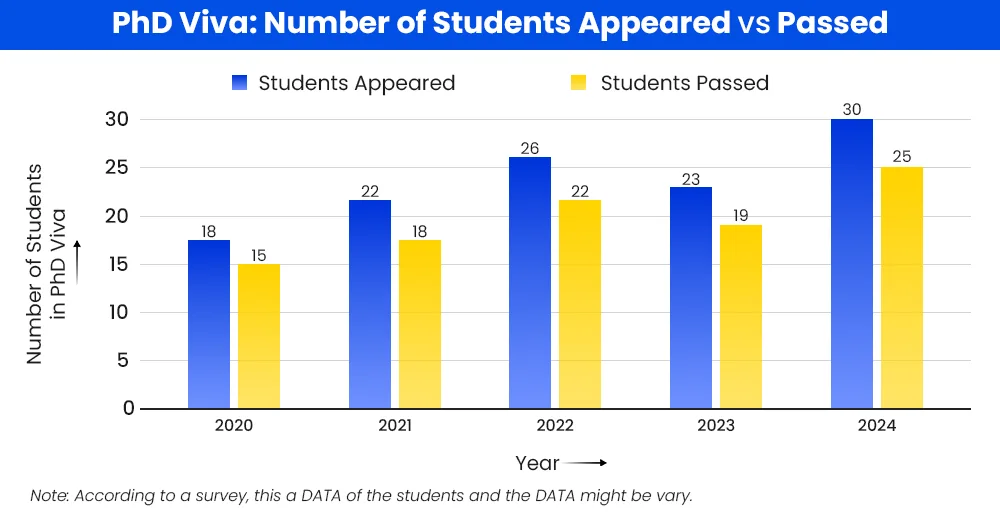
DATA of the Students who Pass the PhD Viva:
|
Year |
Students Passed |
|
2020 |
15 |
|
2021 |
18 |
|
2022 |
22 |
|
2023 |
19 |
|
2024 |
25 |
Note: According to a survey, this a DATA of the students and the DATA might be vary.
Looking For An Alternative Option: DBA is the Solution
While doing a PhD, it is necessary to give a viva and also need to pass it, then you will only get the degree. However, if you are searching for another option that will help you in getting the Dr. title as soon as possible then online DBA (Doctorate of Business Administration) is the perfect choice. However, online DBA is offered by foreign universities and it is also valid in India.
While pursuing this program, the university will assign you the professor who will be expert in their feild and they will help you in completing this program successfully.
Here is the list of the Universities that are offering this course are mentioned below for reference:
|
University |
Program |
Fees (INR) |
|
DBA Online |
₹6,00,000 | |
|
DBA Online |
₹8,14,000 | |
|
DBA Online |
₹8,12,500 | |
|
ESGCI International School of Management Paris Online DBA Program |
DBA Online |
₹8,14,000 |
|
DBA Online |
₹5,50,000 | |
|
DBA Online |
₹7,50,000 | |
|
DBA Online |
₹7,00,000 |
Note: The fees might vary.