

The automotive industry is in a paradigm shift as electric vehicles (EVs) grow in the world. Electric cars became one of the existing facts as the number of people caring about the environment, technological revolution, and governmental support increased. Nevertheless, similarly to any new technology, EVs are also associated with a range of opportunities and issues. The two-sided version of this green transportation revolution needs to be comprehended so that an informed decision can be made regarding the future of mobility.
Why is EV the future trend?
The adoption of electric vehicles is the future of the transportation industry because of the strong combination of environmental, economic, and technological aspects. With the world facing the climate crisis, EVs may represent a viable course of reducing emissions from transportation, with assistance provided by governments in stricter regulations, incentives, and deadlines to eliminate gasoline-powered cars. The battery technology has also become much better—prices have dropped, the performance has increased, and there are new inventions such as solid-state batteries in the offing, which will make the EVs much cheaper.
Reduced operation and maintenance expenses provide the EVs with a high economic benefit, as the preferences of consumers switch towards sustainable and technology-oriented ones. In the meantime, companies are going electric with fleets, nations are pursuing energy autonomy, and the digital design of EVs is irresistibly attractive to self-driving robots. As global sales are skyrocketing, and the increase in sales occurs due to huge investments, the transition to electric mobility is becoming faster and more and more unavoidable.
The Major Advantages of Electric Vehicles
In the modern transport market, electric cars are taking center stage in changing the game. EVs are attracting interest among consumers, manufacturers, and policymakers as more people are showing interest in sustainable mobility. This part examines how they have become increasingly important and influential in contemporary travelling.
1. Environmental Advantages and Zero Emission
Electric cars have been a significant step towards the reduction of our carbon footprint. EVs do not generate tailpipe emissions in comparison to traditional cars that use fossil fuels, and this reduces air pollution by cutting emissions in cities. This matters particularly because cities across the globe grapple with air pollution and the health consequences it has occasioned. This would enable us to greatly reduce the emission of greenhouse gases by switching to electric vehicles, which would help in fighting climate change and also give future generations healthy living conditions.
2. Reduction of Operating and Maintenance Costs
The fact that electric cars are cost-effective in the long run is one of the most persuasive benefits of this type of vehicle. EVs do not contain as many moving components as vehicles with internal combustion engines do, so they do not need as complex a mechanical structure and do not need as much maintenance. It does not need oil changes, replacement of the spark plugs, or fixing of the emission system. The EVs also have a regenerative braking system that greatly extends the lifespan of the brakes. Also, electricity tends to be less expensive than gasoline or diesel, leading to a reduction of fuel expense per mile driven. These savings may be considerable over the life of the vehicle.
3. Excellent Performance and Power On Demand
Electric motors have instant torque, which gives them immediate acceleration, which can sometimes be more than regular vehicles. This creates the effect of an easy-to-drive and responsive vehicle that leaves many EV owners thrilled. The low center of gravity also increases the stability and handling, which is because of the placement of the batteries. EVs are not loud and thereby reduce noise pollution and offer a more comfortable driving experience. It is so smooth in terms of power flow, and there is no gear changing that can be witnessed; the ride is amazing.
4. Energy Efficiency
Electric vehicles convert electricity provided in the grid to the wheels with an efficiency of over 77% compared to the conventional gasoline-powered vehicle, which only converts an average of 12-30% of the power contained in the gasoline. Such efficiency implies that EVs are more efficient in their use of energy sources, or an increase in mileage per unit of energy used. This is an added efficiency benefit when renewable sources of energy are used in the electrical grid.
5. Government Benefits and Tax Credits
Most governments around the globe provide good incentives in order to encourage the use of EVs. Such ones are tax credits, rebates, lower registration charges, and exemptions from congestion fees. Carpool lanes, free parking, and charge infrastructure subsidies are also offered in some areas. These financial incentives will be able to considerably compensate for the initial cost of purchase, and EVs will be more affordable to a wider audience.
6. Innovation and Technological Smartness.
The electric cars of the modern era are leading in technological advancement in the vehicle industry. They are usually fitted with advanced driver assist systems, over-the-air software updates, phone connections, and sophisticated infotainment systems. Most EVs include autonomous driving and connectivity that result in increased safety and convenience. Artificial intelligence and machine learning integration are still being used to enhance vehicle performance, battery control, and user experience.
The Key Disadvantages of Electric Vehicles
Electric vehicles have become increasingly popular, but this should not be seen without the issues that will come with them. By learning about these factors, one will have a fair picture of the technology and its future role in transportation. This paragraph discusses the issues that are usually attributed to EVs.
- Limited Driving Range: The range anxiety problem remains one of the primary concerns of prospective EV customers. The newer models do have a more successful range, but most electric cars cannot be charged as much as a gasoline-powered car. The average EV implies that there is a mean of 150 to 400 miles per charge, and this may not be adequate when travelling long distances without good planning.
- Tariffs for Charging Infrastructures and Time: Charging stations, especially in rural and remote locations, are a challenge. Although the networks of chargers are rapidly growing in the urban centers, the infrastructure is not yet developed. Moreover, it takes a lot more time to charge an EV as compared to fueling a traditional car. It takes 30 minutes to one hour to attain an 80% charge, even by fast-charging stations, where a gasoline fill-up otherwise requires a few minutes. Home charging is convenient, and it can take hours, depending on the type of charger.
- Increased First Purchase Price: Electric cars are generally more expensive to purchase than their gasoline counterparts. This high cost adds up to the high cost of battery technology. The market may reduce this entry cost, but the increased entry cost is a crowd-out among many consumers, although this initial investment can be offset by long-term savings in fuel use and maintenance. Nonetheless, with the growing battery technology and economies of scale, prices are slowly turning competitive.
- Battery Depreciation and Recharge: EV batteries decline in capacity with time and charging cycles. Although a majority of manufacturers do provide a substantial warranty on batteries, degradation is bound to occur eventually. It might be very costly to replace an EV battery pack, as high as thousands of dollars. This is a big long-term factor for EV owners, despite the fact that the technology of batteries is on an upward trend, and the price is also going down.
- Environmental Effect on Battery Production: EVs themselves have zero tailpipe emissions, but when it comes to manufacturing the batteries, one cannot overlook the impact of battery manufacturing on the environment. Lithium or cobalt, among other rare earths extracted to produce batteries, have environmental and ethical problems. Mining can cause habitat loss, pollution of water, and massive carbon emissions. In addition, recycling of batteries is in the infancy stage, and there is abandonment of battery disposal issues.
- Strain on Electrical Grid: As the number of EVs increases, the electricity load will explode, and it may overload the existing electrical system. The peak charging can be at peak periods of electricity consumption, thus creating a dilemma for grid management. Introduction of the electrical grid, which will facilitate mass adoption of EVs, is to be a very expensive and time-consuming process. Nevertheless, vehicle-to-grid technology and smart charging can provide a possible resolution to this demand.
EV vs Hybrid vs Hydrogen Comparison
As the automotive industry transitions to a clean form of motion, there are three main technologies at the forefront: Battery Electric Vehicles (EVs), Hybrids, and Hydrogen Fuel Cell Vehicles. Each of them has its pros and cons; thus, it is vital to know how they will be competing with one another regarding sustainability, cost, and feasibility. The table below highlights the significant differences that are coming forward to shape their future in the transportation industry.
|
Feature/Category |
Electric Vehicles (EVs) |
Hybrid Vehicles (HEVs/PHEVs) |
Hydrogen Fuel Cell Vehicles (FCEVs) |
|
Energy Source |
Battery-powered, charged by electricity |
Combines gasoline engine and electric motor |
Hydrogen fuel cells generating electricity |
|
Emissions |
Zero tailpipe emissions |
Lower than ICE but not zero |
Zero tailpipe emissions |
|
Environmental Impact |
Very low (depends on grid mix) |
Moderate (still burns fuel) |
Very low, but hydrogen production varies |
|
Range |
200–400+ miles typical |
400–600+ miles |
300–400 miles |
|
Refueling/Charging Time |
30 min–12 hrs depending on charger |
A few minutes (gas) + some EV charging |
3–5 minutes |
|
Infrastructure Availability |
Growing rapidly; widely expanding |
Very well established |
Limited and slow-growing |
|
Upfront Cost |
Higher but falling with battery prices |
Moderate |
Highest due to tech and low production scale |
|
Operating Cost |
Low (cheap electricity + minimal maintenance) |
Moderate |
Low fuel cost but hydrogen still expensive |
|
Best For |
Daily commuting, urban use, long-term cost savings |
Drivers wanting efficiency without full electrification |
Fleet operations, long-range travel, quick refueling needs |
|
Main Limitations |
Charging time and range anxiety |
Still dependent on fossil fuels |
Limited infrastructure and high production cost |
Building a Career in the Electric Vehicle Revolution
The electric vehicle market has grown by explosive measures, leaving unprecedented opportunities for professionals who possess the right skills and knowledge. As a student who needs to decide on his career or anyone who works in the field wishing to switch to this exciting industry, specialized courses would put you at the center stage of this technological revolution.
Skills Needed for an EV Career
You will need a wide range of skills, including technical skills, business skills, and sustainability skills, to be a successful professional in the electric vehicle sector. Some of the key skills that you would require are
- Technical and Engineering Skills
An effective career in the EV industry is supported by a powerful technical base. The design and engineering of electric powertrains is highly important and requires knowledge of electric motors, power electronics, battery management systems, and thermal management. Online M.Tech programs in Automotive Engineering, such as at Chandigarh University and Amity University, or niche M.Tech programs in Electrical Engineering with an EV focus at BITS Pilani and Manipal University Jaipur, are also good places to acquire these skills.
Another critical pillar is that of battery technology and energy storage. To create long-term efficient batteries, professionals need to comprehend lithium-ion chemistry, battery cell architecture, charging algorithms, lifecycle management, and other areas. Online M.Tech degrees in Renewable Energy at Shoolini University or UPES, or a PG Diploma in Electric Vehicle Technology at IIT Roorkee, provide full-scale training in this field.
Furthermore, power systems and electronics control development are also necessary to develop EV components. Skills in inverters, converters, motor controllers, and embedded systems are required. Relevant courses would be an online M.Tech in Electronics and Communication from Jain University or LPU and an M.Tech in Embedded Systems from VIT and Manipal University.
- Data Science and AI Skills
In contemporary EVs, information is the key to engineering. Autonomous vehicle functions, predictive maintenance, battery, and smart charging are enabled by machine learning and artificial intelligence. An MCA in Machine Learning at Chandigarh University, an MSc in AI at BITS Pilani, or an MBA in Data Science at IMT Ghaziabad are online programs that provide students with the skills they need to use AI to innovate in EVs.
Of no less significance are data analytics and big data management. Analyzing vehicle telemetry, charging trends, and fleet performance involves the ability to use strong analytical abilities. An MSc in Data Science online at BITS Pilani and Manipal University Jaipur, or an MBA in Data Science and Analytics at Symbiosis and DY Patil University, are the best options to be chosen by professionals who want to convert raw data into practical knowledge.
- Sustainability and Environmental Skills
The EV revolution focuses on sustainability. The professionals should learn about environmental impact assessment, such as life cycle analysis, measuring carbon footprint, and sustainable manufacturing. An MSc in Environmental Science from Chandigarh University or an MBA in Sustainability Management from MICA equips me with the knowledge of designing environmentally sustainable solutions.
Another important field is renewable energy integration. Solar, wind, and grid integration are the domains of expertise that will help to create a sustainable EV charging system. Applicable courses are M.Tech in Renewable Energy online at UPES or DY Patil University, or a degree of PG Diploma in Renewable Energy at IGNOU or Symbiosis.
- Business and Management Skills
A successful EV professional is one who is technologically skilled yet business shrewd. Supply chain and operations management is essential in managing the complex world networks that are needed in the production of batteries and components. MBA programs in Operations or Supply Chain Management available online at such institutions as Amity University, NMIMS, or IMT Ghaziabad equip students with the ability to tackle these issues successfully.
It is also pivotal to learn business strategy and marketing. Professionals should monitor the trends of the EV market and buyer behavior and develop efficient go-to-market strategies. Online MBAs in marketing at Symbiosis, NMIMS, and Amity University or strategic management at IMT Ghaziabad and MICA provide online professionals with these essential skills.
Dominating fast-paced EV projects are also based on project management and innovation. MBA online programs, such as that of Project Management at Manipal University and LPU, or a PG Diploma in Innovation Management at IIM Indore, offer the means to become a leader in cross-functional teams and eventually bring about technological innovation.
- Software and Digital Skills
In the present-day EVs, expertise in software is becoming more vital. Critical skills in automotive software development, such as embedded program development, AUTOSAR, and automotive networking protocols such as CAN and LIN. There are online MCA programs at Jain University or Chandigarh University and M.Tech programs in computer science at BITS Pilani and VIT, and based on those, graduates develop the software backbone of EVs.
The IoT and connected vehicle technologies are changing the way that EVs communicate with infrastructure and other vehicles. Familiarity with vehicle-to-everything (V2X) communication and connected car platforms is required. Online M.Tech courses in IoT offered by Amity University and LPU, or PG Diplomas in IoT offered by CDAC and NIELIT, prepare individuals to create smart, connected mobility solutions.
Why Pursue Specialized Education in EV-Related Fields?
The EV ecosystem includes various fields, including renewable energy and automotive engineering, data science, and environmental management. Due to the increasing growth of the industry, the number of professionals who know the ins and outs of electric mobility, sustainable energy systems, and smart transportation technologies is on the rise.
M.Tech programs for working professionals in renewable energy enable the students to have full knowledge of sustainable energy generation, storage, and distribution systems. This knowledge will play a key role in building the renewable energy infrastructure, which will energize the millions of electric cars. Graduates have the option of working in energy management, grid integration, solar and wind energy systems, and battery technology development. The program encompasses photovoltaics, energy storage, smart grid management, and sustainable energy policy—all the required elements in the EV charging infrastructure.
M.Tech for working professionals in Automotive Engineering offers a profound insight into the design of vehicles, electric powertrains, battery systems, and automotive electronics. This specialization is the one that equips professionals for work in EV manufacturing companies, research and development, vehicle testing, and automotive systems integration. The students get to study electric motor design, power electronics, thermal management systems, and autonomous vehicle technologies. Having practical work and a curriculum that are relevant to the automotive industry, graduates will be assets to the companies that will shift to using electricity in their mobility.
Online MSC in Environmental Science courses cover the sensitive environmental issues in electric cars, such as lifecycle assessment, sustainable manufacturing, and environmental policy. Those professionals having such a background may play a role in the transformation of EVs into genuine sustainability through the creation of battery recycling, minimization of the carbon footprint of the manufacturing process, and the creation of environmental impact assessment frameworks. Jobs are in environmental consulting, business sustainability, policy development, and green technology research.
Online MBA in Data Science, Online MSc in AI, and Online MCA in Machine Learning programs in the EV industry are also becoming more and more relevant. Autonomous driving systems, battery optimization, predictive maintenance, and improved user experiences are some of the technologies that operate under these technologies. The fields of work of data scientists and AI experts include prediction algorithms, charging optimization systems, traffic pattern analysis, and smart grid management. Machine learning algorithms enhance the battery management system, anticipate the failure of components, and allow clever driver support. The car sector is in need of technocrats capable of using big data to establish smarter, safer, and more efficient electric cars.
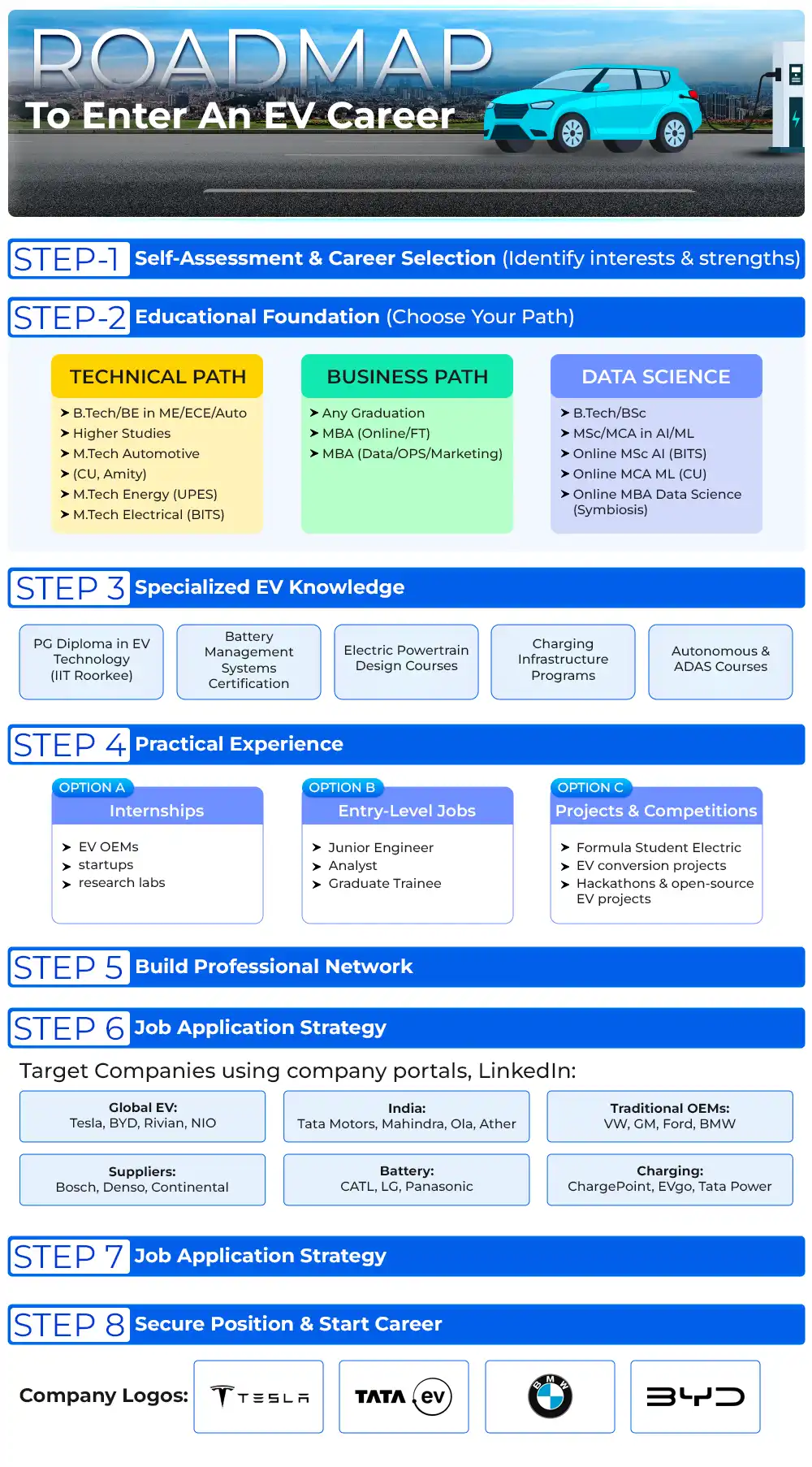
Roadmap to Enter an EV Career (Flowchart)
Top Job Roles in the EV Industry
|
Job Role |
Primary Responsibilities |
Degree Required |
|
Battery Engineer |
Develop, test, and optimize EV battery systems |
B.Tech/M.Tech in Electrical, Chemical, or Mechanical Engineering |
|
Power Electronics Engineer |
Design inverters, converters, onboard chargers |
B.Tech/M.Tech in Electrical or Electronics Engineering |
|
EV Design Engineer |
Create vehicle body design, structure, and ergonomics |
B.Tech/M.Tech in Mechanical or Automotive Engineering |
|
Electric Motor/Drivetrain Engineer |
Design and analyze motors, gear systems, and drivetrains |
B.Tech/M.Tech in Electrical, Mechanical, or Mechatronics Engineering |
|
Charging Infrastructure Engineer |
Plan and develop EV charging networks and grid integration |
|
|
Software Engineer (EV Systems) |
Develop embedded systems, vehicle control software |
B.Tech/B.E. in Computer Science, Electronics, or Electrical Engineering |
|
BMS (Battery Management System) Engineer |
Develop and maintain battery monitoring, safety, and control systems |
B.Tech/M.Tech in Electrical, Electronics, or Mechatronics Engineering |
|
EV Technician / Maintenance Engineer |
Troubleshoot and repair EV electrical and mechanical parts |
Diploma/B.Tech in Electrical, Mechanical, or Automobile Engineering |
|
Thermal Systems Engineer |
Design cooling/heating systems for battery and power electronics |
B.Tech/M.Tech in Mechanical, Thermal, or Automotive Engineering |
|
Supply Chain & Procurement Specialist (EV) |
Manage sourcing of EV components and vendor operations |
Bachelor’s in Supply Chain, Business, or Engineering |
Conclusion
Electric vehicles are one of the most important changes in the history of transportation. Although EVs have strong selling points such as environmental and low operating costs, high performance, and technological advances, they also have some challenges that need to be addressed, such as limited range, the lack of electric chargers, and high initial costs.
With the growing technology and the rising level of economies of scale, most of the existing drawbacks are slowly being reduced. Battery technology keeps on improving, charging networks are developing at a very fast pace, and prices are getting competitive. This transition is being hastened by government support and the growing awareness of consumers.To those who may want to buy an EV, the choice of buying one should be informed by personal driving behavior, availability of charging facilities, and financial viability in the long run. To career seekers, the EV revolution presents a new frontier with a variety of opportunities in the fields of engineering, technology, sustainability, and business.
Electric mobility is clearly the future, and knowing as much as we can about both the opportunities and the pitfalls of this technology will enable each of us to make better choices as customers, workers, or policymakers. When we see the big picture, we will have a chance to be involved in the process of creating a more sustainable transportation ecosystem that is cleaner and more efficient and, therefore, less harmful in the future.Interested in getting on board the EV revolution? It is a time to welcome the transformation and be part of a sustainable future, whether you are thinking of buying an electric car or pursuing a career in this booming industry.