
Business Law is a branch of law that regulates the rights and conduct of individuals, relationships, and business conduct involved in sales, trade, or commerce. Various key areas are covered by business law, including corporate governance, employment law, intellectual property, securities law, antitrust law, contracts, consumer protection, bankruptcy law, and many more. Below are a few points that need to be considered if you wish to learn more about Business laws.
- The legal issues of establishing and operating a business are governed by business law.
- It guarantees that companies abide by tax and licensing regulations.
- It assists in settling conflicts between companies or people.
- It governs the drafting and enforcement of contracts. Acquisitions, dissolutions, and mergers are all covered under business law.
- The rights of both employers and employees are maintained by business law.
- It encourages fair competition and moral corporate conduct.
Business contracts
Business contracts are the terms of agreements that are to be signed by two or more parties who are working together. Certain key aspects of business contracts include risk management, which is enforceable in a court of law. Let’s get an idea of the types of Business Contracts and keep reading this blog to get to know about them in detail.
|
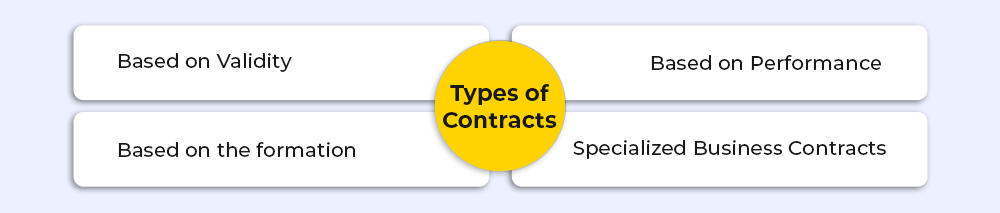
Types of Business Contracts | |
|
Based on Validity |
|
|
Based on the formation |
|
|
Based on Performance |
|
|
Specialized business contracts |
|
Importance of Contracts in Business
It is a must to have a contract signed before starting a project or business this will ensure and explain the detailed roles for each of the partners.
Let’s see what the importance of contracts in business is:
- Defines Obligations: Contracts minimize disputes by outlining each party's obligations in detail.
- Clarifies Terms: Contracts make sure that everything is clear by outlining terms of payment, due dates, deliverables, and limitations.
- Facilitates Business Relationships: By demonstrating a professional dedication to contractual terms, they contribute to the development of trust.
- Supports Compliance: Contracts help companies work according to the rules, guidelines, and industry standards. This is the only way to adhere to the rules and support compliance.
- Offers Legal Recourse: Contracts provide a foundation for pursuing risks or a legal remedy in the event of an infringement or breach.
- Creates Ownership Rights: Contracts specify data ownership, trade rights, and intellectual property.
- Strengthens Negotiations: By outlining conditions and expectations precisely, contracts operate as instruments for successful negotiation.
- Secures Payments: By including explicit billing and penalty provisions, contracts guarantee on-time and complete payments.
- Exhibits Professionalism: A well-written contract shows competence in the business and a dedication to ethical behavior.
- Legal Protection: In any case of a conflict, they offer a legal framework in the name of a contract that prevents each party's interests. This is a must to consider in any kind of business so that there may not be any dispute among two or more parties working together.
- Controls Liability: By outlining responsibilities, guarantees, and disclaimers, they reduce both legal and financial liabilities.
- Encourages Dispute Resolution: Contracts are developed to agree with the partners to avoid any future disputes through the contracts or agreements. Thus, it is said that it supports or encourages dispute resolution.
- Boosts Operational Efficiency: By eliminating uncertainty and increasing accountability, clear contracts simplify processes.
- Maintains Confidentiality: Contracts with non-disclosure clauses safeguard private company data.
- Reduces Risk: Drafting the documents of the contracts limits the risks associated with the finances and the operations of settling down the consequences and expectations.
Types of contracts
Based on Validity
Based on validity, business contracts are classified into the following types:
| Based on Validity | |
|
Valid contract |
A valid contract is an agreement between two or more parties that is created with mutual consent, a legal purpose, and lawful consideration, ensuring rights and obligations are clearly defined, discussed, and protected. |
|
Void contract |
A contract that is void from the start because it lacks necessary components or involves unlawful or impractical activity is known as a void contract. |
|
Voidable contract |
A legally binding agreement can be rejected or enforced by one party for reasons such as deception, coercion, inappropriate influence, or incapacity. |
|
Illegal contract |
An illegal contract contains actions that violate public policy or the law, rendering it void from the start and ineffective in court. |
|
Unenforceable contract |
Although a contract is legally enforceable, it cannot be enforced in court because of technological difficulties or improper legal procedures. |
Based on the formation
The following are the types of contracts based on the formation:
| Based on the formation | |
|
Express contract |
A written or verbal agreement with explicit provisions that demonstrate the parties' shared desire and understanding to create a legally enforceable relationship is an express contract |
|
Implied contract |
A shared purpose to create a legally binding agreement is indicated by an implied contract, which is created by the parties' conduct, behavior, or situation rather than by written or spoken words. |
|
Quasi-contract |
Even in the absence of a formal agreement among parties, a court can establish a quasi-contract as a legal requirement to prevent undue enrichment. |
|
E-contracts |
E-contracts, which are frequently used in activities and are enforceable within contract law principles, are digital agreements that are made and performed electronically. |
Based on Performance
Based on performance, business contracts are divided into the following types:
| Based on Performance | |
|
Executed contracts |
Contracts that have been executed are those in which all parties have fulfilled their end of the compromise or agreement, leaving no responsibilities to be fulfilled and the agreement complete and enforceable. |
|
Executory contract |
A contract that stipulates that the parties involved still have duties or responsibilities to fulfill in the future is executory (contract). |
|
Partly executed and partly executory contract |
A contract that is partially executed and partially executory is one in which one party has performed all of their duties while the other party's compliance is still outstanding or lacking. |
|
Unilateral contract |
In a unilateral contract, one party promises something in return for another party performing a certain act; once the act is finished, the promise becomes legally binding. |
|
Bilateral contract |
A bilateral contract is an arrangement in which both parties pledge to carry out specific tasks, resulting in a legally binding agreement that is enforceable after both parties have accepted it. |
Specialized business contracts
Specialized contracts are those contracts that conclude various other contracts used in businesses. Let’s have a look at their description:
| Specialized business contracts | |
|
Employment Contracts |
To provide clarity and legal protection for both parties, employment contracts are official contracts between employers and staff members that specify job duties, compensation, length, perks, and termination clauses. |
|
Sales and Purchase Agreements |
Legal contracts that specify terms for purchasing or selling commodities or goods, such as price, delivery, warranties, and the obligations of both parties, are trade and purchase agreements. |
|
Non-Disclosure Agreements (NDAs) |
Legal contracts known as non-disclosure agreements (NDAs) protect private information by preventing parties from sharing or releasing it without consent, guaranteeing both privacy and business security. |
|
Partnership Agreements |
Partnership agreements provide seamless operation and legal clarity in a business partnership by outlining obligations, liabilities, profit-sharing, and decision-making guidelines amongst partners. |
|
Franchise Contracts |
Franchise agreements, which specify costs, responsibilities, and conditions between the franchisor and franchisee, grant the right to conduct business under a brand's name. |
How to choose the right contract type for your business
Choosing the right contract type is a must in a business. Several criteria are there that an individual needs to consider before drafting one. These criteria are:
|
Criteria |
Description |
|
Understand Your Business Needs |
Determine whether the transaction is a sale, partnership, job, service, or lease. |
|
Consider the Parties Involved |
To determine the ideal contractual framework, consider each party's positions and duties. |
|
Review Legal Requirements |
Certain contract kinds are necessary for certain industries to adhere to legal requirements. |
|
Determine the Complexity |
Contracts with several terms and clauses may be necessary for complex transactions. |
|
Decide on Contract Formation |
Depending on how the agreement is started, you can choose between express, implicit, or informal contracts. |
|
Validity Status |
Verify that, under current business legislation, your contract will be legal and legitimate. |
|
Include Confidentiality & IP Clauses |
These are essential in contracts that involve technology, employment, and alliances. |
|
Seek Legal Advice |
To be sure the chosen contract type is both legally sound and in line with your business goals, speak with a legal expert. |
|
Know the Purpose |
Decide whether the contract should outline deliverables, provide protection, or be clear. |
|
Assess Duration |
To choose the appropriate format, determine whether the relationship is one-time, continuing, long-term, or short-term. |
|
Factor in Risk |
Examine the associated legal and financial risks and select a contract that reduces them. |
|
Check for Customization Needs |
Instead of adopting generic templates, some contracts must be customized to particular company requirements. |
|
Performance Obligations |
Consider about if the contract will be performed or executory, unilateral, or bilateral. |
|
Clarity of Terms |
Select a contract that has few uncertainties and permits precise, quantifiable phrases. |
|
Dispute Resolution |
Select agreements that include formal channels for resolving disputes, such as mediation or a hearing. |
Common mistakes to avoid in business contracts
Business is growing at a fast pace in this competitive world. Every business needs to set certain rules and regulations to maintain the decorum of the office. However, certain common mistakes are still left behind in business contracts. Let’s know about those mistakes to avoid in business contracts:
|
Mistakes to avoid |
Description |
|
Vague Language |
Legal problems and uncertainty can result from the use of unclear or incorrect words. |
|
Ignoring Legal Review |
Ignoring important terms or compliance concerns may arise from not consulting a legal expert. |
|
Unclear Payment Terms |
Insufficient information on prices, invoices, and penalties might impact cash flow and lead to disputes. |
|
No Dispute Resolution Clause |
Agreements become expensive and time-consuming if the conflict resolution process is not clearly defined. |
|
Skipping Signatures |
Contracts that are not signed are void and not legally enforceable. |
|
Lack of Specificity |
The enforceability of the contract is weakened when duties, deadlines, and deliverables are not specified. |
|
No Termination Clause |
Leaving out exit plans or termination clauses might put parties in a difficult situation. |
|
Verbal Agreements |
When informal agreements or spoken commitments are used in place of formal contracts, enforceability problems arise. |
|
Overlooking Jurisdiction |
Enforcement may become more difficult if relevant laws or legal jurisdiction are disregarded. |
|
Using Generic Templates |
One-size-fits-all contracts frequently lack the necessary customization for particular business requirements. |
How to become a business lawyer who can help businesses?
To become a lawyer who can resolve disputes and help businesses through their legal expertise, they must look for top universities that offer a good-quality education.
Here is a list of top universities offering LLM programs along with their fee structure and specializations offered.
Top Law universities (Based on NIRF ranking 2024)
Law schools are branching out into more areas and specializations. Every year, the National Institutional Ranking Framework creates its list by taking into account several parameters and inspecting universities to examine them. The NIRF ranking list is created by assigning grades to each institution based on these elements and criteria.
The top ten Indian universities according to the NIRF 2024 ranking are shown below:
|
Rank |
Name |
City |
Fees |
Specializations |
|
1 |
National Law School of India University |
Bengaluru |
Admission fee (one time) – Rs. 12,000/- Tuition and Facilities fee – Rs. 2,69,000/- Off-campus housing fee (optional) – 1,12,500/- Total fee per annum – Rs. 3,93,500/- One-Time Refundable Deposit Refundable deposit for SC/ST category students – Rs. 15,500/- Refundable deposit for other students – Rs. 20,000/- The total amount payable by SC/ST category students is Rs. 4,09,000/- The total amount payable by other students is Rs. 4,13,500/- |
|
|
2 |
National Law University |
New Delhi |
For Indian students, the program's tuition is INR 1,25,000. Foreign students must pay USD 3500 in tuition. There will also be additional costs for re-registration, retake exams, etc. |
|
|
3 |
NALSAR University of Law |
Hyderabad |
For the LL.M. 2-year full-time course
For the LL.M. 1-year course
|
2-year LLM program
1-year program
|
|
4 |
NLU Kolkata - The West Bengal National University of Judicial Sciences |
Kolkata |
Fee for 1-year LL.M. program - INR 2,08,200 Fee for 2-year LL.M. program (for first year) - INR 1,67,000 |
2-year program
1-year program
|
|
5 |
Symbiosis Law School |
Pune |
First installment (including 10,000 refundable institute deposit) - INR 1,35,000 Second installment - INR 1,25,000 |
|
|
6 |
Faculty of Law, Jamia Millia Islamia |
New Delhi |
Ranges between INR 1 Lakhs - 10 Lakhs |
|
|
7 |
Indian Institute of Technology |
Kharagpur |
INR 2.5 Lakhs to INR 3 Lakhs |
|
|
8 |
Gujarat National Law University |
Gandhinagar |
INR 1.2 Lakhs to INR 6 Lakhs |
|
|
9 |
Siksha ‘O’ Anusandhan University - SOA National School of Law |
Bhubaneshwar |
INR 1.5 Lakhs |
|
|
10 |
Babasaheb Bhimrao Ambedkar University (BBAU) |
Lucknow |
Tuition fee for LL.M. (Law) 2-year program and Human Rights - INR 1,500 per semester Tuition fee for paid seats - INR 45,000 per semester Tuition fee for 1-year LL.M. program - INR 55,000 per semester |
2-year LL.M. program
1-year LL.M. program
|
Universities offering a 1-year LLM program
Various universities in India are offering a 1-year LLM program that allows students to learn at their own pace and study at any time. Students get the biggest advantage of flexibility; they can study from anywhere in the world. Let’s get to know about such universities or colleges that offer 1-year LLM programs with their offered specializations.
|
Top colleges offering a 1-Year LLM program | |
|
Colleges |
Specializations |
|
Jindal Global Law School (Blended Learning Program) |
|
|
Lovely Professional University |
|
|
National Law University, Delhi |
|
|
Symbiosis Law School International, Pune |
|
|
UPES |
|
|
NLU, Kolkata |
|
Here is the fee for the above-listed universities or colleges that offer 1-year LLM programs:
|
LLM 1-year program fees for various institutions | |
|
Institutions |
Total Fees |
|
Jindal Global Law School (Blended Learning Program) |
INR 3,50,000 |
|
Lovely Professional University |
INR 1,60,000 |
|
National Law University, Delhi |
INR 1,25,000 |
|
Symbiosis Law School International, Pune |
INR 2,50,000 |
|
UPES |
INR 2,79,000 |
|
NLU, Kolkata |
INR 1,39,000 |
Jindal Global Law School
The LLM program at Jindal Global Law School is offered in a hybrid, or blended, learning mode. The college provides access to its Learning Management System, where students can learn through many forms of study material, including live lectures, assessments, recorded lectures, e-libraries, case studies, and more. Let us take a closer look at the available specializations, the cost, and the course outline.
Advantages of pursuing an LLM through a blended learning mode:
- Flexibility
- Face-to-face interaction
- Guest lectures
- Enhance digital skills
- Various growth opportunities
- Self-paced learning
- Learn from global faculty
- Balances personal and professional life
- Access to recorded lectures
Specialization offered:
- Corporate & Financial Law
- AI and Emerging Technologies
- Intellectual Property & Technology Law
- Dispute Resolution
- Taxation Law, Policy, and Regulation
Eligibility criteria:
- Must have completed a bachelor’s degree in law with a minimum of 55% from a recognized university or equivalent institution.
- Entrance exam scorecard - LSAT, or JSAT
Fee structure: Course fee - INR 3,50,000
Syllabus:
Every university offers certain subjects in particular specializations. They use it to develop the best syllabus possible. At Jindal Global Law School, they take the help of law professionals and legal experts to develop their syllabi for each of the specializations offered by them. Let’s get a detailed knowledge of the syllabus offered by the Jindal Global Law School:
|
Syllabus at Jindal Global Law School (Blended Learning Program) | |
|
Specializations |
Syllabus/Subjects |
|
Corporate & Financial Law |
|
|
AI and Emerging Technologies |
|
|
Intellectual Property & Technology Law |
|
|
Dispute Resolution |
|
|
Taxation Law, Policy, and Regulation |
|
Conclusion
In this blog, you get to learn about various contracts and their types. In every business, contracts and agreements should be there so that every individual knows their roles and responsibilities. This prevents the chances of confusion in the future. If you are looking for a future in business law, then you get to learn about various universities and colleges that offer law studies and degrees. You just need to work hard on your studies while practicing on the court.