

An Integrated MBA course is a 5-year dual-degree program for students who want to pursue management as a career right after Class 12th. It combines undergraduate (BBA, or equivalent) and graduate (MBA) education into a singular program of study with a diploma. It allows students to take an Integrated MBA course directly after 12th, allowing them to finish both degrees in a single time frame, without going through a separate admissions process like a 3-year undergraduate course (BBA, B.Com, and BA) and then a 2-year MBA later.
The course is designed in such a way that students refine more advanced managerial capabilities with little interruption to their core business education. The expectation is that the students will become industry-ready professionals at the end of their 5-year period of education.
Who Should Choose an Integrated MBA?
The following is the list of people who fit perfectly into the Integrated MBA course:
- Students who are early in life are sure about pursuing a management career.
- Students who want to avoid the stress of preparing for many entrance tests, such as CAT or XAT, etc., after graduation.
- Students who aspire to study in top institutions like IIMs, IIFT, NMIMS, or Symbiosis.
- Students who want a structured career path with time to focus on their lifestyle development.
- Aspirants who want to build a strong foundation for business skills very early on.
Note: If you are focused, determined, and are ready to start your business education soon after school, then the integrated MBA program will suit you perfectly.
Key Features of the Integrated MBA Course
Here is the overview table of key features of the integrated MBA Course for better understanding:
|
Course Feature |
Details |
|
Course Name |
Integrated MBA (BBA + MBA or equivalent) |
|
Duration |
5 years (10 semesters) |
|
Eligibility |
After Class 12 with a minimum of 60% marks (criteria may vary by institute) |
|
Admission Process |
No separate admission required for MBA; one-time entry after Class 12 |
|
Campus Recruitment |
Top national and international recruiters visit for placements |
|
Exit Option |
Some institutes offer an exit after 3 years with a BBA or equivalent degree |
|
Specializations Offered |
|
|
Return on Investment (ROI) |
High ROI with strong placement opportunities and long-term career benefits |
Duration and Course Structure
The Integrated MBA program is generally 5 years, broken up into 10 semesters. The first three years are comprised primarily of base courses in business, economics, statistics, managing teams and groups, and other soft skills. The next two years are MBA-level advanced courses in areas such as management, finance, operations, and strategy.
Some institutions are using the 3+2 model (3-year UG work + 2-year PG work), and others use the 2+3 model.
This is done so that average students are not only prepared but functionally conditioned from a pedagogical standard, to develop a holistic understanding of business and management, before putting it into practice.
Eligibility Criteria for the Integrated MBA Course
To apply for an Integrated MBA program in India, you must fulfill the following conditions:
- Passed Class 12 or equivalent from a recognized board (CBSE, ICSE, State Boards)
- Scored minimum 60% aggregate marks in Class 12 (relaxation for SC/ST/PWD)
- Age limit: Usually 20 years for the General category (varies with the institute)
- Must appear in the respective entrance exam of the institution
Note: Students from any stream, Science, Commerce, or Arts, are eligible, though having Mathematics or Business Studies is preferred in some colleges.
Top Integrated MBA Entrance Exams in India
Admission to Integrated MBA programs is based on entrance exams. The most popular ones include:
|
Entrance Exam |
Conducted By / For |
Key Highlights |
|
IPMAT |
IIM Indore & IIM Rohtak |
Tests Quantitative Ability, Verbal Ability, Logical Reasoning |
|
NPAT |
NMIMS (Mumbai, Bangalore, etc.) |
For BBA + MBA Tech or General MBA, includes Quant, Reasoning, and English |
|
IIFT Integrated MBA Test |
IIFT Kakinada |
For the 5-Year Integrated MBA at IIFT, an institute-level entrance test |
|
SET |
Symbiosis International University |
For BBA + MBA programs, it includes general aptitude sections |
|
DUET |
Delhi University |
For BMS/BA + MBA programs under DU colleges |
|
CUET |
Central Universities |
Some CUs offer BBA + MBA under the CUET UG/PG framework |
Note: These exams are generally held between April and June every year.
Top Colleges Offering Integrated MBA Course in India (2026)
Choosing the right institute is essential for quality education and placement opportunities. Here are the top colleges:
|
Institute Name |
Program Offered |
Entrance Exam |
Location |
|
IIM Indore |
IPM (BBA + MBA) |
IPMAT Indore |
Madhya Pradesh |
|
IIM Rohtak |
IPM (BBA + MBA) |
IPMAT Rohtak |
Haryana |
|
IIFT Kakinada |
5-Year Integrated MBA |
IIFT Admission Test |
Andhra Pradesh |
|
NMIMS Mumbai |
BBA + MBA (Tech/General) |
NPAT |
Mumbai, Bangalore |
|
Nirma University |
BBA + MBA |
IPMAT/Nirma Entrance |
Ahmedabad |
|
Delhi University |
BA/BMS + MBA |
DUET |
Delhi |
|
Symbiosis Pune |
BBA + MBA |
SET |
Pune |
|
SRM University |
BBA + MBA |
SRM Admission |
Tamil Nadu |
Note: These institutions offer excellent faculty, internships, corporate exposure, and global learning experiences.
Detailed Syllabus of Integrated MBA Course
The Integrated MBA degree is based on two key stages. In Years 1 to 3, students learn the core business and management fundamentals. In Years 4 and 5, students will learn the strategy, finance, and leadership principles at an MBA level. This cumulative structure will allow students to be ready for the industry after completing a 5-year course. The syllabus of the Integrated MBA Course is available below for clarity:
|
Year |
Subjects / Areas of Study |
|
Years 1–3 |
Business Environment, Microeconomics & Macroeconomics, Financial Accounting |
|
Business Mathematics & Statistics, Organizational Behavior, Communication Skills | |
|
Introduction to Marketing, Business Law, Psychology & Sociology for Management | |
|
IT for Business | |
|
Years 4–5 |
Corporate Finance, Human Resource Management, Marketing Strategy |
|
Operations & Supply Chain Management, Business Analytics, Strategic Management | |
|
Project Management, Entrepreneurship, Research Methods in Business | |
|
Global Business Environment, Industry-Specific Electives |
Note: Students are also required to complete internships, summer projects, and dissertations to gain real-life industry experience.
Specializations in Integrated MBA
Students can choose a specialization during the MBA phase, typically in the 4th year. Options include:
|
Specialization |
Focus Areas |
|
Finance |
Banking, Investment, Accounting |
|
Marketing |
Digital Marketing, Branding, Market Research |
|
Human Resource Management |
Talent Acquisition, Performance Management |
|
Operations |
Supply Chain, Logistics, Quality Control |
|
Business Analytics |
Data Analysis, Predictive Modeling |
|
International Business |
Global Strategy, Foreign Trade |
|
IT Management |
Systems Management, Information Technology |
|
Entrepreneurship |
Startup Development, Innovation Management |
Note: Choosing the right specialization can greatly influence your future career path.
Career Opportunities After Integrated MBA
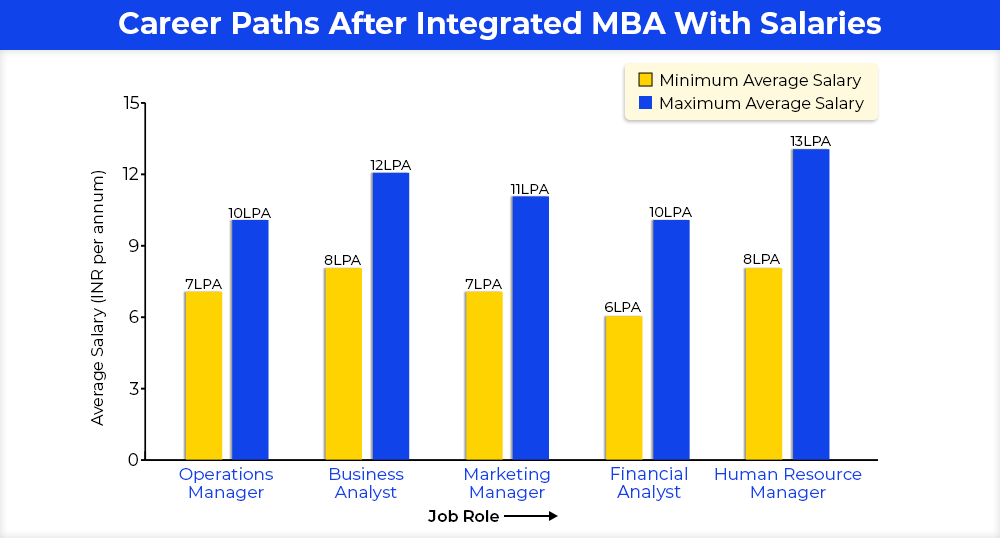
An Integrated MBA course involves various career opportunities in IT, finance, consulting, marketing, and e-commerce. The students will leave the program with a postgraduate management degree, and they will qualify for mid-level manager roles immediately after graduating. Reputable businesses hire Integrated MBA graduates into strategy, operations, human resources, analytics, and business development jobs, with attractive salary packages and swift growth prospects. Below is the list of career opportunities post Integrated MBA courses, along with the average salary package:
|
Job Role |
Average Salary (INR per annum) |
|
Business Analyst |
INR 7–10 LPA |
|
Marketing Manager |
INR 8–12 LPA |
|
Financial Analyst |
INR 7–11 LPA |
|
Human Resource Manager |
INR 6–10 LPA |
|
Operations Manager |
INR 8–13 LPA |
|
Product Manager |
INR 10–15 LPA |
|
Management Consultant |
INR 12–20 LPA |
|
Business Development Manager |
INR 6–9 LPA |
|
Strategy Analyst |
INR 9–14 LPA |
Here is the list of the Industries Hiring Integrated MBA Graduates:
- IT & Software
- FMCG & Retail
- E-commerce
- Banking & Finance
- Healthcare & Pharmaceuticals
- Consulting Firms
- Manufacturing & Logistics
- Media & Communication
Placement Trends and Salary After Integrated MBA
Placements depend on the college and specialization. Here's a general idea:
|
Institute |
Average Package |
Highest Package |
Top Recruiters |
|
IIM Indore |
INR 25–27 LPA |
INR 1.14 Cr (Domestic) |
McKinsey, BCG, Deloitte, Google |
|
IIM Rohtak |
INR 18–22 LPA |
INR 36–40 LPA |
EY, KPMG, Amazon, TCS |
|
NMIMS |
INR 12–15 LPA |
INR 25+ LPA |
HDFC Bank, ICICI, Accenture |
|
IIFT |
INR 15–20 LPA |
INR 30+ LPA |
Infosys, Cognizant, PwC |
Note: Startups and multinational companies are increasingly hiring integrated MBA graduates for strategic roles.
Integrated MBA Fees (College-wise)
Here is the list of approximate fee ranges of various colleges that offer the Integrated MBA course are mentioned below:
|
College |
Total Fees (Approx.) |
|
IIM Indore |
INR 35–40 Lakhs |
|
IIM Rohtak |
INR 34–36 Lakhs |
|
NMIMS |
INR 15–20 Lakhs |
|
Nirma University |
INR 10–12 Lakhs |
|
SRM University |
INR 6–8 Lakhs |
|
Symbiosis |
INR 10–15 Lakhs |
|
DU (BMS + MBA) |
INR 3–5 Lakhs |
Note: Scholarships, education loans, and merit-based fee waivers are available at most institutions.
Pros and Cons of an Integrated MBA Course
Here is the list of the pros and cons of an Integrated MBA course are mentioned below in the table:
|
Pros |
Cons |
|
|
Is an Integrated MBA Better Than a Regular MBA?
Here is the overview table of the differences between Integrated MBA & Regular MBA:
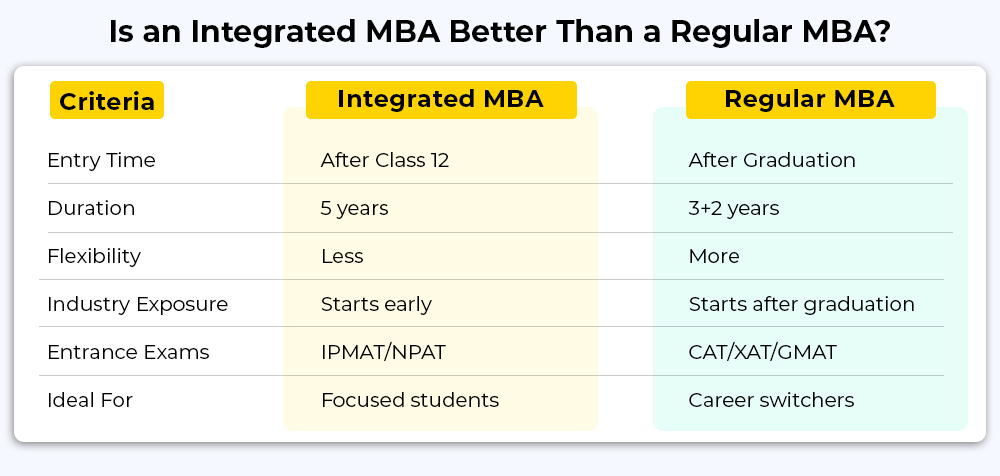
Note: If you are certain about business and management, an Integrated MBA is faster and more structured.
Future Options After Integrated MBA
After pursuing an Integrated MBA, students can choose to:
- Join leading corporations domestically or internationally
- Continue their education with further studies (PhD, CFA, etc.)
- Enter government employment, or civil services
- Become an entrepreneur and start your venture
- Enrol in a global MBA programme or go for an MS abroad
Note: The course prepares the students for managerial, analytical, and leadership skills, which can be used in all fields.
Are there any online options?
Yes, and there are online alternatives for students wishing to study an Integrated MBA after 12th. A number of universities in India offer regular on-campus Integrated MBA options, and some also offer online or blended options for those who would prefer to learn online. These online integrated MBA courses cover the same basics of business, management, economics, communication, and leadership skills as their traditional counterparts.
The major advantage of studying online is that students can learn at their own pace without leaving their home or city, which is helpful for those who cannot move or take time to go to classes full-time. The online option also has live classes, recorded lectures, case studies, and other hands-on learning as well. If you choose an online Integrated MBA option, you can still pursue your management career after 12th, while keeping your personal and professional objectives in balance. It is a terrific option for future managers seeking flexibility and global awareness. Below is a list of the online Integrated courses as mentioned above:
|
Online Integrated Courses | |
| - | |
Conclusion: Is an Integrated MBA a Good Career Option?
Yes, Integrated MBA programs are a workable option for students pursuing a career path in business and management. As for the best examples, there are some premier institutes that do have Integrated MBA programs, such as IIM Indore, IIM Rohtak, NMIMS, etc. These institutes can provide an appropriate Level of learning experience and also lead to a pre-eminent outcome in career success with early placement opportunities as entry-level managers.
Given how corporate expectations have changed with organisations seeking younger and skilled managers, Integrated MBA programs could likely turn the business education timeline in half for organisations with an increasing level of demand for Integrated MBA graduates to satisfy their global demand in India or abroad, as you choose. If your life ambition is to be a business leader and chief executive officer (C.E.O.) or corporate strategist, then the Integrated MBA could be the appropriate launchpad.