
Have you ever wondered how AI bots are writing content that flows in a fluent manner?
AI bots are capable of writing human-written sentences. This is possible due to Parsing. This is possible due to Parsing. Parsing in Natural Language Processing (NLP) allows a machine to read, write, and interpret text. Parsing involves examining the grammatical structure and understand relationships of words in a sentence. A sentence's grammatical structure and relationships, like nouns, verbs, adjectives, adverbs, and interrelationships. To simplify Parsing further, this is a syntax analysis. Today, Parsing is excessively used in translation, chatbots, and information extraction applications.
How does the machine understand what the subject and what the object are, crucial to write a sentence. In this blog, we will figure this out. And after reading the blog, readers can tell what Parsing is in NLP, its types, and applications. Also, which programs are best if they want to learn Parsing in detail?
What is Parsing in NLP?
People need to learn about Natural Language Processing before they start studying Parsing. The Natural Language Processing field of Artificial Intelligence establishes a connection between computer science, linguistics, and machine learning, which enables machines to understand and produce human language. The process enables computers and laptops to interpret and produce human language.
The process requires various operations, which include tokenization, part-of-speech tagging, parsing, sentiment analysis, and machine translation. The blog will concentrate exclusively on the topic of Parsing.
NLP Parsing involves studying the grammatical structure of a sentence to discover how its words and phrases connect with each other. The system enables a computer to analyze a sentence structure by identifying all its components needed for identification, which includes subject, object and verb.
Parsing transforms a basic sentence into a formal system that uses either a parse tree or a dependency graph to represent its structure. The machine can use this information to understand meaning. A crucial step to simplify the complex human languages into a clear structure languages. Without parsing, an NLP system would treat a sentence as just a sequence of words without understanding their connection.
How Does the Parser Work?
A parser in NLP works by analyzing a sentence step by step to identify its grammatical structure and the relationships between words.
- First, the input text is broken into smaller units through tokenization, where the sentence is divided into individual words or symbols.
- Each token is assigned a grammatical label using part-of-speech tagging, such as noun, verb, adjective, or adverb. These tags help the parser understand the role of every word in the sentence.
- The parser applies a set of grammar rules or trained statistical models to organize the words into meaningful structures. It groups words into phrases like noun phrases and verb phrases and builds a hierarchical tree.
- It identifies direct links between words, such as subject–verb or verb–object relations. Modern parsers often use machine learning and deep learning models that learn patterns from large language datasets rather than relying only on fixed rules.
- The parser also resolves ambiguities when a sentence can have more than one interpretation by selecting the most probable structure based on context. This systematic process allows computers to move from raw text to meaningful language understanding.
Types of Parsing in NLP
After knowing the process of parsing works, let’s understand the types of Parsing. Basically, the whole process of parsing is divided into language processing activities to make it convenient so that it can be handled and managed easily.
There are mainly two types of Parsing in NLP:
1) Syntactic Parsing
Syntactic parsing focuses on the grammatical structure of a sentence. It analyzes how words are arranged according to grammar rules and identifies relationships such as subject, verb, and object. The goal is to understand how the sentence is formed. This does not include what it means.
Features
- Works on grammar and sentence structure
- Produces parse trees or dependency graphs
- Uses rules of syntax like noun phrase, verb phrase
- Does not consider real-world meaning
2) Semantic Parsing
Semantic parsing goes beyond grammar and focuses on the meaning of the sentence. It converts natural language into a logical or machine-understandable representation, such as intents, entities, or database queries.
Features
- Understands intent and context
- Represents meaning using logic forms
- Handles ambiguity and synonyms
- Connects language with real-world knowledge
Difference Between Syntactic Parsing And Semantic Parsing
|
Aspect |
Syntactic Parsing |
Semantic Parsing |
|
Focus |
Grammar structure |
Meaning |
|
Output |
Parse tree |
Logical form |
|
Level |
Surface level |
Deep understanding |
|
Use |
Translation, grammar |
AI assistants, QA |
In a few words, Syntactic parsing describes how a sentence is built, while semantic parsing suggests what the sentence actually means. By combining both modern NLP systems achieve accurate language understanding.
3) Parsing Techniques in NLP
There are techniques that are used to understand the structure and meaning of the sentence. When it comes to structure, A parse tree is created. A parse tree is a graphical representation of the grammatical structure of the sentence that helps understand how the structure is constructed.
The parse tree is formulated in two ways:
- Top-Down Parsing
- Bottom-Up Parsing
4) Top-Down Parsing Techniques
When the parse tree is constructed using a top-down approach means parse tree is created from the root node to leaves. The root node is considered the starting point in the top-down Parsing technique and finds the lead nodes, actual words, and parts of speech to make a meaningful sentence.
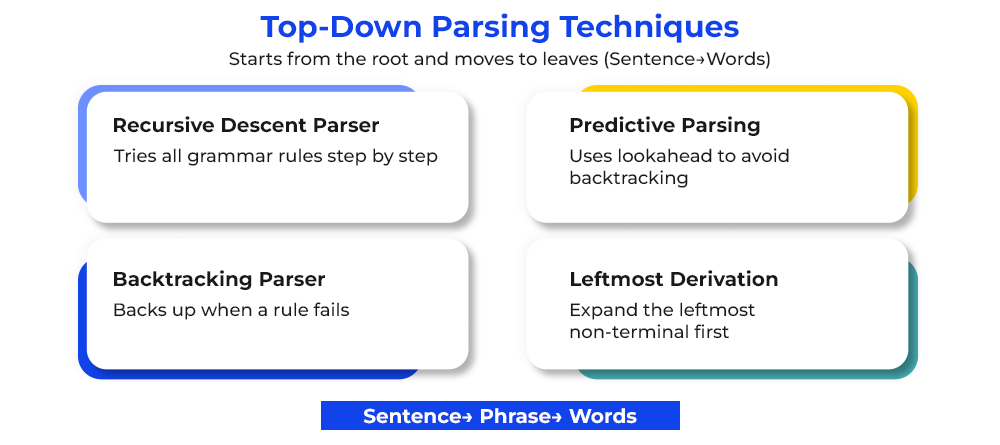
Top-down parsing generally follows a left-to-right scanning of the input and applies grammar productions in that order. The parser selects a production rule for the current non-terminal and expands it. If the expanded symbols match the words in the input sequence, the parser continues forward. However, natural language is often ambiguous, and a selected rule may not always lead to the correct structure. In such cases, the parser uses backtracking. Backtracking means returning to the most recently expanded node, discarding the incorrect production, and trying an alternative rule from the grammar.
5) Bottom-Up Parsing
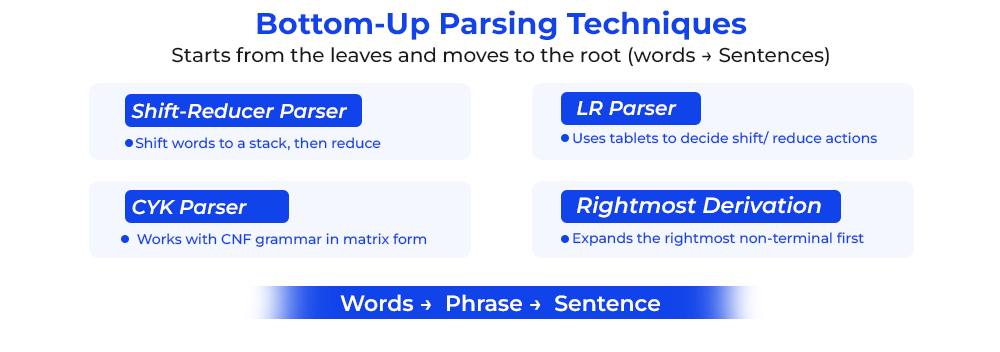
Bottom-up parsing works in the opposite direction. It starts with the actual words and gradually combines them into larger phrases until the start symbol of the grammar is reached. The parser looks at individual tokens first and builds higher-level structures based on grammar rules.
This approach is also called a data-driven approach because it relies on the input data rather than making early assumptions about the overall structure.
Bottom-up parsing is widely used in modern NLP systems because it is more robust for real-world language, where sentences may be complex or irregular. It is suitable for applications like machine translation, information extraction, and syntactic analysis, where accurate construction of sentence structure is essential.
How is Top-Down different from Bottom-Up Parsing Techniques?
Top-down parsing and bottom-up parsing are two opposite approaches used to build the parse tree of a sentence in NLP. The main difference lies in where the parsing process starts and in which direction the tree is constructed.
In top-down parsing, the parser starts from the root node, which represents the whole sentence, and expands it toward the leaf nodes that contain the actual words. It assumes the overall structure first and then tries to match that structure with the input sentence using grammar rules. Because the parser predicts possible structures in advance, it often needs backtracking when a chosen rule does not match the input.
In bottom-up parsing, the process begins with the input words and builds the structure upward until the root node is reached. The parser combines words into phrases and then phrases into larger units according to grammar rules. This method is data-driven and usually requires less backtracking because it relies on the actual input rather than early predictions.
Thus, top-down parsing moves from sentence to words and is goal-driven, while bottom-up parsing moves from words to sentence and is data-driven. Bottom-up parsing is generally more efficient for complex and ambiguous sentences, whereas top-down parsing is simpler and easier to understand.
Different Methods Used To Implement Parsers
Distinct strategies for implementing parsers, ranging from simple pattern matching to complex algorithms that handle ambiguity. Here is a breakdown of how each method works, its logic, and where it is best used.
-
Recursive Descent Parser (Top-Down): This is the most intuitive way to write a parser by hand. It works Top-Down, meaning it starts with the highest-level rule and breaks it down into smaller parts.
-
Shift-Reduce Parser (Bottom-Up): This is a common Bottom-Up method used in compilers and modern NLP efficiency tools. It starts with the individual words and tries to fold them up into a tree.
-
Chart Parser (Dynamic Programming): Chart parsing is designed to handle ambiguity and efficiency. Unlike the previous two, which might re-analyze the same phrase multiple times during backtracking, a Chart Parser saves its work. This is dynamic programming and chart data structures, which remove lots of unnecessary work by storing and reusing intermediate parsing results.
-
Regexp Parser (Shallow Parsing / Chunking): This is fundamentally different from the three above. While the others build a full, deep tree means context-free Grammar, a Regexp Parser uses regular expressions to find flat patterns. This is often called Chunking. It doesn't try to understand the whole sentence structure. It just sweeps across the text looking for specific sequences defined by regex patterns.
Comparison
|
Feature |
Recursive Descent |
Shift-Reduce |
Chart Parser |
Regexp Parser |
|
Direction |
Top-Down |
Bottom-Up |
Bidirectional / Hybrid |
Linear Scan |
|
Structure |
Deep Tree (Nested) |
Deep Tree (Nested) |
Deep Tree (All possibilities) |
Flat Chunks |
|
Complexity |
Simple logic, but slow on ambiguity. |
Fast, used in compilers. |
Slower, but handles all ambiguity. |
Very Fast, limited depth. |
|
Best For |
Learning, simple grammars |
Programming languages, fast NLP |
Complex linguistic analysis |
Information Extraction (Dates, Names). |
How does Parsing make it easier for us?
Parsing helps us to communicate with the machine, which makes our work more efficient. This way, a machine called a computer/ laptop/ smartphone understands the human language and is able to make sense out of a sentence. Many sentences can have more than one meaning, but parsing shows which words belong together and what role they play. Parsing reduces confusion caused by ambiguity.
It also makes many NLP applications possible. In machine translation, parsing ensures that the grammar of the translated sentence is correct. In chatbots and voice assistants, it helps the system understand user intent. In grammar checking tools, parsing detects errors in sentence structure. Information extraction, search engines, and text summarization all depend on parsing to locate important parts of a sentence.
Can Diploma Holders learns NLP and Related fields?
Diploma holders can advance their knowledge if they wish to enhance their skills to secure their jobs. If you are interested in building a career in this field, you can choose different courses to pursue your career. Even today, online courses are available for working professionals who are interested and want to explore artificial intelligence and machine learning.
Here is the list of the courses:
- B.Tech Lateral Entry for Working Professionals
- B.Tech Computer Science
- Online BCA in Artificial Intelligence and Machine Learning
- B.Sc. in Computer Science
- B.Sc. in Information Technology
- B.Sc. with Computational Linguistics or Cognitive Science
- M.Tech in Artificial Intelligence and Machine Learning
- M.Tech for Working professionals in Computer Science
- M.Sc in Natural Language Processing
In case working professionals can’t quit their jobs, they can apply for the approved online program to learn new skills. All these programs enable learners to strengthen their understanding of parsing and its related domains.