

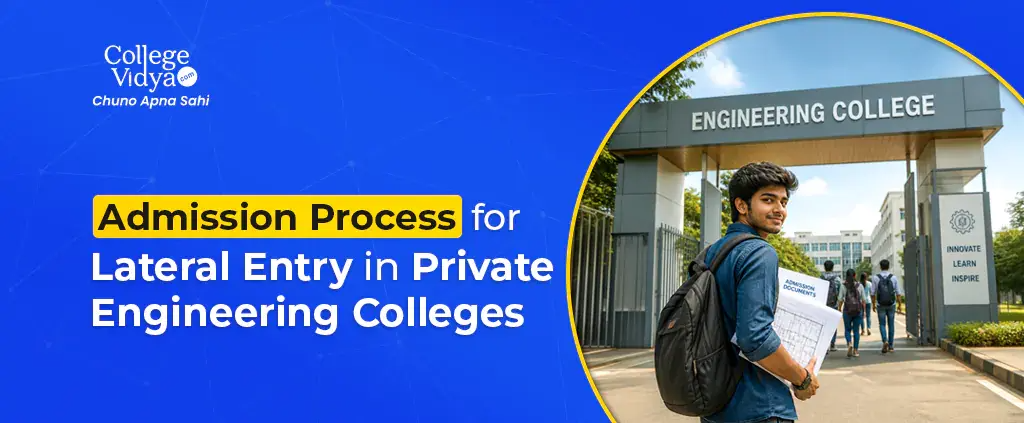
Quick answer: Short version first, since you've probably got a form open in another tab already. Private engineering college lateral entry admission runs through five steps. Check your diploma marks against the college's cutoff. Fill the online application on the university's own portal. Upload your documents. Get your merit or eligibility verified. Pay the fee and confirm your seat. No state counselling rounds, no ranking against lakhs of other candidates, most of it wraps up in four to six weeks once you start.
That's the whole thing in one breath. Now let's talk about why that one breath hides a surprising number of ways to mess this up if you rush it.
Private College Lateral Entry vs Government CET Route
Here's the distinction that trips up almost everyone researching this at 1am with seventeen browser tabs open. Government and state quota engineering seats need you to clear a state CET, JELET, AP ECET, whatever your state runs, followed by centralised counselling. Private engineering colleges? Most of them skip that entirely. Admission runs on your diploma percentage directly, sometimes with the college's own internal test or interview thrown in, but rarely the multi-month CET grind.
Why does this matter so much? Because if you assumed "lateral entry" automatically meant "prep for a state exam," you might be spending four months studying for something you don't even need. I've seen this happen to a diploma student I'll call Ankit, purely because that's not his real name and he'd be mortified. He spent an entire summer prepping for AP ECET assuming it was mandatory everywhere, only to find out the private university he eventually chose admitted straight off his diploma marksheet. No exam. No counselling wait. Just an application form and a document upload he could've done in a week.
Not every private college skips the exam, to be fair. Some run their own entrance tests. But a meaningful chunk of them run purely merit based, direct admission, and that's the piece most generic guides bury three thousand words deep instead of leading with.
Step-by-Step Admission Process
Strip away the college-specific branding, and nearly every private engineering college follows this same sequence.
- Step 1: Check eligibility against the college's specific cutoff. Most ask for 45% to 50% aggregate in your diploma, though a few, KL University being one example, set the bar higher at 60%. Confirm this before anything else, since it changes whether you're even applying to the right tier of college.
- Step 2: Fill the online application on the university's own portal. Unlike government CET applications that route through a state board's website, private colleges run this directly. Basic details, academic history, branch preference.
- Step 3: Upload your documents. Marksheets, certificates, and category proof, if applicable. Get this ready in advance, because scrambling for a missing document mid-application is the single most common reason people miss deadlines.
- Step 4: Get evaluated, either through merit review or an internal test. Purely merit based colleges verify your diploma marks against their cutoff and move you straight to the next step. Colleges running their own entrance test will have you sit that, usually a shorter, less intense affair than a full state CET.
- Step 5: Seat confirmation and fee payment. Once verified, you'll get a formal offer, and paying the admission fee locks in your seat. Some colleges add a short interview here too, mostly a formality to confirm your background and intent rather than a competitive filter.
Most students finish this entire sequence in four to six weeks once applications open, assuming documents are ready ahead of time. Compare that to a government CET route, which can stretch across several months once you factor in exam prep, results, and multiple counselling rounds.
Documents You'll Need Ready
Keep these organized before you touch a single application form.
- Diploma marksheets, all semesters, not just the final one
- Diploma provisional or original certificate
- 10th and 12th marksheets
- Category certificate, where applicable
- Passport-size photographs
- Valid ID proof, Aadhaar, or equivalent
- Work experience letter, if applying through a working professional-specific admission track
- Domicile certificate for colleges with state quota reservations even within a private setup
Merit-Based vs Entrance Test Based Private Admission
Not all private colleges play by the same rulebook, so it's worth knowing which type you're dealing with before you start.
- Purely merit-based colleges admit strictly off your diploma percentage. No test, no interview beyond a basic document check. Fastest route, and genuinely the least stressful if your marks clear the cutoff comfortably.
- Colleges running their own entrance test add one extra step, usually shorter and less competitive than a state CET, but still something to prep for. Worth confirming this upfront rather than assuming, since it changes your entire timeline.
- Working professional admission tracks sit in their own category entirely, evaluating diploma marks alongside verified work experience instead of a straight academic cutoff. We'll get into why that distinction matters in a minute.
Common Delays and How to Avoid Them
A handful of avoidable mistakes show up again and again in this process, worth naming plainly.
- Missing marksheets from earlier semesters. Colleges usually want your full diploma academic record, not just the final result. Track these down before applications open, not after.
- Assuming every private college needs an entrance exam. As we've covered, plenty don't. Confirm the specific college's process directly instead of assuming based on what a friend's college required.
- Waiting until the deadline to verify UGC and AICTE approval. Non negotiable, always confirm this early. A degree from an unapproved program can create real trouble years down the line, during a government job application or higher studies admission, when there's nothing left to do about it.
- Underestimating processing time for category or domicile certificates. These sometimes take longer to procure than expected, especially close to peak application season when local offices get backed up.
None of these are dramatic mistakes. They're small, boring oversights, and somehow they still catch almost everyone who doesn't plan ahead.
Red Flags Worth Watching For
A few warning signs worth keeping an eye on while you're going through this process, because the private college space does have its share of shady operators mixed in with the legitimate ones.
- Admission "guaranteed" without any document review. Real colleges verify your marksheets before confirming anything. If a college or an agent promises a seat before even looking at your diploma record, that's worth questioning immediately.
- Vague or missing approval details. A legitimate private college will clearly display its UGC and AICTE approval numbers, not just a logo on a brochure. If this information is hard to find or vaguely worded, dig deeper before paying anything.
- Pressure to pay before receiving anything in writing. A formal admission offer or provisional confirmation should come before any significant payment, not after a rushed phone call insisting seats are "filling fast."
- Third party agents charging separate "processing fees." Some admission consultants add unofficial charges on top of the college's actual fee structure. Always confirm directly with the university what the official cost breakdown looks like.
None of this is meant to make you paranoid about private colleges generally, most are entirely legitimate and run a clean, straightforward process. It's just worth knowing what a shortcut dressed up as convenience actually looks like before you hand over any money.
Where Working Professional Programs Fit In
This is genuinely the part most "admission process" guides skip entirely, and it's the one that matters most if you're not a fresh diploma graduate with nothing but free time on your hands.
A set of UGC- and AICTE-approved universities run a BTech for Working Professionals admission track specifically built for diploma holders already employed, with at least a year of relevant work experience. The process mirrors the standard private college sequence—application, documents, verification, and fee payment, but the evaluation criteria shifts to include your work experience alongside academics, and the class schedule runs evening or hybrid so your job stays exactly where it is.
Three universities consistently deliver this with genuine, verifiable approval behind them.
- Kalinga University — rated 4.6/5, UGC, AICTE and AIU approved, structured hybrid admission and delivery process
- Lingaya's Vidyapeeth — rated 4.7/5, UGC, AICTE, AIU and NAAC B+ accredited, one of the more established names in this specific pathway
- Sanskriti University — rated 4.6/5, UGC, AIU, NIRF recognised and ISO certified
If your admission process question is really a disguised version of "how do I do this without quitting my job," this is the answer worth comparing before you commit to a purely traditional, full time private college process.
Process Comparison Table
|
Admission Type |
Steps Involved |
Typical Timeline |
Exam Required |
|
Government CET route |
Exam, counselling, verification, fee payment |
3 to 5 months |
Yes |
|
Purely merit-based private college |
Application, documents, verification, fee payment |
4 to 6 weeks |
No |
|
Private college with own entrance test |
Application, test, verification, fee payment |
6 to 10 weeks |
Yes, college specific |
|
Working professional admission track |
Application, documents, experience verification, fee payment |
4 to 6 weeks |
No |
Trying to figure out the fastest, least stressful way into a BTech without pausing your job? Explore BTech for Working Professionals at Kalinga University, Lingaya's Vidyapeeth and Sanskriti University, a straightforward admission process built around the job you already have, backed by the same guidance that's helped 1.25 Lakh+ students choose confidently.