

Quick Overview: A backdated degree is not a valid academic qualification if there is no evidence from the institution that the candidate met all the criteria for the completion of the program by the indicated date of completion or award of the degree. If the student did not meet all the required academic criteria by the specified date, they would not have received any academic qualification.
A backdated degree is generally considered invalid in India. Using such a degree for jobs, higher education, or other official purposes may lead to serious consequences. A “backdated degree” is a degree certificate that carries an earlier award date than is supported by the student's genuine academic records.
For example, when a person does not obtain a bachelor's degree in 2022 but obtains a certificate in 2026 with the claim of having completed the degree in 2022 without satisfying admission, courses, exams, and other academic conditions, the certificate is likely to be a fake academic certification.
This is different from a real case where an accredited university issues a recognized degree certificate with an earlier date based on the university’s supporting documents.
The key question is simple:
Did the student genuinely complete the program under the university's rules, or was an earlier date created to make the person appear qualified when they were not?
If the latter is true, it can create problems with further studies, employment, background verification, and professional requirements. Students should always choose a valid, recognized, and UGC-approved degree from an accredited university. If they have limited time, consider pursuing a recognized online degree from an approved university, allowing them to continue their studies with greater flexibility.
What Does "Backdated Degree" Mean?
This word is generally applied to a credential that seems to have been earned before what the person's academic record indicates. An authentic degree will have an academic track record, which could be something like:
- Admission and enrollment records
- Course or semester records
- Academic credits
- Examination records and results
- Completion of program requirements
- University and degree-award records
The date printed on a certificate cannot be considered in isolation; a qualification's validity depends on whether the university’s official records attest to that document's validity. Documents with an older completion date are fake if the university’s official records cannot verify that date.
Why Do People Use Backdated Degrees?
Backdating is usually used to create eligibility that did not exist at that time. Common uses are:
- Hiding an education gap
- Meeting a job's minimum qualification
- Becoming eligible for a promotion
- Applying for a higher program
- Meeting a professional registration requirement
Is a Backdated Degree Legal in India?
A falsely backdated degree is not a legitimate academic qualification when the claimed completion or award date is not supported by the university’s official records. If the person never studied the course, never appeared in the required exams, or did not meet the requirements on the stated date, the degree has no academic value.
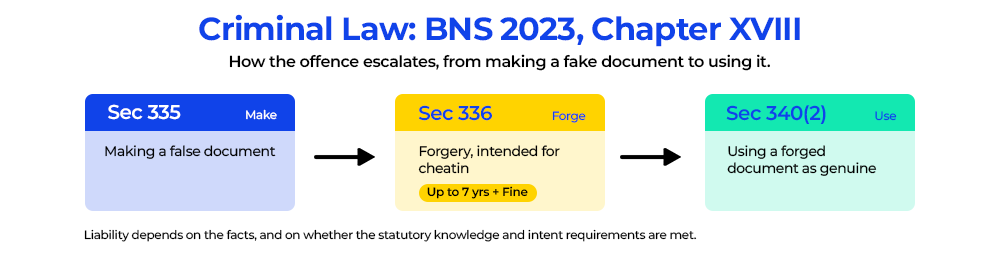
It can also be a crime under the Bharatiya Nyaya Sanhita, 2023 (BNS), Chapter XVIII
- Section 335 defines making a false document, and Section 336 deals with forgery.
- Forgery committed with the intention that the document be used for cheating is punishable with up to seven years' imprisonment and a fine.
- Section 339 addresses possession of certain forged documents with knowledge of the forgery and intent to use them as genuine, subject to the conditions specified in the provision.
- Section 340(2) covers using a forged document as genuine, and it carries the same punishment as the forgery itself.
The last point matters. The person who uses the degree is punished, not just the person who made it. Criminal liability depends on the facts and on whether the applicable statutory requirements, including the relevant knowledge or intent, are satisfied.
What Courts Have Said?
Indian courts treat fake qualifications seriously:
- The Supreme Court has held that producing a fake certificate to get employment is grave misconduct and that dismissal from service can be justified.
- The Allahabad High Court held that appointments obtained based on fake B.Ed. degrees are null and void.
- In 2025, the Allahabad High Court held that an appointment secured through a forged essential qualification certificate is void from the start, and that a confirmed employee can be removed after a show-cause notice without a full departmental inquiry.
- The Supreme Court has also expressed concern over large-scale misuse of fake certificates in Uttar Pradesh and directed a state-wide verification of employees' qualifications.
All cases depend upon their facts. In one such case, the Supreme Court of India refused to quash the appointment of an assistant professor who held a fake PhD degree, as the student did not need that fake PhD since they were qualified in their own right for UGC-NET.
Why Is It Risky?
The risk associated with the acquisition of such a degree is very high, since it can always be proven to be authentic or not even after many months or years down the line. Should such a degree turn out to be false or fraudulently backdated, there will definitely be consequences.
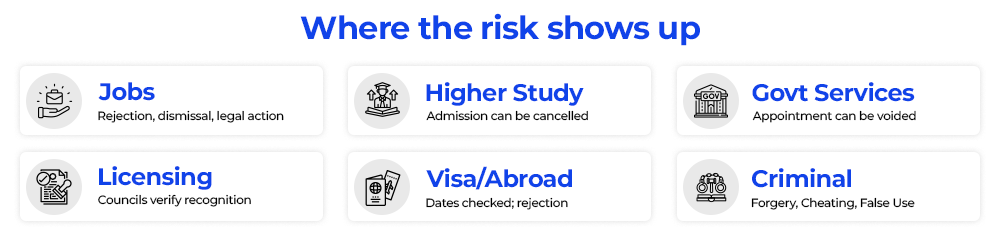
- Employment verification: Employers verify degrees directly with the issuing university. If the university cannot confirm it, the candidate can be rejected or dismissed, and knowingly submitting it can lead to legal action.
- Higher education: Admission based on a backdated bachelor’s degree could also be cancelled if it was used to get into a master’s course.
- Government employment and advancement: The documentation verification would reject the application for candidacy, and the appointment could be subsequently deemed invalid and void.
- Professional licensing: The councils will verify that the qualification is from a recognized institution.
- Criminal implications: Forgery, cheating, and use of false documents can result in criminal prosecution under the BNS.
Fake Universities and Fake Degree Offers
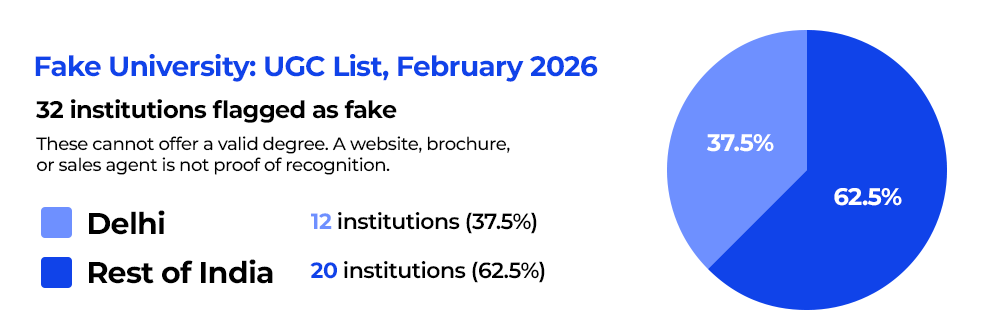
Students must be assured about the institution before paying. There is a list of fraudulent universities provided by the UGC, and according to the UGC’s February 2026 list, 32 fake universities were identified as fake universities, including 12 in Delhi. These universities will not be able to offer a proper degree. I
It is very important to be cautious about all those advertisements:
- Without regular study or genuine examinations
- In an unusually short time
- With a completion date from several years ago
- Without normal admission records or verifiable credits
- Without a university-issued academic record
- Only on payment
A website, brochure, or sales agent is not proof of recognition. Verify the institution, the program, and the academic session through official sources.
What are the Best Alternatives to Backdated Degrees?
Instead of choosing a backdated degree, students can consider valid alternatives such as online degrees and open and distance learning programmes. These options can be helpful if you have limited timer are working professionals who want to continue studying while managing a job and other responsibilities.
Online degree programs offer flexibility, but it is important to choose a university that meets the required UGC regulations. Before taking admission, students should check the university’s recognition status for the specific programme and academic session.
Recognition and Approval for a Valid Degree
Recognition depends on the specific program and the academic session. A university being recognized at some point in the past is not enough for every program.
- Under the UGC-DEB public notice of 19 August 2024, every learner except international learners must generate a DEB-ID using their ABC-ID before enrolling in any ODL or online program.
- The purpose of the DEB-ID is to make sure learners take admission only in programs of institutions recognized by the Commission.
- The Academic Bank of Credits (ABC) maintains and verifies academic credits, which is what a fabricated degree cannot have.
How to Verify a Degree?
A degree certificate should never be accepted on its appearance alone. A genuine degree can be checked against official records, and a backdated or fake one usually fails at one of these steps.
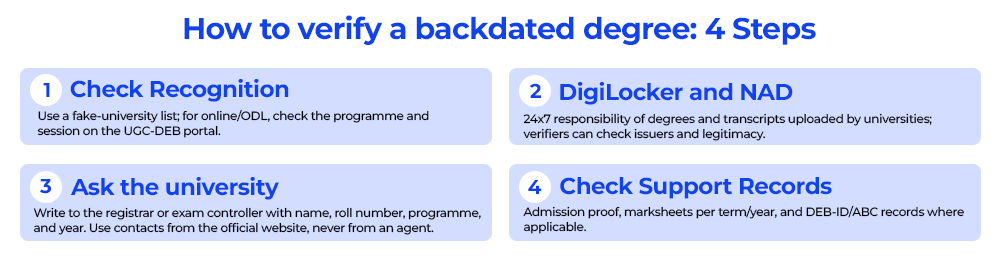
Step 1: Check that the university is recognized.
Check whether the name of the university appears in the UGC’s list of fake universities. Make sure that the degree is given by the university and not just the affiliated college attended by the candidate. In case of an online/distance program, visit the UGC portal.
Step 2: Check DigiLocker and the National Academic Depository (NAD)
NAD is an all-day, 24x7, online repository of educational awards like degrees, diplomas, and transcripts. It has been introduced in order to counteract frauds like award forgery by making online authentication possible. Students can view their degree certificates and transcripts on DigiLocker, and employers or any other verifier can verify the legitimacy and issuer of a document via DigiLocker without getting in touch with the university. NAD has only those records that are uploaded by universities.
Step 3: Verify directly with the university.
Contact the university's registrar or examination controller through a letter addressed to the name, roll number, program, and year of passing of the student. Ask the university to verify the admission documents, examination documents, and the date of awarding the degree. This step becomes particularly important when obtaining a backdated degree because the documents from the university will be the primary proof of the date printed on the document. Always use the contacts available on the university's website and not those provided by any agent or seller.
Step 4: Check the supporting academic records.
An authentic certificate includes proof of admission and enrollment, mark sheets for each term or year, and, for applicable ODL/Online admissions, students may also have DEB-ID and ABC-related records. The absence of a DEB-ID should not by itself be treated as proof that an older degree is fake.
Step 5: Check Recognition and Approval for a Valid Degree
Recognition depends on the university, specific programme, and academic session. Verify recognition through the UGC or UGC-DEB portal for the relevant period. Under the UGC-DEB public notice dated 19 August 2024, learners (except international learners) must generate a DEB-ID using their ABC-ID before enrolling in ODL or online programmes. Missing DEB-ID or ABC records alone do not conclusively establish that an older degree is fake.
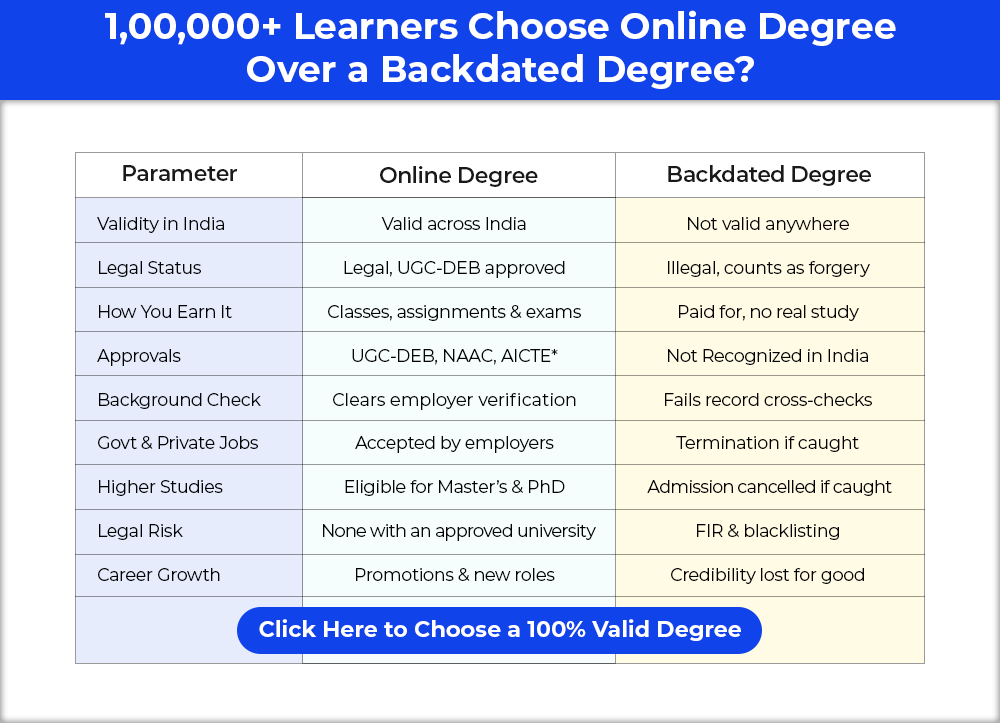
Backdated Degree vs Legitimate Online Degree
|
Factor |
Backdated / Fraudulent Degree |
Legitimate Online Degree |
|
Admission |
No genuine admission record |
Formal admission process |
|
Study |
No genuine study |
Structured programme |
|
Examinations |
None, or not genuine |
Prescribed examinations |
|
Academic credits |
Absent or unverifiable |
Maintained in academic records |
|
University records |
Do not support the certificate. |
Maintained by the university |
|
ABC / DEB-ID |
No legitimate basis |
Required where applicable |
|
Verification |
Fails verification |
Can be verified with the university |
|
Legal status |
Invalid; may attract criminal action |
Valid if recognized |
How to Report a Fake Degree Provider?
- Preservation of evidence: Maintain the advertisement, web page, screenshot, WhatsApp messages, e-mail, proof of payments, brochure, application form, and the certificate issued.
- Make a complaint to the relevant university, UGC, or police authorities, if need be. For any kind of fraud done using the internet, the National Cyber Crime Reporting Portal might also be relevant.
- Do not apply with a doubtful certificate: Do not apply with the certificate for any official purpose just because it is declared genuine or "verified" by the seller.
Why Choose a Legitimate Online Degree?
For students and working professionals who cannot attend a traditional classroom programme, a recognised online degree is the lawful way to close an education gap. It can offer:
- Flexible learning arrangements
- Online lectures and study materials
- Formal assessments and prescribed examinations
- Academic credits and records
- University-issued qualification documents
- A legitimate academic pathway
Not every online programme is recognised for every purpose. Before enrolling, verify:
- The university's status
- The specific programme
- The applicable academic session
- The programme's UGC-DEB recognition or entitlement status, where applicable
- Eligibility requirements
- Examination requirements
- Current fee structure
- Admission and documentation requirements
College Vidya can help students identify recognised online and distance learning programmes by providing information on universities, courses, eligibility, fees and admission requirements, so that they can compare their options and enrol in a genuine programme.
Can You "Get Away" With a Backdated Degree?
No, because even though the certificate might seem genuine at the time of acquisition, it doesn’t mean that it is genuine. There are so many means of verifying credentials in different processes, including recruitment, background checks, documentation, promotions, university admissions, professional registration, and even when someone looks for another job after years.
If the document passes the initial visual test but cannot be confirmed by the awarding body's records, then this document will eventually be found wanting. When false qualifications have been used, the repercussions can extend years beyond the actual receipt of the certificate, including revocation of admission or appointment, dismissal, and even criminal prosecution under the BNS.
What to Do Instead?
In case you have an education gap, here are some legal ways in which you can pursue education without a fake degreecertificate:
- Seek recognized online or ODL courses as per your eligibility and availability.
- Confirm the university and course via the official UGC-DEB website.
- See whether the recognition/entitlement is valid for your academic session.
- Generate your ABC-ID and DEB-ID before admission.
- Attend classes and take the exams as per the prescribed curriculum.
- Secure your admission, fee, exam, and academic documents.
- See the educational requirements for your chosen job or profession before registration.
Conclusion
This is because a backdated degree awarded without proper study and examinations is a fake degree. A certificate that falsely claims that a student earned a degree on an earlier date is not a legitimate academic qualification when the university’s official records do not support that claim.
It is equally dangerous to use such a degree. According to the BNS Act, the punishment for anyone who uses any document in such a way that it appears to be a real one is the same as that of document forgery, and cases have been ruled in which appointments and services of employees based on fake degrees have been canceled.
The safest way would be selecting a good university, checking the program and the semester from the UGC-DEB Website, completing your studies, appearing for exams, and keeping all the necessary documents. Although it takes more time to acquire a real degree, at least you get academic documents along with it.