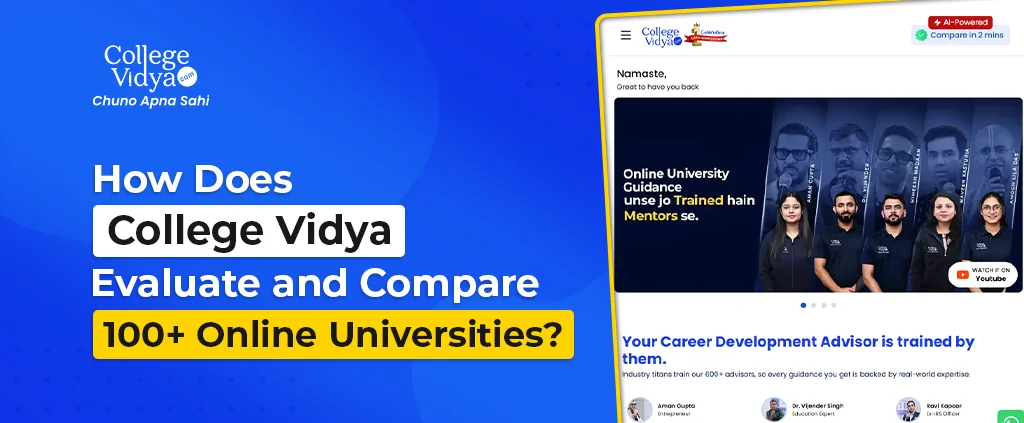



Quick answer: College Vidya started in 2019 as a verified source of online university information. It then evolved into personalized career counselling, expanded its expert network, built post-admission support and learner communities, introduced AI-powered guidance through Sara, and launched its Board of Mentors in 2026. Today, College Vidya says it has guided 1,25,000+ students, evaluated 100+ universities and 1,000+ programs, and built a network of 600+ Career Development Advisors.
There was a point when finding an online degree was mostly a search problem.
You searched for a university. You found a few websites. You opened the brochure. You checked the fee. Maybe you checked a ranking. Then you made a decision.
That worked when there were only a handful of choices.
Then online education exploded.
Suddenly, there were dozens of universities, hundreds of programs, different specializations, different fee structures, different eligibility rules, and an endless stream of advertisements telling learners that every option was the right one.
The problem changed.
It was no longer “Where can I find an online degree?”
It became:
“How do I know which one is actually right for me?”
That is the question College Vidya was built around.
The Problem That Led to the Foundation of College Vidya
Online education solved a very real problem.
A working professional could study without leaving a job. Someone in a Tier-2 or Tier-3 city could access programs that were previously difficult to reach. Learners could continue working while adding another qualification to their profile.
But access created another problem: choice overload.
University websites naturally tell you what is good about their own programs. Rankings may give you a position without explaining how it was calculated. Advertisements highlight the attractive parts. Brochures show the best placement number.
None of those things necessarily answer the learner's actual question.
Does this program make sense for me?
College Vidya's founding belief grew from that gap.
The platform's current positioning puts it rather simply: “We listen first. We guide second.” The idea is to understand the learner's plans, situation, and goals before suggesting a program.
And that distinction matters.
Because the right program for a 22-year-old graduate looking for their first job is not necessarily the right program for a 32-year-old professional trying to move into management.
Same degree category.
Different decision.
College Vidya in 2019: Where and Why It All Started!
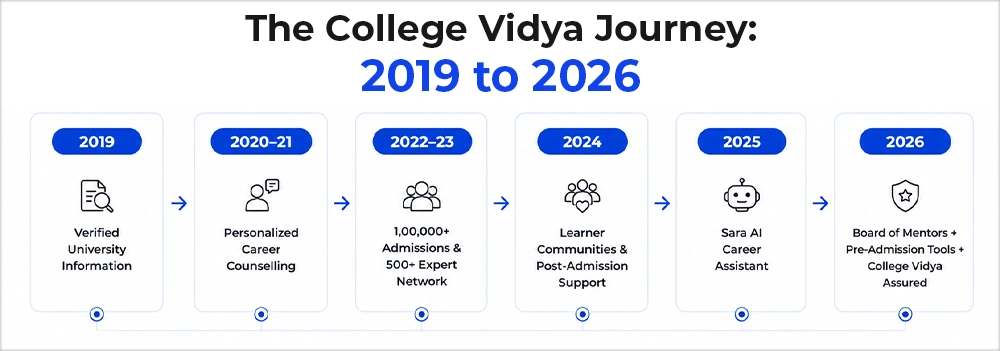
College Vidya launched in 2019 as a verified source for online university information.
At that point, the job was relatively straightforward.
Help learners find reliable information about online universities.
But education decisions rarely stay straightforward for long.
Once learners started looking beyond basic information, another pattern became obvious.
Knowing the fee doesn't tell you whether you can afford it.
Knowing the specialization doesn't tell you whether it fits your career plan.
Knowing that a university offers an online MBA doesn't tell you whether that MBA makes sense for your current job.
The information was there.
The decision was still difficult.
That became the next problem to solve.
When Information Wasn't Enough: Needed Shift to Personalized Guidance
In 2020–21, College Vidya introduced personalized career counselling backed by expert mentorship.
This was an important change in the company's journey.
The platform was no longer only asking:
Which universities offer this program?
It was beginning to ask:
Why are you looking for this program in the first place?
That changes the conversation.
A learner working in sales might be looking at an MBA because they want a managerial role.
Another learner might want the same MBA because they want to move into marketing.
Someone else might simply need a recognized postgraduate qualification to meet an eligibility requirement.
The program name can be identical.
The reason behind the decision isn't.
That is where personalized guidance became important.
College Vidya began building a network of Career Development Advisors around this idea: understand the learner's situation first, then help them evaluate their options.
The Growth Years: From Just Information to 1,00,000+ Admissions
The next phase was less about launching a feature and more about scale.
By 2022–23, College Vidya says it had reached 9 million+ website visits, 100,000+ admissions, and an expert network of 500+ people.
Those numbers tell one story.
The second story is more interesting.
More learners meant more conversations.
More conversations meant more different kinds of questions.
And more questions meant that a guidance platform couldn't rely on a single source of information.
A learner might ask about fees.
Another might ask whether the program's regulatory status is valid.
Another might ask about exams.
Another might be trying to decide between two universities that look almost identical on paper.
And some aren't really asking an information question at all.
They're asking:
“Am I making the right decision?”
That's a much harder question to answer.
The Next Problem: What Happens After Admission?
Getting someone to enroll isn't the end of an education journey.
In 2024, College Vidya expanded into comprehensive learner communities and post-admission support.
That shift is easy to overlook.
A student can make the right admission decision and still have problems six months later.
They might need help understanding an academic process.
They might struggle with the learning platform.
They might have questions about examinations.
They might simply need somewhere to turn when something doesn't go as expected.
So the model began moving beyond:
Find a program → Enroll
towards:
Explore → Compare → Decide → Enroll → Continue
That is the point at which College Vidya starts looking less like a university-information website and more like an education guidance ecosystem.
From Guidance to an Ecosystem
By this stage, College Vidya had another problem to solve.
Good advice depends on good information.
So the platform began building tools around the guidance itself.
The current College Vidya platform says it has built 16 tools divided into two categories: pre-admission tools and post-admission tools - these include assessments, calculators, student reviews, platform trials, outcome data, program filters, career planning, and skill mapping.
The principle behind all of them is fairly simple:
Advice without evidence is still just advice.
Then the Ultimate Question: Who Guides the Counsellors?
This is where the College Vidya story takes a slightly different turn.
If a career development advisor is helping someone make a decision that could affect the next several years of their career, training the advisor becomes just as important as giving them information.
And that is where the Board of Mentors enters the story.
The Board was introduced in 2026 as a working group of industry leaders and academics who train College Vidya's Career Development Advisors using verified data and real-world career judgment.
The question behind it is a good one:
If advisors are helping learners make career decisions, who helps the advisors understand the world those learners are entering?
The Board of Mentors: When College Vidya Changed What “Guidance” Meant
The Board isn't introduced as a publicity stunt!
Its members work with career development advisors on the parts of education decisions that don't appear neatly inside a university brochure.
What does the market actually value?
Does a program make sense for a particular career direction?
How should an advisor evaluate accreditation?
What happens when a learner is choosing based on prestige rather than fit?
How do you distinguish an information gap from a mindset barrier?
These are different questions, and the Board brings different perspectives to them.
That is the idea behind mentored guidance at College Vidya.
The advisor brings the program knowledge.
The tools bring the data.
The mentor perspective brings another layer:
context.
Meet the People Shaping the Guidance—Board of Mentors
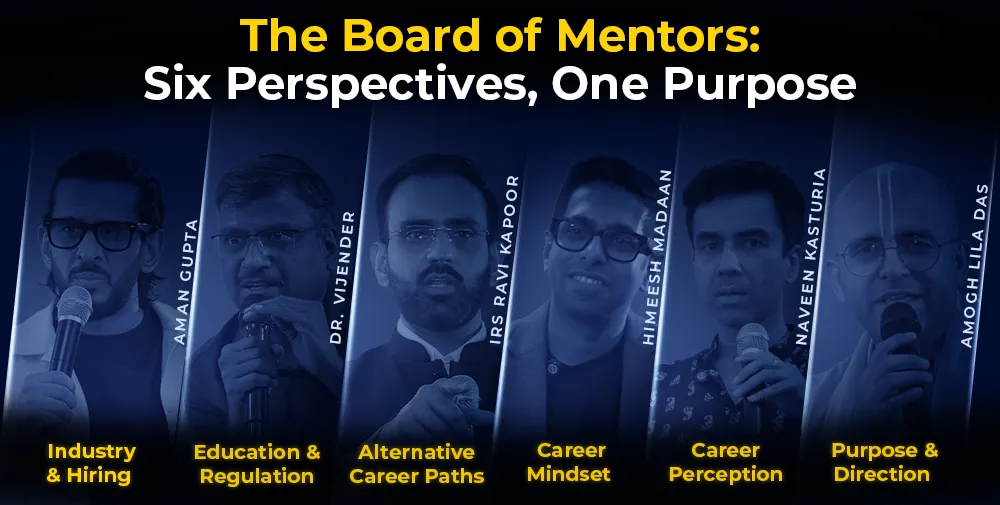
The Board brings together people from very different professional backgrounds.
That's not an accident. That's the point.
Between them, they hand our career development advisors something no placement brochure ever will — real industry knowledge, from the people who've lived it.
Naveen Kasturia, actor and one of the most trusted public voices on career realities, spoke on how perception and prestige quietly steer career decisions — and why learners talk themselves out of a perfectly good option simply because it doesn't sound impressive enough.
Dr. Vijender Singh Chauhan, education policy expert, walked advisors through the regulatory side most learners never see — accreditation, UGC-DEB status, and what actually deserves attention once you look past a university's marketing.
Himeesh Madaan, career mindset coach, helped advisors sharpen a skill that's harder than it sounds: telling apart a learner who's missing information from one who's stuck on a mindset block, and knowing how to move the conversation forward without pushing.
Amogh Lila Das, purpose-driven career advisor, reminded the room of something easy to forget mid-call — learners are making decisions about their lives, not just picking a program, and the final call has to stay theirs.
Ravi Kapoor, ex-IRS officer, sat with advisors on a conversation he knows firsthand — guiding learners who feel they missed the "conventional" route, including those an exam outcome didn't go their way for, to see an online degree as a step forward, not a fallback.
Different backgrounds. Different experience.
One purpose: making every advisor conversation count.
Face Behind the Ecosystem – Rohit Gupta
There is another part of the Board story that is easy to miss.
Mentors can share experience.
But someone has to turn that experience into a repeatable system.
That responsibility sits with Rohit Gupta, co-founder and COO of College Vidya.
According to the Board of Mentors model, Rohit built the career guidance and mentorship system around starting every advisor conversation with the learner's direction rather than a commission target. The system also includes a review process that audits more than 2,000 Career Development Advisor conversations every month and flags recommendations that aren't backed by verified data or matched to the learner's direction.
That distinction is important.
A mentor session can inspire someone.
A system can make that learning repeatable.
What Changed After the Board Walked In?
The difference isn't supposed to be that advisors suddenly know more university names.
They already had access to university information.
The difference is how they use it.
Instead of stopping at:
“This university has an MBA in Marketing.”
The conversation can move towards:
“What are you trying to do after the MBA?”
Instead of:
“This university has a ₹X lakh highest package.”
The question becomes:
“What does the actual outcome data tell us?”
Instead of:
“This university is ranked highly.”
The advisor can ask:
“What methodology is behind that ranking?”
The Board of Mentors says its advisors are trained around verified graduate outcomes, median salaries, actual learner reviews, accreditation evaluation, and cost-to-career analysis.
That is a different definition of guidance.
2025: When College Vidya Entered the AI Era
Human guidance wasn't the only direction the platform was moving in.
In 2025, College Vidya was featured on JioHotstar's Brands of Tomorrow and launched CV Sara, its AI career assistant designed to be available 24/7.
The reason for building an AI layer is obvious.
Education questions don't happen only during office hours.
Someone might be comparing universities at 11 PM.
Someone else might suddenly wonder whether their degree has the right eligibility.
Another learner might want to understand the difference between two programs before speaking to an advisor.
Sara was built around that reality.
The current platform describes the idea simply:
Too many options. One right answer.
The goal isn't to replace the human layer.
It is to make educational information easier to explore before, during, and around a guidance conversation.
2026: Building Trust Before and After Enrollment
By 2026, the pieces were beginning to connect.
College Vidya had:
- 1,25,000+ students guided
- 600+ Career Development Advisors
- 1.5 Cr+ minutes of 1:1 advisory
- 1,000+ programs evaluated
- 100+ universities evaluated
- 30+ evaluation factors
The company also launched Pre-Admission Tools and College Vidya Assured, extending its focus on trust before and after enrolment.
The scale is worth noting.
But the more interesting part is what the scale represents.
College Vidya isn't just dealing with more universities than it did in 2019.
It is dealing with a much larger decision-making problem.
There are more programs.
More specializations.
More learners.
More career paths.
More information.
And therefore, more room for the wrong information to influence the right decision.
Leaders Behind the Growth
There are three founders behind the platform, and their current roles map neatly onto the three problems College Vidya has spent years trying to solve.
Mayank Gupta — Co-founder & CEO
His focus is the larger business vision behind the platform.
His founding statement is simple:
“We built what we wished existed when we were choosing.”
Rohit Gupta — Co-founder & COO
His focus sits closer to the guidance model and its execution.
His stated principle:
“A learner's outcome is the only metric that matters.”
Sarthak Garg — Co-founder & Product Head
His role brings the technology layer into the picture.
His philosophy:
“Technology should serve clarity, not confusion.”
Put the three together, and you get a fairly good picture of what College Vidya has become:
Business thinking + human guidance + technology.
The Numbers Behind the Journey
|
Then |
Now |
|
Launched in 2019 as an online university information source |
100+ universities evaluated |
|
Personalized counseling introduced in 2020–21 |
1,000+ programs evaluated |
|
500+ expert network by 2022–23 |
600+ Career Development Advisors |
|
100,000+ admissions by 2022–23 |
1,25,000+ students guided |
|
Post-admission communities built in 2024 |
1.5 Cr+ minutes of 1:1 advisory |
|
AI career assistant launched in 2025 |
30+ program evaluation factors |
|
Board of Mentors introduced in 2026 |
Human + data + AI + mentor-led guidance |
But the bigger change isn't really visible in the table.
The first version of College Vidya helped learners find information.
The current version is trying to help learners make sense of it.
What Does College Vidya Look Like Today?
Look at the journey backward.
- 2019: Find reliable university information.
- 2020–21: Add personalized career counselling.
- 2022–23: Scale the network and admissions.
- 2024: Stay with the learner after admission.
- 2025: Add an AI layer through Sara.
- 2026: Add Pre-Admission Tools, College Vidya Assured, and the Board of Mentors.
That is not simply a longer list of services.
It is a change in what the company believes its job is.
At the beginning, the problem looked like:
“Where can I find an online university?”
Then it became:
“Which university should I choose?”
And now the question is closer to:
“Which education decision actually makes sense for the career and life I'm building?”
That is a much harder question.
And it requires more than a search result.
Future Vision—What Comes Next for College Vidya?
The education market isn't getting simpler.
More universities will offer online programs.
More specializations will appear.
AI will make information easier to generate.
And that last point creates an interesting problem.
When everyone can get an answer instantly, knowing which answer to trust becomes more important, not less.
That is where College Vidya's current direction becomes clear.
AI can help a learner search.
Data can help compare.
Tools can help calculate.
Reviews can add the student perspective.
Career Development Advisors can understand the learner's situation.
And the Board of Mentors can bring industry perspective into that guidance.
The pieces work together.
The original problem, however, hasn't changed.
There are still too many options.
The difference is that College Vidya is no longer trying to simply help learners find an option.
It is trying to help them understand why one option may fit their direction better than another.
And perhaps that is the simplest way to describe the journey.
From finding universities to finding the right one.