


Let me start with a confession. Fifteen years ago, I was color-coding display rails in a fashion retail store, figuring out why a particular shade of blue was selling better in Delhi than in Hyderabad. I was training sales teams, measuring footfalls, and obsessing over visual merchandising the way most people obsess over spreadsheets. I loved it. It was human, sensory, fast-paced work.
Nobody in that world was talking about artificial intelligence. Nobody was thinking about enterprise transformation, agentic AI, or doctoral dissertations. And absolutely nobody, least of all me, imagined that I would one day be presenting research at the AAAI conference in Singapore, participating in global AI governance discussions at UNESCO Paris and the United Nations in Geneva, teaching doctoral students at a university in San Francisco, and designing India's first AI literacy curriculum for visually impaired learners.
The bridge between those two worlds, between fashion racks and global AI stages, was a doctorate. Specifically, a Doctor of Business Administration (DBA). And if you are reading this, wondering whether a DBA or a PhD might be the right path for you, I want to give you the most honest, experience-grounded answer I can.
The question is not which degree is better. The question is, what door are you trying to open, and which key fits?
First, Let's Be Honest About What These Degrees Are
Both the PhD (Doctor of Philosophy) and the DBA (Doctor of Business Administration) are terminal doctoral degrees. Both require serious research. Both take years of deep, sometimes uncomfortable intellectual work. And both, when done well, change the way you think permanently. Completing either programme earns you the title of Dr, a distinction that reflects not just academic attainment but also a demonstrated capacity for original, rigorous inquiry. But they are built for different purposes, and they attract different kinds of people.
The PhD Program
The PhD is designed primarily around theory creation and the advancement of academic knowledge. If you are drawn to research for its own sake, if you want to spend years examining a phenomenon, building frameworks, publishing in peer-reviewed journals, and eventually teaching in a research-heavy university, then the PhD is probably your home. PhD candidates are typically expected to contribute something genuinely new to the theoretical literature of their field. The audience for your work is largely other academics. The primary output is a dissertation that advances the scholarly conversation.
The Online DBA Program
The DBA was designed for experienced professionals who want to apply doctoral-level rigour to real business problems. The research is still serious; there are no shortcuts, but the framing is different. A DBA asks, 'What is happening in the real world, and what does the evidence tell us about how to improve it? The audience is not just the academy; it includes organisations, industries, and policy environments. The primary output is a dissertation that produces actionable knowledge.
A useful way to think about it: A PhD builds the theoretical map. A DBA uses that map to navigate actual terrain and then reports back on what the terrain was actually like.
Neither is easier. Neither is more prestigious in any absolute sense. What matters is fit.
Getting In: What Each Programme Actually Requires
One of the most practical questions prospective doctoral students ask is, 'What does it actually take to get admitted?' The answer differs considerably between the two programmes, and understanding those differences can save you months of misalignment.
PhD Admission Requirements
A PhD program typically demands a postgraduate degree (usually a Master's) in a relevant discipline, strong academic transcripts, and critical evidence of prior research exposure. Most programmes require candidates to clear a mandatory entrance examination, such as the UGC-NET, GATE, or institution-specific entrance tests in the Indian context. This is followed by an interview where candidates are expected to present and defend a research proposal: a focused, theoretically grounded document that articulates what they intend to study, why it matters, and how they will approach it methodologically. The proposal is not a formality. Admissions committees use it to assess whether your research interests align with faculty expertise and institutional capacity. Without a credible research direction, admission is unlikely regardless of your academic record.
Online DBA Admission Requirements
The DBA takes a different approach. While academic qualifications still matter, the emphasis shifts toward professional experience. Most accredited DBA programmes require a minimum of five to ten years of senior professional or managerial experience, along with a bachelor's/master's degree. The logic is deliberate: the DBA is designed for practitioners who bring real-world complexity into their research, so the admission process privileges that complexity. Rather than a formal research proposal in the PhD sense, DBA candidates are typically asked to submit a professional statement of intent, a document that articulates a specific business or organizational problem they intend to investigate and why their experience positions them uniquely to do so. This is followed by an interview, though the nature of that conversation is more practitioner-focused than theory-driven.
In short, PhD admission tests your theoretical readiness and research aptitude. DBA admission tests your professional depth and the clarity of the problem you intend to solve. Both demand preparation, just of a very different kind.
The Real Question: What Door Are You Trying to Open?
When professionals come to me wondering which doctoral route to take, I ask them one question first: What do you want your working life to look like in five years?
If the answer involves building a research career at a university, producing theoretical contributions, and writing for academic journals, the PhD is almost certainly the better path. Tenure-track academic positions in research universities typically favour candidates with PhDs, particularly those with strong publication records in high-impact journals.
If the answer involves becoming a more effective executive, consultant, or sector leader; transitioning into teaching or executive education while maintaining industry credibility; or contributing to policy, governance, or organisational change in a field you already know well, then the DBA is extraordinarily well-suited to where you want to go.
The DBA does something unusual. It hands you a credential that is respected in boardrooms and classrooms simultaneously. After completing mine, I continued designing AI transformation programmes for Fortune 500 and Forbes-listed clients at Datamatics, while also stepping into an adjunct faculty and professor of practice role at Golden Gate University. The DBA opened both doors at once. That is not an accident of circumstance. It is what the degree is designed to do.
The DBA gave me language that worked in both boardrooms and classrooms, and that is rarer than most people realize.
Learning Commitment: What Your Days, Weeks, and Years Actually Look Like
Understanding the shape of your commitment before you enrol is not a logistical detail. It is the difference between finishing and not finishing. The PhD and the DBA have meaningfully different learning structures, and both deserve an honest account.
The PhD: A Fixed, Immersive Commitment
A traditional PhD is structured around institutional rhythms, not personal ones. Most PhD programs run over three to five years (and often longer), with a curriculum designed around coursework, qualifying examinations, comprehensive reviews, and ultimately a full dissertation. The expectation, particularly in the early years, is close to full-time engagement. Even where part-time options exist, the academic calendar, supervisor schedules, and examination timelines are largely fixed. You adapt to the program. Fellowship funding, when available, often requires candidates to forgo outside employment. The PhD is, by design, a programme that asks you to step out of your professional life to enter a new intellectual one.
The Online DBA: Flexible, Self-Paced, Designed for Working Professionals
The DBA is architected differently. The better programmes are explicitly designed for professionals who cannot pause their careers and who should not have to. Most Online DBA programmes run over two to three years, with a modular structure that allows candidates to move through coursework at a pace that accommodates professional and personal demands. While there are milestones, research proposal approvals, methodology reviews, and dissertation defences, the journey between those milestones is largely self-directed. You bring your own work schedule to the research process. Many DBA candidates conduct fieldwork within their own organisations, which means the research and the professional role can reinforce rather than compete with each other.
The honest truth: an Online DBA or executive doctorate programme will demand between 15 and 20 hours per week of serious focus. It will require you to write, revise, read deeply, question your own assumptions, and occasionally sit with discomfort. But it will not require you to choose between your career and your education. That is precisely the point.
What it does require is clarity about why you are doing it. Curiosity alone is not enough. A specific question you genuinely want to answer, one rooted in the industry or challenge you live closest to, will carry you through the years when the research is hard, the literature review is overwhelming, and your calendar is impossible.
How the Online DBA Actually Works: Classes, Faculty, and Research Supervision
When I speak with professionals considering an online DBA, one of the most common sources of hesitation is a simple, practical uncertainty: what does the learning actually look like? Will I be watching recorded videos by myself, or is there real interaction? Who are the people teaching me? And crucially, when it comes to my dissertation, am I on my own?
These are exactly the right questions to ask, and the answers matter enormously when choosing a program.
Live Sessions vs. Recorded Content
Reputable online DBA programs typically combine both. Core coursework covering research methodology, advanced management theory, and quantitative and qualitative analysis is often delivered through a blend of live virtual seminars (scheduled sessions with real-time faculty interaction and peer discussion) and recorded lectures or modules that you can access at your own pace. The best programs are deliberate about where they use each format: live sessions for complex, discussion-driven topics and recorded materials for foundational concepts you may need to revisit. If you are evaluating a programme, ask specifically: what percentage of the curriculum is delivered live, and what is the attendance expectation?
Who the Faculty Are
In a well-designed online DBA, the faculty are not distant names in a course catalogue. Many are scholar-practitioners who hold doctoral qualifications and continue to operate in or consult with the industry. That combination matters. It means the case studies are drawn from lived experience, the research conversations go deeper than theoretical abstractions, and the feedback on your work comes from people who understand both the academic rigour you must meet and the professional world you are trying to contribute to. When researching a programme, look beyond faculty bios and ask whether the instructors are active in your field, not just teaching about it.
Research Supervision
This is where the architecture of the Online DBA most directly shapes outcomes and where the variation between programs is greatest. In a rigorous DBA, every candidate is assigned a dedicated research supervisor (or a supervisory team) from the point of dissertation commencement. This relationship is not incidental. It is the intellectual scaffolding of the entire research process. A good supervisor brings methodological expertise, helps you sharpen your research question, provides structured feedback on drafts, and prepares you for the final dissertation defense. Look for programs that clearly articulate the supervision model: how supervisors are allocated, how frequently you meet, and what happens if the supervisory relationship is not working.
Before you enrol, ask three questions: Are coursework sessions live or recorded, or both, and in what proportion? Who are the faculty, and are they active practitioners or researchers in my field? How is my dissertation supervisor assigned, how often will we meet, and what does the research support structure actually look like? The answers will tell you more about a programme's quality than its brochure ever will.
My DBA Journey: From Fashion Racks to Global AI Stages
I will not pretend the path was linear. Life rarely is. My career began in retail learning and visual merchandising, building talent development programmes across more than fifty cities, understanding how people learn on shop floors and in fitting rooms. It taught me something invaluable: real learning is messy, contextual, and deeply human. No textbook could have given me that.
Over the years, I moved into AI-integrated learning systems and enterprise transformation and eventually into a senior role architecting intelligent customer experience ecosystems for major clients across APAC, EMEA, and North America. By the time I enrolled in the DBA program at Golden Gate University in San Francisco, I had over fifteen years of enterprise experience and a very specific research question I wanted to answer: Does AI-based training actually improve employee performance and retention, and can the evidence be measured?
That question became my dissertation. Published on ProQuest in 2025, it tracked longitudinal AI adoption across 300 enterprise participants. The research produced evidence that I then brought directly back into my advisory work with C-suite clients and into the classroom with my students. That cycle from practice to research to practice again is precisely what the DBA was designed to enable.
What I did not fully anticipate was how far the research credential would travel. Conference panels at AAAI-26 in Singapore. A UNESCO AI governance session in Paris. Dialogue at the United Nations Institute for Disarmament Research in Geneva. Simultaneous paper acceptances at IIM Kashipur and IIM Indore. Keynotes at IIT Delhi. None of this was on my roadmap when I enrolled. But the DBA gave me the standing, the evidence base, and the confidence to show up at those tables and contribute something substantive.
Three Moments That Changed How I Thought About Learning
1. The moment industry experience made theory feel alive
About midway through my DBA, I was studying academic frameworks on organizational learning and AI adoption. On paper, these were abstract constructs. But I had spent years watching those same dynamics play out in corporate training programmes, in the resistance patterns of sales teams being handed new tools, and in the gap between what a system promised and what people actually used. Reading the theory after living the practice was like suddenly seeing the skeleton inside a body I already knew. The DBA let me do both, and the synthesis was transformative.
2. Reskilling is not a course; it is a life strategy
One of the most underestimated things about pursuing a doctorate as a working professional is what it teaches you about how you learn. I was juggling enterprise AI programmes at Datamatics, raising a family, and conducting doctoral research simultaneously. That is not a tragedy. That is the DBA's natural habitat. The experience taught me that reskilling, real reskilling, is not a weekend course or a certification sprint. It is the sustained commitment to growing your thinking across years, through discomfort, revision, and the occasional crisis of confidence. The doctorate is the most rigorous version of that commitment. And it prepares you to guide others through it, too.
3. The language of evidence changes everything
Before the DBA, I could make compelling arguments based on experience and instinct. After it, I could make the same arguments and cite the evidence. In a boardroom, that is a different kind of authority. In a classroom, it is a different kind of teaching. The ability to say, "Here is what the data shows; here is the methodology; here is what we can and cannot conclude" is not just academic rigour. It is a professional superpower.
Accreditation and Recognition: Does an Online DBA Hold Up?
This is a question that deserves a direct, unvarnished answer because the landscape is uneven, and the stakes of choosing poorly are high.
Not all DBA programmes are created equal, and the difference between a well-accredited programme and an unrecognised one is not a footnote. It is the difference between a credential that opens doors and one that raises eyebrows.
What Accreditation Actually Means
For business and management doctoral programmes, the most rigorous international accreditations are AACSB (Association to Advance Collegiate Schools of Business), EQUIS (European Quality Improvement System), and AMBA (Association of MBAs). These accreditations require programs to meet demanding standards for faculty qualifications, research output, curriculum rigour, and student outcomes. They are not easy to obtain, and institutions that hold them have demonstrated a sustained commitment to quality. When evaluating an online DBA, the presence of one or more of these accreditations is not just a badge; it is a signal that the programme will be recognised by peers, employers, and academic institutions globally.
There are also national-level quality frameworks to consider, including QAA (UK), TEQSA (Australia), and regional accreditation bodies in the United States. The key is to verify that the accreditation is from a recognised body, not one that exists primarily to generate the appearance of legitimacy.
How Online DBA Compares to a PhD in Terms of Recognition
In research universities with strong academic cultures, the PhD retains its position as the preferred credential for full-time faculty roles. That is unlikely to change significantly in the near term. However, for roles that sit at the intersection of practice and academia, such as adjunct faculty, professor of practice, executive education, policy advisory, and senior consultancy, a DBA from an accredited institution is increasingly recognized as a peer credential. The research requirement is equivalent in rigour; the application domain is different. Employers and institutions that understand the distinction are growing in number.
Bottom line on accreditation: Before enrolling, verify that the institution holds at least one of the following: AACSB, EQUIS, or AMBA accreditation. If a programme cannot clearly demonstrate this, the credential carries risk regardless of how impressive the marketing looks.
The Indian Context: What You Need to Know Before You Enrol
India occupies a particularly interesting position in the global DBA landscape, a country with a vast appetite for doctoral education, a rapidly expanding professional class, and an institutional framework that is still catching up with international norms. If you are based in India, or if your career is primarily rooted in the Indian professional ecosystem, there are specific realities you need to understand before making a decision.
Which institutions offer online DBA programs accessible from India?
Online DBAs available to Indian professionals are currently offered primarily by international universities, rather than by Indian institutions. Programs from universities in the United States (including Golden Gate University, Edgewood University, and Birchwood University), France (such as ESGCI), and Switzerland (including SSBM Geneva and Rushford Business School) are among the most commonly pursued. All of these are delivered fully online with the option of campus immersion. A small but growing number of Indian business schools are exploring executive doctorate offerings, though as of now, internationally accredited online DBA programmes with a robust track record remain concentrated outside India. If you are looking for a programme you can pursue from India while continuing to work, the primary options are international, which means you will want to verify recognition carefully.
Does the UGC Recognise an Online DBA?
This is perhaps the most frequently asked question among Indian professionals, and it deserves a clear answer. The University Grants Commission (UGC) is the statutory body that governs higher education in India and determines the recognition of degrees for purposes of employment in government, the public sector, and regulated academic roles. Currently, the UGC's recognition framework for foreign doctoral degrees is not uniform, and the DBA, as a professional doctorate rather than a traditional academic doctorate, sits in an ambiguous space within that framework. For roles in Indian public universities, regulated teaching positions, or government employment that require a recognised doctorate, an Online DBA from a foreign institution may not satisfy UGC requirements in the way a PhD from a UGC-recognised institution would.
However, this is not the full picture. For roles in private industry, multinational corporations, executive education, consulting, and entrepreneurship, the UGC's framework is largely irrelevant. Employers in these spaces evaluate credentials on their own terms: the reputation of the awarding institution, the rigour of the accreditation, and the quality of the research produced. In these contexts, a DBA from a well-accredited international university carries genuine weight.
How Do Indian Employers View a DBA Compared to a PhD?
The honest answer is it depends on the employer, and it is changing. Among traditional Indian institutions, public-sector enterprises, government bodies, and some legacy academic establishments, the PhD continues to be the more readily understood and institutionally valued credential. The DBA is newer to this audience, and unfamiliarity can translate into undervaluation.
Among progressive private employers, multinational firms, consulting practices, and the startup ecosystem, the picture is different. Here, a DBA from a globally recognised institution, particularly one that produced applied research in a relevant domain, is increasingly viewed as a mark of serious professional investment. The combination of seniority, research rigour, and institutional recognition creates a profile that stands out. The fact that a DBA candidate continued to work through the program rather than stepping away from industry is often seen as an asset, not a limitation.
For Indian professionals, the practical guidance is this: If your career is orientated toward Indian public-sector employment, regulated academic positions, or roles where UGC recognition is a formal requirement, investigate very carefully before choosing an Online DBA. If your career is in private industry, multinational environments, executive education, consulting, or entrepreneurship, a well-accredited Online DBA is a strong and increasingly recognised investment. The distinction matters, and the time to understand it is before you enrol, not after.
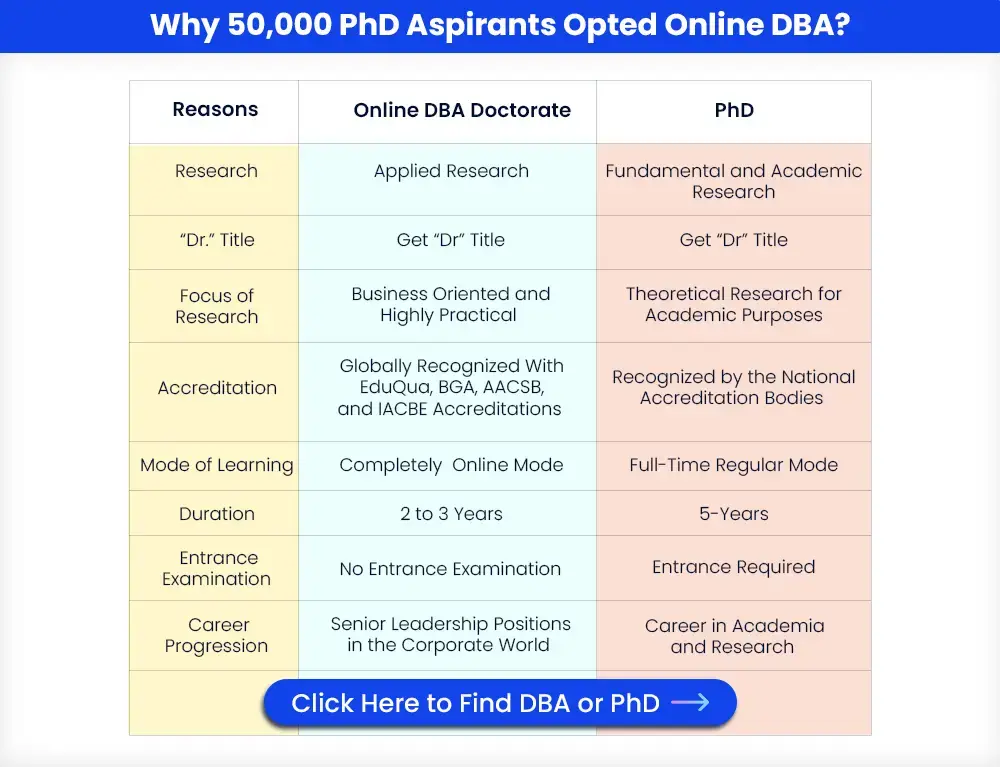
DBA vs PhD: A Practical Comparison
|
Dimension |
DBA |
PhD |
|
Degree Title Awarded |
Dr title upon successful completion and defence of the doctoral dissertation |
Dr title upon successful completion and defence of the doctoral thesis |
|
Primary Purpose |
Apply doctoral rigour to real business and organisational problems |
Advance theoretical knowledge and contribute original scholarship |
|
Ideal Audience |
Experienced professionals, executives, senior managers, and entrepreneurs |
Those pursuing academic research careers or foundational scholarship |
|
Admission Requirements |
Bachelor’s/Master's degree + 5-10 years professional experience + statement of intent + interview |
Master's degree + strong academic record + entrance exam (UGC-NET, GATE) + research proposal + interview |
|
Learning Commitment |
Flexible, self-paced; 15-20 hrs/week alongside full-time career |
Fixed schedule; near full-time; 5-7 years; often incompatible with sustained employment |
|
How Learning Works |
Live virtual seminars + recorded modules; scholar-practitioner faculty; dedicated dissertation supervisor |
Primarily campus-based; supervisor-led; limited online delivery |
|
Research Style |
Applied, problem-centred, practitioner-informed |
Theoretical, literature-building, conceptually generative |
|
Typical Output |
Dissertation with organisational or industry application |
Dissertation contributing to theoretical literature in a field |
|
Accreditation to Look For |
AACSB, EQUIS, or AMBA (institution-level) |
National university accreditation (UGC in India); institutional reputation |
|
UGC Recognition (India) |
Generally not applicable for foreign online DBAs; strong in private industry, MNCs, consulting |
UGC-recognised PhDs accepted for public-sector and academic roles |
|
Career Fit |
Executive roles, consulting, executive education, policy advisory, practitioner-faculty |
Research universities, full-time academic positions, pure research roles |
|
DBA After MBA? |
Natural progression builds on an applied knowledge base |
Possible but less typical for MBA backgrounds |
|
Duration (typical) |
2-3 years, structured for working professionals |
5-7 years, often full-time, funding-dependent |
|
Format Availability |
Increasingly available as online, executive, hybrid |
Primarily campus-based; some online options emerging |
|
Who Should Choose It |
Senior leaders, practitioners, educators, and entrepreneurs wanting to deepen impact |
Those committed to an academic research career or a full-time scholarship |
What My DBA Gave Me That I Did Not Expect
I expected the DBA to give me a credential. I expected it to sharpen my research skills and deepen my understanding of AI adoption dynamics. What I did not expect were the less visible gifts.
Credibility in rooms I had not yet entered. The DBA opened invitations to global conferences, policy dialogues, and academic forums where my industry experience alone would not have been sufficient. The combination of practitioner knowledge and doctoral rigour created a genuinely uncommon profile.
Clarity of thought. Doctoral research forces you to define your terms, state your assumptions, acknowledge your limitations, and defend your conclusions. That discipline bleeds into everything: how you write, how you present, how you advise, how you make decisions under uncertainty.
Confidence that is grounded, not performed. There is a particular kind of confidence that comes from having done the work rigorously. Not the confidence of someone who has read the headlines, but the confidence of someone who has gone into the data, tested the models, and written 40,000 words on what they found. It is quiet. And it is durable.
Teaching opportunities I had not planned for. Within months of completing my DBA, I was invited to join Golden Gate University as adjunct faculty and professor of practice. I now chair and co-chair doctoral dissertations, mentor DBA candidates through their research design, and deliver undergraduate business analytics courses. The DBA gave me the standing to teach at the doctoral level. That door simply was not open before.
Global conversations I had not imagined. From AAAI Singapore to UNESCO Paris to UN Geneva, from IIT Delhi to IIM Indore and IIM Kashipur, the DBA positioned me to participate in conversations that shape how AI is understood, governed, and deployed globally. That is not a credential outcome. It is a contribution outcome. And that distinction matters enormously to me.
A Doctorate Is Not a Title. It Is a Way of Thinking.
I want to close with something that does not appear in any prospectus.
The most lasting gift of a doctorate, whether DBA or PhD, is not the letters before your name. It is the change in how you engage with the world. You start asking better questions. You become more comfortable with uncertainty, more rigorous in your reasoning, and more willing to revise what you believe when the evidence suggests you should. You develop a tolerance for complexity that most professional environments actively reward.
For working professionals, executives, educators, entrepreneurs, and mid-career leaders who are wondering whether it is still possible, I want to say this plainly: it is possible. It is demanding. It is worth it. And the right programme, at the right moment, with the right research question, can reshape not only your career but also the quality of contribution you make to every institution and community you belong to.
The DBA changed how I think. It changed what I could offer. It changed which conversations I was part of. And it gave me, unexpectedly, the deepest kind of professional satisfaction: the sense that the work you are doing is building something that will outlast the moment.
Whether your path leads to a DBA or a PhD, the question that matters is not which degree is more impressive. It is a journey which will make you more useful to your field, to your organisation, to the people you are trying to serve.