

Quick answer: Yes, an online or distance degree is valid for both central and state government jobs, as long as the university offering it is approved by the UGC and the UGC-DEB, and the course itself doesn't fall under one of the technical fields the government excludes from online delivery.
If you've been holding off on applying for a government job because you studied online, that hesitation is probably costing you more than it's protecting you.
1.28 lakh jobs gone in 6 months. Yours could be next.
The confusion isn't really about whether online degrees count, they do. It's about which universities and which courses actually meet the government's specific approval criteria. This blog clears that up so you're applying with confidence instead of second-guessing your own eligibility.
At Glance
|
Question |
Answer |
|
Are online degrees valid for government jobs? |
Yes, if the university and program have the required UGC-DEB entitlement. |
|
Can I apply for civil services with an online degree? |
Yes, a recognised online or distance bachelor’s degree can meet the basic eligibility requirement. |
|
Can I apply for state government jobs? |
Yes, subject to the eligibility rules of the specific recruitment. |
|
Are online degrees equal to regular degrees? |
Yes, valid online and distance degrees are generally treated as equivalent to regular degrees for government recruitment. |
|
How can I verify an online degree? |
Check the UGC-DEB portal for the university, program, and relevant academic session. |
Is an Online OR Distance Degree Valid for Civil Services
|
Factor |
Details |
|
Validity for Civil Services |
Online and distance degrees are generally treated as equivalent to regular, on-campus degrees for civil services and other government recruitment examinations. |
|
UGC Recognition |
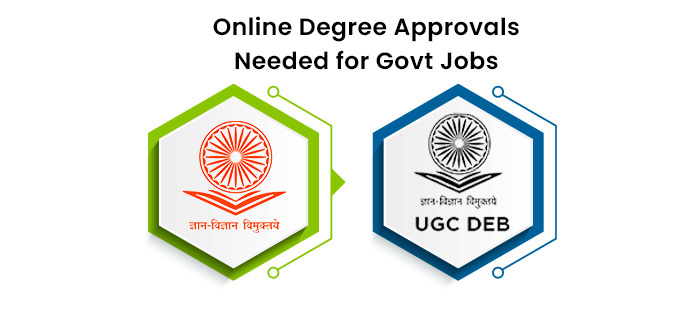
The university offering the degree must be recognized by the University Grants Commission (UGC). |
|
UGC-DEB Entitlement |
For an online or distance programme, the university and the specific programme must have the required UGC-DEB entitlement/recognition for the relevant academic session. |
|
Government Recruitment |
A properly recognized online/distance degree can be used for eligibility in central and state government recruitment, subject to the specific examination's eligibility rules. |
|
If Approval Is Missing |
A degree from a university/programme that does not have the required UGC/DEB recognition may not be accepted for government recruitment, even if the institution otherwise appears legitimate. |
|
Other Accreditations |
Students can also consider universities with additional recognitions or quality indicators such as NAAC accreditation, NIRF ranking, and relevant AICTE approval/recognition, where applicable. |
|
What Students Should Check |
Before enrolling, verify the university, programme, mode of delivery, and UGC-DEB entitlement for the specific academic session. |
What Approval Actually Needs To Be In Place
|
Approval |
Why It Matters |
|
UGC Recognition |
Confirms the university itself is legally authorized to award degrees |
|
UGC-DEB Entitlement |
Confirms the university is specifically approved to offer that program in online/distance mode |
|
AICTE, NAAC, NIRF (optional) |
Additional accreditations that strengthen a degree's credibility, though not mandatory for government job eligibility |
According to the government's own notification, degrees, diplomas, and certificates awarded through open and distance learning by universities established under an Act of Parliament or State Legislature, or institutions deemed universities under the UGC Act, are automatically recognized for central government employment, provided they carry UGC approval.
How Government Recruitment Actually Treats Your Degree
Most government jobs, whether central or state, work on an entrance exam model. There's a minimum educational qualification you need to even sit for the exam, and once you clear that bar, your degree's mode of study, regular, online, or distance, stops mattering. Recruiters are evaluating your exam performance and interview, not re-litigating how you attended your classes. The one exception worth noting: a small number of state government roles skip the entrance exam model entirely, but even in these cases, degrees equivalent to regular ones, including valid online and distance degrees, are accepted.
This equivalence also works in your favor for civil services and other competitive exams. Since these typically only require a bachelor's degree in any discipline from a recognized institution, an online or distance degree clears that bar just as well as a regular one and arguably gives you a practical advantage, since the flexible schedule leaves more room to prepare for the exam itself while you're still studying.
Courses The Government Doesn't Accept In Online Mode
This is the part most people miss it's not about your degree's mode of study being invalid in general; it's that certain technical and practice-heavy fields simply aren't allowed to be offered online in the first place, so any degree in these fields, regardless of where you got it, won't hold up for government recruitment purposes.
|
Field |
Why It's Excluded |
|
Engineering |
Requires hands-on lab and technical training |
|
Medicine & Dental |
Requires clinical, supervised practice |
|
Pharmacy |
Requires practical lab and dispensing training |
|
Nursing |
Requires supervised clinical practice |
|
Architecture |
Requires studio-based, hands-on design training |
|
Physiotherapy |
Requires supervised clinical practice |
|
Agriculture |
Requires field and practical training |
|
Culinary Studies |
Requires hands-on kitchen training |
|
Hotel Management |
Requires practical, on-site operational training |
Minimum Eligibility For Popular Government Jobs
To get a job in the government sector, whether state or central, you have to appear for an entrance examination. There might be several levels of examination, including an interview as well. However, to be able to appear for these entrance examinations, there is a certain minimum eligibility criterion. Only those who fulfill these eligibility criteria will be allowed to give the entrance examination.
Given below are the eligibility criteria for some of the top government jobs in India:
|
Minimum Educational Qualification of Top Govt Jobs in India | |
|
Government Job |
Minimum Educational Eligibility |
|
The candidate must have a bachelor’s degree in any discipline or equivalent (online/distance degree) from a recognised higher education institution. Students in their final year of graduation are also eligible to give the entrance examination. |
|
NDA & Defence Services |
The candidate must have passed their 10+2 or equivalent from a recognised board of examination with Physics and Mathematics as compulsory subjects. |
|
ISRO/DRDO Scientists & Engineers |
The candidate must have a bachelor’s degree in the Science stream or an equivalent technical or professional degree/diploma in Engineering/Computer Science/Technology. |
|
RBI Grade B (DR) - (General) |
The candidate must have a bachelor’s degree in any discipline or equivalent technical or professional qualification (online/distance degree) from a recognised higher education institution with at least 60% aggregate marks (50% for SC/ST/PWD). |
|
Indian Forest Services |
The candidates must have a bachelor’s degree or equivalent in any one of these subjects: animal husbandry and veterinary science, Botany, Chemistry, Geology, Mathematics, Physics, Statistics, and Zoology. The candidate is also eligible with a bachelor’s degree or equivalent in agriculture, Forestry or engineering from a recognised higher education institution. |
|
PSU Jobs |
There are several different types of departments and specializations in PSUs; therefore, the eligibility depends upon the department. You must have a bachelor’s degree or equivalent in a subject that is relevant to the job you have applied for and from a recognized higher education institution. |
|
Assistant Professors/Lecturers in Govt. Colleges |
The candidate must have a Master’s degree or equivalent (online/distance degree) from a recognised higher education institution in the subject you wish to specialise in. |
|
SSC CGL |
The candidate must have a bachelor’s degree or equivalent in any discipline from a recognised higher education institution. This is the basic and minimum eligibility criteria, but since there are numerous types of jobs, there might be slight differences in the eligibility criteria. |
Which Online Degree Actually Improves Your Odds?
Since most government roles accept any discipline, the "best" online degree for government jobs isn't about unlocking eligibility, it's about which subjects overlap naturally with the syllabus of the exams you're targeting.
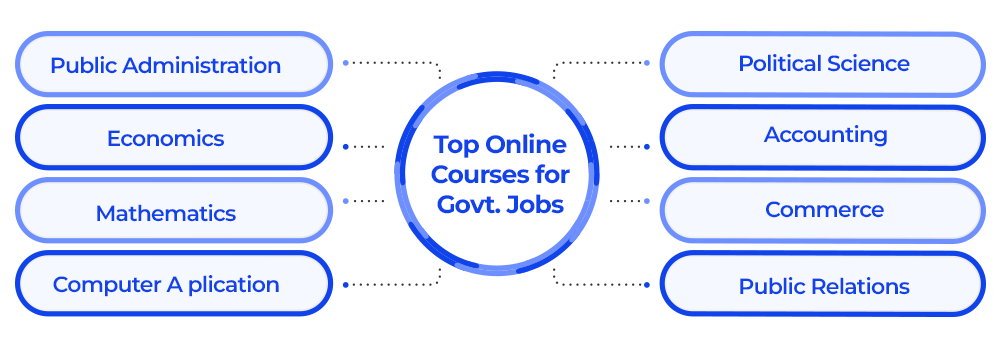
Degrees in public administration, political science, economics, accounting, mathematics, commerce, computer applications, and public relations tend to give candidates a head start, since these subjects overlap directly with common exam syllabi for civil services and banking-sector recruitment.
Common Myths About Online Degrees And Government Jobs
A lot of the hesitation around this topic comes from a few myths that keep circulating, even though they don't hold up against the actual rules.
- Myth: An online degree is treated as "second-class" during recruitment. In reality, once your degree is from a UGC and UGC-DEB approved university, recruiters have no basis to treat it differently from a regular degree. The recruitment process evaluates your exam score and interview performance, not your mode of study.
- Myth: You need a "recognized" degree, and online degrees don't count as recognized. This confuses general recognition with programme-specific entitlement. Recognition applies to the university; entitlement applies to the specific online or distance program. As long as both boxes are checked, the degree counts as recognized in every sense that matters for government eligibility.
- Myth: Only degrees from IGNOU or similar government-run universities are valid online. Plenty of private, UGC-DEB entitled universities offer equally valid online degrees. What matters is the entitlement status of the specific program, not whether the university is government-run or private.
- Myth: Online degrees can't be used for jobs that require a specific percentage or grade. They can, the percentage or grade you scored in an online or distance program is treated the same as one earned through regular mode when recruiters check minimum marks criteria.
Summing Up!
An online or distance degree is just as valid as a regular one for government job eligibility, as long as it comes from a UGC and UGC-DEB approved university and isn't in one of the excluded technical fields. What actually determines your shot at the job from there is your exam performance, not how you attended your classes. Not sure if your shortlisted university is properly UGC-DEB entitled? College Vidya's free counseling can help you verify this before you enroll.



![What to Do After B.Des? [Career Options After B.Des]](https://cdn.collegevidya.com/blog/Career_Options_After_Bachelor_Of_Design.webp)