


The IT industry is a rapidly developing industry in the world today. Startups and multinationals alike, all organizations have become extremely reliant on technology to operate their activities. Owing to this, the need for skilled IT professionals is ever increasing annually.
Nonetheless, acquiring an IT job does not simply depend on the technology. In the recruitment, the candidates are also required to pass through the interviews, where the recruiters test their technical knowledge, problem-solving skills, communication skills, and conceptualization. Being interview-ready can enhance your chances of being selected.
Being a fresher about to take your first job in the IT field or a professional who has a lot of experience but wants a better job, knowing some of the questions that are usually asked in the interview process will make you feel more comfortable in the interview room.
This blog will talk about the best IT interview questions and sample answers and tips to enable you to do better in your next interview.
What is Information Technology (IT)?
Information technology, also referred to as IT, is the utilization of computers, software, networks, and digital systems to store, process, manage, and exchange information. IT is an important aspect of current business since it assists the organizations to conduct their operations efficiently and communicate effectively.
There are numerous sub-disciplines under IT like software development, networking, cybersecurity, database management, and so on. IT professionals are tasked with the role of designing, maintaining, and enhancing technology systems utilized by organizations.
The primary aim of IT is to have the technology systems functioning effectively and safely such that the businesses can accomplish their functions without any hitches. IT professionals are involved in numerous significant activities, whether it is maintaining networks, creating applications, or managing databases of the company.
It has been a core component of nearly all industries, such as healthcare, education, finance, e-commerce, and entertainment. This increased significance has made the need to hire talented individuals in the IT sector continue to rise in the world.
Importance of IT Professionals in Modern Organizations
IT professionals are very crucial in the process of assisting organizations to run efficiently. They make sure that computer systems, networks, and software applications are functioning well so that employees can accomplish their duties without technical failures.
IT professionals have one of the primary functions of maintaining and enhancing the digital infrastructure in the organization. They set up software, administer networks, troubleshoot systems issues, and prevent cyber threats to data.
IT professionals also play another critical role: facilitating innovation in organizations. As technologies like artificial intelligence, cloud computing, and data analytics improve, businesses turn to the services of IT experts who can apply these technologies and optimize their business processes.
Along with this, IT professionals also assist organizations in securing data privacy and security. With the rise in cyber threats, companies require professionals who can secure confidential data and maintain systems to be safe.
Due to these duties, companies seek candidates that possess more than just good technical knowledge; they also require good problem-solving skills and the capacity to act under pressure.
What are the key skills needed for IT jobs?
In order to be successful in the IT industry, it is important that the candidates acquire both the technical and soft skills. During the interviews, recruiters tend to test such skills to see if the candidate is fit to the position.
These are a few basic questions you may face if you are planning to appear for the HR job:
- Technical Knowledge: Technical knowledge is one of the most important requirements in IT jobs. Depending on the area of specialization, candidates ought to possess clear knowledge of programming languages, operating systems, databases, and networking concepts. Software developers, as an example, can require the knowledge of some programming languages, e.g., Java, Python, or C++, etc.
- Problem-Solving Skills: IT professionals are expected to deal with technical issues, which involve logical thinking and analytical skills. Recruiters seek people who are capable of making the right solutions to problems that arise promptly.
- Communication Skills: IT jobs are technical but communication skills are also very essential. IT professionals should be in a position to communicate technical problems to team members, managers, or clients in an understandable manner.
- Teamwork: Most IT projects involve the cooperation of various teams, including developers, testers, designers, and project managers. Hence, team-working competence is a valuable skill.
- Flexibility & Lifelong Learning: Technology is in a state of constant flux. To be up to date in the industry, IT professionals should be ready to learn new tools, programming languages, and technologies.
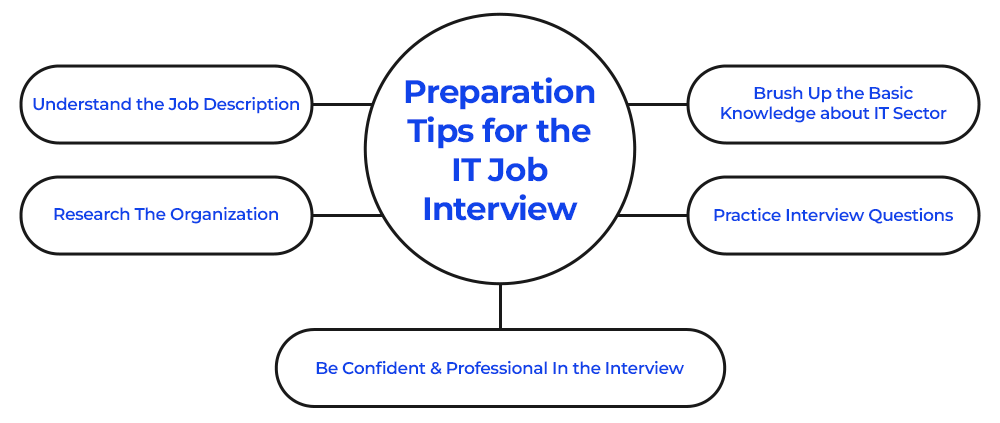
Types of Questions Asked in the Interview
IT interviews typically have various kinds of questions that are aimed at testing various dimensions of the abilities of a candidate.
- Technical Questions- Technical questions are used to examine the candidate's understanding of programming languages, software development, networking, databases, or any other technical aspect of the job.
- Behavioral Questions- These questions are aimed at the personality of the candidate, his or her capability to work in teams, and his/her response to work-related challenges.
- Situational Questions- Situational questions involve hypothetical situations in which the candidates are asked to describe how they would react to a certain situation.
- Problem-Solving Questions- During most IT interviews, the candidate may be required to solve a coding problem or a technical problem to test their problem-solving abilities.
These are a few basic questions you may face if you are planning to appear for the IT job:
|
Basic IT Interview Questions & Answers | |
|
What is Information Technology (IT)?
What is a computer network?
What is an operating system?
What are the main components of a computer?
What is hardware?
|
What is Software?
What is a database?
What is RAM?
What is the difference between RAM and ROM?
What is an IP address?
|
These are a few intermediate IT interview questions & answers you may face if you are planning to appear for the IT job:
|
Intermediate IT Interview Questions & Answers | |
|
What is Cloud Computing?
What are the types of cloud computing?
What is Cyber Security?
What is virtualization?
What is a firewall?
|
What is HTTP?
What is HTTPS?
What is a server?
What is a client-server model?
What is DNS?
|
These are a few software and development questions & answers you may face if you are planning to appear for the IT job:
|
Software and Development Questions & Answers | |
|
What is Programming?
What are some popular programming languages?
What is debugging?
What is an algorithm?
What is Source Code?
|
What is Version Control?
What is Git?
What is the Software Development Lifecycle (SDLC)?
What is an API?
What is open-source software?
|
These are a few advanced IT interview questions & answers you may face if you are planning to appear for the IT job:
|
Advanced IT Interview Questions & Answers | |
|
What is DevOps?
What is Containerization?
What is Docker?
What is microservices architecture?
What is machine learning?
|
What is Big Data?
What is Data Encryption?
What is Load Balancing?
What is blockchain?
What is edge computing?
|
These are a few behavioral IT interview questions & answers you may face if you are planning to appear for the IT job:
|
Behavioral IT Interview Questions & Answers | |
|
Why do you want to work in the IT field?
How do you handle technical challenges?
How do you stay updated with new technologies?
How do you manage tight deadlines?
Describe a Difficult Technical Problem you Solved.
How do you deal with failure in a project?
|
What motivates you in your work?
Where do you see yourself in 5 years?
How do you ensure the quality of your work?
What are your strengths as an IT professional?
What is your biggest weakness?
How do you work in a team environment?
|
What are the common mistakes candidates must avoid in interviews?
Most candidates commit few mistakes, which may influence their selection opportunities. By not making these errors, you can do better. One of the most frequent mistakes is failure to prepare adequately on technical questions. Even experienced professionals are supposed to revise major concepts prior to the interview.
The other error is providing vague or too complex answers. Attempt to explain your responses in a concise and orderly manner. Other candidates also fail to research the company,
such that they may seem not interested in the position. Lastly, absence of confidence and ineffective communication may also affect the performance of the interview. Interview questions can be practised to enhance confidence.
What are the top careers in the IT field?
The IT industry has numerous career opportunities for people possessing various technical skills & interests.
Examples of popular IT job roles are:
- Software Developer
- Web Developer
- Data Analyst
- Cybersecurity Specialist
- Cloud Engineer
- Network Engineer
- IT Support Specialist
- DevOps Engineer
Such functions are found in numerous sectors of finance, healthcare, education, e-commerce, and entertainment. You can also go for the bachelor's and master's degrees, such as an Online BBA in IT and Systems Management, or Online MBA in IT Management to sharpen your skills and get your UG or PG degree done, and that too without affecting your professional working lifestyle.
Conclusion
An IT interview needs not only knowledge in the technical field but also communication skills. Recruiters usually consider the knowledge of technical concepts, problem-solving skills, teamwork skills, and experience in their work when assessing candidates. Candidates can enhance their confidence and performance in the interview process by revising frequently asked interview questions, training on coding problems, and learning more about the company prior to the interview.
The IT business is also expanding at a high rate, and this is offering numerous opportunities to the professionals. The career in information technology can be a successful and rewarding one, and with the help of appropriate preparation and constant learning, the candidates are able to develop their successful careers.