



Quick answer: College Vidya helps you not only find online universities but also compare them on the basis of different factors alongside recognition, career support, and program value. Find online universities with flexible payment plans by comparing total fees, EMI options, scholarships, and payment schedules.
An online degree can look affordable at first glance—until you realize that universities don't always present their fees in the same way. One may advertise a semester fee, another may show the total program cost, while another may lead with a seemingly low monthly EMI.
1.28 lakh jobs gone in 6 months. Yours could be next.
So the real question isn't simply “Which online degree is cheapest?” It's “What will this degree actually cost me, and can I manage the payments without compromising on quality or career value?”
This is where College Vidya steps in; they help students and working professionals compare online degree programs based on total fees, EMI and payment options, scholarships, specializations, recognition, career support, and other important factors—so you can compare the complete picture before committing your money.
What Payment Options Are Available for Online Degrees?
It varies by university, program, and admission cycle, but here's what tends to show up:
- Semester-wise payments
- Annual payment plans
- EMI facilities
- Zero-cost EMI on select plans
- Scholarships or fee concessions
- Early-payment discounts
- Education financing tie-ups
The catch: just because one course offers EMI doesn't mean the next one does, even at the same university. Always confirm the actual payment terms for your specific program before you commit.
How Does College Vidya Help You Compare Fees and Payment Options?
Here's something that trips people up constantly: universities don't quote fees the same way. One shows you the per-semester amount, another gives you the full program cost upfront, and a third leads with the EMI figure. Look at just one of those numbers, and you'll walk away with the wrong picture entirely.
College Vidya puts these side by side so you can actually compare like-for-like—total fees, semester or annual breakdowns, EMI options, scholarships, eligibility, specializations, duration, recognition, career support, and student support - all in one place. Plus counselling, if you want a second opinion on what fits your budget and goals. The point is simple: you get to compare before you commit your money, not after.
What Should You Check Before Choosing a Payment Plan?
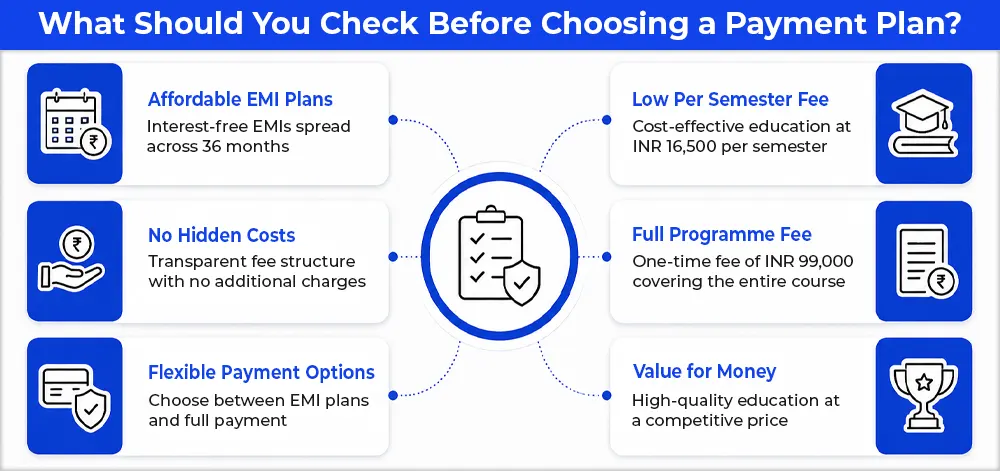
1. Total Program Fee
Don't anchor on the monthly or semester number. Add it all up and know exactly what the full degree costs.
2. EMI Amount and Tenure
If EMI's on the table, look closely at the monthly installment, the repayment period, any interest, processing fees, and the fine print. A smaller monthly number doesn't automatically mean you're paying less overall - sometimes it means you're paying it for longer.
3. Scholarship Eligibility
Some universities knock off fees based on academic performance, category, or professional background. Worth checking if you qualify - and whether it applies to your specific program.
4. Additional Charges
Exam fees, registration charges, certification fees, application fees, admin costs - sometimes these sit inside your tuition, sometimes they show up separately later. Ask before you assume.
5. Refund and Cancellation Policy
Before any large payment or EMI commitment, know what happens if you need to withdraw. This matters more than people think until they actually need it.
6. Payment Schedule
Know exactly when each installment is due. A payment plan is only "flexible" if it actually lines up with your income and existing commitments - not just on paper.
Is the Cheapest Online Degree Always the Most Affordable?
Not always—and this is where a lot of people get it wrong.
A low sticker price looks great until you factor in everything else: total cost, payment flexibility, recognition, academic quality, and how much career support you're actually getting.
A slightly pricier program with manageable EMIs, solid support, and a specialization that's actually relevant to your career can easily be the better deal. This matters even more for working professionals, who need the degree to justify itself both financially and career-wise.
College Vidya Insight: Affordability Is More Than a Low Fee
The cheapest degree on paper isn't automatically the most affordable one in practice. College Vidya's University Report Card 2026 looks at this more holistically, scoring online universities across six dimensions:
The framework is built on insights from 410,000+ student reviews (Source: College Vidya Survey) collected on the platform. Here's the distinction worth remembering: affordability answers "Can I pay for this?" Value answers "What am I actually getting for what I pay?" You need both answers, not just one.
What Can You Compare on College Vidya?
You're not just comparing prices here—you're comparing what each price actually buys you.
|
What to compare |
Why it matters |
|
Total program fee |
Shows the real financial commitment, not just the headline |
|
EMI/payment options |
Helps you plan around your actual income |
|
Scholarships |
Can meaningfully cut the cost if you qualify |
|
University recognition |
Confirms the degree's legitimacy |
|
Specializations |
Matches the course to where your career is headed |
|
Eligibility |
Confirms whether you can even apply |
|
Course duration |
Sets expectations on time commitment |
|
Career support |
Matters if advancement is the whole point |
|
Student support |
Crucial when you're studying remotely |
|
Student reviews |
Gives you a read on the actual learner experience |
College Vidya allows learners to consider these factors together rather than comparing tuition fees alone.
Why Use College Vidya to Compare Online Degree Options?
You could visit ten university sites, cross-reference ten different fee structures, and hope you didn't miss anything. Or you could do it in one place: explore programs, compare fees and payment options side by side, check credentials, look into scholarships, read reviews, talk to a counsellor, and get help through admission—without juggling browser tabs.
Particularly useful if you're working full-time and don't have the bandwidth to chase this information down university by university. College Vidya brings these considerations together, including program information, fees, payment options, scholarships, student feedback, counselling, admission assistance, and career support.
Why Flexible Payment Options Matter for Working Professionals?
If you're working, affordability isn't just "can I pay the total fee?" - It's "Does the payment schedule actually work with my salary and expenses?"
That might mean preferring monthly EMIs over one large upfront payment, semester-wise fees over the full program cost at once, chasing scholarships to ease the load, or picking a specialization that actually moves your career forward. Comparing payment flexibility alongside career value tends to matter more than just hunting for the lowest price tag.
How Does College Vidya Help You From Search to Enrollment?
The process can be simplified into four steps:
- Explore: Find UG and PG programs based on your degree, specialization, and career interests.
- Compare: Weigh fees, EMI options, scholarships, recognition, specializations, career support, and student support against each other.
- Get Personalised Counselling: Get guidance on what actually fits your academic background, career goals, and budget.
- Enroll With Assistance: Once you've shortlisted a program, get help through the admission process and understand the relevant application requirements.
How to Choose an Online Degree That Fits Your Budget?
- Calculate the real cost: Go past the advertised monthly or semester fee to the full program cost.
- Compare the payment flexibility: Check EMI availability, payment schedules, scholarships, additional charges, and refund policies.
- Compare the value: Look at recognition, academic quality, specialization, learner experience, career support, and student services alongside cost.
A program that checks all three boxes is usually a smarter pick than the one that just has the lowest number on the homepage.