


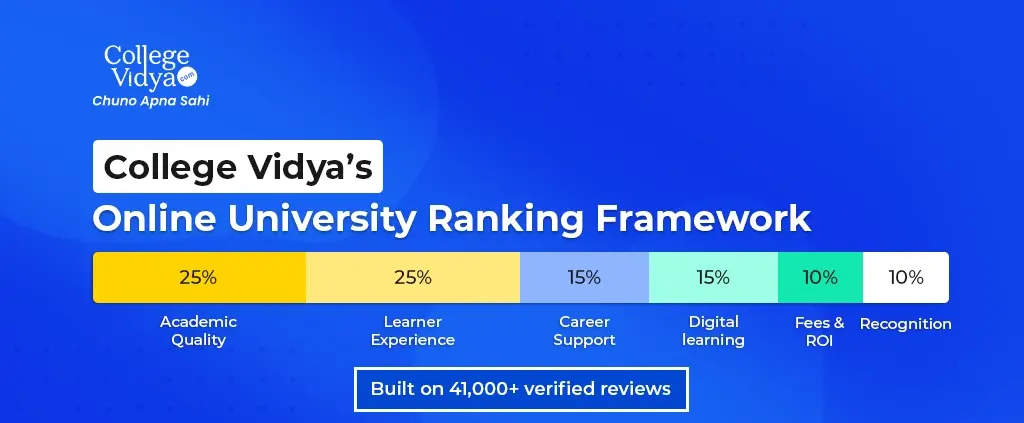
Quick answer: College Vidya ranks online universities in India on six pillars. Academic Quality is 25%. Learner Experience is 25%. Career Support is 15%. Digital Learning Experience is 15%. Affordability & ROI is 10%. Recognition & Trust is 10%. These pillars come from over 410,000 real learner reviews. Each university gets a score out of 100 in the College Vidya Online University Ranking 2026. Half the score is based on what learners say, not what universities claim.
Every year, lakhs of working professionals in India start looking for an online degree and run into the same problem. Every university calls itself the best, every website shows a different ranking, and none of them explain how they reached the number. College Vidya is a comparison platform rather than a course seller, so it has no reason to favour one university over another. This page opens up the full method behind the College Vidya Online University Ranking 2026: what each of the six evaluation pillars measures, why each one carries the weight it does, how twenty UGC-DEB approved universities actually scored, and what the framework does not measure. The aim is simple. By the end, you should be able to judge the ranking for yourself instead of taking it on trust.
Why Did College Vidya Build Its Own Ranking Framework?
Learners come to College Vidya with one question: which online university is right for me? Most rankings in India were built for regular campus colleges. They look at research papers, teacher-student ratio, campus buildings, and placement drives. None of this helps an online learner.
None of it tells a working professional in Faridabad if the LMS will open on a normal phone at 11 PM. Or if the support team will reply before the exam date. Or if the UGC-DEB approval covers their exact course this year. So College Vidya built a framework for the questions online learners actually ask.
Over the years, the platform collected more than 410,000 verified reviews on its Student Review Portal. These are not marketing testimonials. They are real feedback from learners who studied or are still studying. When College Vidya studied these reviews together, one thing became clear. Learners were happy or unhappy for six main reasons, again and again.
Those six reasons became the College Vidya Evaluation Pillars. This framework was not copied from any other ranking. It came from what learners said.
The six College Vidya Evaluation Pillars to Rank Online Universities
| S.No. |
College Vidya Evaluation Pillar |
Weightage |
Max Score |
What it tells you |
|
1 |
Academic Quality |
25% |
25 points |
Is the teaching and syllabus good? |
|
2 |
Learner’s Experience |
25% |
25 points |
Are current learners happy? |
|
3 |
Career Support |
15% |
15 points |
Will the university help your career? |
|
4 |
Digital Learning Experience |
15% |
15 points |
Does the online platform work well? |
|
5 |
Affordability & ROI |
10% |
10 points |
Is the fee worth what you get? |
|
6 |
Recognition & Trust |
10% |
10 points |
Will the degree be accepted? |
Total: 100 points.
Three things about this framework are different from other rankings:
- College Vidya gives learners feedback the same weight as academics: both are 25%. A university can have a great syllabus on paper but still give learners a bad experience. Most rankings never catch this gap. This one is built to catch it.
- College Vidya gives 30% to delivery: Career Support and Digital Learning Experiences together are worth more than any single pillar. In online education, how the course reaches you matters almost as much as what is taught.
- College Vidya keeps affordability and recognition at only 10% each: This is on purpose. If fees had a high weight, the cheapest university would top the list even with poor teaching. If brand had a high weight, the most famous name would win without doing anything. Both are capped, so neither can decide the ranking alone.
Evaluation Pillar 1: Academic Quality (25%)
What College Vidya Checks for Academic Quality
- How up-to-date the syllabus is.
- Whether the syllabus aligns with industry needs today.
- Faculty qualifications.
- Whether regular campus faculty also teach online learners
- How exams and assignments are designed.
- How many specialisations are offered.
- Whether the online course follows the same academic rules as the campus course.
Why College Vidya gives it 25%: this is the base of everything. If the teaching is weak, nothing else can fix it. A good platform and fast support cannot save a bad syllabus.
What the 2026 data shows: in the College Vidya University Online University Ranking 2026, Academic Quality scores go from 21.0 to 24.2 out of 25. The gap is only 3.2 points. This is the closest of all six pillars.
What this means for you: all the universities in this list already teach well. Academic Quality will rarely help you pick between two of them. Use it to remove weak options. Then decide using the pillars where the gap is bigger.
Evaluation Pillar 2: Learner Experience (25%)
What College Vidya checks for Learner Experience
- How good the support is after you take admission
- How fast queries and complaints get solved
- Whether faculty are available outside class hours
- How smooth the admin work is: fees, exams, results, and documents
- How many learners actually finish the course
- Overall satisfaction in verified student reviews
Why College Vidya gives it 25%: this is where online education fails most often. And this is what no brochure will ever tell you. No university will say that its support team takes eleven days to reply. But 410,000 verified student reviews will show it. This is the one thing College Vidya can measure that a normal ranking cannot.
What the 2026 data shows: Learner Experience scores go from 20.6 to 23.5 out of 25.
What this means for you: this pillar tells you how your next two years will actually feel. If you are working and will need help with exam dates, documents, or fee issues, give this pillar more importance than the overall rank.
Evaluation Pillar 3: Career Support (15%)
What College Vidya checks for Career Support
- Career services made for online learners, not just the campus placement cell
- Company tie-ups and recruiter connections
- Resume building and interview preparation help
- Internship and live project opportunities
- How active the alumni network is
- Career growth reported by learners after finishing the course
Why College Vidya gives it 15% and not more: most online learners are already working. The degree helps them get a promotion or change their field. It is not their first job hunt. So the university helps, but your own work experience does most of the job. Giving this 25% would promise more than any online course can deliver.
What the 2026 data shows: Career support scores go from 12.0 to 14.3 out of 15. The gap here is bigger than the academic pillars. The top university is at 95% of the maximum. The lowest is at 80%.
One thing College Vidya wants to say clearly: no online university gives a placement guarantee. If anyone promises you a guaranteed job, treat it as a red flag, not a benefit. A good Career Support score only means the support system exists and you can use it. It never means a job is promised.
Evaluation Pillar 4: Digital Learning Experience (15%)
What College Vidya checks for the Digital Learning Experience
- How stable the LMS is
- How well it works on a mobile phone
- Video lecture quality
- How often live classes are held
- Whether live class recordings are saved for later
- Whether content can be downloaded for offline study
- How much mobile data the platform uses
- Discussion forums and learners interaction
- Practice tests and mock assessments
- Whether the platform stays up during exams
Why College Vidya gives it 15%: in an online degree, the platform is your campus. A bad LMS does not just annoy learners. It directly stops them from finishing the course. It sits below the academic pillars because platforms can be fixed quickly, while teaching culture takes years to change.
What the 2026 data shows: Digital Learning Experience scores go from 11.9 to 14.6 out of 15. This is the biggest gap of all six pillars, around 18% of the pillar range.
What this means for you: this is the pillar that separates universities the most in 2026. Universities that built their platform for online learning from day one are clearly ahead of those that just uploaded campus recordings.It is also the easiest pillar to check yourself. Ask for a demo login. Open the LMS on your own phone, on your own network, at the time you actually plan to study. Ten minutes of this will tell you more than any score.
Evaluation Pillar 5: Affordability & ROI (10%)
What College Vidya checks for Affordability and ROI
- Total course cost, including exam fee, registration fee, and re-attempt charges
- Whether the fee shown is the fee you actually pay
- EMI and scholarship options
- Cost compared to similar universities
- Value you get for your money across the other five pillars
Why College Vidya keeps it at 10%: if fees had a bigger weight, the cheapest universities would top the list even with poor teaching and no support. That would mislead Learners who can afford a better option.
What the 2026 data shows: Affordability scores go from 7.2 to 9.0 out of 10. And here the College Vidya data shows something very useful.
You are not choosing between a good and a bad university. You are choosing what you want to pay for. Either a strong brand name that recruiters recognise, or the same valid degree at a much lower fee.
Which one is right depends on you.
- If you need the degree only to meet a rule, like a government promotion, a PSU grade change, or eligibility for higher study, then you are paying for validity. A costly brand adds very little here.
- If you are changing your field, and recruiters will judge your CV without knowing your background, then the brand name does real work. Here the extra fee can be worth it.
Evaluation Pillar 6: Recognition & Trust (10%)
What College Vidya Checks for Recognition & Trust
- UGC-DEB approval for both the university and your exact course
- NAAC grade and accreditation cycle
- AICTE approval, where the course needs it
- The university's compliance record with regulators
Why College Vidya gives it only 10%. People get confused here, so let us say it directly. Recognition is an entry condition, not a scoring point.
Every university in the College Vidya Online University Ranking 2026 already has valid UGC-DEB approval. A university without it does not get a low score. It does not enter the ranking at all.
So the 10% only measures how much extra trust a university has above that basic level. Things like NAAC grade, how old and established the institution is, and how familiar the name is to employers.
What the 2026 data shows: Recognition & Trust scores go from 7.4 to 8.7 out of 10. This is the smallest gap in the framework. That makes sense, because every university here has already crossed the same approval line.
What every learner must check for themselves. UGC now requires Learners to create a DEB-ID linked to their ABC-ID at the time of admission. Before you pay any fee, go to deb.ugc.ac.in and check four things:
- The university has current approval for online mode
- Your exact course is on the approved list
- The approval covers your admission session
- Your subject is allowed online (UGC does not allow some practical subjects like medical and allied fields to be taught fully online)
No ranking can replace this check, including the College Vidya Online University Rankings. Approval is renewed every year, not given once forever.
How College Vidya Turns Six Scores into One Rating
Each pillar is scored within its own maximum. Then the six scores are added. College Vidya does not apply any curve or make any changes afterwards.
Example: the top-ranked university in the College Vidya Online University Rankings 2026
|
College Vidya Evaluation Pillar |
Score |
Maximum |
% of pillar |
|
Academic Quality |
24.2 |
25 |
96.8% |
|
Learner Experience |
23.5 |
25 |
94.0% |
|
Career Support |
13.8 |
15 |
92.0% |
|
Digital Learning Experience |
13.9 |
15 |
92.7% |
|
Affordability & ROI |
8.5 |
10 |
85.0% |
|
Recognition & Trust |
8.7 |
10 |
87.0% |
|
Overall |
92.6 |
100 |
92.6% |
One important point. The maximum is different for each pillar. So you cannot compare raw numbers across pillars. A Career Support score of 13.8 is actually better than an Academic Quality score of 21.0, even though the number is smaller. One is 92%. The other is 84%. Always convert to a percentage first.
The College Vidya 2026 Rankings: All 20 Universities
This is the complete list of universities ranked in the College Vidya University Report Card 2026. All twenty are UGC-DEB approved. Each one was scored on the same six pillars, using the same weights, so the comparison is fair across the board.
Before you read the table, one thing is worth knowing. The gap between the first and the last university is only 10.7 points. Every university here scores above 81 out of 100. So there is no bad option on this list. A university at rank 18 is not a weak university. It simply has a different mix of strengths.
|
Rank |
University |
Overall Score (/100) |
|
1 |
Alliance University (Alliance Online) |
92.6 |
|
2 |
DY Patil Online, Pune |
91.2 |
|
3 |
Amity University Online |
90.3 |
|
4 |
LPU Online |
90.0 |
|
5 |
UPES Online |
89.4 |
|
6 |
Amrita AHEAD Online |
88.8 |
|
7 |
NMIMS CDOE |
88.6 |
|
8 |
Chandigarh University Online |
88.1 |
|
9 |
GLA Online University |
86.7 |
|
10 |
Shoolini University (SCDOE) |
86.0 |
|
11 |
Vivekananda Global University Online |
85.8 |
|
12 |
Sharda University Online |
85.7 |
|
13 |
Uttaranchal University Online |
85.0 |
|
14 |
Manipal University Jaipur (MUJ Online) |
84.6 |
|
15 |
D. Y. Patil University, Navi Mumbai (DYPU Online) |
84.1 |
|
16 |
Christ University Online |
83.9 |
|
17 |
Sikkim Manipal University (SMU Online) |
83.7 |
|
18 |
Parul University Online |
83.3 |
|
19 |
Kurukshetra University Online |
82.5 |
|
20 |
Andhra University Online |
81.9 |
What the College Vidya 2026 data tells us
When you read all twenty scorecards together, four things stand out. These are more useful than the rank number itself.
- All twenty universities are within 10.7 points: scores run from 92.6 down to 81.9. Every university in the online university ranking scores above 81%. So there is no bad choice in this list. A university at rank 18 is not a mistake. It simply offers a different mix of strengths.
- The gap between nearby ranks is very small: Some universities are separated by less than one point. So rank 6 is not clearly better than rank 9. In the College Vidya framework, the rank is a summary. It is not a final verdict.
- Digital Learning Experience: This separates universities the most, with an 18% gap. If you want one pillar to compare your shortlist on, use this one.
- Two clear types of university appear: one group is strong in Career Support and digital learning. These are delivery-focused universities with big industry links and well-built platforms. The other group is strong in affordability and recognition. These are older public and legacy institutions offering trusted degrees at low cost, with lighter career support.
Neither type is better. They suit different Learners. This is exactly why College Vidya scores them separately instead of mixing everything into one brand score.
How to use the College Vidya Evaluation Pillars to shortlist
The rank column is the least useful part of any ranking table. Here is a better way.
Step 1. Use recognition & trust as a filter, then stop using it. Check UGC-DEB approval yourself on deb.ugc.ac.in for your exact course and session. Once every option clears this, the pillar has done its job.
Step 2. Find your main constraint. One of these usually decides everything:
- Tight budget: give weight to affordability & ROI, then academic quality
- Working professional with little time: give weight to digital learning experience and learner experience
- Changing your career field: give weight to career support and recognition & trust
- Studying only to meet an eligibility rule: give weight to affordability, because brand adds little here
- Need a specific subject: give weight to academic quality and check specializations directly
Step 3. Compare percentages, not overall scores. Two universities may be only 0.4 points apart overall but six percentage points apart on the pillar you care about.
Step 4. Check the top two pillars yourself. Ask for an LMS demo. Watch one full recorded lecture, not a short sample. Send the support team a real question and see how long they take. Talk to a current Learner, not someone who passed out three years ago.
Step 5. Calculate the total cost, not the advertised fee. Add exam fees, registration fees, re-attempt charges, and EMI charges. The fee shown on the website is usually not the full amount.
What the College Vidya framework does not measure
Being clear about limits is as important as showing strengths. College Vidya does not measure:
- Salary outcomes. Reliable salary data for Indian online degrees does not exist at scale. Any ranking showing exact salary growth numbers is guessing. College Vidya makes no salary claims.
- Individual faculty. Scores are for the institution, not for your specific teacher.
- Course-level differences. A university's online MBA and online BCA may not be equally good. Scores are university-level.
- City-wise brand strength. A name that is strong in Mumbai finance may be weaker in Bengaluru tech.
- Future performance. Scores reflect the review period. Approvals, faculty, and platforms all change.
One more honest limitation. Review-based pillars only reflect Learners who chose to write a review. That is not a perfect sample of everyone enrolled.