

Quick Answer: Yes, you can do a PhD directly after a bachelor's degree in India. You need a 4-year undergraduate degree with a minimum of 75% marks, which makes you eligible for the UGC-NET exam. Once you clear NET, you can take direct admission into a PhD program, skipping the master's degree entirely. This is a recent UGC policy change, and it applies regardless of your undergraduate specialization, so you can even switch subjects for your PhD. Reserved category candidates (SC, ST, OBC non-creamy layer, PwD, EWS) get a 5% relaxation in the marks requirement. The program typically takes 4-5 years to complete, covering coursework and thesis research. Strong academic records, research experience, and a well-written statement of purpose improve your chances, even though they aren't always mandatory. If you're a working professional looking to grow into leadership roles with flexible, self-paced learning, an Online DBA is worth considering. It requires only 55% marks in your bachelor's, 3-5 years of work experience, and no entrance exam, making it accessible even if you don't meet the direct PhD criteria.
Thinking about a PhD but don't want to spend two more years on a master's first? Most students still go the long way: bachelor's, then master's, then PhD. But that's changing now. UGC updated the NET eligibility rules, and if you have a 4-year bachelor's degree with 75% marks, you can qualify for NET directly. That means you can skip the master's degree entirely and go straight into a PhD. Reserved category candidates get a 5% relaxation in marks too.
This path works best if you already know you want a research career. It saves you years and gets you into real research work much sooner. But it's not the only option. If you don't meet the criteria, or you're a working professional looking for leadership growth instead of pure research, an Online DBA is worth considering too. In this article, we'll cover who each path suits, the benefits, and the challenges you should expect along the way.
Is it Possible to do a PhD after a bachelor's degree?
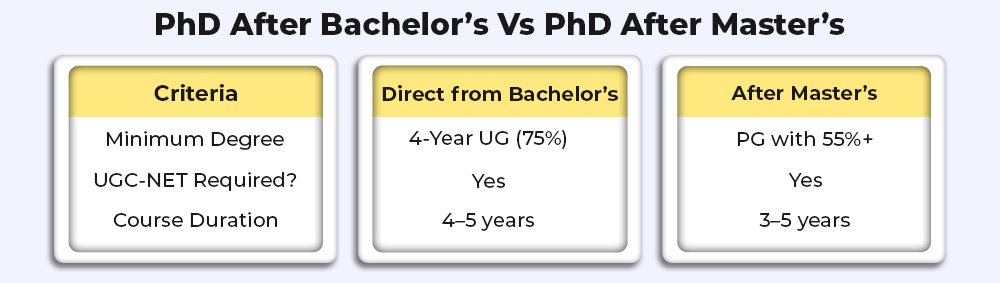
Yes, you can pursue a PhD after a bachelor’s degree, but you should have a 4-year degree with a minimum of 75 percent marks. Fulfilling these eligibility criteria makes you eligible for the UGC-NET exam, and once you pass the entrance exam, you can take admission to a PhD program. Yes, it is now possible to pursue a PhD after completing your bachelor's degree. In India, the regulations have recently been modified. If you have a 4-year bachelor's degree with a minimum of 75% marks (or equivalent marks), you are eligible to apply for a PhD without completing a master's degree first.
The University Grants Commission (UGC) has stated that students with good academic performance can also appear for the National Eligibility Test (NET) immediately after their bachelor's. This choice is not unique to India alone. Numerous universities in the U.S. and other nations also welcome students to pursue PhD courses after their undergraduate level. However, to be shortlisted, you need good grades, strong recommendation letters, and a well-written statement of purpose.
What are the eligibility criteria for a PhD after a bachelor's?
Fulfilling the below-mentioned criteria is necessary if you want to apply for a PhD after a bachelor’s:
|
Criteria |
Details |
|
Educational Qualifications |
|
|
Research Experience |
|
|
Entrance Examination |
|
|
Relaxation for Reserved Categories |
5% relaxation in marks for SC, ST, OBC (non-creamy layer), PwD, and EWS categories. |
|
Other Requirements |
|
Fulfilling these eligibility criteria will help you get admission to a PhD program, too, without hassle.
But what about someone who won't be able to fulfill these eligibility criteria? Do not worry; there is another alternative available to you, and that alternative is an online DBA. It is also a doctorate program that requires no entrance exam, and if you only need 55 percent marks in your bachelor’s, you will be able to apply to an online DBA program. Along with this, you also need a working experience of 3-5 years to apply to the DBA program.
|
Popular Among Working Professionals | |
What is the duration of the PhD program after having a bachelor's degree?
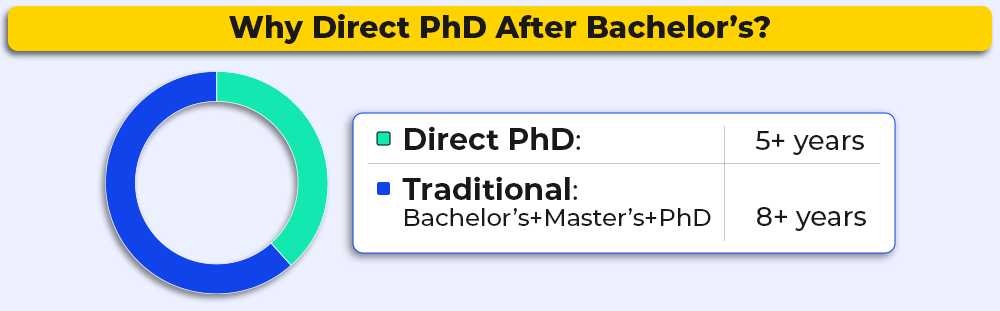
The duration of the PhD directly after a bachelor’s degree stays the same, which is 4-5 years, but if you are someone who wants to complete your doctoral degree in less time, then you must opt for an Online DBA program; the duration of the online DBA is 3-5 years. Moreover, it is equivalent to a PhD program. Moreover, by opting for an Online DBA, you can access top-level options such as CEO, CXO, etc.
Why You Need To Skip a Master's for a PhD After a Bachelor’s?
Pursuing a PhD immediately after your bachelor's degree has numerous benefits. Here are some of the significant advantages:
- Saves Time: You don't have to waste additional years pursuing a master's degree. You get to begin your research and academic pursuit early.
- Saves Money: You avoid the expense of a master's program, such as tuition fees and living costs. This reduces your overall education cost.
- Early Research Opportunities: You can start doing research projects immediately. An early start allows you to get published and establish academic networks.
- Quicker Career Advancement:
- Completing your PhD early allows you to secure better jobs earlier.
- It allows you to develop professionally quickly in both academic and corporate roles.
- Greater Subject Flexibility: You can select a PhD subject even if it is not related to your bachelor's degree. This provides an opportunity for you to study new and blended subjects. Pursuing a PhD after your bachelor's saves you time and money and puts you ahead in your career and research ambitions. People also pursue a PhD after a B.Tech
What is the application process for a PhD after a bachelor's degree?
To apply for a PhD after a bachelor's, you need to follow the simple steps given below:
|
Step |
Description |
|
Identify Research Interests |
Explore topics that interest you. Look at faculty profiles and research projects to find programs and supervisors that match your goals. |
|
Contact Potential Supervisors |
Email professors whose work matches your interests. Many universities require a supervisor’s approval before applying. |
|
Prepare Application Materials |
Collect these documents: Application form, research proposal, academic CV, statement of purpose or cover letter, transcripts, and recommendation letters. |
|
Check Eligibility Criteria |
Make sure you have the needed qualifications, usually a 75 percent mark in your 4-year bachelor's degree. Some programs may need research experience. |
|
Submit Application |
Apply through the university's portal. Follow all the instructions and deadlines. |
|
Entrance Exams (if needed) |
Some universities may ask for the GRE, GMAT, or other tests to check your academic readiness. |
|
Interviews and Evaluations |
If selected, attend an interview to discuss your research ideas and background with faculty or supervisors. |
|
Admission Decision |
The university will review your application and inform you if you're accepted, waitlisted, or rejected. |
|
Enrollment and Orientation |
If accepted, finish the admission process by paying fees and submitting documents. Attend orientation to get familiar with your program. |
Some Commonly Asked Questions about a PhD After a Bachelor's
1) How long does it take to do a PhD after a bachelor's degree?
A PhD after a bachelor's degree takes 5 to 7 years. There are some universities that provide direct admission, but you may need to take additional coursework first.
2) Can I pursue a PhD after a BA degree?
Yes, it is possible to do a PhD after a BA in certain fields and countries. But most students still pursue a master's first. If you wish to do it straight away, you will need good grades and perhaps some research experience.
3) Can you do a PhD after only a bachelor's?
Yes, you can apply for a PhD after your bachelor's if the university accepts direct entry. If you have 75 percent marks in your 4-year bachelor’s. However, most colleges prefer students who already have a master's.
4) Can I pursue a PhD after a BA?
Yes, you can, but it varies with field and university. Some courses may still require a master's degree before that, while some accept BA graduates straight away.
5) Can I apply for a PhD after a 3-year graduation?
No, you can not. According to the recent updates by the UGC, you can apply to a PhD program after a bachelor’s, but you should have 4 4-year bachelor’s with a 75 percent mark.
6) Can I do a PhD directly after a BSc in India?
Yes, in India, if you possess a 4-year BSc with a minimum of 75% marks, then you can directly apply for a PhD. You can also appear for the NET exam without doing a master's.
- If you don't hold 75%, you can attempt a 1-year master's and apply with 55% marks.
- The UGC now also states, "You are not required to publish a research paper prior to submitting the thesis.
7) Can I pursue a PhD after a BSc without an MSc?
Yes, in India, some schemes allow you to enroll for a PhD immediately after a BSc if you score well (75% and above). These programs take 4 to 5 years. You do not need an MSc for this.
8) Can I shift subjects for a PhD in India?
Yes, you can. You do not necessarily have to work with the same topic as your master's. PhD studies tend to place more emphasis on research interest, and changing fields is possible.
9) How long does a PhD take after a bachelor's?
It typically takes 5 to 7 years. This comprises 2–3 years of classes and a further 2–3 years for research and writing your thesis. In India, in case you have a 4-year degree and 75% marks, you can bypass a master's and directly pursue a PhD.
10) Is it possible to do a PhD in psychology after a BA?
Yes, it is possible to pursue a PhD in psychology after a BA.
Here's what you need to know:
- It requires a minimum of 4 years for a bachelor’s degree with 75 percent marks.
- Following completion, you'll need to pass licensing examinations to practice.
- Most students apply with a bachelor's degree, and a master's is not necessarily mandatory.
- If you hold a 4-year degree and 75% marks, you are eligible to apply directly as per UGC norms.
How Directly Pursuing a PhD After a Bachelor’s Improves Your Job Prospects?
You can check the table below to know the job prospects after a Ph.D. without having a master's:
|
Job Profile |
Average Salary (Monthly) |
Scope of Work |
Top Recruiters |
|
Research Scientist |
Rs. 80,000 – Rs. 120,000 |
Conducts experiments and analyses |
Google, IBM |
|
University Professor |
Rs. 70,000 – Rs. 150,000 |
Teaches and conducts research |
Harvard, Stanford |
|
Data Scientist |
Rs. 90,000 – Rs. 140,000 |
Analyzes data to inform decisions |
Amazon, Microsoft |
|
Clinical Researcher |
Rs. 75,000 – Rs. 130,000 |
Manages clinical trials |
Pfizer, Merck |
|
Policy Analyst |
Rs. 60,000 – Rs. 100,000 |
Analyzes policies and regulations |
Government agencies |
|
Software Engineer |
Rs. 80,000 – Rs. 130,000 |
Develops software solutions |
Facebook, Apple |
|
Biostatistician |
Rs. 70,000 – Rs. 120,000 |
Applies statistics to biological data |
Genentech, Novartis |
|
Environmental Scientist |
Rs. 65,000 – Rs. 110,000 |
Study environmental issues |
EPA, NGOs |
|
Management Consultant |
Rs. 85,000 – Rs. 140,000 |
Advises organizations on strategy |
McKinsey & Company |
|
Financial Analyst |
Rs. 70,000 – Rs. 120,000 |
Analyzes financial data |
Goldman Sachs |
|
Market Research Analyst |
Rs. 60,000 – Rs. 100,000 |
Study market conditions |
Nielsen |
|
Chemist |
Rs. 65,000 – Rs. 115,000 |
Conducts chemical research |
BASF |
|
Mechanical Engineer |
Rs. 75,000 – Rs. 125,000 |
Designs mechanical systems |
Boeing |
|
Psychologist |
Rs. 70,000 – Rs. 130,000 |
Study mental processes |
Hospitals |
|
Artificial Intelligence Engineer |
Rs. 95,000 – Rs. 150,000 |
Develops AI algorithms |
Tesla |
|
Cybersecurity Analyst |
Rs. 80,000 – Rs. 130,000 |
Protects systems from cyber threats |
Cisco |
|
Educational Administrator |
Rs. 70,000 – Rs. 120,000 |
Manages educational institutions |
Universities |
|
Pharmaceutical Scientist |
Rs. 80,000 – Rs. 140,000 |
Develops new drugs |
Johnson & Johnson |
|
Urban Planner |
Rs. 65,000 – Rs. 110,000 |
Plans for land use in urban areas |
City Planning Departments |
|
Social Worker |
Rs. 50,000 – Rs. 90,000 |
Supports individuals and communities |
Non-profits |
Can I do a PhD after a 3-year bachelor's?
Students can now pursue a PhD directly after completing their 4-year bachelor's degree; they cannot apply for a PhD with a 3-year bachelor’s degree. Because of the updated guidelines from the University Grants Commission (UGC). If a student has a four-year undergraduate degree with at least 75% marks, they are now eligible to take the National Eligibility Test (NET) and begin their PhD.
This is a big shift from the earlier rule, which required a master’s degree to qualify for NET. The new policy also allows students to choose any PhD subject, even if it's different from their undergraduate field, giving them more academic flexibility. For students from reserved categories, there is a 5% relaxation in the minimum marks required.
|
Top Specializations for PhD for Working Professionals in 2026 | |||
| - | - | - | |
What to Do If You Have a 3-Year Bachelor’s Degree and Still Want to Do a PhD Program?
If you are someone who is looking for options to pursue a doctorate program without having a master’s degree, then you can opt for an Online DBA program. It is a doctorate program that is equivalent to a PhD program. Moreover, there is no requirement for a 4-year bachelor’s degree to pursue an online DBA program. It only requires a bachelor’s degree with a minimum working experience of 3-5 years.
To know the universities offering an online DBA program, check the table below:
|
Universities |
Fees |
|
INR 6,00,000 | |
|
INR 8,14,000 | |
|
INR 8,12,500 | |
|
INR 8,14,000 | |
|
INR 5,50,000 | |
|
INR 7,50,000 | |
|
INR 7,00,000 |
Conclusion
Pursuing a PhD after a bachelor's degree is now possible in India, thanks to UGC’s new guidelines. If you have a 4-year undergraduate degree with 75% marks, you can directly apply for a PhD without completing a master’s. This saves both time and money, while allowing early exposure to research. You can also switch your field of study, offering more flexibility in choosing your research interest. For those who do not meet these criteria, an Online DBA is a great alternative. Overall, direct PhD pathways open up exciting career opportunities in research, academia, and industry.