

If you are planning to study a PhD in India, you might be wondering about direct PhD admission. Many students want to know if they can get admission into a PhD program without going through tough entrance exams or a long process. In this article, we will explain everything about PhD direct admission. We will cover eligibility, admission process, universities, fees, scholarships, career opportunities, and common questions.
What is PhD direct admission?
A PhD (doctor of philosophy) is the highest level of degree in any subject. It is a research-oriented program in which the students engage with a particular subject, develop a thesis, and add new information.
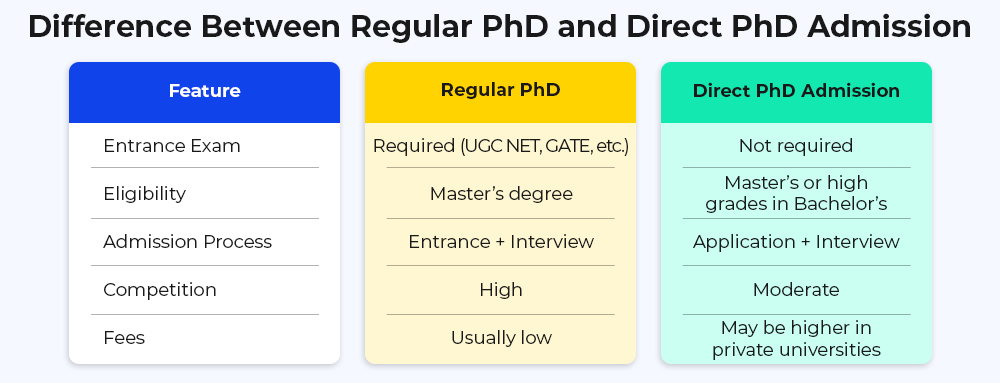
As a rule, students need to clear entrance exams such as UGC NET, CSIR NET, GATE, or university-level exams to obtain admission to a PhD. However, direct PhD admission is provided in some universities. In this, students obtain admission into a PhD course without an entrance exam. The admissions are most often based on past academic history, research proposals, work experience, or an interview.
Who Can Apply for PhD Direct Admission?
Eligibility requirements can vary from university to university, but the common requirements include:
- A master's degree in the relevant subject with a minimum of 55% marks (50% for reserved categories).
- Some universities also provide direct PhD entry after a bachelor's (such as B.Tech or MBBS) if the student's academic performance is extremely good.
- Some universities give direct admission to candidates with national-level fellowships (like UGC-JRF, CSIR-JRF).
- In many private universities, working professionals with experience can also apply for direct PhD admission.
Types of PhD Direct Admission
For many students in India, doing a PhD (Doctor of Philosophy) is a big dream. A PhD is the highest degree you can achieve in education. It helps you become an expert in your subject, contribute new knowledge, and build a career in research or teaching.Most students think that they must clear the NET exam (National Eligibility Test) to get admission into a PhD program. But the good news is that there are many other ways to get PhD admission without NET in India.In this article, we will explain how to do a PhD without NET, the eligibility, admission process, career opportunities, benefits, and more all in so that everyone can understand.
What is NET and Why Do Students Worry About It?
The NET (National Eligibility Test) is a national-level exam conducted by the UGC and CSIR in India. It is mainly for those who want to become assistant professors or get research fellowships. Many universities also accept NET qualifications for PhD admission.
But the exam is very competitive, and thousands of students cannot qualify. That is why many students feel stuck and think they cannot do a PhD.The truth is, you can still do a PhD without NET. There are many other pathways available, and universities also provide alternative admission options.
Eligibility for PhD Without NET
The basic requirements for applying to a PhD without NET are almost the same as regular PhD admission. They include:
- A master's degree (M.Sc., MA, M.Tech., MBA, M.Com., etc.) with at least 55% marks from a recognized university (50% for reserved category students).
- Some universities may ask for research experience or publications in journals.
- A few universities have their own entrance exam or interview process.
- Candidates with an M.Phil degree often do not need to take any entrance exam.
- Working professionals with relevant job experience are also eligible for part-time or sponsored PhD programs.
So, if you meet these requirements, you can apply for a PhD even if you have not cleared NET.
How to Get PhD Admission Without NET?
Now let us look at the main ways to get PhD admission without clearing the NET exam.
1. University-Level Entrance Exams
Many universities in India conduct their own PhD entrance exams. These are different from NET and usually test your subject knowledge, research ability, and logical thinking.
Some popular universities that have their own entrance tests are:
- JNU PhD Entrance Exam (Jawaharlal Nehru University)
- DU PhD Entrance Test (Delhi University)
- BHU RET (Banaras Hindu University Research Entrance Test)
- AMU PhD Entrance Exam (Aligarh Muslim University)
- Private university entrance exams (like Amity, LPU, SRM, etc.)
If you clear the test, you will also have to attend an interview round. Both together decide your final selection.
2. Direct Admission for MPhil Holders
If you already hold an MPhil degree, many universities allow you to get direct admission into a PhD program without writing any entrance exam.
This is because MPhil itself is a research-focused program, and it shows that you already have research skills. Universities see MPhil holders as prepared candidates for a PhD.
3. PhD for Working Professionals (Sponsored/Part-Time Programs)
If you are already working in an organization or company or as a teacher, you can apply for a part-time or sponsored PhD program. Most of the universities accept admission to a part-time PhD program based on the UGC-NET exam score.
But a few universities in this type of admission, universities look at your work experience, research proposal, and an interview instead of NET. You can continue your job while doing research. This is very useful for industry experts, teachers, and professionals who want a doctoral degree.
4. PhD in Private Universities
Many private universities in India offer PhD programs without NET. They usually conduct their own selection process, which may include:
- Written test
- Interview
- Evaluation of research proposal
Some top private universities offering PhD without NET are:
- Amity University
- Lovely Professional University (LPU)
- SRM University
- Manipal University
- OP Jindal Global University
These universities are UGC-recognized, and their PhDs are valid in India and abroad.
5. PhD Admission Through Research Proposal and Interview
Some universities allow students to get admission directly based on their research proposal and interview.
If you can present a clear, strong, and unique research topic, and explain your plan of study, you may get admission without writing any exam.
This option is good for students who already have publications, projects, or a strong interest in a specific research area.
6. PhD Through Distance Learning or Online Mode
One issue with online doctorates in India is that they are not recognized, but some universities do offer a more flexible doctorate program to be exact: an online DBA.
An online DBA, i.e., Doctor of Business Administration, is a professional doctorate meant for working professionals who want to study business at a very high level of competency without actually working for it. It is different from the MBA and emphasizes research: leadership, problem-solving, and application of knowledge to real business situations. The courses are delivered completely online; you do not have to quit your job to attend classes, watch lectures, and study. All Online DBA programs are flexible and can coordinate with your schedule of time. Hence, it is convenient to manage work and family commitments.
With this course, you will be learning management, leadership, business strategy, research methods, and global business trends. You also do a research project or dissertation based on an actual business issue, so you become an expert in your profession. To be accepted into an Online DBA, normally, you have a master's degree (such as an MBA) and business or management work experience. Some colleges also accept experienced professionals with several years of experience without an MBA.
The degree takes 3 to 5 years to complete, depending on your pace and the regulations of the university. Upon finishing an Online DBA, you can be employed in premium leadership roles such as CEO, Director, or Senior Manager, or enter into teaching and research at universities. Professionals also employ the DBA as a stepping stone to becoming consultants or business entrepreneurs.
The best part of an Online DBA is that it provides you with world-class education, international networking opportunities, and research skills without requiring you to abandon your career. It is an ideal option for those who want to achieve the pinnacle of business education and utilize that knowledge directly against real-world problems.
Benefits of Doing a PhD Without NET
Choosing a PhD without NET comes with many advantages:
- More flexibility- You can choose university exams, direct admission, or private university options.
- Wider opportunities- There are many private, deemed, and distance universities offering admission.
- Ideal for professionals- If you are working, you can still pursue a PhD alongside your job.
- Faster admission process- You don’t have to wait for NET results to start your PhD.
- Different pathways- Even if you fail NET, you still have alternate ways to achieve your dream.
Career Opportunities After PhD (With or Without NET)
A PhD obtained either with NET or without NET is of equal value if it is from a renowned university.
You can establish a career after a PhD in numerous industries:
- Academics- You can be an Assistant Professor, Lecturer, or Research Guide.
- Research- You can be employed in research institutes, laboratories, or think tanks as a Scientist or Research Officer.
- Corporate Sector- Large firms recruit PhD graduates to work in R&D, data science, management, and consultancy.
- Government Jobs- PhD graduates can join policy-making organizations, PSUs, or government research institutes.
- Entrepreneurship- You may establish your own research-based firm, consultancy, or educational institution.
The average salary for PhD graduates in India is INR 6 LPA to 20 LPA, depending on industry and experience.
Important Tips to Get a PhD Admission Without NET
- Score good marks in your Master’s or MPhil degree.
- Prepare a strong research proposal with a unique topic.
- Highlight your work experience and publications.
- Apply to multiple universities to increase your chances.
- Always check if the university is UGC-recognized.
- It is entirely possible in India to pursue a PhD without NET. While NET is one of the options, there are many more options such as university-level entrance exams and so on.
- This is amenable to the students and working professionals who are willing to pursue their dream of doing a doctorate on merit. It is only with good choice of university and a good research plan that a researcher is able to stay focused on his goals.
So, if you do want to go ahead with further studies and undertake research but are worried about the NET, don't ever lose hope. You indeed can gain admission into a PhD course and sculpt a very fine career in academics, research, or industry.
PhD Direct Admission Process
The process could be slightly different in every university, but the overall steps are:
- Check Eligibility- Check if you have the academic and experience requirements.
- Select University- Select whether you desire to apply at government universities, IITs, central universities, or private universities.
- Prepare Research Proposal- A research proposal is a short document that summarizes what subject you wish to study in your PhD.
- Apply Online- Fill the online application form on the university website.
- Submit Documents- Upload academic certificates, ID proof, and research proposal.
- Interview/Presentation- Some universities call students for interviews or presentations.
- Get Admission Letter- If selected, you will receive an admission letter and can start your PhD.
Documents Needed for PhD Direct Admission
- Bachelor’s degree and mark sheets
- Master’s degree and mark sheets
- Migration certificate
- Transfer certificate
- Research proposal
- Work experience proof (if required)
- Passport-size photos
- ID proof (Aadhar card, Passport, etc.)
Top Universities in India Offering PhD Direct Admission
Some universities that are known for direct PhD admissions are:
Private Universities
- Amity University
- Lovely Professional University (LPU)
- Sharda University
- Galgotias University
- OP Jindal University
Government & Central Universities
- Jawaharlal Nehru University (JNU)
- Delhi University
- Banaras Hindu University (BHU)
- Aligarh Muslim University (AMU)
|
University |
Eligibility |
|
Amity University |
Master’s degree with more than 55% OR 4-year Bachelor’s with more than 75%more than CA/ICWA/CS or equivalent with more than 55% also eligible. |
|
Lovely Professional University (LPU) |
Master’s degree (2-year) with more than 55% OR 4-year Bachelor’s with more than 75% plus 3 years work/research experience than CA/CS with more than 55% also eligible. |
|
Sharda University |
Master’s degree (PG) with more than 55% (or more than 50% for SC/ST/OBC/EWS). |
|
Galgotias University |
Master’s degree required per NEP 2020 (10+2+3+2 or 10+2+4+2 or 10+2+4 pattern). |
|
OP Jindal University |
Master’s degree with more than 55% (5% relaxation for reserved categories), more than NET desirable but not mandatory, more than entrance test + interview required. |
|
Jawaharlal Nehru University (JNU) |
Master’s / MPhil with more than 55% OR 4-year Bachelor’s with more than 75%more than NET/JRF/GATE required as per schoolmore than MPhil with GPA 6/10 also eligible. |
|
Delhi University (DU) |
Master’s / MPhil degree with more than 55% (50% relaxation for reserved), more than NET/GATE, etc., may be exempt from the entrance test. |
|
Banaras Hindu University (BHU) |
Master’s with more than 55% overall and more than 50% in the relevant subject, more than admission via RET or NETmore than RET used per current admissions. |
PhD Direct Admission Fees
PhD fees depend on the university type:
- Government Universities: INR 20,000 to INR 60,000 per year
- Private Universities: INR 1,00,000 to INR 3,00,000 per year
- IITs/IIMs: INR 50,000 to INR 2,00,000 per year
In addition, students also have to pay thesis submission fees, exam fees, and other charges.
Scholarships for PhD Direct Admission
Many scholarships are available for PhD students, such as:
1. UGC JRF Fellowship (via UGC-NET)
Eligibility
Candidates must qualify in the UGC–NET (National Eligibility Test) conducted by the National Testing Agency (NTA) to earn the Junior Research Fellowship (JRF), or eligibility for assistant professorship or PhD admission.
To be eligible:
- You need at least a Master’s degree (or equivalent).
- UGC–NET is a computer-based test (CBT), held twice a year across 85 subjects.
- If you clear JRF, you can apply for PhD programs or assistant professor roles, based on university norms.
UGC JRF is merit-based via UGC–NET. Clearing the exam unlocks the fellowship and eligibility for doctoral admission.
2. CSIR JRF Fellowship (via CSIR–UGC NET or GATE)
Eligibility via CSIR–UGC NET
As per the official CSIR information:
- Indian citizens with a Master’s degree (or equivalent) and at least 55% marks for General/EWS or 50% for SC/ST/OBC-NCL/Third Gender/PwD are eligible to take the exam.
- The test determines eligibility for JRF, Lectureship, or PhD admission.
- The fellowship includes Rs. 37,000/month for the first two years, then an upgrade to SRF at Rs. 42,000/month, contingent on research progress.
Eligibility via GATE
Another route:
- For engineering (BE/BTech), pharma (BPharm), or biotech degrees, a valid GATE or GPAT score is required.
- Candidates face interviews at CSIR labs to confirm eligibility.
CSIR JRF comes via two paths. CSIR–UGC NET (with Master ’s-level eligibility exams) or GATE/GPAT for technical graduates. Once selected, students receive a stipend and may upgrade to SRF later.
3. INSPIRE Fellowship
Unfortunately, I could not locate the INSPIRE Fellowship’s official website. The government’s INSPIRE program includes SHE (Senior Health Education) fellowships for PhD scholars in Science and Engineering, offering financial support based on merit. Without official site details, I can’t provide precise eligibility or benefits.
4. University Research Fellowships
This category includes fellowships offered by universities themselves, such as departmental or institute-level scholarships. Each university runs its own selection process based on academic performance, research potential, or entrance tests. Since these vary widely, and without one centralized source, I can’t summarize eligibility universally here.
5. State Government Fellowships
These are fellowships extended by various state governments to PhD candidates. Programs like NFOBC (OBC Fellowship), NFSC (SC/ST Fellowship), or NFPwD (PwD Fellowships) exist. Eligibility typically aligns with the candidate’s category (e.g. SC/OBC/PwD) and PhD enrollment, but details are managed by the respective agencies. Specific eligibility criteria would vary by state.
6. Private University Scholarships
Many private universities and deemed institutions offer their own doctoral scholarships Rs. based on academic merit, research potential, or achievements. Since each university sets its own rules, there’s no single unified source. These scholarships might reduce fees or provide stipends depending on internal policies.
|
Fellowship Type |
Eligibility Highlights |
|
UGC JRF (via UGC-NET) |
A master’s degree more than must to clear UGC–NET to qualify for JRF or assistant professorship. |
|
CSIR JRF (via CSIR–UGC NET) |
Master’s with more than 5% (General) or more than 50% (reserved), more than the test required. Stipend Rs. 37K → Rs. 42K. |
|
CSIR JRF (via GATE/GPAT) |
BE/BTech/BPharm/Biotech with a valid GATE/GPAT plus lab interview for selection. |
|
INSPIRE Fellowship |
Not specified due to lack of official source. |
|
University-level Fellowships |
Vary by institution based on merit or research, more than eligibility varies. |
|
State Government Fellowships |
Category-based support (SC/OBC/PwD) varies by state program. |
|
Private University Scholarships |
Internal merit-based awards, more than eligibility, vary with each university. |
- UGC JRF Fellowship: You need to clear UGC–NET. It uses your master’s degree.
- CSIR JRF Fellowship: You either clear a special CSIR–UGC NET test (with required marks) or use your GATE/GPAT scores with an interview.
- INSPIRE, State, University, and Private Fellowships: They depend on where you apply. Each has its own rules.
Advantages of PhD Direct Admission
- No need to write tough entrance exams.
- Faster admission process.
- Suitable for working professionals.
- Good option for M.Phil holders.
- More flexibility in research.
Challenges of PhD Direct Admission
- Limited seats in top universities.
- Private universities may have higher fees.
- Some employers prefer PhDs with competitive entrance qualifications.
- Requires a strong academic record.
Career Opportunities After a PhD
After completing a PhD, you can work in many fields:
- Academic Jobs: Assistant Professor, Lecturer, Research guides.
- Research Jobs: Scientist, Research Officer, Project Managers.
- Corporate Jobs: R&D Manager, Business Analyst, Data Scientist.
- Government Jobs: Research institutes, policy-making, PSUs.
- Entrepreneurship: Start your own research-based firm or consultancy.
Average salary after a PhD in India can range from INR 6,00,000 to INR 20,00,000 per year, depending on the field and experience.
Tips to Get a PhD Direct Admission Easily
- Score high marks in a Master’s or Bachelor’s.
- Prepare a strong research proposal.
- Highlight work experience and achievements.
- Apply early before seats are filled.
- Choose universities that openly offer direct admission.
How is an Online DBA a perfect alternative to a PhD Program?
When people think about the highest level of education, most of them think about a PhD. A PhD, also called Doctor of Philosophy, is a research degree that makes you an expert in one subject. It is well respected, but it is also very long, difficult, and sometimes not practical for working professionals.
In the last few years, another degree has become very popular Rs. the DBA (Doctor of Business Administration). Many universities now offer an Online DBA, which means you can study for it fully online, without leaving your job or shifting to another city. For business professionals, managers, and leaders, an Online DBA is proving to be a perfect alternative to a PhD program.
1) The Focus of Study
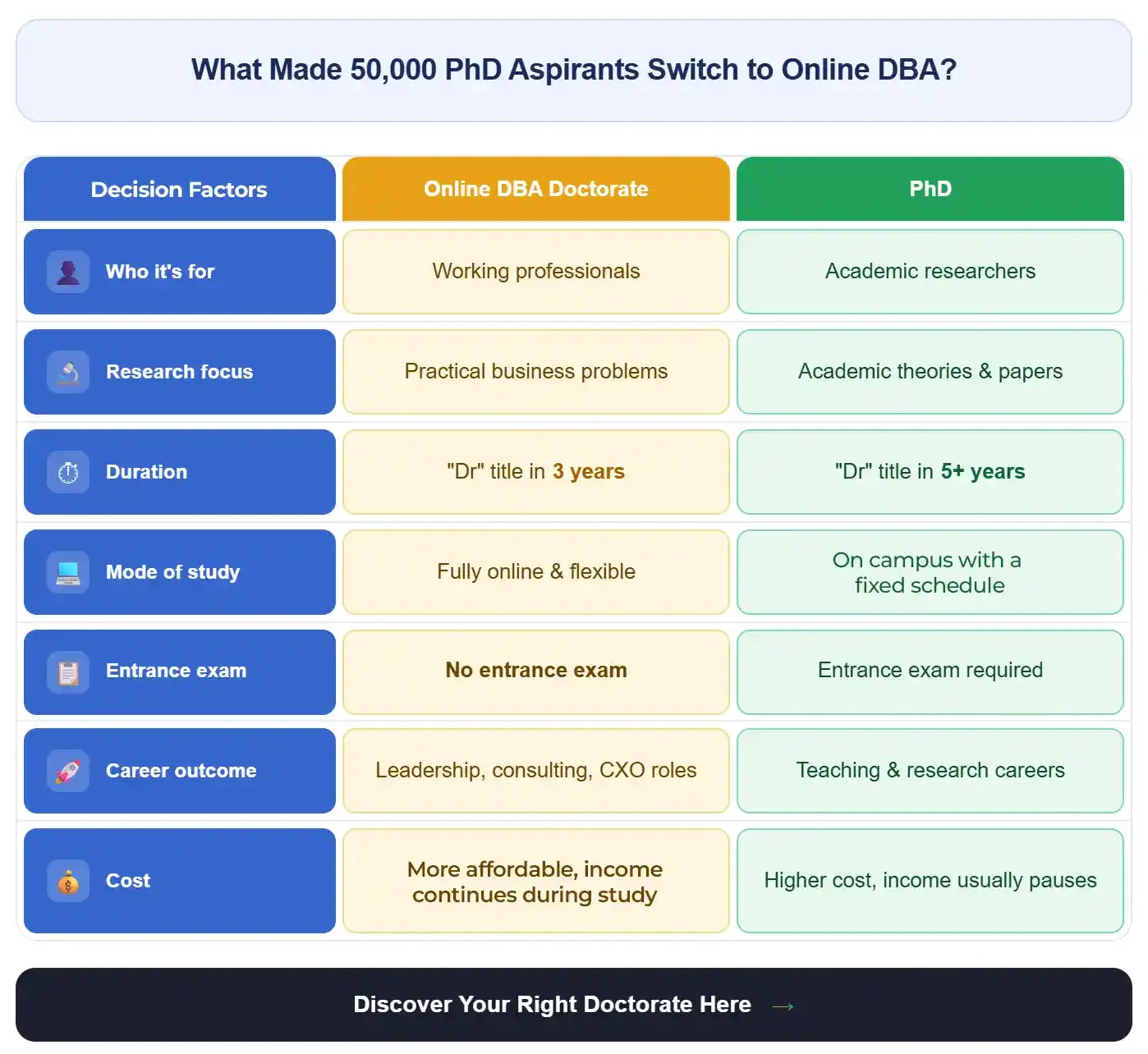
A PhD program is fully focused on theory and original research. Students spend years studying one narrow topic, reading research papers, and writing a thesis that adds new knowledge to their subject. For example, in business, a PhD student might spend years studying only one topic like “consumer behavior in rural markets.”On the other hand, an Online DBA program is more focused on practical problems and real business issues. Instead of just studying theories, DBA students research topics that can directly help companies, industries, or markets. For example, a DBA student may study “how digital marketing is changing retail sales” or “how AI can improve supply chain management.”
So, if your goal is to become a research scholar or a university professor in pure academics, a PhD is good. But if you want to apply research to real-life business situations, an Online DBA is a perfect choice.
2) Flexibility and Learning Style
PhD programs are usually full-time and require students to be on campus. You have to attend classes, meet professors regularly, and work in labs or libraries. This means you cannot usually work a full-time job while doing a PhD.An Online DBA, on the other hand, is designed for working professionals. Classes are online, lectures are recorded, and assignments can be done from anywhere. You can continue your job, earn money, and study at the same time.This flexibility is the main reason why many professionals prefer a DBA over a PhD. You don’t have to choose between career growth and education. You can have both.
3) Time Duration
A PhD can take a very long time, usually 5 to 7 years or sometimes even more. This is because the research process is very detailed and requires a lot of time for writing and approval.An Online DBA usually takes 3 to 5 years to complete. It is structured in a way that busy professionals can finish it without wasting years. This shorter duration makes it a more attractive option for people who want a doctorate degree but cannot spend half of their life studying.
4) Career Opportunities
After a PhD, most students look for jobs in academia or research. They usually become professors, researchers, or authors of academic papers. While this is great for people who love teaching or pure research, it may not be useful for someone who wants to be in business leadership roles.
An online DBA opens doors to higher-level corporate positions such as:
- CEO (Chief Executive Officer)
- Director of Strategy
- Senior Manager
- Business Consultant
- Entrepreneur
It also gives you the option to teach in universities, because a DBA is also a doctorate. Many universities accept DBA graduates as professors.
So, with a DBA, you get the best of both worlds Rs. you can stay in business and also move into academics if you want.
5) Practical Research vs. Theoretical Research
The biggest difference between a PhD and a DBA is in the type of research.
- In a PhD, the research is theoretical. The aim is to add something new to the field of knowledge, even if it is not directly useful to businesses.
- In a DBA, the research is applied. The aim is to solve a real business problem.
For example:
- A PhD student might research “The psychological reasons behind customer brand loyalty.”
- A DBA student might research “How loyalty programs in retail stores increase repeat sales.”
The DBA research has a direct business impact, which makes it more useful for professionals and companies.
6) Cost and Return on Investment
PhD programs are often funded by universities, but they give a small stipend and require full-time commitment. So, financially, a PhD may not be very rewarding in the short term.
An Online DBA is usually paid for by the student, but since you can continue working during the program, you keep earning. Also, after completing the DBA, you can move to higher-paying leadership roles. This gives you a much better return on investment (ROI) compared to a PhD.
7) Recognition and Value
Some people think that only a PhD is valuable, but this is not true anymore. The DBA is also a doctorate degree, and it is widely recognized around the world. Many universities, companies, and even governments treat a DBA as equal in level to a PhD.
The difference is not in value, but in focus. PhD is for academics, DBA is for professionals.
8) Global Networking
PhD students usually work in one department with a small group of professors and researchers. Their network is limited to academics.
An Online DBA program, however, often brings together professionals from different countries, industries, and companies. This creates a global network of business leaders. Such a network is extremely valuable for business opportunities, partnerships, and career growth.
9) Work-Life Balance
Doing a PhD is like a full-time job. Many PhD students feel stressed, isolated, and financially weak during their research years.
With an Online DBA, you can maintain a good work-life balance. You don’t have to leave your job, your income, or your family life. This makes it a healthier and more practical choice for working adults.
Who Should Choose What?
Choose PhD if you want to:
- Become a career researcher
- Work in universities as a professor
- Focus on theory and knowledge building
- Spend years in academic research
Choose Online DBA if you want to:
- Grow in your corporate career
- Take leadership roles in business
- Become a consultant or entrepreneur
- Do applied research with real business impact
- Study while continuing your job
Both a PhD and a DBA are doctoral degrees, but they serve different purposes. A PhD is best for people who want to live in the world of academics and theory. An Online DBA is best for people who want to apply research to solve real business problems while growing in their professional careers. The Online DBA is flexible, shorter in duration, practical, and directly useful for professionals. It helps you get the respect of a doctorate degree without the long struggles of a PhD. For business leaders and working professionals, the Online DBA is truly the perfect alternative to a PhD program.
Conclusion
PhD direct admission is a great option for students who want to skip entrance exams and start their research quickly. Many private and government universities in India offer this pathway. It is especially useful for M.Phil holders, bright B.Tech graduates, and working professionals. Before applying, students should check university recognition, eligibility, and fees. A direct PhD has the same value as a regular PhD if done from an approved university. If you are serious about research and want to save time, PhD direct admission can be your best choice. It opens doors to academic, research, and corporate careers, and helps you become an expert in your chosen field.