

Quick answer:
The most in-demand B.Tech specializations for 2026 are:
- CSE: AI/ML, Data Science, Cybersecurity, Cloud Computing
- VLSI/Embedded Systems on the tech side,
- Mechanical, Mechanical & Automobile, Robotics & Automation,
- Civil
- Electrical
- Chemical
- Aeronautical
- Biotechnology
But knowing that these specializations are not sufficient, learners should know why these specializations are in demand and what makes them relevant in the upcoming years.
Asking yourself one simple question: Is pursuing an engineering degree a promising career for me? And if yes, which branch?
This blog is written to answer exactly that. How engineering can be a rewarding career for learners. This also includes an honest guide on what engineering is, which B.Tech specializations are worth giving attention to in 2026, what they pay, what you will actually study, and how to pick the one that fits you.
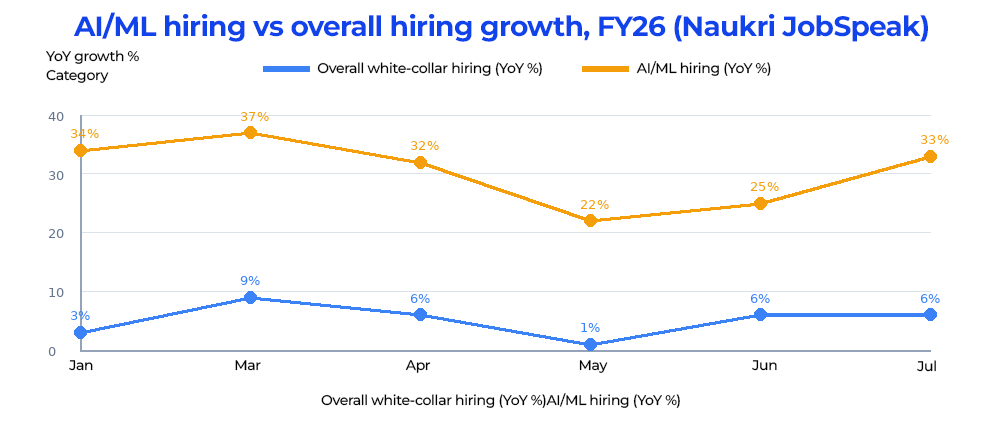
Here's the data straight from Naukri's monthly JobSpeak reports for FY26:
|
Month |
Overall hiring growth |
AI/ML hiring growth |
|
January 2026 |
+3% |
+34% |
|
March 2026 |
+9% |
+37% |
|
April 2026 |
+6% |
+32% |
|
May 2026 |
+1% |
+22% |
|
June 2026 |
+6% |
+25% |
|
July 2026 |
+6% |
+33% |
What Is Engineering, Really?
Engineering focuses on how to solve a problem using science and math. Likewise,
- how to build a bridge that doesn't collapse,
- how to write an app that doesn't crash,
- how to design a car engine that uses less fuel,
- how to make sure a hospital's data never gets hacked.
To become an engineer, learners have to be passionate and apply for the B.Tech program.
A B.Tech (Bachelor of Technology) is a 4-year undergraduate degree that trains learned developing foundational knowledge. The program also includes labs, project work, and internships.
1.28 lakh jobs gone in 6 months. Yours could be next.
Engineering Is Changing—And That's Actually Good News
Ten years ago, choosing computer science or mechanical was simple; you picked a branch and studied roughly the same syllabus for four years.
That's not how it works anymore:
Today, branches are splitting into focused specializations because companies want people with specific, ready-to-use skills, not just a general degree:
- Computer science has split into software development, data science, AI/ML, cybersecurity, and cloud computing.
- Mechanical engineering now overlaps heavily with automation and robotics.
- Electronics has a whole sub-world around chip design (VLSI) that barely existed as a mainstream career choice a decade ago.
The B.Tech Specializations That Matter In 2026
Top B.Tech specializations that are relevant in the upcoming years are shared:
1. Computer Science Engineering (CSE) — The Software Branch
Still consider the most popular and most applied-for branch in India, and for good reason. It opens the widest range of doors. The program focuses on developing skills related to:
- Programming
- Data Structures
- Algorithms
- Operating Systems
- Databases
- Software Development
What's changed: A plain CSE degree is no longer offering a rising career. Companies increasingly want to know what you specialised in within CSE. This means learners need to develop specialized skills mentioned below apart from the knowledge offered in CSE.
- AI&ML
- Cloud Computing
- Data Science/Analysts
- Cubersecurity
- Software Development
Not just degree, but skillset matters to companies:
|
What should learners focus on if enrolling in CSE? | |
|
Electives/tools |
Data Structures & Algorithms, DBMS, Operating Systems, Python, Java, Git/GitHub, basic AWS or Azure. |
|
Sectors hiring |
IT services, product startups, e-commerce, fintech, banking technology, healthcare tech. |
|
Who should pick this? |
Someone who wants the broadest possible career options and is willing to specialize further during college through electives, internships, or certifications. |
Fresher salary: That depends on employee performance. For learners' reference, in the table, salaries of top performers are shared:
|
Fresher Salary After Computer Science and Engineering | |
|
General service companies (TCS, Infosys, Wipro) |
₹3.5–7 LPA |
|
Strong skills in AI, cloud, or cybersecurity |
₹8–14+ LPA |
|
Product companies like Google, Amazon, and Adobe |
₹12–30 LPA |
2. Artificial Intelligence & Machine Learning (AI/ML)—Now a Standalone Branch
There was a time when AI and ML were topics learners picked up as electives inside CSE. That's changed. Now, a B.Tech in AI/ML is offered as its own degree, with a curriculum built entirely around it.
This emphasis is given to how machines learn from data to build models that recognize images, understand language, predict outcomes, or automate decisions.
|
What should learners focus on if enrolling in AI/ML? | |
|
Electives/tools |
Python, TensorFlow/PyTorch, Statistics & Probability, Linear Algebra, Natural Language Processing, Computer Vision. |
|
Sectors hiring |
|
|
Who should pick this? |
Interested in math and statistics, not just coding. Applied Maths is crucial for AI/ML |
Fresher salary: ₹6–12 LPA is common for a focused AI/ML graduate, and this can be significantly higher at product companies and GCCs (Global Capability Centres) in cities like Bengaluru and Gurugram.
3. Data Science & Business Analytics — The "Decision-Making" Branch
Data Science & business analytics is related to AI/ML, but the focus is entirely different. The difference is that AI/ML focuses on building intelligent systems. However, data scientists are digging into large amounts of data to find patterns. These patterns help companies make better decisions by understanding the behavior of their customers.
By predicting the nature of customers, companies can make informed decisions like what to sell, where to expand, and which customers might leave:
|
What should learners focus on if enrolling in data science/business analytics? | |
|
Electives/tools |
Python, SQL, Excel/Power BI, Tableau, statistics, and basic machine learning. |
|
Sectors hiring |
E-commerce, banking and finance, insurance, consulting, healthcare, logistics. |
|
Who should pick this? |
Someone who enjoys working with numbers and stories together, as data science is as much about explaining "why" as it is about calculating "what." |
Fresher salary: Roughly ₹5–10 LPA, with strong Python and machine learning skills pushing this higher.
4. Cybersecurity—Protecting Everything Digital
Banking, healthcare, and government systems are shifting online. Thus, protecting information from hackers, data breaches, and fraud is necessary to prevent misuse. Hence, it is a cybersecurity is the fastest-growing specialization right now.
|
What should learners focus on if enrolling in cybersecurity? | |
|
Electives/tools |
Networking fundamentals, Linux, Ethical Hacking basics, Cloud Security, certifications like CEH, Security+, CISSP (usually done after or alongside your degree). |
|
Sectors hiring |
Banking (BFSI), IT services, government and defence, healthcare, e-commerce — basically any organisation handling sensitive data. |
|
Who should pick this? |
Someone who's naturally curious about "how things can be broken into" and enjoys detail-heavy, investigative thinking. |
Fresher salary: Roughly ₹3.5–8 LPA to start (entry-level roles like SOC Analyst), rising quickly with experience and certifications; senior specialists and security architects can cross ₹25–50 LPA.
5. Cloud Computing—The Infrastructure Behind Every App
Every app, website, or online service runs on servers—the cloud, like Amazon's AWS, Microsoft's Azure, or Google Cloud instead of a company's own physical computers. So, cloud computing specialists design, manage, and secure this infrastructure.
|
What should learners focus on if enrolling in cloud computing? | |
|
Electives/tools |
AWS/Azure/GCP fundamentals, Linux, Docker, Kubernetes, Networking, DevOps basics. |
|
Sectors hiring |
IT services, SaaS startups, fintech, e-commerce, and GCCs of global companies now operating out of Indian cities like Bengaluru, Hyderabad, Pune, and Gurugram. |
|
Who should pick this? |
Someone who likes systems and infrastructure more than writing app-facing code — cloud roles are more "behind the scenes" but very well paid. |
Fresher salary: Roughly ₹5–9 LPA with a foundational cloud certification (AWS or Azure); this rises sharply with 2–3 years of experience, since demand for certified cloud engineers is currently outpacing the number of trained people.
6. VLSI Design & Embedded Systems — Where Chips Are Born
This is a niche specialization; it's becoming increasingly important as India builds its own semiconductor (chip-making) industry through government initiatives like the India Semiconductor Mission.
VLSI is about designing the tiny chips inside every phone, laptop, and car. And embedded systems are about programming the small computers built into everyday devices, including a washing machine or a car's dashboard.
|
What should learners focus on if enrolling in VLSI Design/Embedded Systems? | |
|
Electives/tools |
Verilog/VHDL, digital electronics, C/C++, RTOS (Real-Time Operating Systems), CAD tools used in chip design. |
|
Sectors hiring |
Semiconductor companies, automotive (especially electric vehicles), telecom, consumer electronics. |
|
Who should pick this? |
Someone who enjoyed electronics and circuits in school more than pure software — this branch rewards patience and precision. |
Fresher salary: Roughly ₹4–8 LPA at Indian design houses, but ₹16–28 LPA at global chip companies with India R&D centres like Intel, Qualcomm, NVIDIA, and Samsung.
7. Mechanical Engineering — The Original "Core" Branch, Reinvented
Mechanical engineering is the classic branch. This branch focuses on Machines, engines, manufacturing, and thermal systems. Mechanical Engineering has been around for decades and still offers strong, stable career paths, especially in government jobs (PSUs) and core manufacturing.
Industry demand: With core mechanical engineering skills, learners have to focus on newer skills such as automation, robotics, simulation software, or electric vehicle technology.
|
What should learners focus on if enrolling in mechanical engineering? | |
|
Electives/tools |
SolidWorks, AutoCAD, thermodynamics, manufacturing processes, and increasingly, basic Python or PLC programming for automation exposure. |
|
Sectors hiring |
Automotive, manufacturing, energy (including renewable energy), heavy industries, PSUs like BHEL and NTPC. |
|
Who should pick this? |
Someone who wants a stable, well-respected core engineering career and doesn't mind that entry-level pay is lower than software roles — the trade-off is long-term stability and government job eligibility. |
Fresher salary: Roughly ₹2.5–6 LPA for a general core mechanical role; this climbs meaningfully (₹8–15+ LPA) if you add automation, CAE/simulation, or robotics skills on top.
8. Mechanical & Automobile Engineering—Built For The EV Era
This is a more focused version of mechanical engineering, built specifically around vehicles — cars, bikes, and increasingly, electric vehicles (EVs).
How is this specialization different from mechanical engineering? It's not the same as plain mechanical engineering. While mechanical engineering covers all machines broadly, this specialization goes deep into vehicle design, engines (or EV motors and batteries), and transportation systems.
|
What should learners focus on if enrolling in Mechanical & Automobile Engineering | |
|
Electives/tools |
Automobile design software, engine/EV powertrain fundamentals, battery technology basics, vehicle dynamics. |
|
Sectors hiring |
Automobile manufacturers (Tata Motors, Maruti, Mahindra), EV startups, auto component makers. |
|
Who should pick this? |
Someone specifically drawn to vehicles and transportation — India's EV push means this is one of the more future-looking "core" specializations right now. |
Fresher salary: Roughly ₹3–6 LPA to start, with strong growth in EV-focused companies and startups where automobile + electrical knowledge together is in short supply.
9. Robotics & Automation Engineering — The Bridge Branch
Here's where a lot of students get confused, so let's be direct: Robotics & Automation is different from both plain Mechanical and Mechanical & Automobile. It sits at the intersection of mechanical engineering, electronics, and computer science—you design the physical robot (mechanical), you build its sensors and circuits (electronics), and you write the code that makes it "think" and move (software/AI).
This branch has grown fast because manufacturing, logistics, healthcare, and agriculture are all adopting automation and robotics quickly, backed by government pushes like "Make in India."
|
What should learners focus on if enrolling in Robotics & Automation? | |
|
Electives/tools |
ROS, Python, PLC and automation systems, computer vision, SolidWorks or Fusion 360 for design |
|
Sectors hiring |
Manufacturing and warehousing (automated factories), healthcare (surgical robots), agriculture (farm automation), defence. |
|
Who should pick this? |
Someone who genuinely enjoys all three worlds — mechanical, electronics, and coding — and doesn't want to fully commit to just one of them. |
Fresher salary: Roughly ₹4–7 LPA on average, but engineers who combine robotics with Python and AI (using tools like ROS — Robot Operating System) have reported packages reaching ₹15–30+ LPA at specialised companies.
10. Civil Engineering—Building The Physical World
Civil engineering focuses on designing and maintaining the infrastructure we all depend on—buildings, bridges, roads, water supply systems, and increasingly, "smart cities."
|
What should learners focus on if enrolling in civil engineering? | |
|
Electives/tools |
AutoCAD, STAAD Pro, Revit (BIM), surveying, structural analysis. |
|
Sectors hiring |
Construction and real estate, government infrastructure projects, urban planning bodies, consulting firms. |
|
Who should pick this? |
Someone who wants to see their work standing physically in the real world, and who is comfortable with fieldwork alongside office design work. |
Fresher salary: Roughly ₹2.5–4.5 LPA to start; this grows steadily with experience, and specialised skills like BIM (Building Information Modeling) or structural design can add a real premium.
11. Electrical Engineering—Powering Everything
Electrical engineering covers how electricity is generated, transmitted, and used—from power plants to the wiring in your home. It overlaps increasingly with renewable energy and electric vehicles.
|
What should learners focus on if enrolling in electrical engineering? | |
|
Electives/tools |
Power systems, control systems, MATLAB, renewable energy fundamentals, basic PLC/automation. |
|
Sectors hiring |
Power generation and distribution, renewable energy (solar/wind), telecom, EV component manufacturing. |
|
Who should pick this? |
Someone interested in energy systems and the shift toward renewable power — a genuinely important, growing area for India. |
Fresher salary: Roughly ₹2.5–5 LPA to start, with strong opportunities in PSUs (like BHEL, NTPC) that offer long-term stability, and higher pay in private renewable energy and EV companies.
12. Chemical Engineering—Turning Science Into Industry
Chemical engineering applies chemistry and physics to industrial processes—making everything from fuels and plastics to medicines and food products at large scale.
|
What should learners focus on if enrolling in chemical engineering? | |
|
Electives/tools |
Process engineering, fluid mechanics, chemical process simulation software (like Aspen), safety and environmental regulations. |
|
Sectors hiring |
Oil & gas (IOCL, HPCL, BPCL, ONGC), pharmaceuticals, fertilisers, petrochemicals. |
|
Who should pick this? |
Someone who liked chemistry more than physics in school and wants a career with strong public-sector job security. |
Fresher salary: Roughly ₹3–6 LPA to start, with strong, stable opportunities in public sector oil and gas companies.
13. Aeronautical / Aerospace Engineering—Reaching For The Sky
This specialization focuses on designing and maintaining aircraft, spacecraft, and related systems — a smaller, more specialised field with fewer seats but a lot of prestige.
|
What should learners focus on if enrolling in Aeronautical Engineering | |
|
Electives/tools |
Aerodynamics, propulsion systems, aircraft materials, CAD tools specific to aerospace design. |
|
Sectors hiring |
ISRO, HAL, DRDO, private aviation and defence companies, Air India and other airlines (for maintenance-focused roles). |
|
Who should pick this? |
Someone with a genuine, long-standing interest in flight and space — this field rewards passion, since seats and openings are more limited than in mainstream branches. |
Fresher salary: Roughly ₹3.5–6 LPA to start at most companies, though ISRO, DRDO, and major aerospace players can offer strong long-term growth and job security.
15. Biotechnology—Where Biology Meets Engineering
Biotechnology blends biology, chemistry, and engineering to solve problems in healthcare, agriculture, and the environment. Understanding of biotechnology is essential for developing vaccines, genetic research, and sustainable food production.
|
What should learners focus on if enrolling in Biotechnology? | |
|
Electives/tools |
Genetic engineering basics, bioprocessing, lab techniques, basic bioinformatics tools. |
|
Sectors hiring |
Pharmaceutical companies (Cipla, Biocon, Serum Institute), research institutions, agricultural biotech firms. |
|
Who should pick this? |
Someone genuinely interested in biology and research, who is comfortable with the idea that this path often benefits from further studies after B.Tech. |
Fresher salary: Generally more modest at entry level compared to tech branches, though it grows well with a postgraduate degree (M.Tech, M.Sc, or PhD) or a move into research and pharma R&D roles.
What the Hiring Data Actually Show About Top B.Tech Specializations?
After researching on platforms like Naukri.com, Indeed, and Glassdoor:
- India's white-collar hiring index closed the last financial year up 8% — the strongest growth in three years, showing genuine recovery, not just noise.
- Fresher hiring (0–3 years) is growing faster than any other experience group — postings for freshers rose around 16–17% year-on-year in early 2026, which is genuinely good news if you're about to enter the job market in a few years.
- AI/ML roles are the standout performer, with hiring in this category growing over 30% year-on-year for several months in a row — this isn't hype; it's showing up consistently in job posting data.
- Demand for freshers in the ₹20+ LPA salary band also grew sharply, meaning top-skilled graduates (not just top-college graduates) are increasingly commanding strong starting packages.
- Non-IT sectors like healthcare, insurance, real estate, and hospitality have also picked up fresher hiring strongly — a reminder that engineering skills (especially data and automation skills) are now valued well beyond traditional IT companies.
The takeaway: don't just chase "which branch pays the most" — look at which branches show up consistently in growing hiring categories, because that tells you where the next four years of demand is heading, not just where it stands today.
Which Sectors Are Genuinely Promising Right Now
Based on where hiring is actually growing, keep an eye on:
- Artificial Intelligence and data-driven roles: growing across every industry, not just tech companies.
- Semiconductors and chip design (VLSI): a genuinely new opportunity area for India, backed by government investment.
- Electric vehicles and clean energy: mechanical, electrical, and automobile engineers are all finding fresh demand here.
- Cybersecurity: a persistent skills shortage means steady, long-term demand.
- Cloud computing and infrastructure: as more businesses (not just tech firms) move online.
- Infrastructure and construction: India's continued investment in metros, highways, and smart cities keeps civil engineering relevant.
- Healthcare technology: combining biotech, data science, and AI for diagnostics and drug research.
A Word On Colleges And Fees: Best for Engineering
You don't need to get into an IIT to have a good engineering career, though it certainly helps with starting salaries and brand value. Here's a realistic picture:
- IITs, NITs, IIITs, and BITS Pilani: These educational institutes sit at the top. These institutes offer strong placements and higher starting packages, but have very competitive entry through JEE Main/Advanced or BITSAT.
- State government engineering colleges: There are many institutes affiliated with state universities, and colleges offer affordable education, especially for core branches like civil, mechanical, and electrical.
- Private universities: Some have excellent placement records and modern labs and infrastructure for newer branches like AI/ML and Data Science, while others are simply degree-focused.
Fee ranges vary a lot by branch and institution type—government colleges can be as low as ₹1–2 lakh for the full 4-year course, while private colleges typically range from ₹4–10 lakh, and specialised or premium programs (like Robotics & AI or Biotechnology at top private universities) can go higher.
Flexible B.Tech programs (also called B.Tech for working professionals) have also become a genuine option in recent years — useful if you want to combine studies with part-time work, though these are generally more relevant after you've already started your career, not as a first choice straight out of Class 12. The program helps learners to earn a degree after a diploma.
Whichever college you shortlist, always verify it is approved by AICTE and, where relevant, accredited by UGC. This matters for the validity of your degree down the line.
How To Actually Choose Your Specialization
Here's a simple, honest process — not a checklist to overthink, just a way to bring some clarity:
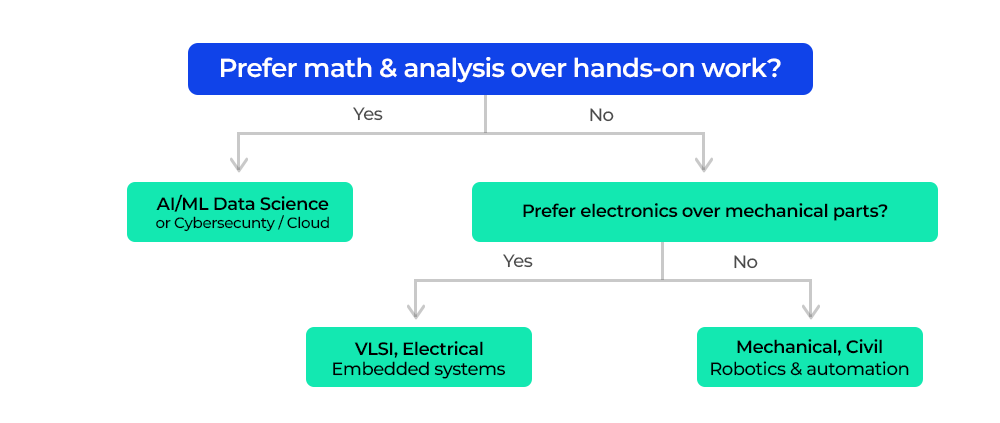
- If you liked physics numericals and circuits, electronics/electrical is for you. If you enjoyed chemistry experiments, chemistry or biotech is the right choice. You spent days on your first coding project? Try CSE, AI/ML, and Data Science!
- Avoid picking a branch based purely on whether it is a trending field of engineering. AI/ML is trending now, but if you truly do not like mathematics and statistics, you are going to have a tough time studying this discipline for four years. In general, the branch where you are willing to invest time and effort will always win over the branch that sounds cool.
- Think about the geographical location where you would like to work and live. Jobs in cloud computing, AI, and cybersecurity tend to concentrate in big metro tech hubs. Core branches such as mechanical, civil, and electrical engineering provide more options both in smaller cities and PSUs.
- Think about your attitude to taking risks. Specialized branches (AI/ML, cybersecurity, Cloud) usually pay better at the start, but at the same time, are vulnerable to changes in technology trends. Core branches (Civil, electrical, and mechanical) pay slightly lower at the beginning but provide stable earnings in the long run, especially via government jobs.
- Listen to someone who works in the industry. Seniors, LinkedIn contacts, or your engineering school teachers will paint a much more realistic picture for you.
- Remember that you always have an option to specialize later in your life. It is quite common for engineers to go from core branch to data, automation, and management via M.Tech, MBA, or any other specialisation.
If none of this excites you even a little, that's fine too—engineering isn't the only respectable path. But if even two or three points above feel true for you, it's worth exploring seriously.
Why Engineering Is Still A Valuable Career Choice
A lot of students worry: "With AI doing everything now, will engineering even matter in a few years?" It's a fair question, and the honest answer is — the nature of engineering jobs is changing, but the need for engineers is not going away. In fact, it's growing in new directions.
Here's why a B.Tech is still worth your time and money:
- Real hiring demand. India's white-collar hiring closed the last financial year with its strongest growth in three years, and fresher hiring (0–3 years of experience) is growing faster than any other experience band right now.
- Multiple paths from one degree. A single B.Tech can lead you into software, hardware, research, government jobs (PSUs), higher studies (M.Tech, MBA), entrepreneurship, or even a completely different field like finance or consulting.
- Skills that don't expire. Problem-solving, logical thinking, and the ability to learn new tools quickly — these skills stay valuable even if the specific technology you learned in college becomes outdated.
- India is investing heavily in engineering-driven sectors — semiconductors, electric vehicles, renewable energy, infrastructure, and AI — which means real, long-term job creation, not just hype.
Who Should Consider Engineering?
Engineering is not only for the "topper" who solves 5 physics numericals before breakfast. It is genuinely worth considering if any of these sound like you:
- You enjoy figuring out how something works, not just what it does.
- You're comfortable with math and don't mind sitting with a problem until it clicks.
- You like building or fixing things—apps, gadgets, machines, or even just spreadsheets.
- You want a career where the market is genuinely hiring, not one where the openings are shrinking every year.
- You are okay with continuous learning — because unlike some careers, engineering doesn't stay the same for 20 years. It keeps changing, and you have to keep changing with it.
Conclusion
In 2026, demand from engineering is different. The nature of the problems has changed, which requires sustainable solutions. The branches that are growing fastest are AI/ML, data science, cybersecurity, cloud, VLSI, and robotics. And the classic branches like mechanical, civil, electrical, and chemical aren't going anywhere either. These are just evolving alongside these newer fields.
Pick a specialization that genuinely interests you, be realistic about the effort it will take, and stay open to learning new skills even after you graduate. That combination — genuine interest plus continuous learning — matters more than any single "best" branch on any list, including this one.