


In today’s world, businesses are growing alarmingly, thus the need for corporate lawyers. This blog will help you know what corporate law is, what corporate lawyers do, their importance to businesses, what steps you should follow to become a corporate lawyer and a few more things. Let’s start our journey by learning about corporate law.

What is corporate law?
Hmm! What is corporate law? Well, corporate laws are laws that set certain rules and criteria that govern how businesses or companies are formed and run. These laws cover all aspects from the establishment of a business to its day-to-day operations.
Under corporate laws, there are 5 key principles that one needs to follow to maintain the rhythm of the laws and regulations, and these are:
- Limited liabilities: A fundamental principle of corporation law is limited liability, which shields shareholders by capping their financial exposure at the amount that they contributed to the business. This promotes funding and entrepreneurship as non-public property is covered if the business sustains debts or legal obligations.
- Investor ownership: The basic principle of corporate law is investor ownership, which gives shareholders ownership rights associated with their ownership stake in the company. These laws ensure investor involvement, obligation, and a well-balanced company governance system. They additionally include the power to vote in critical business decisions, acquire dividends, and benefit from capital gains.
- Separate legal personality: Another fundamental principle of corporate law is the Separate Legal Personality. This principle explains that a company is a completely different legal entity from its owner. Here, a property can be owned, entered into contracts, sued, or sued by another party in its name, ensuring the continuity of the business and reducing the personal liability for stakeholders and the founders.
- Transferability of shares: if the owner wishes to sell his shares, the business can continue operations and run errands for the employees working in it. In corporations, transferring shares is rather simple, allowing for continuity and flexibility in the event of ownership changes.
- Delegated management: Delegated management in the corporate world simply means that the work has been divided equally among the different people in an organization. This is done to manage all the roles, day-to-day responsibilities and operations.
Major functions of Corporate Law in India
It is necessary to know the key functions or the major functions of Corporate Law in India. In India, Corporate Law plays a vital role in framing the legal framework under which every company or business runs.
- The establishment of businesses and the registration procedures.
- Rights of shareholders and duties of the board.
- Legal compliance and reporting requirements for mergers, acquisitions, and restructuring.
- Defense against corporate wrongdoing and fraud.
These laws ensure businesses are effective, transparent, and operate fairly. Modifications to corporate laws can substantially affect an organization's management system and economic development. Corporate law addresses more than a few legal concerns that groups may have, imparting them with safety and benefits consisting of tax exemptions and easier financing.
Additionally, corporate law ensures that the organizations are following the rules that are meant to be followed by them.
Corporate governs the formation, management, and regulations of any business or corporation. Additionally, they ensure they work and run their business lawfully, nothing goes out of their trail and can be tracked when needed.
What legal areas are covered under Corporate Law?
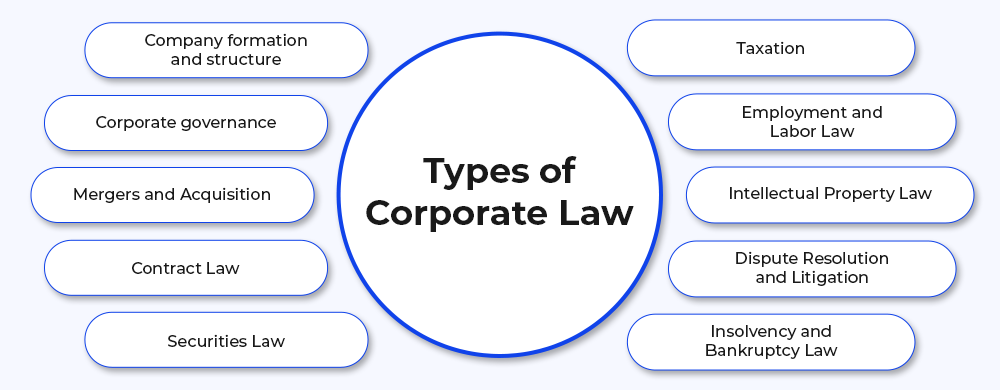
Corporate law covers various legal areas that allow the business to run smoothly with complete regulation of information, governance, and operations of the business. Let’s see the table below for more clarity on this very topic:
|
Legal areas |
Description |
|
Company formation and structure |
laws regarding incorporation, business forms, and governing papers such as the AoA and MoA. |
|
Corporate governance |
Laws related to decision-making strategies, shareholder rights, director obligations, and board structure. |
|
Mergers and Acquisitions (M&A) |
Legal processes for corporate combinations, takeovers, and restructuring. |
|
Contract Law |
Drafting, negotiating, and enforcing commercial contracts and agreements. |
|
Securities Law |
Construct laws related to issuing shares, insider trading, public offerings, and compliance with SEBI rules. |
|
Taxation |
Corporate tax responsibilities, tax law compliance, and transaction structuring for tax efficiency |
|
Employment and Labor Law |
legal duties towards workers, including contracts, benefits, and workplace safety. |
|
Intellectual Property Law |
Protection of copyrights, trade secrets, trademarks, and patents. |
|
Dispute Resolution and Litigation |
Procedures for settling disagreements among shareholders, contract violations, or legal infractions. |
|
Insolvency and Bankruptcy Law |
IBC regulations are associated with debt settlement, insolvency procedures, and company winding up. |
Importance of Corporate Law for Business
For businesses, corporate law is as important as air is for our survival. Below are a few points that may help you to know the importance of Corporate Law for your business:
- Ensures that businesses are formed legally.
- Makes business transactions and contract enforcement easier.
- Uses legal identity to support business continuity.
- Gives disagreements a legal framework for resolution.
- Gives disagreements a legal framework for resolution.
- Protects the rights and interests of investors.
- Outlines the responsibilities of executives, directors, and stockholders.
- Manages reporting and financial disclosures.
- Permits acquisitions and mergers to go smoothly.
- Encourages responsibility and openness.
- Helps manage risks and liabilities effectively.
Education Path to Corporate Law
If you are interested in pursuing a Law degree, then you must be enthusiastic about studying it. There are various specializations that you can choose from, and if you wish to become a Corporate Lawyer, choose Corporate Law as your specialization. Let’s see what the steps are to become a Corporate Lawyer. The stepwise roadmap to your objective is discussed below:
- Register and take the law entrance exams like CLAT, AILET, etc: Initially, you need to complete your 10+2 with any stream and then enroll for a 5-year or 3-year bachelor's degree. Before this, you need to take a law entrance exam, where you need to score good marks to get admission to a good university or institution.
- Get admitted to a recognized and reputable institution: After qualifying law entrance exam, a merit list will be formed based on which you are given admission to a law school or university.
- Pass all the exams in the course: After getting admission to a good university, you need to pass all the exams in the program. Also, you need to study all the subjects with full dedication and must have to gain a deep understanding of the subject and the topics in that very subject.
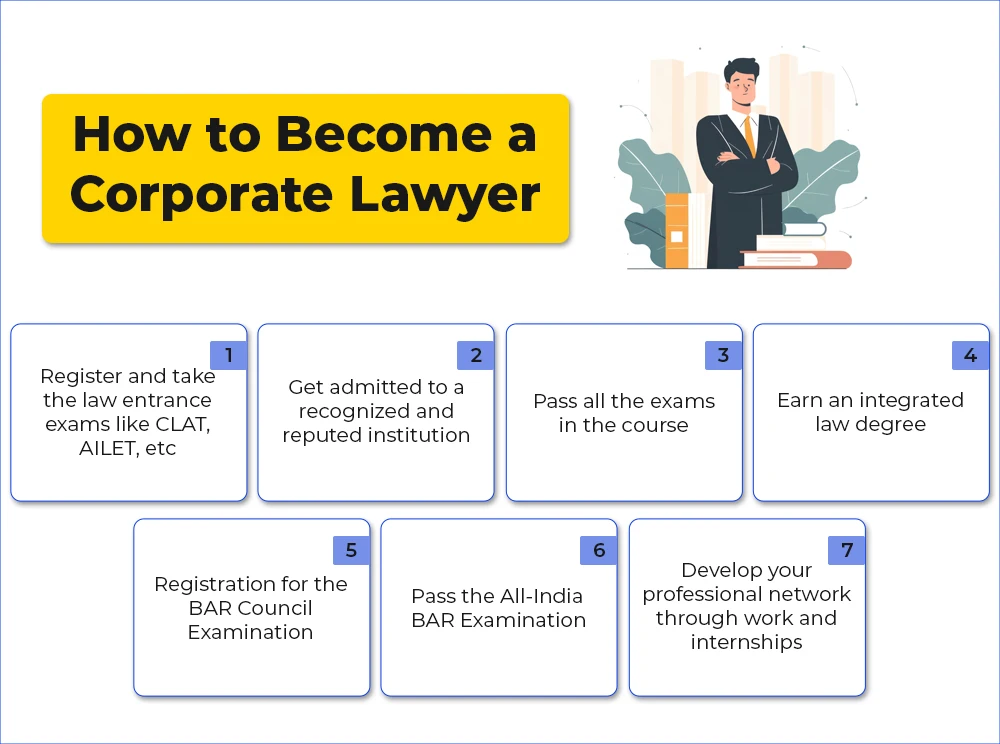
- Earn an integrated law degree: After passing the exams, you can enroll in an integrated course for a master’s degree.
- Registration for the BAR Council Examination: You need to apply for the All India Bar Examination (AIBE) and qualify for that exam which is conducted by the Bar Council of India itself. Remember, this would be a tough exam and has competition. As many students would be applying at the same time as you are. You can take this exam after completing your LLB as well.
- Pass the All-India BAR Examination: Qualify for this exam with good grades and get a certificate to practice in the court of law.
- Develop your professional network through work and internships: While practicing, you can develop your professional network and expand it so that in any situation if you wish to get a second opinion, you can directly contact the person or the attorney or the law professional so that you can get the situation cleared.
List the universities offering an LLM in Corporate Law
Various universities in India are offering corporate law as a specialization. Some universities offer a single specialization and some offer a combination of two specializations which can be beneficial for one in the future. Let’s have a look at the below-presented table fr the top universities offering LLM in Corporate law along with the type of university, entrance exam required, duration of the program and fee structure.
|
University |
Type |
Program |
Entrance Exam |
Duration |
Fees |
|
National Law University, Delhi (NLU Delhi) |
National Law University, Delhi (NLU Delhi) |
LLM in Corporate Law |
All India Law Entrance Test (AILET) |
1 year |
INR 1,50,000 - INR 2,00,000 per year |
|
National Academy of Legal Studies and Research (NALSAR), Hyderabad |
Government University |
LLM in Corporate Law |
Common Law Admission Test- Postgraduate (CLAT-PG) |
1 year |
INR 1,30,000 per year approx |
|
National Law Institute University (NLIU), Bhopal |
Government University |
LLM in Business and Corporate Law |
Common Law Admission Test- Postgraduate (CLAT-PG) |
1 year |
INR 1,20,000 per year approx |
|
Banaras Hindu University (BHU), Varanasi |
Government University |
LLM in Corporate and Financial Law |
Entrance Exam (BLAT) |
2 years |
INR 10,000 per year approx |
|
Delhi University (DU), Faculty of Law, Delhi |
Government University |
LLM with specialization in Corporate Law |
DU LLM Entrance Test |
2 year |
INR 5,000 - INR 10,000 per year approx |
|
Jindal Global Law School, O.P. Jindal Global University, Haryana |
Private University |
LLM in Corporate and Financial Law |
based on the LSAT or a valid score in the entrance exam in the university |
1 year |
INR 4,00,000 per year |
|
Symbiosis Law School, Pune |
Private University |
LLM in Business and Corporate Law |
Symbiosis All India Admission Test (AIAT) |
1 year |
INR 2,00,000 - INR 2,50,000 per year |
|
Amity Law School, Noida |
Private University |
LLM in Corporate Law |
Amity Entrance Exam or based on merit |
1 year |
INR 1,50,000 per year approx |
|
NMIMS School of Law, Mumbai |
Private University |
LLM in Corporate Law |
NMIMS Entrance Exam |
1 year |
INR 3,00,000 per year |
Syllabus for the specialization Corporate Law
Here is the general syllabus that is offered by most of the universities in India; however, some universities change a few of the subjects based on their needs and today’s demand. Let’s check the syllabus for the LLM in Corporate Law:
|
Syllabus for LLM in Corporate Law | |
|
Semester I |
Semester II |
|
|
|
Semester III |
Semester IV |
|
|
Jindal Global Law School (Blended Learning Program)
Jindal Global School is one of those universities offering a 1-year LLM program and Blended Learning Mode. Here in this program, students get all the studying material on the Learning Management System (LMS) provided by the university. This university offers an LLM in Corporate law in combination with Finance Law which is a plus point for the students of Corporate Law. Let’s see the syllabus offered by the Institution.
Eligibility Criteria:
- A Bachelor of Laws degree, which must be LLB, must have been earned within the last three and a half years, or aspirants must be in their last semester of study.
- To be excused from the admission exam (JSAT), candidates must have taken entrance exams like the LSAT, CLAT PG, or DU LLM exam within 12 months before applying.
- A candidate will also not be required to take the JSAT admission exam if they have a valid international LSAT score within five years of applying.
Syllabus:
Let’s learn about the syllabus offered by Jindal Global Law School for Corporate Law and other specializations as well.
|
Syllabus at Jindal Global Law School (Blended Learning Program) | |
|
Specializations |
Syllabus/Subjects |
|
Corporate & Financial Law |
|
|
AI and Emerging Technologies |
|
|
Intellectual Property & Technology Law |
|
|
Dispute Resolution |
|
|
Taxation Law, Policy and Regulation |
|
Other specializations offered at Jindal Global Law School
Specialization offered:
- Corporate & Financial Law
- AI and Emerging Technologies
- Intellectual Property & Technology Law
- Dispute Resolution
- Taxation Law, Policy, and Regulation
Fee structure:
Course fee - INR 3,50,000
Career Opportunities in Corporate Law
In India, Corporate law is in high demand. After completing a certain degree, students are open to a wide variety of opportunities for themselves. Under corporate law, there are various specializations that they can choose for completing their degrees and these specializations may include Intellectual property (IP), Banking & Finance, Project Finance, Litigation, Mergers & Acquisitions (M&A), Taxation, Securities Law, and more.
|
Specialization |
Job profiles |
Average annual salaries |
|
Intellectual property (IP) |
Trademark attorney, Patent Agent, IP attorney |
INR 10 LPA - INR 25 LPA |
|
Banking & Finance |
Banking Lawyer, Finance Lawyer, Debt Recovery Lawyer |
INR 10 LPA - INR 25 LPA |
|
Project Finance |
Project Finance Lawyer, Infrastructure Lawyer |
INR 10 LPA - INR 25 LPA |
|
Litigation |
Corporate Litigation Attorney, Commercial Litigation Attorney |
INR 10 LPA - INR 25 LPA |
|
Mergers & Acquisitions (M&A) |
M&A Lawyer, Due Diligence Analyst |
INR 10 LPA - INR 25 LPA |
|
Taxation |
Tax Lawyer, Tax Consultant, Transfer Pricing Analyst |
INR 10 LPA - INR 25 LPA |
|
Securities Law |
Securities Lawyer, Capital Markets Lawyer |
INR 10 LPA - INR 25 LPA |
Citywise Average Salary of Corporate Lawyers
- Bangalore - ₹ 29.3 Lakhs
- New Delhi - ₹ 12 Lakhs
- Pune - ₹ 9.2 Lakhs
- Gurgaon - ₹ 9 Lakhs
- Hyderabad - ₹ 8.5 Lakhs
- Chennai - ₹ 7.9 Lakhs
- Mumbai - ₹ 6.6 Lakhs
- Kolkata - ₹ 5.1 Lakhs
Skills that one must look for in a Corporate Lawyer
This field is all about skills that any lawyer has. The lawyer who has been brushing his knowledge with time and changes in the laws can only become the horse of a long race. Otherwise, he may leave behind the other Lawyer who has the latest knowledge regarding the laws. There are so many skills that are required and you cannot even count them on your fingers. Below are a few major skills that you must look into for your corporate lawyer.
- Excellent Communication & Negotiation Skills: To be a good corporate Lawyer, they need to have good communication skills, as their words will play a major role in the court of law. Communication and negotiation skills are most important for any lawyer to be in the list of good lawyers. These skills will help them to settle the matter and prevent litigation.
- Attention to Details: In the law field, a lawyer needs to work on their attention to detail as they cannot skip a single word, that single word may be helpful in solving the case to solve. This will help the lawyers find the loopholes that many businesses keep on repeating in their work unethically.
- Perseverance & Passion: Okay! As you may know, any case can stretch from one day to weeks and even to years as this is a tedious process to work on. Patience is also needed in this field. Lawyers can’t rush to complete the case in a few hearings, this process may take time, so, they may have perseverance, patience, and passion towards their work.
- Knowledge about the Latest Trends: Knowledge is the key to success for the lawyer. With time, there are amendments in the laws and the world as well, so, a lawyer must keep himself updated. Laws are changing constantly and a lawyer must keep this in mind and keep on reading and learning on the new updates in the laws. This will help the lawyer to work on his case with more focus and dedication.
Top recruiters in India
Almost every company and business needs to have its Corporate lawyer to run the business legally. Below are a few of the top recruiters that hire corporate Lawyers:
- Cyril Amarchand Mangaldas,
- Luthra & Luthra,
- AZB & Partners,
- Shardul Amarchand Mangaldas & Co,
- Vaish Associates,
- S&R Associates,
- HSA,
- Reliance Industries,
- Trilegal, and many more
Conclusion
This blog was all about what corporate law is, what corporate law is, its key principles, universities offering law degrees in corporate law, their fee structure, syllabus, and almost everything that you need to know about becoming a corporate Lawyer. Boost your confidence and start your journey to your destination. There are multiple opportunities that you can choose from, so choose wisely as this would be the biggest decision and the investment of your life.