

Quick Overview: A fake degree certificate is not accepted in India, as it is illegal to use it. If someone is caught, they may be fired or have their admission revoked. Therefore, make sure that you have an authentic degree certificate.
Fake degree certificates are invalid in India and can lead to serious legal consequences for those who use or issue them. The authenticity of academic qualifications is essential to maintaining trust, fairness, and credibility in the education system and professional world. Fake Degree certificates could lead to more opportunities for securing better jobs, further studies, and improved career prospects.
However, fake degree certificates are a major concern because they create many problems for students, prospective employers, institutions of higher learning, and the students involved. Students fall prey to agents who promise to give them their degrees without sitting for examinations. Others obtain these fake degrees from institutions that lack the mandate to issue legitimate degrees to their students.
In India, it is necessary to check the recognition status of the university and also validate the document from the issuing authority before accepting an academic document. Information regarding recognized institutions and universities that are not authorized to grant recognized degrees is made available by the UGC.
This article will give you information on detecting a fake certificate, the dangers of using a fake certificate, how to verify your academic qualifications, and what to do if you suspect academic fraud.
What Is a Fake Certificate in India?
In India, a fake certificate is an educational or official certificate that has been fake, tampered with, or misrepresented to be a real certificate. In the context of education, it could be a degree certificate, a diploma, a marksheet, a provisional certificate, or any other academic certificate that does not reflect any valid qualification.
Some examples of fake academic certificates are:
- A degree issued by an institution that does not have the legal authority to award that qualification.
- A genuine certificate altered to change the candidate's name, marks, course, or passing year.
- A fake marksheet showing examinations that the student never passed.
- An academic document falsely claiming that a person completed a course.
- A certificate obtained through an agent who promises a qualification without the required academic process.
How to Spot a Fake Degree Certificate?
A Fake Degree Certificate may look professional, but its appearance alone cannot establish its authenticity. The following checks can help students, employers, and educational institutions identify potential warning signs.
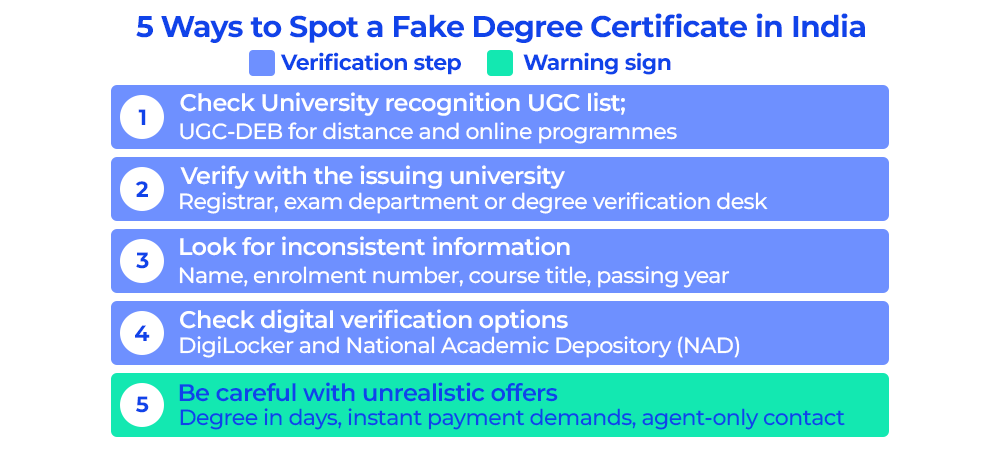
1. Check University Recognition
First, find out whether the institution offering such a qualification is legally approved and accredited to offer this degree or certification. Go to the UGC website and read all the necessary details regarding recognized universities and institutions that do not have the authority to grant recognized degrees. In the case of distance education programs, refer to the UGC Distance Education Bureau and see the eligibility criteria for that program. Just seeing the name of an institution in your search results is not sufficient.
2. Verify the Degree With the Issuing University
Please contact the university via its official website, examination department, registrar, or degree verification department to verify whether the details provided by the candidate, such as name, enrollment number, course, exam year, and degree, tally with those of the institution.
The UGC recognition details help ascertain the regulatory position of the institution but do not necessarily authenticate each certificate. Verification from the issuing university is one way of validating a particular academic qualification.
3. Look for Inconsistent Information
Make a comparison between the degree certificate and marksheets, registration documents, and other supporting documents. These include:
- Spellings of the candidate's name being different.
- Enrollment or registration numbers being different.
- Course titles that differ from those on the marksheets.
- Passing years that vary among all academic documents.
- Details about examinations that do not match the name of the university.
- Changes made to the date, seal, signature, and printing on the document.
All these differences could be due to genuine reasons like mistakes or corrected certificates issued by the university.
4. Check Digital Verification Options
Some universities provide access to academic awards using the National Academic Depository (NAD) and DigiLocker. If they do, use the legitimate platform to obtain or validate your academic documents. You can access DigiLocker and the National Academic Depository for details about your available academic documents.
Lack of presence in the online record is not always an indication of fraudulent documents. Factors like the age of the qualification, the participating institution, and the presence of digital records may play a part in this process. In case the document is not available online, you may approach the institution that issued it.
5. Be Careful With Unrealistic Offers
Be wary of an agent who assures you of a degree within days without having done the necessary work of studying and examination. Also be wary of guarantees of qualifications offered by agents, demands that you pay right away, and attempts to prevent you from communicating with the university.
Do not depend on information provided to you by agents through WhatsApp messages and social media adverts, and certificate samples. Always check out the university before paying any fees.
Backdated Degree Certificate: What You Should Know?
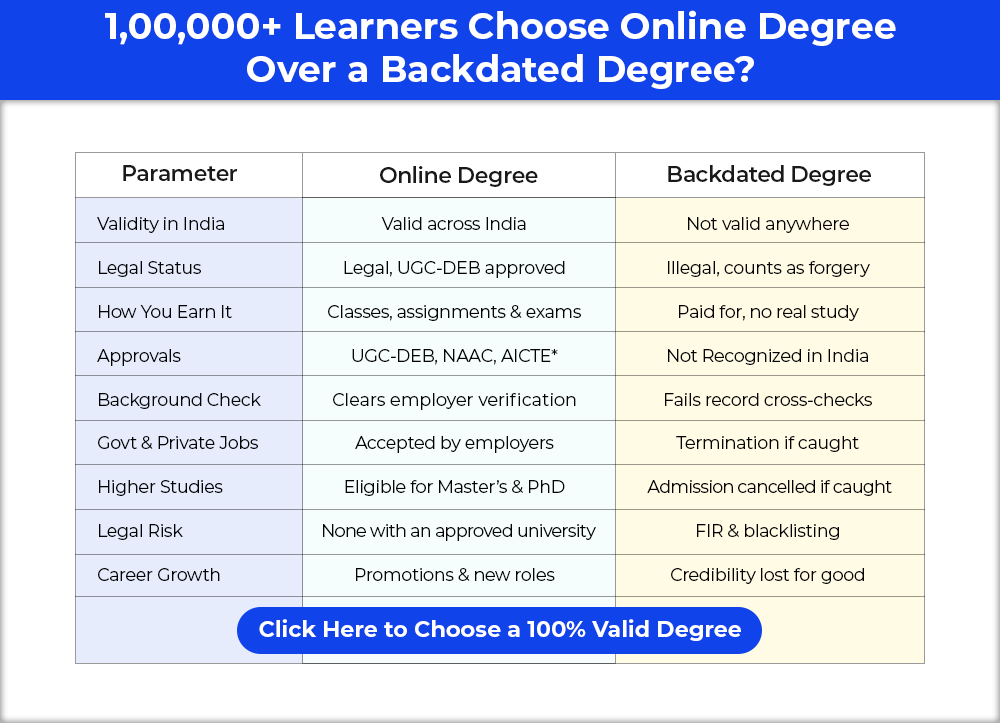
A Backdated Degree is Invalid in India, and it will not be considered as a degree for jobs, higher education, or other official purposes may lead to serious consequences. A backdated degree certificate is a certificate that shows a previous date or academic year than what the situation calls for. However, one should exercise great caution while understanding this phrase, as the issuance of such certificates in a later period does not mean that the certificate is fake.
As an illustration, a university may give out a replacement degree certificate to a graduate some years after graduating from college. This should not be confused with altering the passing year of graduation to make it look like the student graduated some years ago.
A Backdated Degree certificate becomes controversial when one makes alterations to academic dates or examination years in order to fulfill certain employment and admission requirements.
Before taking up the document, make sure you get the date of completion and award from the university. Just because the date on which the certification was awarded comes later than the year mentioned in the degree certificate does not mean that the document is fraudulent.
Legal Risks of Using a Fake Certificate in India
There could be many consequences for using a fake academic document. Depending on the circumstances, the law, and the use of the document, the possible consequences might include:
- The rejection of your job application.
- The termination of your employment.
- The denial of admission, promotion, or any academic benefit.
- Loss of professional credibility.
- Criminal action where an offense is committed.
There are clauses for fake degrees, fake documents with intent to commit fraud, and using any fake document in the Bharatiya Nyaya Sanhita, 2023 (BNS), Chapter XVIII. It is relevant to note that depending upon the nature of the document and the behavior of the student, the law and punishment differ.
A student who uses a forged certificate for the purpose of securing employment or any other benefit shall pay the price. If you are accused of doing something like that, then it is best to seek an Indian lawyer's help.
Fake Degree India: Why Does Verification Matter?
The problem of fake degrees in India is significant as employers and educational institutions consider academic qualifications while taking decisions regarding recruitment, admissions, promotions, and professional competency. Fake qualifications may be detrimental to legitimate aspirants and the reputation of educational institutions. On the other hand, false accusations could harm the career of an honest student. Employers must have a uniform procedure for verifying credentials.
- Ensure that the candidate’s consent is obtained where necessary and gather the necessary information about their academic qualifications.
- Check for the validity of the university and whether the program is approved or accredited.
- Contact the issuing institution or its validation portal.
- Compare the degree with mark sheets and other supporting documents.
- Provide the candidate with an opportunity to clear any inconsistencies.
These steps help organizations make evidence-based decisions rather than relying on a certificate's appearance, rumors, or unverified online claims.
Online Degree: A Better Alternative to Fake Certificates
Fraudulent academic degrees are not a dependable way to enhance one’s career prospects. Such academic degrees might not be valid for the purpose of jobs, admissions, or anything else, and their creation, possession, or submission for illegal purposes will have serious repercussions under relevant law. In case you do not want to jeopardize your career by earning an uncertain academic degree, it is recommended to pursue a genuine online degree program from a UGC-approved university authorized to offer that particular program in the respective academic year.
Online degrees would be a practical option if you want to save time, work while studying at the same time, or study while managing all the other obligations that you have. For those who are working, they should think about getting into an online degree course in fields such as management, commerce, and information technology, among others, depending on what career they have in mind and how they fit in the requirements of admission into such programs. Sites like College Vidya can help you look at the different alternatives in terms of online degrees and universities.
Fake Degree Certificate Complaint: Where and How to Report It?
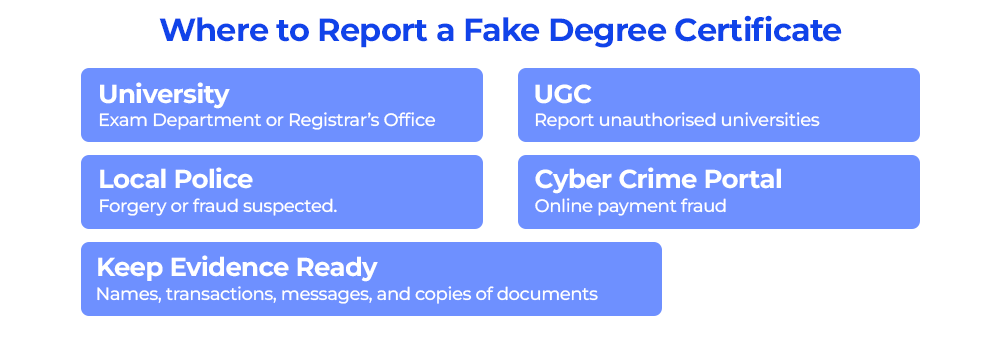
If you suspect that someone has created, sold, or used a fraudulent degree, preserve the available evidence and report the matter through an appropriate official channel.
1. Contact the University
In case the problem involves a particular degree, you may approach the exam department of the university or the registrar's office for verification purposes. You will need to provide all necessary information regarding your degree certificate.
2. Report Suspected Fake Universities to the UGC
If any institution says that it confers degrees through unauthorized channels, you can find details on the official website of the UGC. Information is published by the UGC about such institutions, and it takes the necessary actions within its jurisdiction. Based on the situation, you may also have to approach the appropriate authority of the state or centre.
3. Approach the Police if Fraud Is Suspected
If there is any information regarding fraud in connection with the acquisition of fake academic documents, one may go to the local police and file a complaint with all the necessary documentation. One may provide the names of the students or institutions along with any transactions made, copies of messages exchanged, and copies of the documents obtained.
4. Report Online Payment Fraud
In case you have paid an agent and feel that you have been cheated through online transactions, you should report such financial fraud immediately through India’s National Cyber Crime Reporting Portal or the relevant police complaint channel.
How to Protect Yourself From a Fake Certificate?
Prevention is easier than dealing with a fraudulent qualification later. Follow these practical steps:
- The application should be made through the authorized website of the concerned university.
- Ensure the recognition of the institution and the approval status of the program before making payments.
- Keep your admission letters, fee receipts, marksheets, and examination reports safe.
- Download certificates only from official sources in digital form.
- Do not get fooled by any agent promising degrees without completing any academic requirement.
- Always ask for an explanation from the university whenever there is any mismatch in the certificate details.
In case you find that your certificate is false, you should not present it as authentic. Hold on to all the necessary documents and ask for an explanation from the certifying institution. In case you have submitted an incorrect document, then you should consult your lawyer regarding what to do next.
Conclusion
A fake academic degree certificate can mean losing a job and admission prospects, financial losses, and professional reputation for that matter. Based on the situation, the conscious misuse of a fake academic document can bring about legal troubles.
What is the best thing to do? It is always best to ascertain the legitimacy of the institution, verify academic records through the university concerned, and utilize any kind of online verification service available.
If you are a student, job seeker, professional employee, or even an employer, avoid judging a certificate based solely on its looks. Accurate verification and academic records will always work in favor of legitimate qualifications and those who hold them. A legitimate educational course, which includes a legitimate online degree qualification, is much better than using a fake or misrepresented academic document.