

Suppose you are someone who is driven by the need to interact regularly with people and feel that you can guide meeting business goals for an organization. In that case, sales management is a career with potent opportunities for you.
Sales management is the domain of sales and business development wherein a professional functions at a managerial capacity to guide a sales team to meet certain defined business goals to grow the profits gained by the organization.
This is a very well-developed and fairly compensated career domain across industries and one can easily enter into this career irrespective of their educational background. Starting off as a sales associate, one can gain due experience and escalate to a managerial role.
But before we dive deeper into the selection of sales management as a career, we shall explore various aspects of the domain in detail.
Why Choose a Career in Sales Management?
When it comes to venturing into sales as a career, many individuals consider it an easy entry point into the professional world. However, in addition to being an accessible career, sales management offers several attractive advantages that strengthen its case.
Here are a few of the prime reasons you should consider becoming a sales manager:
- Accessibility of Entry: One of the prime reason to venture into sales management as a career is the ease of entry into this field. Usually, there are no educational restrictions to venture into sales roles and work one’s way up to sales management, hence making the field more accessible to individuals from diverse educational background.
- Potential for Compensation & Perks: With performance-based incentives and lucrative compensation, the scope of sales roles from a financial standpoint is quite appealing, making it one of the most popular career domains in India.
- Gaining Proficiency Over Transferable Skills: Being a sales professional, especially, at the managerial level allows an individual to gain proficiency over a host of transferable skills like interpersonal skills and soft skills which provide a leverage to them even in case they wish to switch their career to any other domain.
- Networking Opportunities: Sales management involves frequent interactions with numerous clients, making up for opportunities to form a strong and wide professional network.
- Potential for Career Escalation: Sales management is a domain wherein satisfactory performance right from the fresher levels has scope for career escalation. Thus, with excellence in performance, the scope available to grow from associate to managerial roles is significantly in sales management.
However, it is also essential to remember that as a career, sales management can be highly competitive, fast-paced and dynamic, requiring considerable efforts to meet business targets while upholding service quality.
Roles & Responsibilities of a Sales Manager
Being a job role at the managerial level, a sales management job includes a holistic participation of the professional in various stages of managing and meeting the business objectives of a firm through sales functions.
Some of the major job responsibilities of a sales manager are enlisted below :
- Development of a nuances sales strategy to meet business objectives in coordination with the team they are managing
- Conducting regular market research and analysis to identify competitive challenges, market conditions, user feedback around product/service, own market positioning etc.
- Working regularly on the budget and resource allocation to the various members of the sales team to ensure seamless and efficient performance.
- Work actively in customer relationships management (CRM) by making use of sales integration tools, CRM tools etc.
- Monitoring sales metrics of oneself and of the various team members being managed so as to evaluate performance, revenue growth and lead quality.
- Regularly managing the team and leading with due diligence, supporting activities like recruitment, training and mentoring for the development of team members.
Key Skills Needed for Sales Management
Sales management as a domain require the professional to possess exceptional conversational and persuasive skills, both of which lie at the heart of closing successful deals with potential customers to grow business. However, with the field evolving rapidly, there are a number of other technical and soft skills which have become crucial to thriving in this role. These have been elaborated upon below.
1) Technical Skills & Knowledge to Succeed as a Sales Manager
Some of the essential technical skills and knowledge domains in which a sales manager must have expertise are listed below. These include proficiency across a number of domains including sales data analysis, forecasting, customer relationship management and so on.
|
Key Skills |
Specifications |
|
Customer Relationship Management (CRM) |
Possessing proficiency in the use of CRM tools including those like HubSpot, Salesforce etc. which enable the tracking of leads, customer interactions, sales activities and so on. |
|
Lead Generation |
A central skill for sales management including the generation of active leads, i.e. potential customers using a myriad of communication strategies, leveraging outbound strategies, market research and so on. |
|
Sales Forecasting & Analytics |
Being able to use various analytical softwares such as Hubspot, Salesforce, Pipeline etc. to analyse available sales data for current insights and make predictions about future sales performance. |
|
Strategic Planning |
This includes the ability to form meticulous sales plans and strategies aligned with the business goals of the firm, backed by concrete research, analytics and forecasting. |
|
Negotiation Skills |
Proficiency and awareness of various negotiation and influence tactics to effectively get stakeholder and customer buy-ins, pitch own ideas and close deals |
|
Sales Integration |
As a manager of sales, the professional should also be able to seamlessly integrate all aspects of sales activities including strategic planning, activities, team collaboration, closing deals, CRM etc. to enhance overall sales performance of oneself and their team. |
2) Soft Skills to Succeed as a Sales Manager
While expertise in technical areas and certain hard skills are certainly needed to thrive as a sales manager, soft skills and interpersonal competence are at the heart of this role. This is so because the core components of this job role require the person to regularly interact with and manage clients, potential customers and stakeholders to generate leads.
The major soft skills important to thrive as a sales manager have been mentioned below:
|
Key Skills |
Specifications |
|
Communication Skills |
Having excellent skills of verbal and written communication so as to influence and impact clients and customers to convert them into active leads. |
|
Strategic Thinking |
Having a strategic acumen so as to be able to visualise the larger scheme of business objectives and accordingly tailor conversations with customers to generate more leads. |
|
Adaptability |
Adaptability is a key skill in sales management which enables a professional to mould and tailor their communication styles and negotiation tactics to match the needs of the situation and each customer. |
|
Emotional Intelligence (EI) |
To be able to connect with customers and clients as well as build trust and rapport, a sales manager must be adept at picking and regulating the various emotional reactions that may get elicited during sales calls. |
|
Leadership Skills |
The ability to lead is a central skill needed for a sales manager to connect with their team, align strategies of the organisation with team goals as well as inspire team members towards excellence. |
|
Problem-Solving Ability |
Being able to skillfully manage internal and external problems and concerns that can arise in the agile and dynamic nature of sales management. |
What are the Career Opportunities for Sales Management (Types of Options available in Sales Management)
In the field of sales and business development (often commonly abbreviated as “BD”) there are a number of sales channels which are targeted. A sales manager or a professional interested in sales can seek general experience in the BD domain followed by choosing to specialise in a specific channel, e.g. international sales, territorial sales, regional sales, retail sales, channel sales, e-commerce and so on.
These career domains differ based on the size of the area/territory under the supervision of the manager as well as specific channel through which the business targets are being met.
In general, sales management is a lucrative field from a financial standpoint, given the double advantages of a fixed pay and a variable, incentive-driven component. The further details of the career opportunities available for a sales manager to explore, are provided below.
|
Career Option |
Average Salary (Per Annum) |
|
Sales Manager |
INR 6,50,000 |
|
Regional Sales Manager |
INR 12,00,000 |
|
Business Development Manager |
INR 7,00,000 |
|
Channel Sales Manager |
INR 6,00,000 |
|
Sales Operations Manager |
INR 11,00,000 |
|
Retail Sales Manager |
INR 5,00,000 |
|
e-Commerce Sales Manager |
INR 9,00,000 |
|
Key Account Manager |
INR 10,00,000 |
Career Analysis: Scope of Advertising and Communications
To fully analyse the nature of this career domain, it is important to dive deep into the industry trends, costs involved in venturing into the career as well as the common growth trajectory that can be achieved as a sales manager in India. Further details of the same have been provided below.
Demand for Sales Managers : Industry Trends
As digitization and automation are taking strides, the career of sales management is also seeing major transformation in its industry practices.
Some insights and statistical figures providing light into the field of sales management are provided below:
- Forecasts predict that nearly 75% of customer interactions will be supported by AIand automation tools by 2026
- Automation and a number of AI-driven tools have found usage in sales management, especially in enabling professionals to personalise their customer interactions.
- There is an increasing focus being laid on relationship building in the sales domain, shifting the focus from transactional selling to customer centricity and trust.
- Account-based marketing or ABMis a new sales model being deployed by many organisations which includes personalised outreaches to high-value accounts.
- Recent surveys post the coronavirus pandemic indicate that a major chunk of sales functions are shifting to the remote and virtual domain, including virtual client meetings, product demos, closing deals etc.
- Big data and predictive analytics are coming up as two of the highly demanded skills in sales management as data forecasting and analytics are taking centre-stage in sales functions.
Fees & Cost Involved in Becoming a Sales Manager
Sales management in itself is an accessible professional domain to enter into. There is no stream or educational background related constraints to become a sales associate and escalate to become a sales manager.
However, as professional domains are becoming more nuanced and specialised, many organisations demand that sales professionals have specific and tailored education in marketing, sales or business development.
Accordingly, there are a number of UG and PG degrees, certificates and diploma courses in this specialisation with varying fee ranges that allow students access to quality higher education in sales and business development, making up for a strong professional base.
The average course fee associated with a number of such online and regular courses are tabulated below for reference.
|
Sales Management Courses |
Approximate Course Fees |
|
BBA in Sales & Marketing |
INR 1,50,000 |
|
Bachelor of Commerce (B.Com ) |
INR 1,00,000 |
|
INR 80,000 | |
|
INR 1,00,000 | |
|
Online B.Com in Accounting & Finance |
INR 2,00,000 |
|
INR 80,000 | |
|
INR 1,50,000 | |
|
INR 2,00,000 | |
|
INR 2,00,000 | |
|
PG Diploma in Sales & Marketing |
INR 1,00,000 |
|
Certified Sales Manager |
INR 3500 |
|
Professional Certificate Program in Marketing and Sales Management |
INR 1,60,000 |
Career Growth Trajectory of Sales Management
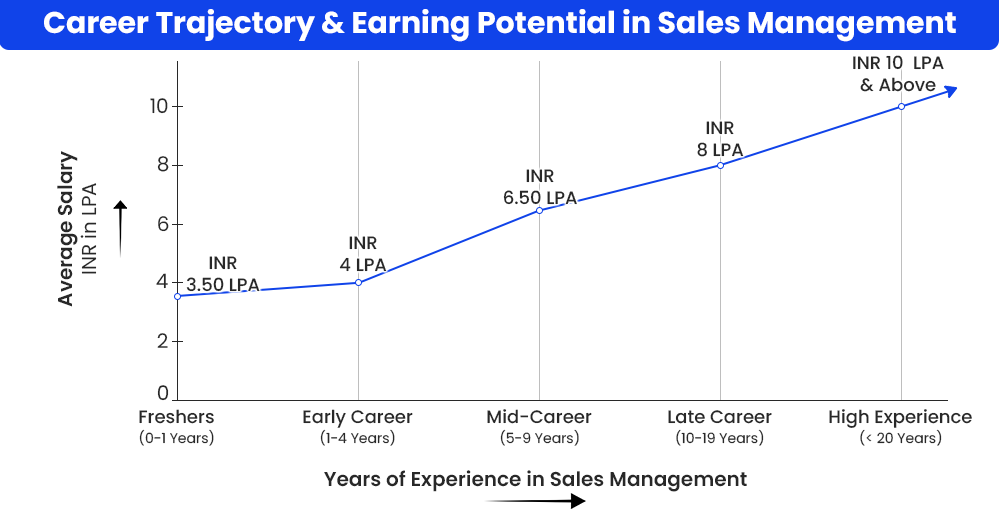
The growth trajectory in the field of sales and business development is quite appealing. There are quite well-defined hierarchies to escalate through in sales management. While one can start off as a sales associate as a fresher, one can work their way up through hierarchies like inside sales representative, sales team leader, account executive (AE), sales manager, regional sales manager and to higher rungs like sales engineer.
The compensation in sales roles usually encompasses two components–fixed component or the base salary and the variable component or the incentives. With sales proficiency, one can enhance their income significant through added incentives.
With further years of experience, the average compensation one can earn grows further, as represented in the graph below:
Career Navigator: What Course to Pursue for a Career in Sales Management?
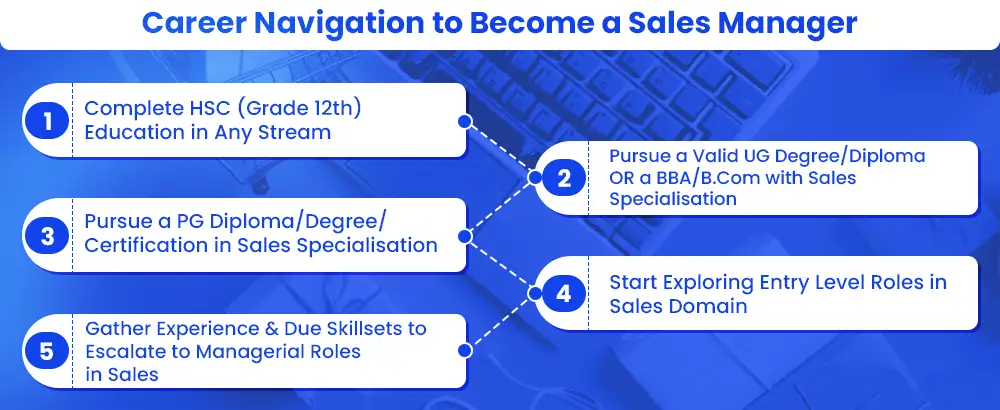
When it comes to establishing a career as a sales manager, there are usually no particular degrees or courses mandatory for eligibility. In turn, individuals from any educational background and stream are free to venture into a career in sales.
While a high school diploma may be mandatory to apply to associate level roles in sales, a college undergraduate or postgraduate degree may be required at managerial levels. There are courses like B.Com, BBA etc. which offer specialisations related to sales as enlisted above with details. PG levels degrees and diplomas also offer focused and specific education in sales and business development.
An overall trajectory for developing a career in sales has been provided below:
There are a number of eminent institutions in India in the public and private sector units which offer higher education in sales, marketing, advertising and related domains. These colleges and universities usually offer a range of qualifications including those like undergraduate degrees, diplomas as well as potsgraduate degrees, diplomas and certifications. Such courses are available for students to pursue not only in the regular classroom mode but also in the fully online mode.
Some of the notable educational institutions providing such courses have been enlisted below: