

Quick Overview: A fake certificate is an invalid certificate because it is either fake or issued illegally. You can report the certificate to the police, the issuing institution, or any other educational authority. Do not forget to include evidence with your application.
In India, fake degree certificates are considered invalid and can lead to serious legal consequences. A fake degree certificate can ruin a student’s career, shake confidence in educational institutions, and even lead to major legal issues. If you find out that a fake degree certificate was involved in recruiting someone, or even think that there is a chance of fraud, you need to know how to deal with the situation.

In India, a case of a suspicious degree certificate can be filed with the police, the particular university, and the relevant education department. This guide tells you about all the steps you need to take in order to make your case of a fake degree certificate valid.
What Is a Fake Degree Certificate?
A Fake Degree Certificate is a fake certificate stating that a student has graduated from a university or college. Below are some common forms of fake degree certificates:
- A fake degree certificate that has been issued even without completing the course.
- A certificate bearing a fake name of a university or a fake university registration number.
- A legitimate certificate whose information, such as qualifications, grades, or year of graduation, has been changed.
- A degree certificate that has been issued by a university that does not issue it.
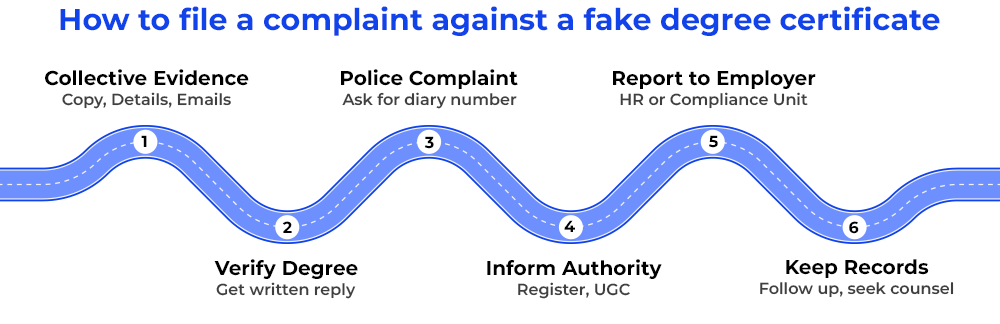
How to File a Complaint Against a Fake Degree Certificate in India?
Follow these steps to report a suspected fake degree certificate in India.
Step 1: Collect Evidence
Before filing a complaint, collect all the relevant information regarding the suspect certificate. The information collected may be any of the following:
- A photocopy or picture of the suspect certificate.
- Name and other information of the student.
- Name of the university, course, and year of graduation.
- Documents of employment application, if any.
- Correspondence via email or messages, advertisements, etc., which were used for the certificate.
- Confirmation obtained from the university, if any.
Avoid collecting evidence illegally or making fake allegations in public.
Step 2: Verify the Degree With the University
- Reach out to the university mentioned on the certificate to get a confirmation regarding the qualification.
- The certificate number, student’s name, course particulars, and year of passing should be mentioned wherever possible.
- Ask for a written confirmation as to whether the degree is from that particular institution. Should the university find any discrepancies, keep a record of their written response, as it could serve as proof to support your case.
- You could also check whether the university is recognized on the UGC website https://www.ugc.gov.in.
- Bear in mind that the recognition of the university and the authenticity of the certificate are two different things.
Step 3: File a Police Complaint
If there is evidence of fake, cheating, or fraudulent use, submit a written complaint to the local police station. Your complaint should include:
- Your name and contact details.
- The accused person's details, if known.
- A clear description of the suspected fake degree certificate.
- Information about how and where the certificate was used.
- Copies of supporting evidence and university verification.
- A request to investigate the suspected offence.
A request for an acknowledgment or the diary number may be made. The police will evaluate the case and apply the relevant laws as per their judgment. If your case involves cybercrime, such as online fraud, you can visit the website for Cyber Crime.
Step 4: Inform the Relevant University or Education Authority
- If the certificate is purported to be issued by a university, contact the registrar or examination wing of the university.
- In the case that it relates to recognition of an institution or fake university, lodge the complaint with the relevant educational authority, such as the UGC, etc., as may be applicable.
- Provide the name, address, web address, details of the certificate, and relevant documents wherever available.
- The authority will consider the matter and act on the same in accordance with law.
Step 5: Report the Matter to the Employer, If Relevant
- If there is a suspicion that the person has obtained the degree certificate through fraudulent means and then used it to obtain a job or a promotion, the Human Resources department or Compliance Unit of the organization must also be notified.
- Prepare a factual report on the situation in writing along with the evidence and ask for confirmation from the issuing university.
- The employer has to follow the internal policies of the company, employment laws, and the investigation process before disciplining the employee.
Step 6: Keep Records and Follow Up
In the wake of submitting your fake degree certificate complaint, make sure that you keep all documentation relating to this process. These should include:
- Acknowledgment of receipt or the complaint reference number.
- Date and venue of lodging the complaint.
- Email communication with the university or other authorities.
- Verification report and other documentation.
- Replies from the police or relevant institutions.
In the absence of any reply, follow up with the concerned authorities. In cases where there is considerable financial or employment loss associated with the complaint, it is advisable to seek legal counsel.
What Are the Legal Consequences of Using a Fake Degree Certificate in India?
Using a fake degree can lead to criminal charges, workplace repercussions, revocation of appointment, or other consequences, depending on the facts. Some provisions in Indian law on fake documents, cheating, and fraudulent use of documents are in the Bharatiya Nyaya Sanhita, 2023 . The sections and consequences will depend on the offense and its proof. Other consequences can be:
- Rejection of the employment application.
- Disciplinary or termination action, in accordance with appropriate procedures.
- Revocation of admission or qualification, if appropriate.
- Financial or reputational harm.
- Further investigation of the organization or students.
A suspected fake degree certificate does not automatically establish criminal guilt. The competent authorities must assess the evidence and follow the applicable legal process.
How Can You Avoid Fake Degree Certificates?
Students, employers, and recruitment agencies can take simple precautions to reduce the risk of degree fraud.
- Verify your degrees with the university itself.
- Check whether the university is recognized using official sources of the UGC.
- Be careful about any universities offering degrees without studying and exams.
- Do not fall into the trap of those agents who offer degrees in return for money without any academic process.
- Do not forge any academic documents.
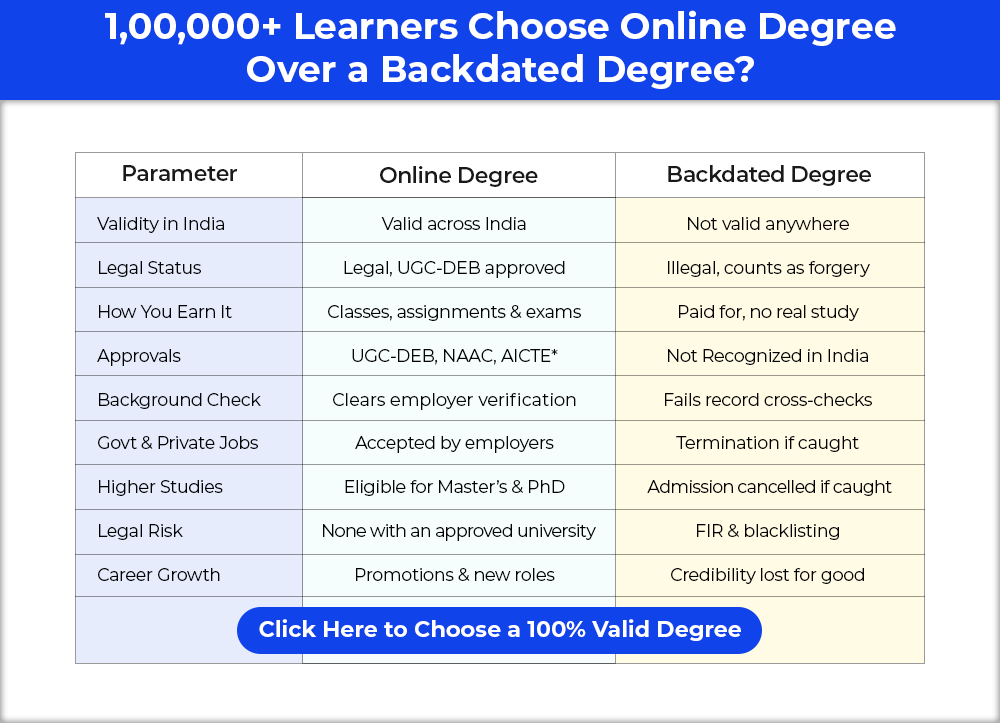
Instead of Fake Degree Certificates, Choose an Online Degree with College Vidya
If you lack sufficient time to attend a college, or you are a working student who wants to upgrade your career, getting an online degree will be a wise option rather than using a fake degree certificate. A real degree will assist you in developing your skills and open doors to more career prospects.
College Vidya can provide students and working professionals with the option of searching for online degrees from universities that are recognized. You need to make sure that the university is UGC approved and the online course that you are planning to attend is also recognized or allowed to be offered online.
One should never opt for a bogus online degree program because it would jeopardize one's career. It is always important to verify the authenticity of the university and its courses before making the choice of attending them.
Conclusion
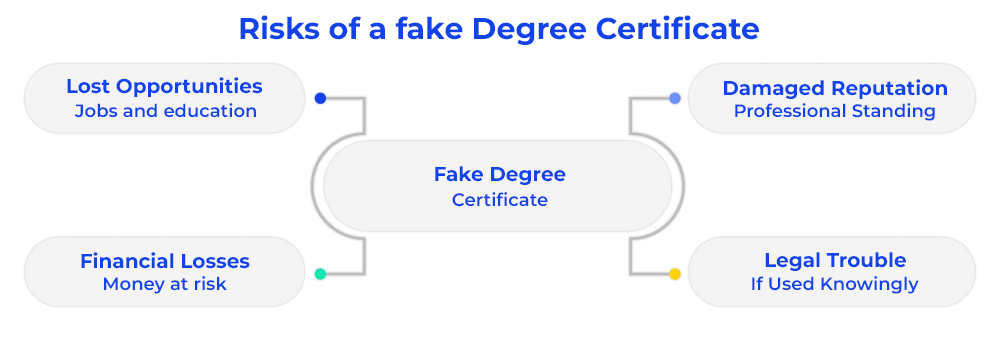
Some of the risks associated with possession of fake degree certificates are the loss of job opportunities or education opportunities, financial losses, and damage to one's professional reputation. At times, there might be legal consequences in case one uses such a certificate knowing that it is forged. In order to prevent all these challenges, one needs to confirm the validity of the educational institutions.
Whatever your role, whether a student, job seeker, working professional, or employer, do not be fooled by looks. Verification and accurate academic credentials will help to preserve the validity of those qualifications and those that rely on them.
Using a proper educational path that involves having an appropriate online degree from an appropriately accredited institution is a better alternative when developing future career prospects rather than using any fake academic credentials.