


 Expert Interviews
- University Reviews
- Career Guide
 Video Counseling
Important Facts
- Ask any Question - CV Forum

How to Upskill with Online Degrees After a Career Break?
vaishnavi Sep 18, 2025 1K Reads
Are you also that person who is confused about which field will be a perfect match for you after a long career gap? When professionals change their jobs and move into a new area in the industry, it is called a career switch. A career switch can be done by anyone, regardless of age or experience. People often change their careers when they do not like their old job, or they want to pursue new interests.
Career switches also improve work-life balance, seek enhanced pay, or find better job satisfaction. A job switch is an option for both recent graduates and experienced employees who are eager to gain new skills and apply them to a successful career transition.
Let’s explore how you can pivot to a new career successfully through online bachelor's degrees or postgraduate courses, and why platforms like College Vidya offer a credible path to do just that.
Why More Professionals Are Taking Career Breaks Today
Career breaks are not regarded as a setback anymore but as deliberate decisions made for personal and professional development. More professionals from all over the world take breaks from work to work on their mental well-being, caregiving, skill acquisition, or simply to redefine their life objectives. LinkedIn reports that approximately 62% of professionals worldwide have taken a break from work, and another 35% are likely to do so in the near future.
In the United States, a survey by HR found that 47% of employees have had a career break sometime in the past, and statistics from more than 27 million resumes indicate that career gaps lasting more than 12 months now occur in 25% of profiles, compared to 19% five years ago.
Short-term gaps are even more prevalent, with continuously employed professionals now constituting fewer than half of the workforce. Mental well-being is a primary call for this trend, especially among young colleagues.
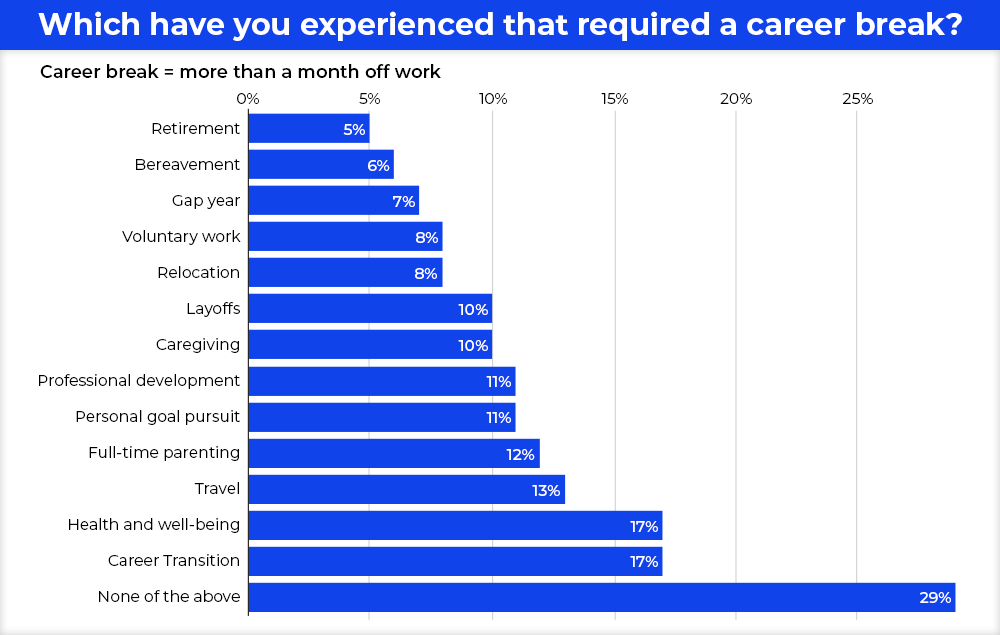
In the United Kingdom, 99% of children aged 18 - to 24 and 61% of 25 to 34-year-olds have taken sick leave for stress or burnout. The tendency to break the career indicates a conscious step, which is against more balanced, meaningful approaches to learning, life, and work.
The Challenges of Restarting a Career After a Break
Sometimes people take a career break for many reasons, such as marriage, family pressure, health problems, but the main reason is to avoid burnout from work. But returning to work after a break often presents challenges that feel heavy sometimes.
The biggest challenge is the fear of not being aware of trends like Technology, software, and working methods that are developing fast. A person returning after a few years may be out of contact, especially in areas such as IT or marketing. Employers may also be surprised if the person is skilled to work. This can reduce confidence and make the interview process scarier.
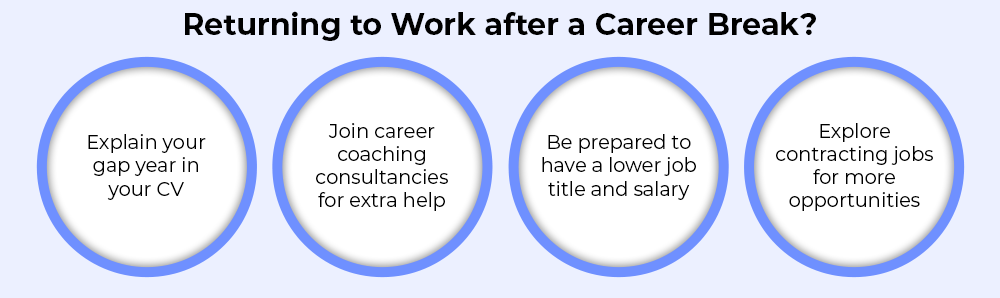
Returning to work after a career break?
- Explain your gap year in your CV.
- Join career coaching consultancies for extra help.
- Be prepared to have a lower job title and salary.
- Explore contracting jobs for more opportunities.
Another is to rebuild a professional network. While taking a break, most individuals lose contact with previous industry contacts or colleagues. A network helps one to get new opportunities, and without it, it takes more time to find a job. Older contacts and networks should be established by participating in events or joining online forums to connect with new professionals in the industry.
There's also the matter of how to explain the career gap. Employers might interpret it as a negative sign. Being truthful and upbeat when discussing the break is necessary. Revealing what was gained during the period—whether learning to run a household, volunteering, or taking classes, can be an indicator of development and responsibility.
Sometimes, balancing work life and corporate life, and after taking a long break and getting back to work, can be a new challenge for the person. To reduce the stress, it is good to start with part-time work or freelancing, and slowly, slowly, you can get on track.
Even with these obstacles, it is extremely possible to resume your career. Most people come strong with new ideas and skills. The most important thing is to be patient, continue to learn, and rely on your values. Getting skills can make a bridge between the differences by taking small courses, an online degree, or an internship. A powerful CV, positive attitude, and concentrated goals can go a long way.
It is fun and daunting to pick up your career after a career gap. Most individuals take breaks for personal issues, upbringing, family care, medical issues, or burnout. Returning to work after a break, however, tends to have stumbling blocks that feel burdensome in the early stage.
The greatest challenge is the fear of not knowing about trends such as Technology, software, and work methods that are evolving quickly. The individual coming back after a couple of years can be out of touch, particularly in fields like IT or marketing. Employers can also be shocked if the individual is competent to work. This can lower confidence and make the interview process more intimidating.
Another is reconstructing a professional network. During a break, most people lose touch with old industry contacts or colleagues. Networking assists in getting new job opportunities, and without it, it takes more time to get hired. Reconquering old contacts and networking by going to events or signing up for online forums to reach out to new professionals within the industry must be accomplished.
There is also the issue of how to frame the career gap. Being honest and positive when explaining the gap is the main point. Sharing what was accomplished during the time, how to manage a household, volunteering, or course attendance can be a measure of growth and maturity.
Work-life balance can also be difficult. Returning professionals might have new responsibilities at home, and it does take some time to readjust to work. To make it easier to adjust, it is a good option to begin by doing flexible or part-time work if possible.
How An Online Degree Can Be A Game-Changer After A Career Gap
Here are the most important points that will help you understand how an online degree can fulfill your career gap.
Flexibility That Fits Your Life
One of the biggest benefits of an online degree is flexibility. You do not need to give up your current employment, move, or follow a strict schedule. You can study from home according to your own program, and according to simplicity. It is especially useful to have parents, nurses, or someone to balance many areas of responsibility. If you are an early riser or a night owl, online learning lets you learn at your own speed and time.
Affordable Learning
Traditional college courses are expensive, especially when you factor in travel, housing, and other expenses. Online courses are cheap, and you can save money while getting a high-quality education. Many courses also provide payment schemes or financial assistance, making it easy to invest in your future without debt.
Skill-Specific Development
Online degrees are created to provide practical, work-ready skills. If you're interested in business, healthcare, technology, or design, there's a program to help you reach your objectives. Select courses that align with the job market and understand what employers really want. This helps you change careers or return to the workforce confidently.
Access to Global Opportunities
With an online program, you are not limited to your country or to on-campus. You can take courses from leading universities around the world. It provides a new opportunity and lets you learn from leading figures in your career. This allows you to network with classmates and professionals, which you otherwise do not have access to, and which you can use when you apply for new employment.
Increasing Confidence and Credibility
For those returning to work after a break, an online degree shows employers that you’re serious about your career. It proves that you’ve kept your skills up to date and are ready to contribute. A job switch is something that everyone does for graduates and experienced employees who want to gain new skills and also want a good career transition.
A Smart Step Forward
Whether you start a new career or go in a different direction, providing an intelligent, flexible, and cheap solution to expand online degrees. They enable you to gain new skills, gain confidence, and unlock the doors to new opportunities. When the change is the only stable, it is one of the most powerful assets you have. So if you are thinking of making a step, consider an online degree - this can only be the key to your next chapter.
Top Online Degrees That Help You Relaunch or Switch Careers
You also always want to pursue an online degree that can enhance your skills and knowledge. Here are some breakdowns:
For UG, you should have completed the 12th grade (or equivalent) from a recognized board.
|
Online UG Degree (3 years) |
Career Opportunities |
|
Public Relations Specialist, Journalist or Content Writer, Marketing Executive, Human Resource Executive, Civil Services Preparation, Social Media Manager, NGO Worker, or Social Worker, and many more |
|
|
Biostatisticians, Scientific Assistants, Lecturers, Research Analysts, Chemists, and many more |
|
|
Accountant, financial analyst, and tax consultant, as well as emerging fields like digital marketing, Data analysis, and many more. |
|
|
Marketing, finance, human resources, and operations, Marketing managers, financial analysts, HR executives, operations managers, and many more. |
|
|
Software Developer, Web Developer, Systems Analyst, Data Analyst, Technical Support Engineer, Cybersecurity Analyst, among many others. |
For PG courses, you must have passed a bachelor's degree from a recognized university with a minimum 50% score (not required by many online colleges) in the general category and some percentage lower in reserved categories.
|
Online PG Courses (2 years) |
Career Opportunities |
|
Education, media, public relations, social work, content writing, journalism, and roles in government and the corporate sector, among many others. |
|
|
Data Science and Analytics, Teaching and Research, IT and Software Development, Government Jobs, Environmental Science and Sustainability, and many more. |
|
|
Financial analysts, tax consultants, accountants, auditors, and in various positions within the banking and insurance sectors |
|
|
Management consultant, entrepreneur, project manager, operations management, financial analyst, human resources, information technology, digital marketing manager, and many other positions. |
|
|
Software developer, data scientist, cloud computing specialist, cybersecurity analyst, software developer, data scientist, cloud computing specialist, cybersecurity analyst and many more. |
You must have at least a UG and three years of experience to work as an online database administrator.
|
Online Doctorate Courses |
Career Opportunities |
|
Chief Executive Officer, Management Executive, Corporate Training and Development, Management Analyst/Consulting, Management/Organizational leaders, and many more |
Top Universities Offering Online Degrees
Here are the universities that can help you pursue an online degree:
|
Universities |
University USPs |
|
UGC, NAAC, WASC, and QAA have all accredited the program. Offers QS-ranked online MBA programs. |
|
|
Known for global tie-ups and placement support. |
|
|
Offers various online programs with specializations. |
|
|
A recognized institution for online degrees. |
|
|
Another option for online degrees. |
|
|
Known for its online programs. |
|
|
Part of Manipal Academy of Higher Education, which provides a variety of online programs. |
|
|
Offers online programs in various disciplines. |
|
|
A state university that also offers online courses. |
|
|
Offers online programs and is known for its online education. |
Real-Life Stories: How Online Degrees Helped Professionals Restart Their Careers
1. Anjali – From Stay-at-Home Mom to HR Manager
“After spending six years away from the workforce to raise her children, Anjali struggled to find her footing again in the job market. Despite having prior experience in human resources, she found that industry tools and hiring practices had evolved significantly. Determined not to be left behind, she enrolled in an online Master’s in Human Resource Management from a UGC-approved university. The flexible format allowed her to manage her family and studies simultaneously. Within a year of completing her degree, she landed a job as an HR Manager at a mid-sized IT company. Her updated knowledge and proactive mindset impressed her employers, and she credits her online degree for helping her rebuild her confidence and career.”
2. Raj – From Field Engineer to IT Project Lead
“Raj had been working as a field engineer in oil and gas for almost a decade before taking a break due to a health issue. During his recovery, he realized he wanted to transition into tech project management, a less physically demanding but intellectually engaging role. He pursued an online MBA in IT & Project Management while freelancing part-time. By the time he completed his degree, he had built up a small portfolio of IT coordination projects. Shortly after, he was hired as an IT Project Lead at a consulting firm. For Raj, the online degree wasn’t just an educational tool; it was the bridge to a safer, more satisfying career path.”
3. Meena – From Career Break to Digital Marketing Specialist
“Meena left her career in sales after getting married and relocating internationally. Years later, she wanted to return to work but wasn’t interested in her old field. Curious about digital marketing, she enrolled in an online PG diploma in Digital Marketing through a platform like College Vidya. She completed live projects and certifications in SEO, content marketing, and Google Ads, all from home. With her portfolio in hand, she applied for freelance roles and now works full-time as a Digital Marketing Specialist for an e-commerce brand. Her online degree helped her build entirely new skills and pivot to a booming industry all on her terms.”
How to Choose the Right Online Degree for Your Career Comeback
The online degrees have also become more prevalent and mainstream over the past few years. Most employers now view them as equal to standard degrees, particularly when some specific factors are in place. These factors assist in demonstrating that the degree is not just legitimate but also applicable in the workplace.
-
Accreditation of the Institution
The very first thing they check is if the school that provides the online degree is accredited. Accreditation is when the school has qualified to certain standards of quality. If the degree is from a very good and well-established university, then employers will appreciate it more.
-
Relevance to the Job
Companies like to understand how the degree is related to what they do. If the online degree helps find relevant skills for the job, such as project management, data analysis, or business strategy, it is more valuable.
-
Practical Skills and Knowledge
Online courses also emphasize practical skills. They usually incorporate case studies, collaborative projects, and tasks that show real-life scenarios. If the graduate can demonstrate how the skills were applied in their workplace or within the course, it adds value to the degree.
-
Time Management and Discipline
Finishing an online degree while in employment or running other commitments demonstrates exceptional discipline. It indicates that the individual is capable of handling time, concentrating, and delivering on time. These are attributes valued by employers and desired in potential leaders.
-
Reputation of the Program
Some of the online programs are operated by leading universities and enjoy a good reputation. If the program is renowned for high standards and satisfactory results, employers tend to believe in it. A recognized name can go a long way.
-
Capability to Implement Learning
The company values people who can take what they learn and use it to solve problems or improve performance. After doing an online degree, you can also get a hike and promotion according to your skills and creativity.
An online degree is as valuable as a regular one if it is from a reputable school, provides useful skills, and is supported by quality performance. It is not so much how the degree was obtained that is important, but how it contributes to making the individual grow and succeed in their career.
Industries Where Online Degrees Are Highly Respected for Career Comebacks
The following are some of the prominent industries that have a high demand for online degrees:
-
IT & Software Development
The IT sector is one of the largest users of online education. With frequent innovations in programming languages, frameworks, and tools, continuous upgrading is necessary.
- Popular online degrees: Online MCA, Online M.Sc. In Data Science, Online BCA, Online PG Diploma in AI/ML
- Why it works: Employers assess skills and certificates instead of traditional classroom learning. Project portfolio, coding tests, and tools are the most important.
-
Banking, Finance & FinTech
The industry requires both technical and management talent. Given regulatory changes and innovative financial products, finance employers appreciate candidates who are actively learning and evolving.
- Popular Online Degrees: Online MBA in Finance, Online PG Diploma in FinTech, Online B.Com with ACCA
- Why It Works: The synergy of money smarts and data/tech alignment is essential, as both are now needed in many jobs.
-
Tech Degree
One of the biggest challenges is that people are not aware of the online industry and market trends. The professionals working in curriculum development, instructional technology, or education sales gain firsthand experience.
- Popular Online Degrees: Online MBA in Oil & Gas Management, Export and Import Management, Disaster Management, and many more.
- Why It Works: These programs provide flexibility and applicability in a digitally-native environment.
-
Logistics, Supply Chain & Operations
With increasingly intricate global supply chains, businesses are seeking operations management and analytics-trained professionals.
- Top Online Degrees: Online MBA in Logistics & Supply Chain Management, Online PG Diploma in Operations
- Why It Works: Industry-relevant coursework and simulation render online degrees a convenient choice for working managers.
Online degrees are not just accepted, they're expected in industries where learning agility and digital literacy are key to staying competitive.
Final Thoughts: Your Career Break Doesn’t Define Your Future
Taking a career break is no longer seen as a setback. It’s a strategic pause. Whether your time away was due to personal responsibilities, burnout, or the need to rediscover your passion, it can be a powerful launching pad for something greater. The professional world is changing, and today’s job market values resilience, adaptability, and continuous learning more than a perfect career timeline.
Online degrees are turning out to be a dependable link between where you are and where you wish to be. They provide the potential to study at your own rate, the possibility of acquiring job-ready skills, and the respectability that is required to impress recruiters. Whether you wish to get back to your old job or begin anew in an entirely new profession, the resources are within your reach.
FAQs (Frequently Asked Questions)
Yes. Unless they are from fake or unaccredited institutions, most respectable employers today do accept online degrees, particularly if they are from accredited universities and emphasize employment-based skills. The trick is to enroll in a program from a UGC-recognized or internationally accredited university.
Yes. Online degrees are all about flexibility. You can go at your own pace, watch pre-recorded lectures, and complete your coursework on your own time, which is great for working professionals or homemakers.
Yes, online degrees are widely employed by students as a means of making a switch into new fields. For instance, you can make a switch from teaching to online marketing, or from engineering to management, provided you choose the correct specialty and develop your skill set.
Be truthful and assertive. Discuss what you learned during your break, whether soft skills such as time management or hard skills via online courses. Employers appreciate development, flexibility, and proactive upskilling.
All online universities provide student support, mentorship, career guidance, and placement services. Websites like College Vidya even assist you in selecting a suitable course, comparing courses, and enrolling comfortably.
Online degrees tend to be cheaper than their offline counterparts. Prices differ from university to university, but you usually have the options of EMI, scholarships, or government-sponsored websites that make learning affordable.
By vaishnavi
3 Years of experience/ academic writer/ freelance writer
An academic writing expert and a freelancer with an experience of 3 years.
Every query is essential.
Our team of experts, or experienced individuals, will answer it within 24 hours.
Recommended for you
Tired of dealing with call centers!
Get a professional advisor for Career!
LIFETIME FREE
Rs.1499(Exclusive offer for today)

Pooja
MBA 7 yrs exp

Sarthak
M.Com 4 yrs exp

Kapil Gupta
MCA 5 yrs exp
or

Career Finder
(Career Suitability Test)
Explore and Find out your Most Suitable Career Path. Get Started with our Career Finder Tool Now!

ROI Calculator
Find out the expected salary, costs, and ROI of your chosen online university with our free calculator.