



Quick answer: M.Tech cannot be joined straight away through a standard 3-year Bachelor of Science degree program. M.Tech is a course in engineering, and most universities and colleges demand at least a 4-year B.Tech/B.E. Degree or a 4-year Bachelor of Science degree or a master's degree in some relevant science discipline as a minimum requirement to join.
Through this blog post, we will learn about the precise position of B.Sc. degree holders, what has been changed in NEP 2020, relevant entrance exams, and possible alternative routes available to you. Master of Technology, or M.Tech, is a two-year post-graduation engineering course program. The program is enrolled by candidates after B.Tech or learners who have studied computer science, physics, mathematics, and statistics.
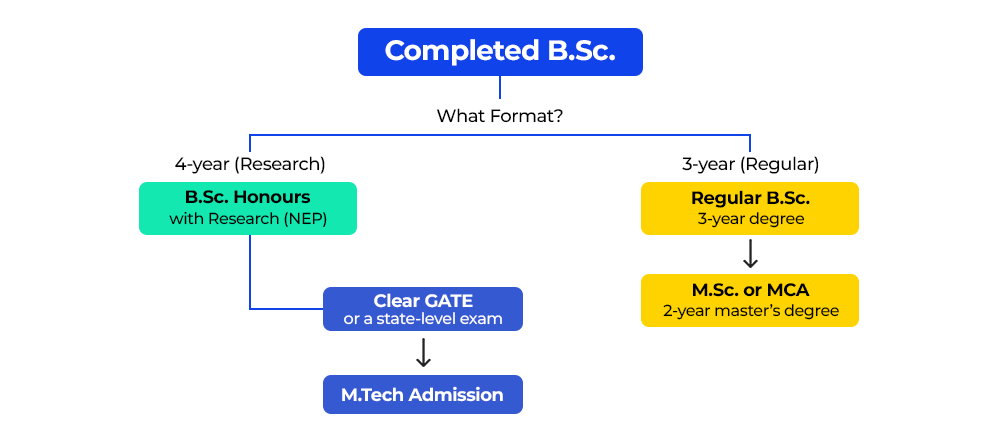
That said, there are two routes for a B.Sc graduate to reach an M.Tech degree:
- Do an M.Sc (or MCA) after your 3-year B.Sc. program, then apply for M.Tech. This is the most common and widely accepted path.
- Complete a 4-year B.Sc (Honours with Research) / B.S. degree under NEP 2020. This is also a recognised, GATE-eligible qualification in its own right, and it's the newest, fastest-growing way for science graduates to reach a technical postgraduate degree without a separate M.Sc in between.
Either way, learners need to clear an entrance exam. The entrance exam, GATE, is necessary to enroll in the top-tier colleges and institutes.
An Overview of M.Tech
Here is an overview of the M.Tech program:
|
M.Tech Program | |
|
Parameter |
Details |
|
Full Form |
Master of Technology |
|
Education Level |
Postgraduate |
|
Duration |
2 years |
|
Standard Eligibility |
|
|
Course Fees |
₹2–10 Lakhs (varies by institute type) |
|
Entrance Exams |
GATE, OJEE, IIT-H PGEE, AP PGECET, BHU PET |
|
Top Institutions |
IITs, NITs, IIITs, VIT, BITS Pilani |
Can I apply for M.Tech after B.Sc?
Not directly if you studied a 3-year B.Sc. degree program. However, a 4-year B.Sc program can apply for an M.Tech program. M.Tech is a postgraduate technical degree, and its curriculum has a certain depth of engineering fundamentals that a standard 3-year B.Sc simply doesn't cover. So universities set the bar at either a B.Tech or a 4-year B.Sc. or a master's-level science qualification that can substitute for an M.Tech degree program.
There are two situations where a B.Sc actually can lead somewhere:
Route 1: The 4-Year B.Sc (Honours with Research) Route—NEP 2020
Since NEP 2020's rollout, many Indian universities now offer a 4-year B.Sc (Honours with Research). This program is also listed as B.S. (Research) as part of the multiple-entry-exit undergraduate framework. This isn't the same as a regular 3-year B.Sc with an extra year tacked on. The 4-year B.Sc. graduation includes a dedicated research component in the final year, and GATE officially recognizes it as a separate, distinct eligible qualification, listed alongside B.Tech/B.E. in the GATE brochure.
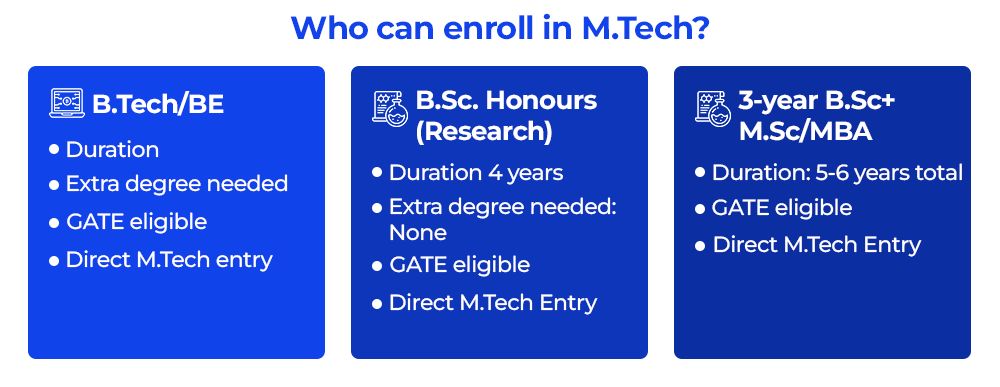
This matters because it means a 4-year B.Sc (Research) graduate can appear for GATE and be considered for M.Tech seats without first doing an M.Sc. If your university offers this NEP-aligned 4-year B.Sc track, it's worth checking whether it's structured as a research degree, as mandatory for GATE eligibility.
Route 2: M.Sc or MCA After a 3-year B.Sc
If you've done a regular 3-year B.Sc, the established route is:
|
How to do M.Tech after B.Sc.? |
|
Once you hold the master's degree, you become eligible to sit for GATE and apply to M.Tech programs the same way a B.Tech graduate would.
Eligibility Checklist for M.Tech After B.Sc
Read the eligibility carefully here for M.Tech after B.Sc:
|
M.Tech for B.Sc. | |
|
Eligibility |
|
GATE Eligibility and Cutoffs—What's Different for B.Sc Graduates
GATE is conducted by the IITs (IIT Guwahati organized the 2026 edition) and is the entrance exam that matters most for a serious M.Tech attempt.
Here's how the eligibility actually breaks down for science-background candidates:
|
Degree/Program |
Qualifying Requirement |
GATE Eligible |
|
B.Sc./B.A./B.Com (3-year) |
Regular bachelor's degree |
Eligible for GATE, but only for M.Sc/PhD admission — not directly for M.Tech |
|
B.Sc (Research) / B.S. (4-year, NEP) |
4 years after 10+2 |
Eligible for M.Tech directly |
|
M.Sc / MCA (after B.Sc) |
Master's degree in a relevant subject |
Eligible for M.Tech |
|
B.Sc (Agriculture/Horticulture/Forestry) |
4-year program |
Eligible for M.Tech in relevant specializations |
On marks: GATE itself has no minimum percentage to appear for the exam, but for M.Tech admission and PSU recruitment, most institutes require:
|
Minimum Grade Required for GATE |
|
A GATE score is valid for 3 years from the result date, so it's worth planning your M.Tech applications within that window.
Don't Overlook IIT-JAM
If you're going the M.Sc-after-B.Sc route, IIT-JAM (Joint Admission Test for M.Sc) is the exam that gets you into a strong M.Sc program at an IIT or reputed university in the first place. It's the often-missed first step in the B.Sc. → M.Sc. → M.Tech pipeline—clearing it well opens up better M.Sc. seats, which in turn makes your eventual GATE/M.Tech application stronger.
How to Apply for M.Tech After B.Sc?
To apply for the M.Tech After B.Sc. follow the instructions:
|
Steps to Apply for M.Tech After B.Sc |
|
Top M.Tech Specializations for Science Graduates
Your M.Sc stream (or research focus, if you took the 4-year B.Sc route) usually maps to specific M.Tech specializations:
|
Specialization |
Best Suited For |
|
M.Tech in Computer Science |
B.Sc/M.Sc in CS, IT, Mathematics |
|
M.Tech in Electronics & Communication |
B.Sc/M.Sc in Physics, Electronics |
|
M.Tech in Environmental Engineering |
B.Sc/M.Sc in Environmental Science, Chemistry |
|
M.Tech in Electrical Power Systems |
B.Sc/M.Sc in Physics, Electrical-adjacent subjects |
|
M.Tech in VLSI Design |
B.Sc/M.Sc in Electronics, Physics |
|
M.Tech in Mechanical Design |
Applied Physics, Mathematics backgrounds |
Top Colleges Offering M.Tech After B.Sc. (4-year) (NIRF 2025 Engineering Rankings)
Here are the top-notch M.Tech programs that can be pursued after a 4-year B.Sc:
|
NIRF 2025 Rank |
Institution |
City, State |
|
1 |
IIT Madras |
Chennai, Tamil Nadu |
|
2 |
IIT Delhi |
New Delhi |
|
3 |
IIT Bombay |
Mumbai, Maharashtra |
|
4 |
IIT Kanpur |
Kanpur, Uttar Pradesh |
|
5 |
IIT Kharagpur |
Kharagpur, West Bengal |
|
6 |
IIT Roorkee |
Roorkee, Uttarakhand |
|
7 |
IIT Hyderabad |
Hyderabad, Telangana |
|
8 |
IIT Guwahati |
Guwahati, Assam |
|
9 |
NIT Tiruchirappalli |
Tiruchirappalli, Tamil Nadu |
|
10 |
IIT (BHU) Varanasi |
Varanasi, Uttar Pradesh |
Fees at these top-ranked institutes typically fall between ₹2–4 Lakhs for the full program, but seats are limited, and competition is steep. Private and state-level institutes offer a wider net of seats at a somewhat higher cost, and shouldn't be ruled out if a top-10 seat doesn't come through.
Career Scope After M.Tech (via B.Sc → M.Sc/4-Year B.Sc Route)
An M.Tech program that has its base in science becomes a very appealing offer for recruiters for jobs in R&D as well as analytics sectors, because in this way you get the best of both worlds. The common job profiles may be:
- Data Analyst / Data Scientist
- Automation Engineer
- Computer Scientist
- Product Development Engineer
- Research Engineer (R&D departments)
Common recruitment sectors can be seen in the IT sector, pharma, energy, R&D centers, telecoms, healthcare technology, and the manufacturing sector. To know the exact salary data for your particular profile, it is recommended to refer to the latest placement report of your targeted institute, since these figures keep changing every year.
Alternative Formats: M.Tech for Working Professionals
If a full-time, on-campus M.Tech isn't realistic for you right now — say, you're already employed — note that online or distance M.Tech is not valid in India, per AICTE norms and a Supreme Court ruling, because of the degree's practical/lab-based components.
The valid, AICTE-approved alternative is "M.Tech for Working Professionals" (also called M.Tech with Flexible Timings), where classes run on weekends, letting you continue working while you study.
|
Parameter |
Regular M.Tech |
M.Tech for Working Professionals |
|
Learning Mode |
On-campus, full-time |
Flexible weekend classes |
|
AICTE Approval |
Yes |
Yes |
|
Duration |
2 years |
2–2.5 years |
|
Admission Mode |
Entrance exam-based |
Direct or entrance exam-based |
|
Eligibility |
B.Tech/B.E./B.Sc(Research)/B.Sc+M.Sc |
Same |
|
Course Fees |
₹2–4 Lakhs |
₹1–2 Lakhs |
|
Employer Recognition |
Standard |
Equal weightage (AICTE-approved) |
Other Alternatives Worth Considering
If neither the M.Sc route nor the 4-year B.Sc (Research) route fits your timeline, a few other paths are worth exploring:
- State technical university bridge/lateral programs — some state universities run specific bridge courses for science graduates that lead into technical postgraduate programs; eligibility and recognition vary by state, so verify AICTE/UGC approval before enrolling.
- MBA or MCA after B.Sc — if the goal is career progression rather than a purely technical degree, these are faster, well-established routes with strong industry acceptance.
- Direct M.Sc → PhD track — for those inclined toward research over industry-facing technical roles.
Conclusion
While a regular 3-year B.Sc degree won’t help you crack an M.Tech program, things have changed after NEP 2020. There’s the newly introduced 4-year B.Sc (Honours with Research) program that’s GATE-approved; it was never there before. The other route is through the traditional 4-year M.Sc or MCA program. Either way, you’ll need to plan well in advance around GATE (or IIT-JAM, if pursuing the M.Sc program), and in case you’re unable to go for a regular course, you can pursue the GATE-approved M.Tech for Working Professionals option.





![M.Tech in Computer Science: Details, Admission, Eligibility, Syllabus, Colleges, Scope [2026]](https://cdn.collegevidya.com/blog/mtech-computer-science-and-engineering.webp)
![BITS WILP M.Tech. Artificial Intelligence and ML [Reviews]](https://cdn.collegevidya.com/blog/mtech-wilp-from-bits-pilani.webp)