

M.Tech is a 2-year postgraduation engineering program which stands for Master of Technology. The courses attract those learners who have an interest in academics and research work related to engineering in their domains. Different programs are offered to learners as the M.Tech Regular Program, M.Tech for Working Professionals, and Sponsored M.Tech.
However, it isn’t easier to enroll in the M.Tech program. To get admission to M.Tech programs in the best universities like IITs, NITs, and top-notch state universities, even advanced learners have to fight the tough competition and get a good score in the entrance exam. If anyone is looking to register for the M.Tech program, can check the eligibility criteria for the best universities to complete the program.
M.Tech Entrance Exam 2026
It is clear to readers that they require qualifying marks in the entrance exam conducted for M.Tech (Master of Technology) Admission. Here is the list of the M.Tech Entrance Exam:
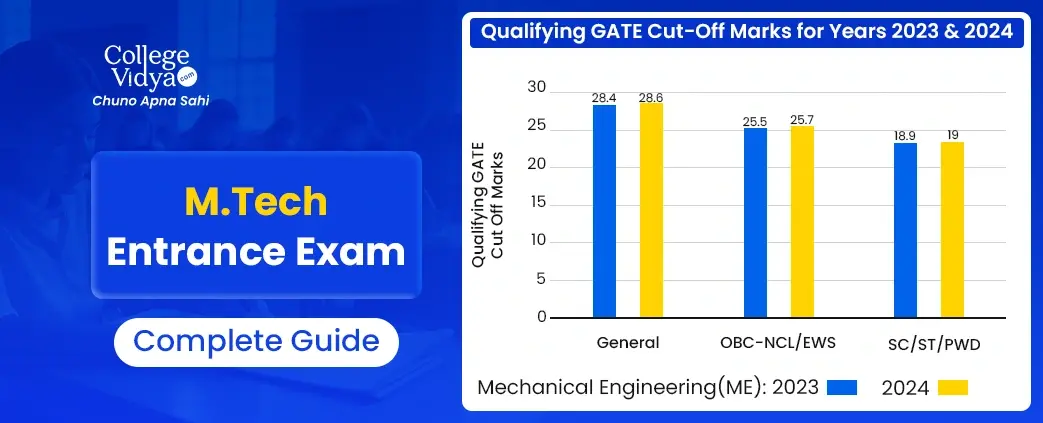
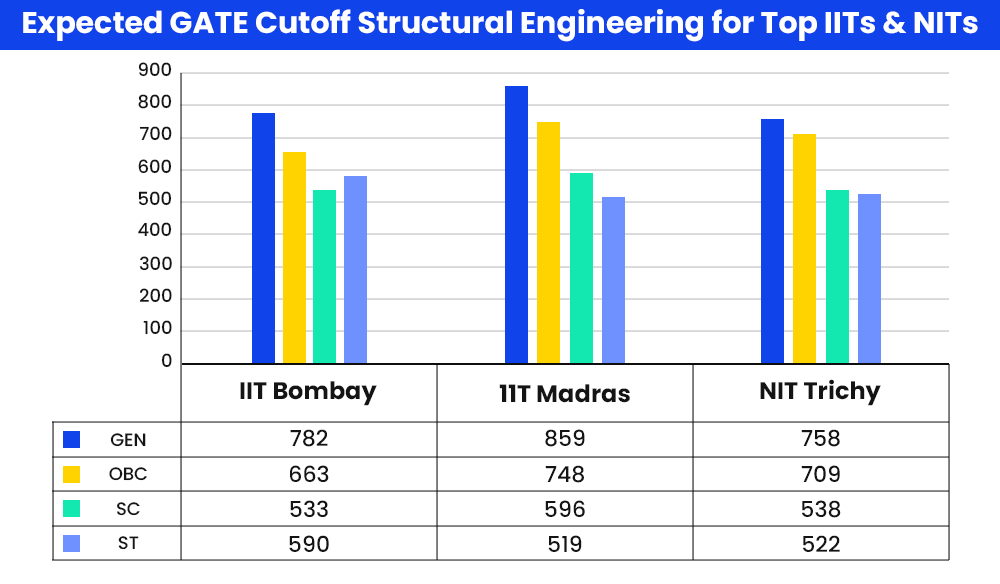
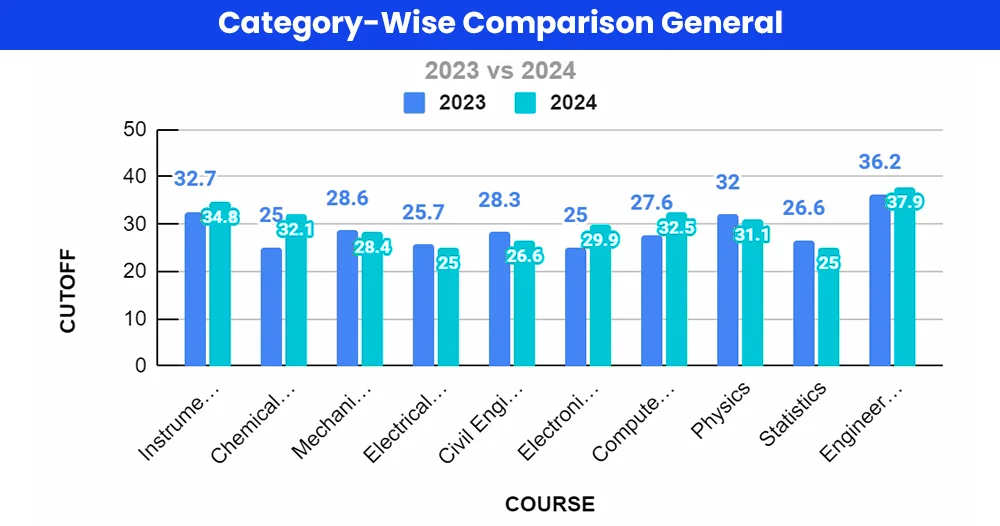
GATE : GATE (Graduate Aptitude Test In Engineering) is the most accepted admission exam for M.Tech and the college is allotted to the students based on the marks scored by applicants in their exam. GATE is organized and conducted by IISc Banglore and 7 IIT institutes. The exam is important to enroll in the best engineering colleges such as IIT and NIT etc. In addition to that GATE is important for PSUs like DRDO, IOCL, ONGC, NTPC, and BHEL.
Some other popular M.Tech entrance exam names are:
- IIIT-B MTech. Admission (IIIT Admissions to Bangalore MTech)
- IIIT Delhi PG (Entrance Test IIITD - PG)
- TS PGECET
- PGCET
- TANCE
List of M.Tech Entrance Exams 2026 Date
Below are the most preferred admission tests applied by the prospective candidates besides Gate with their tentative application date:
|
M.Tech Entrance Exam |
M.Tech Entrance Exam Application Date (Tentative) |
|
TANCET 2025 |
The second week of January 2025 |
|
AP PGECET 2025 |
Last Week of February 2025 |
|
SRMJEEE PG 2025 |
Last Week of December 2025 |
|
VITMEE 2025 |
Last Week of March 2025 |
|
JNU CEE M.Tech 2025 |
First Week of March 2025 |
|
CUCET Engineering 2025 |
Second Week of March 2025 |
|
BITS HD Admission Test 2025 |
Third Week of March 2025 |
|
Karnataka PGCET 2025 |
Last Week of May 2025 |
|
IIIT Delhi M.Tech 2025 |
Last Week of June 2025 |
|
TS PGECET 2025 |
Third Week of March 2025 |
|
Gujarat PGCDT 2025 |
Last Week of June 2025 |
|
OJEE PG 2025 |
First Week of June 2025 |
|
MET PG 2025 |
December 2025 |
|
JIIT PGET 2025 |
April 2025 |
M.Tech Entrance Exam Qualifying Criteria 2026
Students who are planning to apply for the admission test have to meet the following MTech Entrance Exam Eligibility Criteria 2026:
- Students must have completed a graduation degree in engineering.
- They should have acquired at least a 50% aggregate score in their graduation.
- It is mandatory to have major subjects (Physics, Chemistry, and Maths) at 12 standard.
- Anyone who has completed the 5 years of science program can also apply for the entrance exam.
M.Tech Entrance Exam (GATE) Syllabus
Students need to prepare well for the entrance exam and they can’t take the risk of not selecting. Hence, here is the syllabus shared for the GATE exam:
M.Tech Computer Science Entrance Exam (GATE) Syllabus
|
Course |
Subjects |
Topics |
Computer Science |
Java Programming |
Basics of Java, Control statements, polymorphism, keywords, operators, inheritance, Classes, and Objects |
|
Computer Organisation and Design |
ALU and data path, Machine instructions and addressing modes, Instruction pipelining, RISC and CISC | |
|
Programming and Data Structure |
Programming in C/C++, Functions, Recursion, Control Structures, OOPS Fundamentals, Parameter passing, Pointers, Arrays, stacks, queues, File handling, linked lists, graphs, and trees | |
|
Databases |
Relational model, Database design, Query languages, Database Security and Privacy, Data Warehousing, and Mining | |
|
Operating System |
CPU Scheduling, Process Management System, File systems, Memory management and Virtual memory, Disk Operating System, and synchronization. | |
|
Networking |
ISO/OSI stack, Multiplexing, Network Models, Transmission Media, Ethernet, Access Control, Routing, Network layer Protocols, Security and cryptography |
M.Tech Civil Engineering Entrance Exam (GATE) Syllabus
|
Course |
Subjects |
Topics |
|
Civil Engineering |
Steel Structure |
Principles of working stress method, Built-up sections and frames, Design of connections, Design of Industrial roofs, Design of simple members and frames |
|
Concrete Structure |
Working stress, Design of beams, slabs, columns, Limit state and Ultimate load design concepts, Analysis of beam sections, Bond and development length. | |
|
Structural Analysis |
Statically determinate and indeterminate structures, Displacement methods, Analysis of trusses, arches, beams, cables, and frames, Stiffness and flexibility methods, Influence lines | |
|
Construction Planning and Management |
Construction activity, Use of Basic principles of network - analysis in the form of CPM and PERT, Quality assurance principles, Basic principles of Economic analysis and methods, Cost optimization and resource allocation, Project profitability |
M.Tech Electrical Engineering Entrance Exam (GATE) Syllabus
|
Course |
Subjects |
Topics |
Electrical Engineering |
Circuit Theory |
Electric Circuits Network graph, Sinusoidal steady‐state analysis, KCL, KVL, Transient response of DC and AC networks, Node and Mesh analysis, Resonance, theorems. |
|
Signal System |
Shifting and scaling operations, Sampling Theorem, Linear Time-Invariant and Causal systems, Fourier series representation of continuous periodic signals | |
|
Power System |
Power Systems, AC and DC transmission concepts, Power generation concepts, Electric field distribution, and insulators, Models, and performance. | |
|
Electronic Devices and Circuits |
Analog and Digital Electronics Characteristics of diodes, MOSFET, BJT, Amplifiers, Simple diode circuits, Oscillators, and Feedback amplifiers Mechanical Engineering |
M.Tech Mechanical Engineering Entrance Exam (GATE) Syllabus
|
Course |
Subjects |
Topics |
Mechanical Engineering |
Engineering Mechanics |
System of forces, equilibrium equations, free-body diagrams, Friction, Energy methods, Impulse-momentum, Principles of virtual work |
|
Theory of Machines: |
Displacement, flywheels and governors, velocity and acceleration, gyroscope | |
|
Vibrations |
Free and forced vibration of freedom systems, vibration isolation, effect of damping, resonance | |
|
Computer Integrated Manufacturing |
Basic CAD/CAM concepts and their integration tools | |
|
Engineering Materials |
Structure and properties of engineering materials, heat treatment, phase diagrams, and stress-strain diagrams for engineering materials. |
M.Tech Biotechnology Entrance Exam (GATE) Syllabus
|
Course |
Subjects |
Topics |
Biotechnology |
Plant and Animal Physiology |
Photosynthesis, hormone functions, cell structure, Animal Physiology, hormones, Circulatory System, different systems |
|
Plant and Animal Cell |
Classification and general characteristics, Cell Membrane, Cell organelles, Classical experiments of biology | |
|
Genetics and Environmental Science |
Genetics and Nucleic acid, Molecular Biology, Transgenic, Genetically Modified Plants, Genetic engineering, Ecology, Evolution, Environmental Science | |
|
Applied Biotechnology |
Plant Biotechnology, Industrial Biotechnology, Animal Biotechnology, Industrial Biotechnology, Bioinformatics, Bioprocess engineering and technology, Intellectual Property Rights | |
|
Metabolism |
Metabolism-carbohydrates, Enzymes, lipids and proteins |
M.Tech Admission 2026 through GATE Entrance Exam
The admission process for universities and institutes for M.Tech varies from one university to another university. Many colleges/institutes ask for the most common admission exam for M.Tech i.e. GATE. So, prospective candidates can prepare and apply for the M.Tech entrance exam GATE 2026 register in premium institutes like IITs and NITs. Let’s check who can apply for the GATE entrance exam for M.Tech.
Eligibility Criteria for M.Tech Entrance Exam (GATE)
Common guidelines applicants have to follow the basic guidelines if they are planning for an M.Tech:
- An engineering graduation degree is a must, it can be a B.E./ B.Tech degree from an approved university.
- A valid GATE or state/ private university entrance exam score is needed that is based on the list shared by the colleges to shortlist the candidates.
- Those students are also eligible for the M.Tech program who have completed 5 years in Applied Science/ Science.
- After MCA and M.Sc students can try for M.Tech if they are interested in pursuing the program. However, they have to score well in M.Tech Entrance Exam like GATE, BITSAT, HD, PGEE, and PGET for selection.
M.Tech Admission 2024 without GATE
Is it possible to get M.Tech admission without GATE or any other entrance exam? Yes, students can also register for the M.Tech program without a GATE score.
M.Tech In IIT without GATE
M.Tech in IIT without GATE is possible but applicants have to apply for the sponsor seats. Here are the different eligibility criteria to sign up for the sponsorship seats:
Admission selection guidelines for M.Tech in IIT without GATE:
- Candidates must have completed their graduation in engineering from IIT.
- They must have secured an 8 CGPA or above aggregate score.
- Candidates who are registering for sponsored seats are required working experience at least of 2 years.
- Candidates may be asked for WAT (Written Ability Test) conducted by IITs for sponsored seats.
M.Tech for Working Professionals
Students who are applying for the M.Tech for Working Professionals don’t have to sit for the entrance exam and the program is designed for the employees working in organisations to enhance their skills. According to their requirement to upgrade their knowledge, a program is customized for advanced professionals known as M.Tech Flexible Timing.
What is M.Tech Flexible Timing?
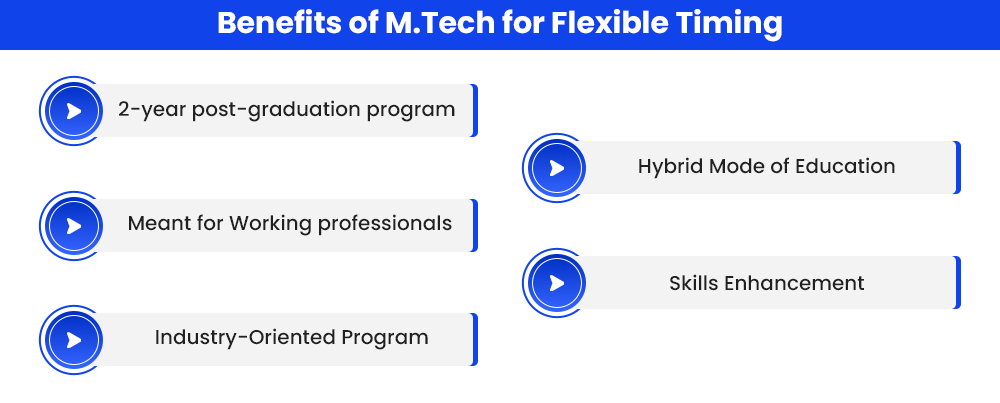
M.Tech Flexible Timing is a 2-year post-graduation program that is specially designed for working professionals according to their requirements to improve their efficiency and proficiency in their domain while managing their jobs.
Those who are looking for a part-time M.Tech program can enroll for the M.Tech flexible time shifts for a working program. The advantage of registering M.Tech flexible timing course allows one to handle their work commitments with higher education. Furthermore, the program follows the hybrid mode of education where learners don’t have to visit campus to attend the classes. Online classes are shared with the students. These classes are organized on weekends/ holidays to avoid the working hours.
However, students have to visit the campus for the lab sessions. For the ease of the students, virtual lab facilities are also provided to the students so it is easier for them to understand the concepts. So students can access the lectures 24x7 at their convenience.
|
Students Also Looking For! | |
Who Should Apply for the M.Tech Flexible Timing?
Those who are looking for the training program with their jobs simultaneously can apply for the Online M.Tech Flexible Time Shifts program. Let’s find out who will benefit from the part-time M.Tech postgraduation program:
- Working Professionals: those who want to develop their skills without leaving their post. M.Tech for working professionals is a great to upskill and cross-skilling (to learn new skills for the current job).
- Career-oriented students: students who want to secure their jobs. Hence they need to learn more skills to be competent enough for their jobs can apply for the program.
- Ambitious Engineers: Engineers who are passionate about their work and want to research thoroughly their preferred subject can also register for the program.
- Experienced Engineers: Skilled professionals who have enough experience and capabilities to serve the higher positions but their promotion is declined due to the lack of required qualification. They can apply for the M.Tech for Working professionals for flexible time shifts.
- Academics: if any is interested in academics and wants to share their knowledge with others can also register for the M.Tech for Flexible Timing Program.
What are the Eligibility Criteria for the M.Tech Flexible Timing Program?
The program is especially designed for the working professionals who can complete their postgraduation while continuing their job.
- Enroller must have completed their graduation in engineering and can apply for M.Tech Flexible Timing for working professionals.
- After M.Sc and MCA, learners can also apply for the M.Tech Flexible Timing program.
- There is no age limit to register for the M.Tech for working professionals.
- Candidates must require a 50% aggregate score in graduation or post-graduation from a recognized university.
- A minimum working experience of 2 to 3 years is required in the relevant field.
Specializations for M.Tech Flexible Timing
For the M.Tech program, learners can choose the program based on their qualifications and experience. List of specializations that students can register for the program:
- Computer Science Engineering
- MTech Civil Construction for Working Professionals
- MTech Civil Highway for Working Professionals
- MTech Civil Structural Engineering for Working Professionals
- MTech Electrical Engineering Working Professionals
- MTech Electrical Power Electronic for Working Professionals
- M.Tech Electronics and Communication for Working Professionals
- MTech Electronics VLSI for Working Professionals
- M.Tech Environmental Engineering for Working Professionals
- M.Tech Mechanical for Working Professionals
- MTech Mechanical Production for Working Professionals
- MTech Mechanical Design for Working Professionals
- MTech Electrical Power System for Working Professionals
- MTech Civil Engineering for Working Professionals
Fee structure of M.Tech Flexible Timing Course
Not all, but few universities provide an M.Tech Flexible Timing program for employees. Check the names of the colleges to enroll in the program. The course fee for the M.Tech for working professionals is less compared to the regular M.Tech program. Check the fee that learners have to pay if they are enrolling in these universities:
|
M.Tech for Working Professionals University’s Name |
Fees per semester (INR) |
|
40,000 | |
|
36,000 | |
|
62,500 | |
|
38,000 |
Top colleges for M.Tech Regular Program in India
If anyone preparing for the regular M.Tech program then they should consider the best colleges mentioned here for the M.Tech:
|
Institute Name |
Fees |
|
N/A | |
|
16,150 | |
|
Delhi Technological University |
1,66,000 |
|
ICT Mumbai |
N/A |
|
Thapar University |
3.81 Lakhs |
|
3.80 Lakhs | |
|
10.35 Lakhs |
Conclusion
When students are planning for the M.Tech working professionals from private universities don’t conduct entrance exams. However, the privilege is restricted to the employees offering their services to any registered organization.
Notwithstanding, if someone is aiming for the best university be it a private, state, or national university, they have to apply for the entrance exam either GATE or conducted by them. Students have to earn the qualifying marks in the entrance exam to proceed to the next step for admission.






![M.Tech in Computer Science: Details, Admission, Eligibility, Syllabus, Colleges, Scope [2026]](https://cdn.collegevidya.com/blog/mtech-computer-science-and-engineering.webp)
![BITS WILP M.Tech. Artificial Intelligence and ML [Reviews]](https://cdn.collegevidya.com/blog/mtech-wilp-from-bits-pilani.webp)