

The top career opportunities after an Online DBA are C-suite executive roles, board directorships, senior consulting, Professor of Practice positions, chief strategy roles, entrepreneurship, policy advisory, and executive coaching. In India, these roles pay between ₹15 lakh and over ₹1 crore per year. But the most common outcome is not a new job. It is a bigger role at the same company you already work for. That is exactly why the online format has become the first choice for senior professionals: you never have to leave the career that qualifies you in the first place.
Looking to move into senior leadership roles, increase your salary potential, or gain a globally recognized doctoral qualification without leaving your job? An Online DBA (Doctorate in Business Administration) is becoming one of the most preferred doctoral programs for experienced professionals who want career growth in business, management, consulting, and executive leadership.
Today, organizations are actively searching for professionals who can handle complex business challenges, lead strategic decision-making, and drive organizational growth. Unlike a traditional PhD that focuses heavily on academic research and theory development, an Online DBA emphasizes applied research, business strategy, leadership, and real-world problem-solving. This practical learning approach makes the program highly suitable for working professionals and entrepreneurs. In this blog, we will discuss the high-paying career options one can pursue after an Online DBA Doctorate.
Top Career Opportunities After Online DBA At a Glance
Here is a brief overview of the top high-paying career options one can pursue after an Online DBA-
|
Career opportunity |
Salary band (India, per year) |
Time to reach |
Best-fit specialisation |
|---|---|---|---|
|
Chief Executive Officer |
Rs 40L to Rs 1Cr+ |
5 to 10 years |
Leadership & Strategy |
|
CFO / COO / CHRO |
Rs 25L to Rs 80L |
2 to 5 years |
Finance, Supply Chain, HR |
|
Board / Independent Director |
Sitting fees + commission |
After C-suite |
Leadership & Strategy, Finance |
|
Strategy Consultant to Partner |
Rs 15L to Rs 50L; no limit if independent |
0 to 2 years |
Any; Analytics |
|
Professor of Practice to Dean |
Rs 6L to Rs 25L |
0 to 1 year |
Any |
|
Chief Strategy / Transformation Officer |
Rs 25L to Rs 60L |
2 to 4 years |
Analytics, Emerging Tech |
|
Founder |
No limit |
Immediate |
Any |
|
Policy Advisor |
Rs 8L to Rs 30L |
1 to 3 years |
International Business |
|
Executive Coach / Thought Leader |
Rs 25,000 to Rs 1L+ per session |
0 to 1 year |
Leadership & Strategy, HR |
Why does the online format work better for a Doctorate?
For many years, the doctorate and the career were two separate paths. Everyone knew it. A full-time PhD meant four to six years away from work. Your career froze at exactly the moment the degree arrived. You came out at 42 with a thesis and a gap in your CV. Most sensible people looked at that and chose the career. Who would not? The Online DBA does not just fix this problem. It flips it completely.
- You keep growing while you study. Three years of promotions, targets, and network building, all running alongside your research instead of it. When you finish, you have both, and each one makes the other stronger. This is the main reason so many graduates get promoted inside their own company instead of moving out. They spent three years visibly getting better at the job, in front of the people who make the decisions.
- Your office becomes your research lab. Your dissertation is built around a real problem in a real business, usually your own. It is not a practice for the work. It is the work itself, done to doctoral standards, and your employer benefits. Programmes in this category research topics such as go-to-market strategy for B2B SaaS companies or leadership culture in fast-growing teams. You are being paid to solve the same problem you are being graded on.
- The classroom is senior. This is the quiet advantage. Twenty to thirty people who have all run something, from different industries, who will argue with you for three years. That group only exists because the format lets working executives attend. Take it away, and you are sitting in a seminar with 26-year-olds.
And the maths is simple. Roughly Rs 4 lakh to Rs 11 lakh, with no loss of salary, against role bands of Rs 25 lakh to Rs 80 lakh. It is not a close call.
|
Doctoral Program (Working Professionals) | |
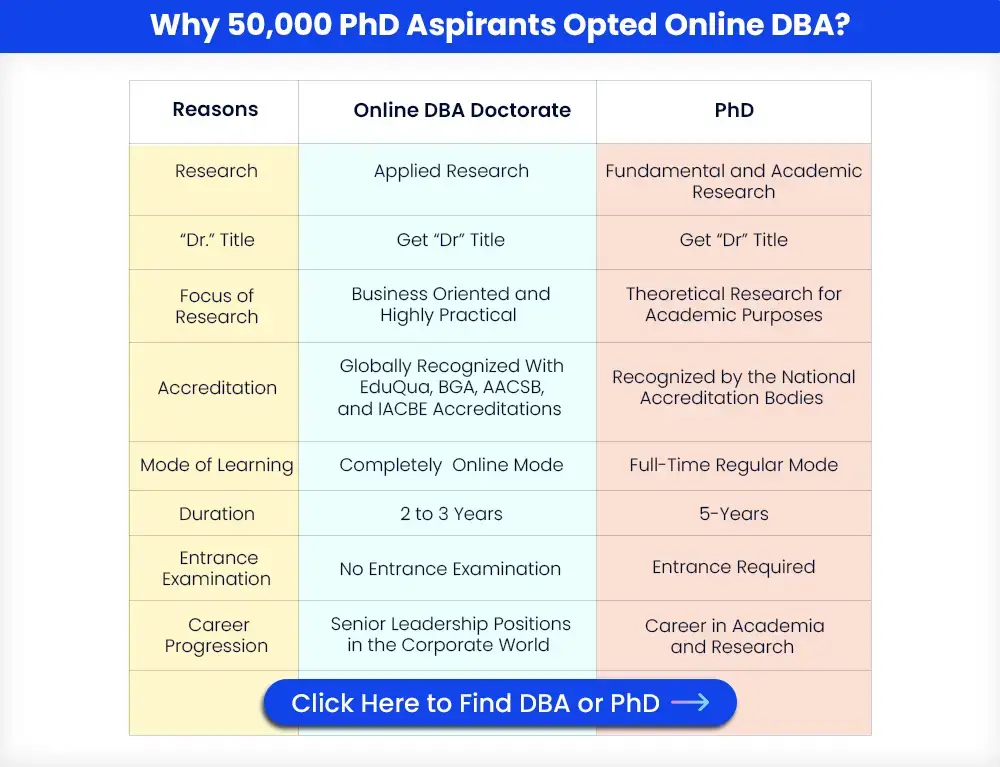
The speciality of DBA is about applying the knowledge on the practical ground rather than just reading and researching, which happens in a typical PhD.
Career Opportunities After an Online DBA: The Full Breakdown
1. Chief Executive Officer and Business Head Roles
Everyone leads with this one. So let us be clear about what the degree actually does here, because it is smaller and more useful than "it makes you a CEO."
It teaches you to work with evidence. Here is what that means in real life. Top-level decisions get taken on incomplete data, under time pressure, in rooms where everyone has a reason to present things in their own favour. Three years of standing in front of people whose job is to attack your findings changes how you read a business case. You stop asking whether the number supports the plan. You start asking what the number can actually prove.
Boards notice this. That is why the degree reads as ability, not decoration. The path is almost always one step at a time. Nobody jumps the queue. The doctorate is the tiebreaker between two candidates with similar records.
|
Role |
Salary band (per year) |
Usually reached from |
|---|---|---|
|
Chief Executive Officer |
Rs 40L to Rs 1Cr+ |
CXO or business head |
|
Managing Director |
Rs 40L to Rs 1Cr+ |
CEO or country head |
|
President / Country Head |
Rs 35L to Rs 80L |
SVP or business unit head |
|
Business Unit Head / SVP |
Rs 30L to Rs 60L |
VP |
2. Functional C-suite roles
This is the one you should actually aim at. And it gets far less attention than it deserves. Functional CXO roles are genuinely within reach in two to five years if you are already a Senior Director or VP in that function. High ceiling, short runway. And your specialisation maps straight onto the target, so nothing gets lost in translation.
What this Online Doctorate adds here is very specific. A functional CXO spends their whole life arguing for budget against colleagues who are equally senior and equally sure they are right. Doctoral research training is, in plain terms, training in building an argument that survives someone trying to tear it apart. That is not close to the job. That is the job.
|
Role |
Salary band (per year) |
Matching specialisation |
|---|---|---|
|
Chief Financial Officer |
Rs 30L to Rs 80L |
Finance |
|
Chief Operating Officer |
Rs 30L to Rs 80L |
Supply Chain, Operations |
|
Chief Human Resources Officer |
Rs 25L to Rs 70L |
Human Resource Management |
|
Chief Marketing Officer |
Rs 25L to Rs 60L |
Marketing |
|
Chief Risk / Compliance Officer |
Rs 25L to Rs 60L |
Finance, Leadership & Strategy |
3. Board and governance roles
Almost nobody writes about this. It may be the most interesting option on the whole list. Boards need people who can read a risk register properly, question a management claim without being influenced by the executive team, and chair a committee without losing control of it. That skill set is rare. A doctorate signals it clearly. And in India, where independent director seats move through reputation and network rather than applications, "Dr." on a board profile does real work.
Look at where the market is going. At least one programme in this category now runs a dedicated board-readiness track built with a Big Four academy. It covers governance, ethics, risk, digital readiness, stakeholder engagement, and full boardroom simulation. Providers do not build tracks like that unless demand is building there. The money works differently here. Holding several positions at once is normal, and that is the whole point of them.
|
Role |
How it pays |
Realistic entry point |
|---|---|---|
|
Independent Director |
Sitting fees per meeting plus commission on profits |
After a C-suite or senior functional career |
|
Audit / Risk Committee Member |
Included in director fees |
Finance or risk background |
|
Advisory Board Member |
Retainer or equity |
Easier first seat than a full board |
|
Board Chair |
Highest fees, highest accountability |
After several directorships |
4. Consulting and advisory
This is the fastest conversion of the lot and the clearest line from degree to income. Consulting sells expertise, and expertise is a claim. A doctorate is a claim somebody else has already checked. In a market where the only other signal is a company logo on your CV, that is pricing power. But here is the real point, and most people miss it. Your dissertation is the product. It is documented, defended, original work on a live business problem, and you can put it in front of a client on day one. So choose your topic the way you would choose your first sales deck. Because that is what it becomes. Choose the problem your future clients already have.
|
Role |
Salary band (per year) |
Notes |
|---|---|---|
|
Management Consultant |
Rs 15L to Rs 35L |
Entry point for most |
|
Strategy Consultant |
Rs 20L to Rs 45L |
Higher billing, narrower brief |
|
Practice Lead / Principal |
Rs 35L to Rs 60L |
Owns a sector or capability |
|
Partner |
Rs 60L+ |
Equity, not salary |
|
Independent Consultant |
No ceiling |
Depends entirely on your network |
5. Academic and teaching roles
An Online DBA also opens the door to teaching, and in India, this is bigger than most people realise. Private universities, B-schools, and executive education providers actively want people who have actually worked in the field they teach. That is where Visiting Faculty and Professor of Practice roles come in. A doctorate is usually what makes you eligible, and most people start with two or three sessions a term, which fits around a full-time job. Accreditation bodies like NAAC and NBA give weight to faculty with industry experience, so a CFO with 18 years and a doctorate is exactly the profile a B-school is looking for.
One distinction matters. A permanent assistant professor post at a UGC-regulated university needs a PhD, and an Online Doctoral Degree from a foreign university would need UGC equivalence for that route. Visiting Faculty, Professor of Practice, and adjunct roles at private institutions do not work that way and are open to you. For most senior professionals, these are the better roles anyway. Per-session rates often beat a salaried academic post, and your industry career keeps running alongside.
|
Role |
What it pays |
Commitment |
|---|---|---|
|
Visiting Faculty |
Rs 5,000 to Rs 25,000 per session |
2 to 3 sessions a term, alongside your job |
|
Professor of Practice |
Rs 8L to Rs 25L per year |
Part-time or full-time |
|
Programme Director |
Rs 15L to Rs 30L per year |
Full-time |
|
Dean / Department Head |
Rs 25L to Rs 50L per year |
Full-time, a career change |
|
UGC-regulated Assistant Professor |
Per pay commission scale |
Needs granted equivalence. See the UGC section below |
|
Top University for Doctorate Programs | |
6. Strategy and transformation roles
This is one of the fastest-growing options and probably the closest fit of all. Think about what these roles actually do. Should we enter this market? Should we buy this company? Will our AI plan survive contact with the numbers? You are paid to answer questions nobody has answered before, in front of senior people, using evidence, on a deadline. That is a dissertation with a P&L attached
Almost every large Indian company is running some mix of digital transformation, AI adoption, or market restructuring right now. Many are finding that their strategy team was built to plan, not to analyse. Those are two very different skills, and this is the gap you fill.
|
Role |
Salary band (per year) |
What it actually owns |
|---|---|---|
|
Chief Strategy Officer |
Rs 30L to Rs 60L |
Where the company goes next |
|
Chief Transformation Officer |
Rs 30L to Rs 60L |
Getting it there |
|
VP / Head of Strategy |
Rs 25L to Rs 45L |
Strategy for a business unit |
|
Head of Corporate Development |
Rs 25L to Rs 50L |
Mergers, acquisitions, partnerships |
|
AI Governance Lead |
Rs 25L to Rs 50L |
Where AI is allowed, and who is accountable |
7. Entrepreneurship and business ownership
What the degree adds here is not what people assume. It is not credibility. It is the discipline of testing your own idea before you spend money on it.
Most ventures fail because the founder fell in love with a solution and never seriously tried to prove themselves wrong. Doctoral training is three years of doing exactly that, in public, until you get good at it. That habit is worth more to a founder than any module on entrepreneurship.
Here is the clean example. Someone researches inefficiency in healthcare markets, then launches a health-tech venture straight out of that research. The dissertation was a market study. You did your due diligence as coursework, at doctoral standard, for the price of tuition.
|
Route |
What it pays |
What the DBA contributes |
|---|---|---|
|
Startup Founder |
No ceiling, no floor |
A tested idea before you spend money |
|
Consulting Firm Owner |
Rs 20L to Rs 50L+ |
The credential is the product |
|
Family Business Successor |
Varies |
Professional credibility with banks, boards, and non-family staff |
|
Franchise / SME Owner |
Varies |
Discipline in evaluating the market |
8. Policy and economic advisory
Hardly anyone talks about this one. It is more open than you would think. Start with the logic. If there is one sector that needs decisions backed by evidence, it is the government. And in India, the stakes are high. A single regulatory change can reshape an entire industry overnight.
So there is real demand for people who can work out what a policy will actually do, rather than simply argue for it. Ministries want it. So do regulators, trade bodies, industry associations, and think tanks. And that is exactly what three years of research training teaches you to do.
|
Role |
Salary band (per year) |
Where |
|---|---|---|
|
Policy Advisor |
Rs 8L to Rs 25L |
Ministries, regulators |
|
Regulatory Strategy Head |
Rs 15L to Rs 30L |
Large corporates, industry bodies |
|
Senior Fellow / Researcher |
Rs 10L to Rs 25L |
Think tanks, policy institutes |
|
Trade / Investment Advisor |
Rs 12L to Rs 30L |
Trade bodies, state investment agencies |
|
Multilateral Advisor |
Higher, USD-linked |
World Bank, ADB, UN agencies |
9. Executive coaching and thought leadership
The least discussed, and the most reliably monetisable, if you already have a network. Coaching, corporate training, keynotes, board advisory, publishing. All of it is priced on authority. And this is a market with no licensing body and no standard qualification. That makes a doctorate an unusually strong differentiator. When the competing credential is a weekend certification, "Dr." becomes a pricing lever.
Your dissertation is an asset once again. Turn it into a book, a framework, a keynote, or a workshop.
|
Route |
What it pays |
Notes |
|---|---|---|
|
Executive Coach |
Rs 25,000 to Rs 1L+ per session |
Retainers are where the money is |
|
Corporate Trainer |
Rs 50,000 to Rs 2L per day |
Needs a named framework |
|
Keynote Speaker |
Highly variable |
Follows publication, not the other way round |
|
Author / Thought Leader |
Indirect, but it compounds |
Feeds every other route on this page |
Which Online DBA Specialisation Maps to Which career?
This is the table most people actually come looking for. Find your field in the left column and read across.
|
Specialisation |
Primary roles it opens |
Secondary roles |
Career ceiling |
|---|---|---|---|
|
Leadership & Strategy |
CEO, Board Director, Chief Strategy Officer |
Executive coach, faculty |
Highest. Works across every sector |
|
Finance |
CFO, Financial Controller, Policy Advisor |
Board audit committee, faculty |
High and very clearly defined |
|
Human Resource Management |
CHRO, HR Director, Organisational Development Head |
Faculty, executive coach |
High |
|
Healthcare Management |
Healthcare CEO or COO, Health Policy Analyst |
Health-tech founder, faculty |
High, but locked to one sector |
|
Supply Chain Management |
Supply Chain Director, COO |
Consultant, faculty |
High |
|
Business Data Analytics |
Chief Strategy Officer, Chief Data Officer, Consultant |
Faculty |
High and rising |
|
Marketing |
CMO, Brand Consultant |
Faculty, coach |
Moderate to high |
|
International Business |
Country Head, Trade Advisor |
Policy advisory, consulting |
High, depends on mobility |
|
Emerging Technologies / Generative AI |
Chief Transformation Officer, AI Strategy Advisor, AI Governance Lead |
Consultant |
Rising fastest |
Industry-Specific Opportunities for Online DBA Graduates
The roles above are the general map. But most readers are not general. You are in banking, healthcare, or IT. What you really want to know is what an Online DBA Doctorate does for someone in your sector. So here is the honest principle first. This Online Doctoral Degree does not move you between industries. It moves you up inside one. Your fifteen years of domain knowledge are an asset. The doctorate turns that knowledge from experience into authority. So the roles below are not new careers. They are the senior end of the career you already have.
|
Industry |
Senior roles |
Why the doctorate matters here |
|---|---|---|
|
Healthcare and hospitals |
Hospital CEO, Clinical Strategy Director, Health Policy Advisor, Healthcare Innovation Head |
Healthcare decisions carry clinical and regulatory risk together. Working from evidence is not a nice-to-have here. It is the job. |
|
Banking and financial services |
CFO, Chief Risk Officer, Compliance Strategy Head, Corporate Finance Strategist |
Heavily regulated, and every decision must stand up to a regulator. That is exactly what doctoral training teaches. |
|
Information technology and SaaS |
Chief Transformation Officer, AI Governance Lead, Digital Strategy Head |
The sector moves faster than its own evidence. People who can test a claim instead of repeating it are rare |
|
Manufacturing and operations |
COO, Supply Chain Director, Industrial Strategy Planner, Operations Innovation Lead |
Process improvement is applied research by another name. The DBA Online formalises what good operations leaders already do by instinct. |
|
FMCG and retail |
CMO, Category Strategy Head, Consumer Insights Director |
Consumer research is the core discipline. A doctorate in it stands out in a crowded field |
|
Consulting and advisory |
Partner, Sector Practice Lead, Independent Consultant |
Direct conversion. The credential is the product, and your dissertation is your first case study |
|
Government, PSU, and public policy |
Policy Advisor, Regulatory Strategy Head, Public Sector Innovation Advisor |
Evidence-based policy design. Note that equivalence is usually needed for government posts |
|
Education and edtech |
Dean, Programme Director, Higher Education Strategy Consultant |
This sector hires doctorates by definition. A practitioner doctorate is rare and valuable here |
|
Energy, infrastructure, and ESG |
Sustainability Strategy Head, ESG Compliance Lead, Renewable Strategy Advisor |
New reporting rules, thin evidence base, heavy scrutiny. Perfect territory for applied research |
|
Family business and SME |
Managing Director, Board Chair, Professionalisation Lead |
The DBA is often what turns a family successor into a credible professional leader in the eyes of banks, boards, and non-family staff |
How to Maximize Career Opportunities After an Online DBA?
Here is the uncomfortable truth. The degree does nothing on its own. Most graduates finish, update their LinkedIn headline, wait, and then decide the degree did not work. The graduates who actually see returns do a specific set of things, in a specific order, starting immediately. Here it is as a checklist.
|
Action |
What exactly to do |
When |
Why it works |
|---|---|---|---|
|
Publish the research |
Turn your dissertation into at least one public piece: a journal article, a book, a long industry report, or a named framework |
Months 0 to 3 |
Unpublished research is a private achievement. Published research is an asset that works while you sleep. |
|
Reposition your profile |
Rewrite your LinkedIn headline, CV, and bio around the research problem, not the credentials. Not "Dr. X, CFO" but "Dr. X, I research why mid-market manufacturers fail at working capital transformation" |
Months 0 to 3 |
A title is just a fact. A research position is a hook. Hooks bring in calls. Titles do not |
|
Get on one stage |
One industry association event, panel, or webinar. Speak about your research, not your job |
Months 3 to 6 |
Nothing turns a doctorate into visible authority faster. This is where your first consulting and board conversations start.t |
|
Take one adjunct seat. |
One Visiting Faculty or Professor of Practice engagement at a private business school. Two or three sessions a term |
Months 3 to 9 |
Low commitment, it pays, and it makes the academic option real instead of theoretical. Teaching your framework also sharpens it |
|
Work the cohort |
Stay in touch with your 20 to 30 classmates on purpose. One call a month, not one LinkedIn like a year |
Throughout, forever |
The most underused asset in the whole programme. Senior people across industries who already trust you |
|
Make the move |
The internal promotion conversation, an external search, your first client, or your first board seat. Pick one and act. |
Months 6 to 12 |
This is where the two-to-three-year salary curve actually starts. It does not start on graduation .day |
|
Join the professional bodies. |
Industry associations, alumni networks, director institutes, if board work is your target |
Year 1 onward |
Board seats and advisory work move through networks and nominations, not applications. |
|
Keep the research alive |
One new published piece a year. It does not have to be academic |
Year 2 onward |
Authority fades. A doctorate from six years ago with nothing since looks like a purchase. One with an ongoing body of work looks like a practice. |
|
Add one adjacent skill.l |
A short certification in whatever your target role needs: governance, digital transformation, ESG reporting |
Year 1 to 2 |
The doctorate gives you depth. A current certification shows you are not stuck in the past. |
Who can apply for an Online DBA?
Eligibility varies by institution, but the pattern is consistent:
- A master’s degree from a recognised university, usually with 55% or equivalent. Some institutions accept a bachelor’s degree with strong work experience instead.
- Work experience. Usually, 3 years minimum on paper. The realistic figure is much higher. Most cohorts sit at 10 to 15 years.
- No entrance exam in most cases. Admission is profile-based, judged on your academic background and professional record.
- An interview or research proposal at some institutions.
Fees and ROI: Does an Online DBA actually pay back?
An Online DBA costs roughly ₹4 lakh to ₹11 lakh, spread over three years, with EMI and instalment options at most institutions. Your salary keeps coming in the whole time. That is the number everyone forgets, and it is the whole argument.
| Cost Factor |
Online DBA |
Full-time PhD |
|---|---|---|
|
Tuition |
Rs 4L to Rs 11L |
Rs 50,000 to Rs 5L |
|
Salary foregone (3 years at Rs 30L CTC) |
Rs 0 |
Rs 90L+ |
|
Total real cost |
Rs 4L to Rs 11L |
Rs 90L to Rs 1.8Cr |
When does it pay back? If an Online DBA helps you land one promotion that takes you from Rs 30 lakh to Rs 45 lakh, you recover Rs 11 lakh inside a year. If it opens an independent consulting practice faster. If it gets you one board seat, it may pay back permanently, because board seats compound.
Challenges and considerations
Being straight about this is the point. Here is what to plan for.
- The time commitment is real. Three years, alongside a demanding job, often alongside a family. The dissertation phase is 18 to 24 months of sustained work, right at the end, when your motivation is at its lowest. Completion rates across this category are not published often, and there is a reason for that. Ask.
- The market at the top is competitive. Everyone chasing a C-suite seat has a track record. The doctorate is a differentiator, not a guarantee. It competes against people with better networks and longer records. Plan to stand out on your research topic, not on the letters.
- Balancing two identities takes effort. If you want an industry career and an academic presence, you are running two profiles at once. Managed well, they strengthen each other. Managed badly, they dilute each other. Be deliberate about which one leads.
Do employers value an Online DBA degree?
Yes, an Online DBA is highly regarded in the global business landscape. What employers actually look at is the accreditation and standing of the awarding institution, how relevant your research is, your existing industry record, and whether you can apply your research to a real problem in front of them.
Nobody in a corporate interview asks whether you attended lectures in a hall or on a screen. They ask what you found out and what you did with it. The format only becomes a problem when the institution behind it is weak. And that is an accreditation question, not an online question.
Future Trends in Online DBA & Career Opportunities
Worth knowing where this is going, because you are buying a three-year asset.
- AI governance is the fastest-growing job. Every large organisation is deploying AI, and very few have anyone qualified to decide what it may touch, how the risk is managed, and who is accountable when it fails. This is a strategy and governance problem, not an engineering one. There is a genuine shortage of people who can do it.
- ESG and sustainability reporting are becoming a board-level function. New disclosure rules, a thin evidence base, and heavy scrutiny. In other words, an environment where applied research is the core skill.
- Boards are professionalising. Expectations for independent directors in India keep rising. The pool of credible candidates is not rising as fast. This is the quiet opportunity in the whole category.
- Professor of Practice is expanding. Private higher education keeps growing, and accreditation frameworks keep rewarding practitioner faculty. Demand for senior people with doctorates who have actually run something is going up, not down.
- Global work without relocation is now normal. Cross-border advisory, board seats, and consulting engagements are increasingly done from wherever you are. A globally recognised doctorate travels in a way an India-only credential does not.
- And lifelong learning is now the baseline. A doctorate finished in 2026 with nothing published since will be read by 2032, as a purchase. One piece of public thinking a year keeps it alive.