

When it comes to the most valuable resource for any organisation, human resources surely stand out as one of the central pieces of the puzzle. Human resources refer to a company's employees and key stakeholders, and HR professionals are the employees of any firm responsible for managing and catering to the needs of all human resources, i.e., the companies.
Having started in personnel management, human resource management as a career domain has evolved multifolds to have now become an indispensable component of organisational effectiveness on a cross-industrial basis. As a result, the demand for well-qualified HR professionals is as high as ever. Individuals with an acumen and enthusiasm for interaction with others, forming social connections and impacting organisational strategies can venture into a career in human resource management.

Why Choose a Career in Human Resource Management?
While one of the lucrative industries of India and abroad, the field of human resource management has grown and matured quite a lot over the past few decades in India. Hence, many professionals are apprehensive about whether this career will become obsolete in due course. However, statistical facts and figures show the growing demand of the field of HRM in India.
Given below are some of the key reasons you should consider taking up a career in human resource management:
- High Demand for HR Professionals: The human resource management industry is growing as a career field, and is expected to expand by a growth rate of 10.5% annually over the coming decade. As a result, the demand for well-qualified professionals and their services is to increase significantly in this domain.
- Diverse Scope in the Field: While the HR career domain may appear relatively homogenous to a layman, there is ample scope for career diversification in this field–be it recruiters and talent acquisition specialists, HR analysts, training and development specialists, HRBPs, strategic HR professionals and so on.
- Ability to Contribute to Organisational Success: Professionals working in the human resources field have the opportunity to contribute quite significantly to organisational policy, strategic HRM, HR analytics, etc., all of which can guide business decisions and the success of the organisation.
- Agility & Quick Evolution: This career domain is impacted continuously by changing employment and labour laws, market conditions, need or expansion, job rotations and so on, making agility and evolution its key characteristic. Individuals thriving in such conditions can succeed significantly in this field.
- Indispensability to Organisational Effectiveness: With HRM being an ever-present component of organisations for them to function, this career field is unlikely to ever turn obsolete or saturate in terms of opportunities as the need for trained and qualified HR professionals is only to grow as businesses continue to make strides and grow in size with more manpower.
Hence, the field of HR is not only well-compensated and full of scope for budding professionals, it also provides them with a chance to contribute meaningfully to organisational success.
Roles & Responsibilities of a Human Resource Manager
Understanding the nature of a career and the key responsibility domains associated with it is essential, not only for succeeding in the role but also for making the right career choice. The field of human resources is a joining point of correspondence between the management and employees of an organisation. Their role is critical to the effective management of all functions related to the personnel management on an end-to-end basis of the employee lifecycle.
The major responsibilities associated with the roles of an HR professional have been enlisted below.
- Recruitment & Staffing, which includes tasks such as identification of recruitment channels, the actual practice of rolling out openings, regularly contacting potential candidates, interviewing them, managing the stages of selection, employee onboarding, and so on.
- Training & Development of employees at various levels in an organisation to ensure their upskilling, compliance of performance with current industry standards, working on the career development of current employees, their performance management and so on.
- Compensation & Benefits Management through which the payrolls of the existing employees are managed, the structure of compensation plans for new roles is created, the perks and benefits of an organisation are structured and so on.
- Leadership Development & Succession Planning constitute two important aspects of organisational and human resource management, focusing on aspects like identification and further training and development of future leaders for the company.
- HR Business Partnership is one subdomain of HRM in which an HR professional contributes actively in the organisational strategy development from a human resource management perspective.
- Employee Relations Management is another key domain about the management of employees’ grievances, conducting regular performance reviews, working on employee retention, etc., to foster an overall positive relation between an organisation and its employees.
- Performance Management includes aspects such as regular performance reviews of employees, teams, leaders, aligning them closely with organisational objectives, providing requisite training, feedback, and aligning benefits and rewards based on the performance of employees.
- Policy Development is a key HR responsibility as HR professionals, especially at managerial and senior levels are often responsible for ensuring the compliance with labour laws and accordingly formulate policies and laws for the company’s administration and smooth operations.
Key Skills Needed for Human Resource Management
While soft skills and interpersonal competence lie at the heart of this career domain, certain technical skills are also an important part of the desirable repertoire of skillsets. These have been elaborated upon below.
1. Technical & Hard Skills to Succeed as a Human Resource Manager
The technical and hard skills required for an HR professional cover a range of areas such as proficiency in analytical software, payroll practices, recruitment, etc, being well-versed with labour laws, basics of digital literacy, industry best-practices, and so on. These have been elaborated upon herein.
|
Key Skills |
Specifications |
|
Recruitment |
Recruitment and talent management are two key aspects that guide the HR practices and organisational effectiveness, and hence strong knowledge of the recruitment practices in one’s company, the industry, as well as employment laws and best practices is important for an HR professional. |
|
Payroll Practices |
Expertise in aspects related to payroll management of the employees of an organisation, including but not limited to their compensation structure designing, benchmarking against industry standards, benefits and perks management, etc., are key factors guiding the HR profession. |
|
Administrative Expertise |
Proficiency in handling administrative tasks such as employee leave management, attendance regulation, and supervision, influx and outflow of employees, etc. are important for succeeding in an HR-related role. |
|
Digital Literacy |
Digital literacy in terms of basic knowledge surrounding cybersecurity, proficiency with software for HRMS, etc., has lately become a key part of the repertoire of skills needed to succeed in the profession of HR. |
|
Data Analysis |
Although not central, however, data analysis in terms of market data analysis, employee data analysis, and company data analysis are important for functions related to policy development, performance management, recruitment and selection, compensation, and so on. |
|
Labour Law Knowledge |
Knowledge of the labour law of a country, alongside the best employment practices, is important for an HR professional to possess. |
2. Soft Skills to Succeed as a Human Resource Manager
Even more critical than the hard skills needed for an HR professional to succeed is the repertoire of soft skills focusing mainly on interpersonal competence in the form of communication skills, conflict resolution, leadership, influence and so on. Key soft skills needed in this field have been enumerated below.
|
Key Skills |
Specifications |
|
Interpersonal Skills |
The key job responsibilities of an HR professional revolve around interacting with and managing the human resources of an organisation, making interpersonal skills the most critical skill for the profession. |
|
Communication Skill |
Effective and clear communication, in verbal and written form, is important for HR professionals to effectively manage stakeholders such as managers, leaders, and employees of the organisation. |
|
Adaptability & Flexibility |
The HR work environment requires agility owing to shifting work conditions, labour laws, policies and organisational requirements, making adaptability and flexibility an essential skill to possess. |
|
Conflict Resolution |
Considering the stakeholder management involved in the profession, effective conflict resolution skills are important for |
|
Leadership Skills |
HR professionals are key stakeholders in management, organisational policy and employee relations, making leadership and influence skills imperative for their role. |
|
Time Management Skills |
HR professionals must be efficient at managing multiple responsibilities simultaneously while adhering to specific timelines to enhance the organisational process efficiency. |
What are the Career Opportunities for Human Resource Management? (Types of Options available in Human Resource Management )
One of the key advantages of seeking to develop a career in human resource management is the opportunity to go for a specialisation in a field of HRM or explore the field as a HR generalist. This provides an early professional the chance to explore the field and choose the domain that best aligns with their career aspirations.
A few of the major available job options in the domain of human resource management along with details about their compensation have been enlisted below for reference.
|
Job Role in HRM |
Average Salary (Per Annum) |
|
HR Generalist |
INR 4.26 LPA |
|
HR Manager |
INR 7.78 LPA |
|
Talent Acquisition Specialist |
INR 5.82 LPA |
|
Training & Development Manager |
INR 10.3 LPA |
|
Compensation & Benefits Manager |
INR 18.92 LPA |
|
HR Analytics Specialist |
INR 5.5 LPA |
|
HR Business Partner (HRBP) |
INR 9.37 LPA |
|
Learning & Development (L&D) Specialist |
INR 7.8 LPA |
Career Analysis: What is the Salary & Demand for Human Resource Management?
A deep dive into the industry of HRM as a career has been provided below in terms of its industry trends, the courses and financial investment involved in education in the field as well as the scope of growth through the years as an HR professional.
1. Demand for Human Resource Managers: Industry Trends
Some of the industry trends and statistics to consider in 2024 include:
- There is an enhanced focus in the domain of human resource management on upskilling and reskilling of employees, making learning and development, training, etc., key subdomains to focus on.
- There is also a forecasted increase in the integration of AI in HR functionalities including talent acquisition, predictive analytics, performance management, and so on.
- Diversity, equity and inclusion, commonly referred to as DEI, is emerging as one of the leading fronts in this industry, as the awareness surrounding the need for embracing diversity in organisations is rising.
- With evolving legislations around compensation transparency, HRM as a domain lays more emphasis on maintaining fair pay for all employees as well as establishing transparent channels of communication and enquiry about compensation for employees.
2. Fees & Cost Involved in Becoming a Human Resource Manager
One can explore options for education in HRM either at the undergraduate level as a BBA or at the postgraduate level as an MBA, executive MBA or PG diploma/certification. Furthermore, a doctorate in HRM is also a high-level educational option available for those who already hold a postgraduate degree in management.
Courses in HRM are available in primarily three modes of education in India to pursue–offline or regular mode of education, the distance mode of education, and the fully online mode. The online mode of learning provides courses holding equivalent value as a regular course, but in a relatively affordable fee range to students and working professionals.
The available online courses in the field of HRM along with their approximate fee ranges have been enlisted below.
|
Human Resource Management (HRM) Courses |
Approximate Course Fees |
|
INR 2,00,000 |
|
|
INR 2,50,000 |
|
|
INR 1,80,000 |
|
|
INR 1,50,000 |
|
|
INR 1,80,000 |
|
|
INR 5,00,000 |
|
|
INR 63,000 |
|
|
INR 75,000 |
|
|
INR 7,00,000 |
|
|
INR 1,50,000 |
Career Growth Trajectory of Human Resource Management
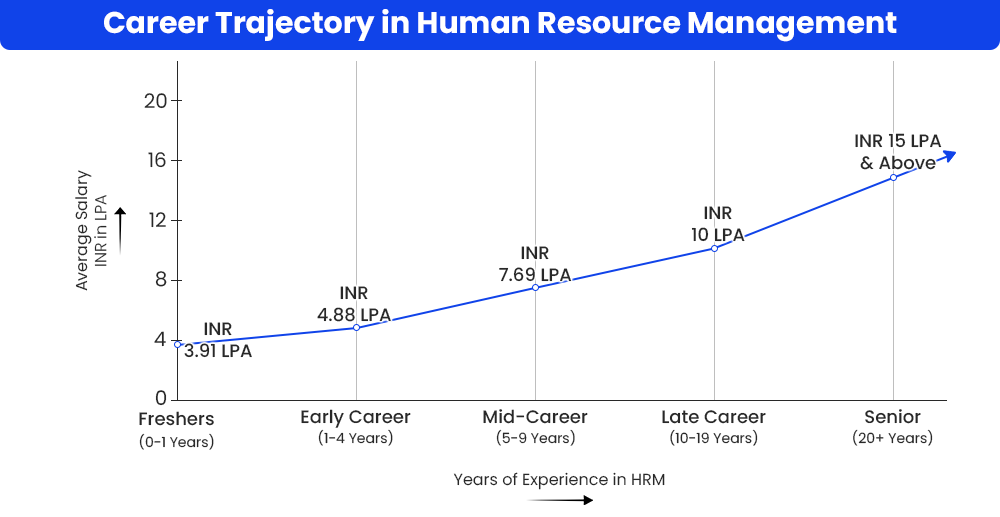
The scope of growth in human resource management is quite appealing, with figures reaching up to 5 times the initial salaries offered in the field. The growth trajectory offered in the field of HRM to a professional has been represented below.
Career Navigator: What Course to Pursue for a Career in Human Resource Management?
When it comes to developing a career in human resource management, students from all academic backgrounds can venture into the field after completing their school education or undergraduate education.
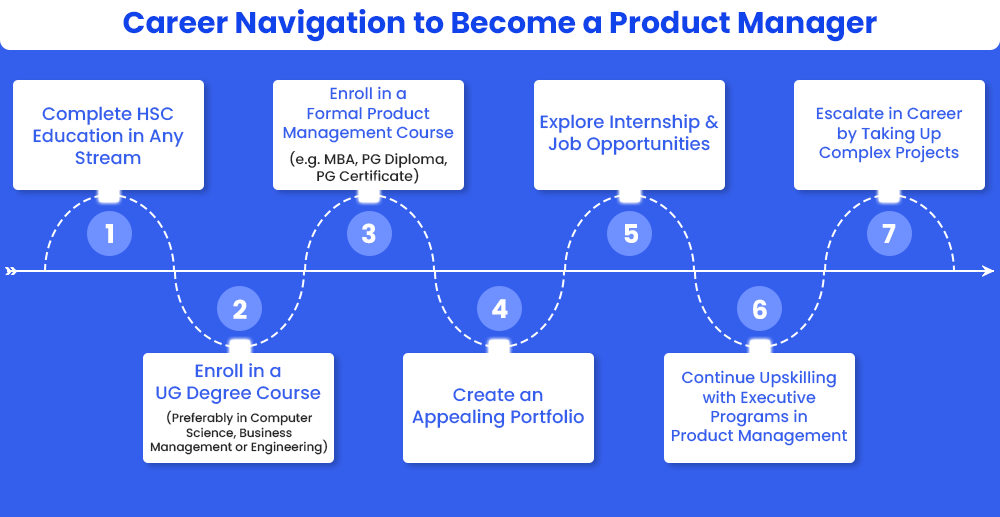
For establishing a career in HRM, a student can complete education in any stream in class 12th or equivalent level. Further, they can either choose to start specialising in HRM at the undergraduate level or take up a general course related to management or any other background. At the postgraduate level, one can consider pursuing either a master’s degree like MBA in HRM or a PG diploma or certification to upskill in a specific domain of the field.
The career navigation path of developing a career in HRM is represented below.
Top Colleges & Institutes for HRM
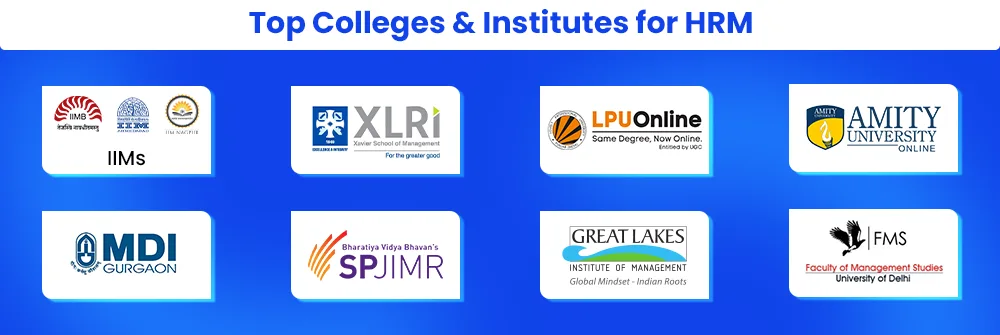
In India, the top courses available for training and upskilling in HRM include a BBA, an MBA, a PG diploma, and certifications. These courses are offered by some of the top management institutes and B-schools of India in the regular and online modes. Some of the eminent institutions of India that offer courses in HRM have been represented below.
Conclusion
As this blog has established, human resource management or HRM as a career is a domain that provides dynamic opportunities to grow oneself in the corporate sector as well as establish a strong network for prospects. With a core focus on the interpersonal relations, policies, and best practices in corporate domains and organisations, this career can be a fulfilling choice for professionals with a prowess in interpersonal communications and relations management.