

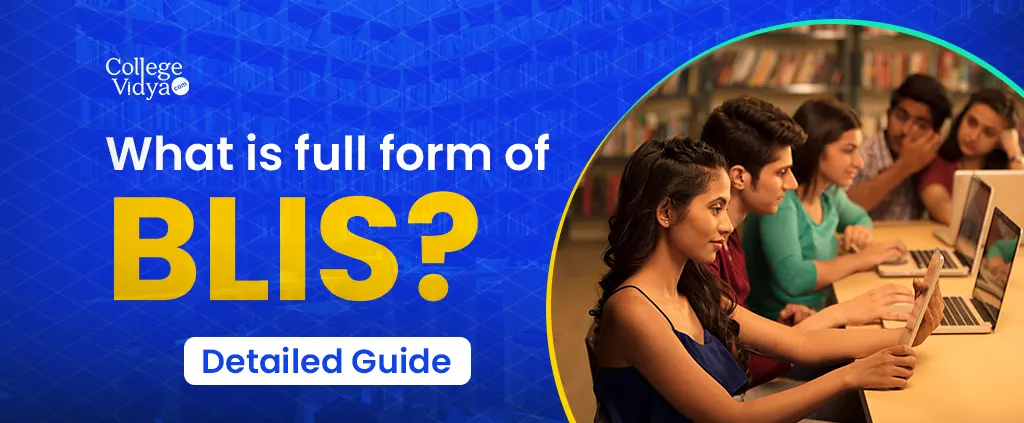
BLIS is an undergraduate degree of 1 year, BLIS stands for Bachelor of Library and Information Sciences. This program teaches skills for managing libraries efficiently. Students learn about listing, cataloging, and organizing information. The course prepares them for places in smooth library operations and access to information.
For applying for the course applicants must have passed class 12th with at least 50% marks. Some universities offer a 5% discount on reserved categories when enrolling in BLIS courses.
The B.Lib course curriculum covers library and information science concepts. It covers topics such as document organization, classification, and archiving. Students learn about bibliographic control, indexing, and library research.
What is the full form of BLIS?
BLIS stands for Bachelor of Library and Information Sciences. It's a course that helps you learn how to run and organize libraries well. You also learn how to provide different library and information services. The course takes one year to complete.
Why choose BLIS ?
The BLIS course is great if you're interested in library science and want to do well in library management. Here's why it's a good choice:
- After BLIS, you have many job options like Archivist, Cataloguer, Researcher, and Abstractor.
- BLIS opens up diverse paths. You could get into information science as an Indexer or Information Architect.
- The Indian Library Association found an 8% rise in librarian demand due to digital resources and managing information.
- The government's National Mission on Libraries (from 2012) aims to modernize and digitize libraries. This means more job opportunities for librarians in public and private sectors.
Course Objectives of Bachelor’s in library and Information Science
|
UG & PG Programs Details Guide | |
At the end of the program, you:
- Gain a strong foundation in the principles of library and information science.
- Develop practical skills in cataloging, indexing, and archiving.
- Understand the role of information technology in modern libraries.
- Learn about research methods and techniques for finding information.
- Explore the changing landscape of digital and content libraries
Mode of Education of Bachelor’s in library and Information Science
Duration and eligibility are the same in all three modes, but what makes the difference is that in online mode you will have convenience. You can study anytime, you can upskill yourself while working,and the average fee for online is also less in comparison to regular mode, but in regular mode you don’t get convenience.

|
Area |
Regular Mode |
Online/ Distance/Part-Time Mode | |
|
Flexibility |
Timings of the classes are fixed. |
You can learn at your own time, no fixed classes. | |
|
Learning Environment |
Students needs to take classes in the classroom |
It held in virtual classroom with the help of technology | |
|
Cost |
Cost of it is high due to physical infrastructure |
It cost less due to absence of physical infrastructure | |
Program highlights of Bachelor’s in library and Information Science
The BLIS program covers a wide range of topics, including but not limited to:
- Introduction to Library and Information Science
- Categories and classifications
- Information retrieval system
- Library management and administration
- Digital Library and Information Technology
- Research methods in library work
Course curriculum of Bachelor’s in library and Information Science
The BLIS course program focuses on library and information science concepts. It familiarizes students with a variety of library science topics, with an emphasis on bibliographic control, indexing, document classification, cataloging, research, and archiving. Below is the syllabus for the one year Librarian course and its B.Lib subjects.
|
Semester I |
Semester II |
|
Society and Library- Kinds of Libraries, Five Laws of Library Science |
Documentation of Techniques and Services |
|
Library Catalogue: Nature and Functions |
Bibliographies and Bibliographic Control |
|
Information Technology in Daily Life |
Classification of Documents by CC |
|
Classification of Documents by DDC |
Theory of Classification: Growth and Structure of Knowledge |
Eligibility criteria of Bachelor’s in library and Information Science
For applying for the course applicants must have passed class 12th with at least 50% marks from a recognized board or passed a degree with a diploma in library science.
Duration of Bachelor’s in library and Information Science
Duration of this course is minimum 1 year including 2 semesters, maximum it can go to 2 years.

Reference books of Bachelor’s in library and Information Science
- "Introduction to Library and Information Science" by Arun Kumar Sharma
- "Foundations of Library and Information Science" by Richard E. Rubin
- "Library and Information Science: UGC-NET/SLET/JRF Practice Set" by Mithilesh Kumar Sinha
- "Library and Information Science: Objective Type Questions" by R. Gupta
- "Information Science" by David G. Lankes
Different universities offering the course
There are numerous universities offering the course some of them I have mentioned below-
- Acharya Nagarjuna University
- Indira Gandhi National Open University
- Annamalai University
- Madurai Kamaraj University
- LPU
Evaluation of Bachelor’s in library and Information Science
Assessment methods include assignments, quizzes, tests, projects and presentations. Regular assessments ensure your understanding of the topics and help you apply theoretical knowledge to real-life situations.
- Continuous Evaluation (CE) 30% weightage
- Term End Examination (TEE) 70% weightage
Projects of Bachelor’s in library and Information Science
The BLIS course aims to prepare students by involving them in practical projects related to library management. This provides hands-on experience before entering the professional field. Notable BLIS course projects include:
- Assess the impact of staff training on library growth.
- Understand student attitudes towards library facilities.
- Explore growing trends in the use of social media for information. Overcome challenges in purchasing library resources and services.
- Research the information search habits of children at public libraries.
- Analyze the resilience of public libraries in the digital age.
Career prospects after completing Bachelor’s in library and Information Science
People who hold a Bachelor of Library and Information Science [BLIS] degree have various job choices.
You can work in both the public and private sectors. Also, they might become librarians in educational institutions.
After finishing their B.Lib.I.Sc degree, you can even take civil service exams.
Many private companies hire B.Lib.I.Sc graduates, and these jobs often pay well.
Those with a B.Lib.I.Sc degree can choose to keep learning. They could go on to get a master's degree in library science.
Upon completion of the BLIS program, you can explore a variety of career opportunities, including:
- Librarian
- Information Analyst
- storage staff
- Content management
- Digital Resource Specialist
What salary one can expect after completion of course?
Professionals who have completed an online BLIS course in India can expect to earn an average salary of around INR 3-4 lakhs per annum. However, the salary may vary depending on various factors such as experience, job profile, and the organization they work for.
Entry-level professionals in the library and information science field can expect to earn a starting salary of around INR 2-3 lakhs per annum. However, with experience and expertise in the field, professionals can earn a higher salary of around INR 5-6 lakhs per annum or more.
Professionals who hold higher qualifications and certifications in the library and information science field, along with relevant experience, can earn even higher salaries.
Also, those who pursue career paths in specialized areas such as digital libraries or information management can also earn higher salaries than those in general library and information science roles.
Why should you opt for an online Bachelor's in library and Information Science ?
Pursuing a BLIS degree has many advantages. One is the ability to have a variety of job options. Soon there will be more jobs for librarians and information professionals, so now is a good time to enter the field.
Another good thing about a BLIS degree is that you can work in many different places. You can work in libraries, archives, museums, and information management places. This allows you to work with a wide variety of documents, such as old books, photographs, and digital items.
Furthermore, with a BLIS degree, you gain many skills. You become better at talking, researching and organizing things. You will also learn about new technologies and trends in library and information science.
|
Degree |
Bachelors |
|
Full Form |
Bachelor of Library and Information Science |
|
Duration |
1 Year |
|
Age |
No Age Limit |
|
Course Eligibility |
For applying for the course applicants must have passed class 12th with at least 50% marks |
|
Average Fees |
INR 5,000- 1 Lakh. |
|
Job Roles |
Assistant Librarian, Technical Writer, Library Assistant, Librarian etc. |
|
Mode of learning |
Online and distance |
|
Opportunities |
Public Libraries,Private Libraries, Libraries in Schools and Colleges |